
On this page
Start here
Quick answer
Stop using the oven until the door closes and seals normally. Turn the oven off and let it cool completely, then check from the outside for a rack, pan, foil, shipping material, or other obstruction; inspect whether the latch arm is left in a position that blocks the door, and look for a displaced gasket or a door that sits unevenly from a hinge problem. Do not slam or force the door, move a hot latch, remove the door, or reach around spring-loaded hinges. On self-clean models, the latch is for the self-clean function and may not release while the oven is hot; follow the exact model instructions after cooling. If the latch remains in the way, the door is bent or sagging, the gasket is damaged, or the cause is not obvious, leave the oven out of service and call an appliance technician.
Before you begin
Safety first
- Keep the oven off until the door closes normally. Do not force or disassemble the latch, remove the heavy door, release spring-loaded hinges, operate self-clean, or continue cooking with a door gap.
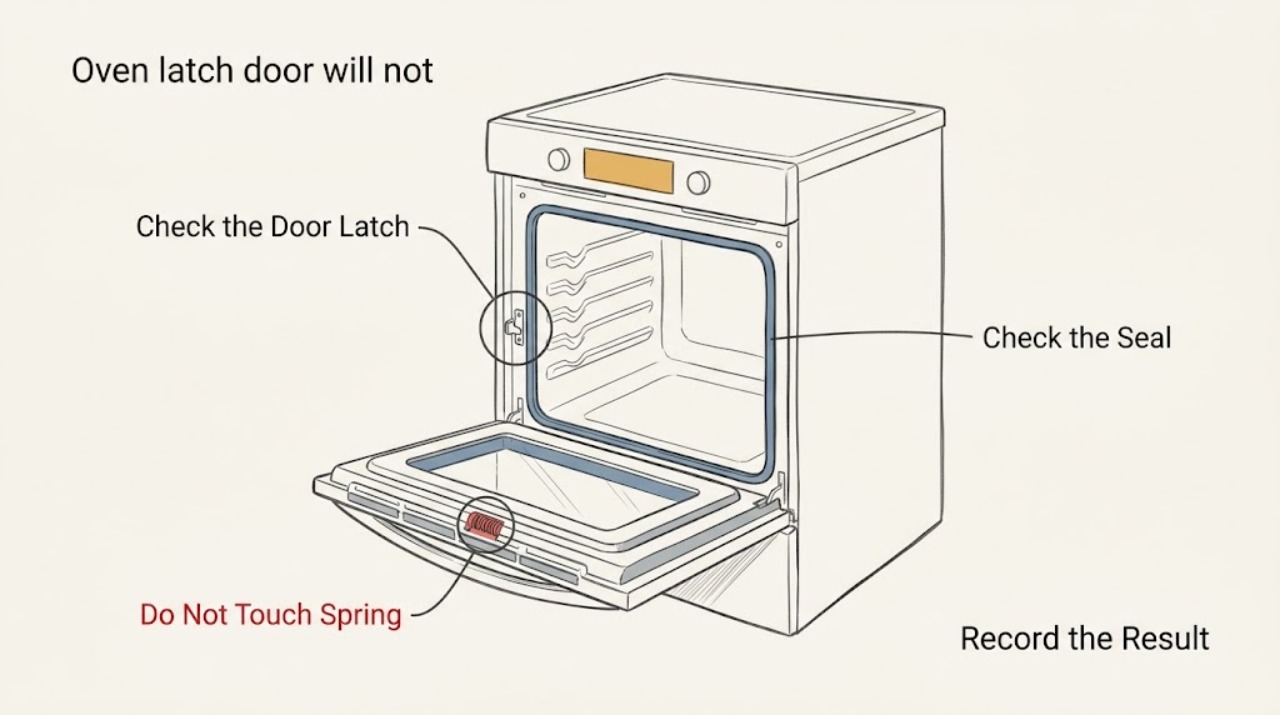
Work through in order
Diagnostic checks
Use only checks that match the exact appliance or system and its official guide.
-
Check 1
Turn the oven off and wait until the door, frame, latch, and interior are fully cool before inspecting them; do not try to close or move the latch while the oven is hot.
Expected result: The door problem began after baking or self-clean, or the appliance is already cool but the latch still blocks closure.
Next step: If hot, wait for complete cooling and consult the exact model instructions. If cool and still blocked, continue only with cold exterior checks and keep the oven out of service.
Why this matters
Why: Heat can leave a self-clean latch engaged or prevent it from releasing on some models. A latch that remains obstructive after complete cooling is more likely mispositioned, bent, or faulty.
-
Check 2
With the oven cold, remove only cold bakeware or loose items that are plainly in the way, and check that racks are fully inserted and not protruding into the door path; do not force a rack or pan past resistance.
Expected result: A rack, pan, foil, shipping material, or other object blocks the door, or the cavity is clear but the door still stops short.
Next step: Remove the cold obstruction and gently recheck the door once. If it still will not close, stop using the oven and continue with visual latch and seal checks rather than adding pressure.
Why this matters
Why: A physical obstruction can prevent the door from reaching the frame even when the latch is normal. If the cavity is clear, the latch, gasket, hinge, or door alignment becomes more likely.
-
Check 3
Look at the latch arm or lock hook at the upper front of the oven frame, above the gasket, without touching it; compare its position with the model manual and note whether it is protruding, bent, bowed, or visibly misaligned.
Expected result: The latch is in its normal parked position, is extended into the door path, or appears bent or damaged.
Next step: If the latch is extended, bent, or damaged, do not push it back with force; record the model and arrange appliance service. If its position is normal, inspect the gasket and hinge alignment without disassembly.
Why this matters
Why: A latch arm left in the locking position or bent out of alignment can prevent the door from closing. A normal-looking latch does not rule out a hidden latch mechanism or hinge problem.
-
Check 4
Inspect the gasket around the door and oven opening and the visible door alignment from the front and sides; look for a section pulled out, folded, hardened, torn, scorched, or a door that sits lower or farther out on one side, without pulling the gasket or lifting the door.
Expected result: The gasket is seated and intact, the gasket is displaced or damaged, or the door is visibly crooked, sagging, or uneven.
Next step: Do not operate the oven or attempt to bend the hinge or gasket into place. Photograph the condition and have an appliance technician identify the correct gasket, hinge, or door repair.
Why this matters
Why: A displaced or damaged gasket can hold the door away from the frame. A crooked or sagging door makes a hinge, hinge receiver, or door alignment problem more likely than a latch-only problem.
-
Check 5
Recall whether the door was recently removed, reseated, transported, installed, or exposed to an impact, and identify whether it opens downward or to the side; do not remove the door again to test the hinges.
Expected result: The door was recently removed or installed, the appliance is new or was moved, an impact occurred, or none of these apply.
Next step: Use the exact owner or installation manual for identification only. If the door needs reseating, the hinges are under tension, or the model is unknown, leave the repair to a technician.
Why this matters
Why: GE notes that door removal and reseating vary by model and that a door must be seated correctly for proper function. Recent movement makes hinge seating or alignment more likely; an unexplained change may indicate wear or damage.
-
Check 6
Read the oven model label and note any door, lock, or self-clean message on the control without starting a cycle; after all cold checks, try only a gentle normal close with empty racks and no pressure on the latch.
Expected result: The door closes and seals normally, closes only with force or a gap remains, or a door/lock message persists.
Next step: If the door does not close and seal normally, stop using the oven and provide the model, symptom, latch position, gasket/hinge observations, and any display message to an appliance technician.
Why this matters
Why: A normal close after removing a clear obstruction supports a simple blockage. Resistance, a visible gap, or a persistent control message means the latch, hinge, gasket, or control system still needs model-specific diagnosis.
Use your observations
Decision map
Find the observation that best matches what you see, then follow the next safe action.
-
PATH 01Next step
What you see
The oven is cold and a rack, pan, foil, shipping material, or other loose object is clearly blocking the door; the latch and gasket look normal.
Do this next
Remove the cold obstruction without force and gently check closure once. If the door still does not seal, stop using the oven and arrange service.
Why this path and its safety boundary
Why it matters: A physical obstruction is more likely than a failed latch or hinge.
-
PATH 02Next step
What you see
The latch arm is extended into the door path, bent, bowed, or visibly damaged after the oven is fully cool.
Do this next
Do not push, bend, or disassemble the latch. Keep the oven out of service and have a technician use the exact model procedure.
Why this path and its safety boundary
Why it matters: The latch mechanism is a leading cause of the door not closing, and forcing it could damage the lock or door.
-
PATH 03Next step
What you see
The gasket is folded, pulled out, torn, scorched, or hardened, or the door sits unevenly against the frame.
Do this next
Do not run the oven or force the door into alignment. Provide photos and the model to an appliance technician for the correct gasket or hinge assessment.
Why this path and its safety boundary
Why it matters: A seal or hinge/alignment problem is more likely than a latch-only issue and can prevent proper closure and heat retention.
-
PATH 04Next step
What you see
The problem began after baking or self-clean and the latch or door message remains while the oven is hot, but there is no visible damage.
Do this next
Wait for complete cooling and follow only the exact model instructions. If the latch or message remains after cooling, do not run another cycle and call for service.
Why this path and its safety boundary
Why it matters: The self-clean lock may not release until the appliance has cooled, depending on the model; the condition cannot be judged during the hot state.
-
PATH 05Next step
What you see
The door was recently removed, reseated, installed, transported, or impacted, or the cause remains unclear after the cold checks.
Do this next
Keep the oven out of service. Do not remove the heavy door or handle spring-loaded hinges; arrange model-specific appliance service.
Why this path and its safety boundary
Why it matters: Hinge seating, hinge receiver, door alignment, or a model-specific latch/control fault is more likely than a loose obstruction.
Helpful context
Understand the symptom
Do not cook with a door that will not close
A door that remains open or cannot seat against the oven frame can let heat escape and may leave the latch, hinges, or seal under abnormal stress. Turn the appliance off, allow it to cool, and remove only cold, loose items that are plainly blocking the door. Do not compensate with a towel, a prop, a clamp, or extra pressure, and do not use self-clean to test a door that cannot close normally.
The latch is one path, not the only path
A protruding or bent latch arm can catch the door, but the same symptom can come from a rack or pan, a distorted or displaced gasket, a door that was not seated after removal, or a bent or misaligned hinge. Check these from a cold, stable appliance without taking the door apart. A door that closes only when pushed hard is not a successful repair; it needs model-specific assessment.
Self-clean latch behavior depends on the model
GE notes that the oven door latch is intended for self-clean operation on models that use one, and that the oven may need to cool before the latch can be moved. Some electronic-control models do not have a user-operated latch and may show a door message instead. Do not move an unfamiliar latch or attempt a control sequence from another model; record the model and use its manual or appliance service.
Safety boundary
Stop conditions
- Do not use the oven until the door closes and seals normally against the frame.
- Do not force, slam, bend, or pry the latch, door, gasket, or hinge, and do not run self-clean to test a door that will not close.
- Do not remove or reseat a heavy oven door, release spring-loaded hinges, or disassemble the latch without the exact model procedure and appropriate service controls.
- Stop for smoke, scorching, exposed insulation, broken glass, a door that drops or swings unexpectedly, a persistent lock message after cooling, or any gas or electrical concern; keep the appliance off and call qualified service.
Only after diagnosis
Potential parts
- oven door latch
Consider this only when the exact model-specific diagnosis confirms that the latch is bent, damaged, or failed after obstructions and door alignment have been ruled out.
Match the exact oven model, latch style, self-clean or electronic-control configuration, and manufacturer parts information; do not force a similar-looking latch. - oven door hinge
Consider this only when a technician confirms that a hinge or hinge receiver is bent, misaligned, worn, or damaged and is preventing normal closure.
Confirm the exact model, door direction, hinge design, and installation requirements; hinges can be spring-loaded and are not a casual swap. - oven door gasket
Consider this only when the model-specific inspection confirms that the gasket is displaced, torn, scorched, hardened, or otherwise preventing a normal seal.
Match the exact model, gasket profile, attachment method, and temperature-rated part information; do not use a generic strip as a substitute.
When checks do not resolve it
Need a professional?
Request appliance service for a bent or stuck latch, hinge or hinge-receiver misalignment, damaged gasket, broken glass, persistent self-clean lock state, door-control message, or any door that will not close and seal without force.
Safety scope: Keep the oven off until the door closes normally. Do not force or disassemble the latch, remove the heavy door, release spring-loaded hinges, operate self-clean, or continue cooking with a door gap.
Have this ready
- Provide the oven make and model, range or wall-oven configuration, door opening direction, whether the issue followed baking, self-clean, installation, removal, transport, or impact, latch position, obstruction check, gasket and hinge observations, display message, and cold exterior photos.
Common questions
FAQ
Can I use the oven if the door will not close all the way?
No. Keep it off until the door closes and seals normally. A gap can let heat escape and may indicate a latch, hinge, gasket, or alignment problem.
Why is the latch preventing my oven door from closing?
The latch may be left in a self-clean locking position, bent into the door path, or part of a model-specific locking mechanism. Let the oven cool completely and do not force the latch; use the model instructions or call service.
Could a rack or pan keep the oven door from closing?
Yes. A protruding rack, oversized pan, foil, or loose material can block the door. Remove only cold, clearly accessible obstructions and recheck gently once; if the door still will not seal, stop using the oven.
What if the oven door is crooked or sagging?
A hinge, hinge receiver, or door-seating problem is more likely than a latch-only issue. Do not lift the heavy door or release its spring-loaded hinges; keep the oven off and arrange appliance service.
Should I replace the gasket when the door will not close?
Only if the exact model-specific inspection confirms that the gasket is displaced or damaged and is preventing closure. A crooked door or protruding latch needs a different diagnosis, so do not buy a gasket by appearance alone.
Read the exact guide
Official sources
- Range - Oven Door Will Not LatchGE Appliances · Manufacturer guidance used for the self-clean-only latch boundary, cooling before latch operation, and checking that the door can close freely.
- Range & Wall Oven - Oven Gasket Not Sealing ProperlyGE Appliances · Manufacturer guidance used to distinguish a normal small door gap from major sealing problems and to identify damaged gaskets or broken or misaligned hinges as service causes.
- Range & Wall Oven - Removing or Reseating Oven DoorGE Appliances · Manufacturer guidance used to explain why a recently removed or reseated door may not close and why door and hinge procedures vary by model and involve a heavy door.
- Oven Door Won't Close - Wall OvenWhirlpool Corporation · Cross-manufacturer guidance used for checking racks, bakeware, and model-specific soft-close behavior without generalizing a repair.
- Oven Door is Not Closing - Checking the LatchWhirlpool Corporation · Cross-manufacturer guidance used for the safe visual distinction between a latch arm that blocks closure and other model-specific door repairs.
Community feedback
Share a repair observation
Share a plain-text repair observation. Accepted observations are published automatically; this page may take a moment to update.