
On this page
Start here
Quick answer
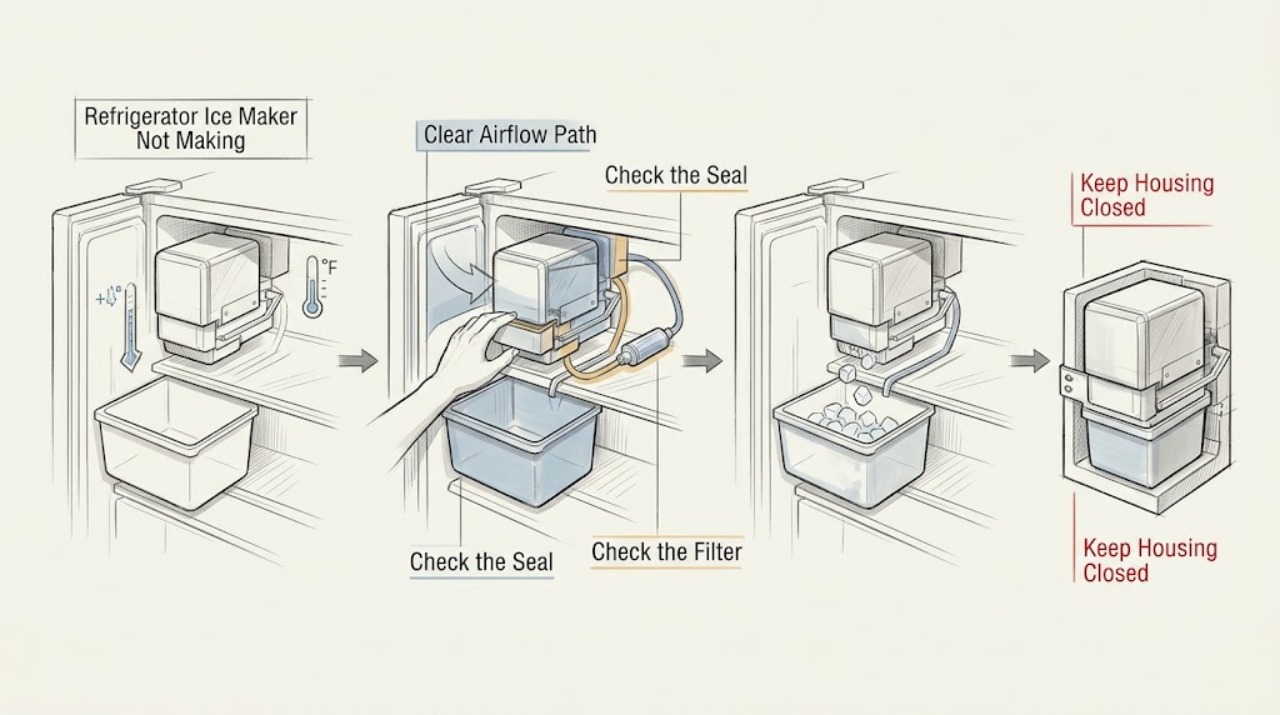
If the freezer is cold but the refrigerator ice maker is not making ice, verify the ice maker is turned on, the bin or feeler arm is not signaling full, and the freezer door and ice-maker bucket are seated and sealing correctly. Check the visible water shutoff valve and line for a closed valve, kink, or recent filter installation that restricted flow. Use the exact model manual for a user test or reset only if provided; note whether the maker moves and whether water enters the mold. A silent test, no fill water, a frozen or inaccessible fill tube, an error code, or a maker that jams again points to a water, valve, motor, sensor, wiring, or control fault rather than freezer temperature. Do not chip ice with a sharp tool, heat the assembly with a hair dryer, remove water lines, bypass a door or fill safety, or replace the ice maker based on the symptom alone. Arrange qualified appliance service when the water path or internal assembly needs disassembly, the test fails, or ice production does not return after the safe checks.
Work through in order
Diagnostic checks
Use only checks that match the exact appliance or system and its official guide.
-
Check 1
Read the freezer's displayed setting and, if the model manual provides a user measurement method, confirm the actual compartment temperature without blocking vents or leaving the door open. Compare the result with the exact model's ice-maker temperature requirement; check that packages are not pressed against the air outlet and that a recently installed or serviced refrigerator has had the manual's stabilization time.
Expected result: The displayed or measured freezer temperature is above the model target, the ice-maker area is warmer than the rest of the freezer, vents are blocked, the door is opened often, or the freezer is at its normal target and remains cold.
Next step: Correct only the setting or food placement allowed by the owner's manual and allow the compartment to stabilize before judging production. If the freezer is already cold and clear, continue with the ice-maker status, bin, and water-path checks.
Stop if: Do not block vents, repeatedly change the temperature setting, use an improvised heat source, or keep the door open to force a test.
Why this matters
Why: A warm compartment or blocked airflow can delay or prevent an ice-making cycle even when the freezer feels cold. If the freezer is at the model target with clear airflow, temperature is less likely to be the main cause and the maker's control, water, or harvest path deserves attention.
-
Check 2
Use the control panel or the ice maker's clearly marked user control to verify that ice production is on. With the freezer door open only briefly, confirm the ice bucket is fully seated, the feeler arm or level sensor is not held in the full position, the bucket contains only ice, and the door closes without an item blocking it. Follow the model manual for the correct bucket orientation.
Expected result: Ice Off is displayed, the arm is raised or obstructed, the bucket is mis-seated or packed with clumped ice, the door does not seal, or all controls and seating appear normal.
Next step: Correct a clear user setting, reseat the bucket, or remove only loose clumps as the manual permits. Close the door and allow one normal cycle; if the maker stays idle or the bucket freezes together again, record that pattern and continue to the water check or service boundary.
Stop if: Do not force a frozen bucket, bend the feeler arm, pry ice from the mold, bypass the door sensor, or use a sharp tool to clear an obstruction.
Why this matters
Why: An off control, full-bin signal, mis-seated bucket, clumped ice, or warm door seal can stop production even with a cold freezer. Normal controls and seating shift attention to the water supply and whether the ice maker completes a cycle.
-
Check 3
From an accessible, dry position, check that the refrigerator's water shutoff is open and the visible supply line behind the appliance is not kinked or crushed. If the filter was recently replaced, confirm it is the exact model's user-approved filter, fully seated, and sealed; dispense water using the normal dispenser if the refrigerator has one, without disconnecting a line.
Expected result: The valve is closed, the line is kinked, dispenser flow is weak or absent, water stopped after a filter change, the filter is mis-seated, or dispenser flow is normal.
Next step: Open a clearly identified user shutoff or reseat the filter only as the model manual permits, then allow the water system to purge or stabilize as directed. If flow remains weak, the line is hidden, or the ice maker still does not fill, arrange service rather than disconnecting tubing.
Stop if: Do not pull the refrigerator hard against the wall, loosen compression fittings, cut tubing, use chemicals, or work on a leaking or wet water connection near electricity.
Why this matters
Why: No or restricted water flow can leave a cold ice maker empty. A recent filter change or kink can restrict the inlet path; normal dispenser flow does not prove the ice maker's valve, fill tube, or internal route is clear, but it makes a general supply failure less likely.
-
Check 4
If the owner's manual identifies a user test or reset button, run it exactly as described with the bucket and door arranged as required. Watch and listen only from the normal access area: note whether the ejector or tray moves, whether a test chime or response occurs, and whether the water valve fills the mold at the end. Do not hold the arm, force gears, or repeat the test continuously.
Expected result: The maker completes movement and fills, moves but does not fill, does not respond, shows an error, or is frozen or inaccessible behind a cover.
Next step: If the test fills, close the appliance and allow the normal production interval before judging output. If it does not fill, respond, or complete normally, stop testing and arrange qualified appliance service with the observed result and model number.
Stop if: Do not apply external power, jumper contacts, remove covers, manually harvest ice, probe wiring, or keep cycling a stalled or noisy mechanism.
Why this matters
Why: Movement without water points more toward the water path, inlet valve, filter, or fill tube. No movement or response points toward power, control, sensor, motor, wiring, or the ice-maker assembly. An error or inaccessible frozen assembly is a service clue, not permission to disassemble it.
-
Check 5
With the ice maker off and the user-accessible bin removed only as the manual permits, look for loose clumps, a sheet of frost, an empty mold after a failed fill, water in the bin, or a visible fill-tube blockage. Record whether the maker previously worked, stopped after moving the refrigerator or changing a filter, makes one batch and stops, or repeatedly jams; do not remove the maker to reach hidden parts.
Expected result: The bin is clumped, the fill tube or maker is visibly frozen, the mold is dry, water is present but cubes do not release, production resumes briefly then stops, or no accessible obstruction is visible.
Next step: Remove only loose ice that the manual says is safe to remove and restore the bin correctly. Do not thaw or disassemble a frozen assembly; if the obstruction returns, the mold remains dry, or water cannot release, leave the maker off and arrange service.
Stop if: Do not use a knife, pick, boiling water, hair dryer, heat gun, or open flame; do not force the bucket, fill tube, ejector, or ice-maker housing.
Why this matters
Why: A full or clumped bin can signal that the maker is full, while a dry mold suggests no water reached it. Water present without release points toward harvest or ejector trouble; recurring frost, repeat jams, or a hidden blockage points to a component or temperature/water-path fault. A clear accessible area does not rule out an internal valve, motor, sensor, or control issue.
Use your observations
Decision map
Find the observation that best matches what you see, then follow the next safe action.
-
PATH 01Next step
What you see
The freezer is set or measured warmer than the model's ice-making target, has blocked airflow, or has a door or bucket sealing issue.
Do this next
Restore the user-level setting, airflow, door, or bucket seating described by the manual and allow stabilization. If the target is reached but there is still no cycle, follow the ice-maker and water branches.
Why this path and its safety boundary
Why it matters: The ice maker may be waiting for a sufficiently cold, stable compartment even though the freezer feels cold elsewhere.
-
PATH 02Next step
What you see
Ice Off is active, the feeler arm or level sensor is held full, the bucket is mis-seated, or clumped ice blocks the normal level signal.
Do this next
Correct the marked setting or bucket position and remove only loose clumps allowed by the model manual. If the signal returns with an empty, correctly seated bin, arrange service for the sensor, arm, or control.
Why this path and its safety boundary
Why it matters: The maker is being told not to harvest or not to add ice; freezer temperature is not the immediate cause.
-
PATH 03Next step
What you see
The ice maker moves in its user test but the mold stays dry, dispenser flow is weak, a filter was recently changed, or the visible water line is kinked.
Do this next
Correct only a clear user-level valve or filter issue. Have qualified service test water flow, the inlet valve, and hidden fill tubing when the path remains restricted or the maker does not fill.
Why this path and its safety boundary
Why it matters: Restricted supply, filter seating, inlet valve, pressure, or a frozen or blocked fill tube is more likely than the freezer temperature.
-
PATH 04Next step
What you see
The maker does not respond to the model-approved test, shows an error, jams after a normal fill, or contains water that never releases into the bin.
Do this next
Leave the maker off and arrange qualified appliance service for model-specific diagnosis. Do not force harvest, jumper contacts, or replace the assembly from a generic match.
Why this path and its safety boundary
Why it matters: A motor, mold heater, ejector, sensor, control, wiring, or ice-maker assembly fault is more likely; a cold freezer does not clear the mechanism.
-
PATH 05Next step
What you see
The ice maker is frozen behind an inaccessible cover, water is leaking near electrical parts, the bucket cannot be removed without force, or an error persists after a safe reset.
Do this next
Turn the ice maker off if its normal control is accessible, keep the area dry, and arrange qualified appliance service. Do not heat, pry, disassemble, or repeatedly reset the appliance.
Why this path and its safety boundary
Why it matters: The condition exceeds routine user checks and may cause water damage, electrical risk, or damage to the ice-maker assembly.
Helpful context
Understand the symptom
A cold freezer rules out only one part of the problem
Ice production needs the freezer or ice-maker compartment to reach the model's operating temperature, but the ice maker also needs an enabled control, a correctly seated bin or arm, a sealed door, and a working water path. A freezer that feels cold can still have an incorrect displayed setting, a warm pocket near the ice maker, blocked airflow, or a door that leaks cold air. Confirm the temperature and then move to the ice maker's own cycle and water-fill clues rather than repeatedly lowering the freezer setting.
No ice and no water are different clues
If the ice maker cycles but the mold never receives water, the visible supply, filter, fill tube, inlet valve, or water-pressure path becomes more relevant. If it never moves or responds to the model's test, a control, motor, sensor, harness, or ice-maker assembly fault is more likely. If water enters but cubes do not release, a jammed or frozen mold and the ejector or harvest mechanism need service-level diagnosis. Keep the distinction in your notes; it prevents an unnecessary part swap.
Only after diagnosis
Potential parts
- refrigerator water filter
Only consider this category when the filter is overdue, incorrectly seated, or restricts water flow after the model's user check; a cold freezer and no ice alone do not prove the filter is at fault.
Filter shape, connection, and approval vary by refrigerator model. Confirm the exact model and follow the owner's installation and flushing instructions. - refrigerator ice-maker water inlet valve
Only consider this category after a qualified diagnosis confirms that the supply and filter are adequate but the valve does not deliver water during the ice-maker cycle.
Valve ports, voltage, tubing connections, and control behavior are model-specific; do not test or replace it without the correct service procedure. - refrigerator ice-maker assembly
Only consider this category when model-specific diagnosis confirms a failed motor, sensor, mold, heater, or control within the ice-maker assembly after temperature and water checks pass.
Ice-maker style, connector, mounting, and control logic vary by model. Confirm fit and have a technician handle access where wiring or frozen components are involved.
When checks do not resolve it
Need a professional?
Arrange qualified appliance service when the freezer is at the model's target but the ice maker remains silent, fails its user test, never fills, repeatedly jams, shows an error, has a hidden or frozen fill path, or needs valve, motor, sensor, wiring, or assembly access. Keep the ice maker off for a leak near electrical parts, an inaccessible frozen assembly, or a bucket that requires force. Do not use sharp tools, hair dryers, heat guns, boiling water, external power, jumper wires, or repeated resets; do not disconnect water lines or select a replacement part from appearance alone.
Common questions
FAQ
Why is my refrigerator ice maker not making ice if the freezer is cold?
A cold freezer rules out only a temperature problem. The maker may be off, blocked by a full or mis-seated bin, unable to receive water through the filter or line, or unable to complete its motor, sensor, or harvest cycle. Use the model's controls and test instructions, then keep the maker off and arrange service for a failed cycle or hidden water path.
Should I reset an ice maker that is not producing ice?
Only use a reset or test procedure explicitly provided for your refrigerator model. Observe whether the maker moves and fills, then allow the normal production interval. If it does not respond, shows an error, or fails again, do not keep cycling it; arrange qualified service.
Can a water filter stop a cold refrigerator from making ice?
Yes. A clogged or incorrectly seated filter can restrict water flow even while the freezer stays cold. Check or reseat it only as the model manual directs, and use the normal dispenser as a clue. If flow remains weak or the maker still does not fill, the inlet valve, pressure, or hidden fill path needs service diagnosis.
What if the ice maker makes a sound but no ice?
A cycle sound without water can point toward restricted supply, filter seating, inlet valve, pressure, or a frozen fill tube; movement without release can point toward a harvest or ejector problem. Record whether the mold is dry or contains water and use the exact model test. Do not remove covers or force the mechanism.
Can I thaw a frozen ice maker with a hair dryer or sharp tool?
No. Do not pry ice, use a sharp tool, hair dryer, heat gun, boiling water, or open flame. Samsung specifically directs service for an ice maker or bucket that is frozen and cannot be safely removed; leave the maker off and arrange qualified help when the blockage is inaccessible.
Read the exact guide
Official sources
- Ice Maker Not Working - TroubleshootingWhirlpool Product Help · Refrigerator ice-maker water supply, freezer temperature, on/off state, water filter, and visible line troubleshooting
- Refrigerator - Icemaker Not Producing IceGE Appliances · Refrigerator ice-maker switch, freezer temperature, food load, filter flow, stuck ejector, and service guidance
- Samsung ice maker is not workingSamsung · Refrigerator ice-maker temperature, sealing, on/off status, bucket, user test, water flow, frozen assembly, and service boundary
- Ice Maker Troubleshooting: How to Fix an Ice MakerWhirlpool · Refrigerator ice-maker water inlet valve, temperature, control arm, frozen inlet tube, water flow, and conditional service diagnosis
Community feedback
Share a repair observation
Share a plain-text repair observation. Accepted observations are published automatically; this page may take a moment to update.