
On this page
Start here
Quick answer
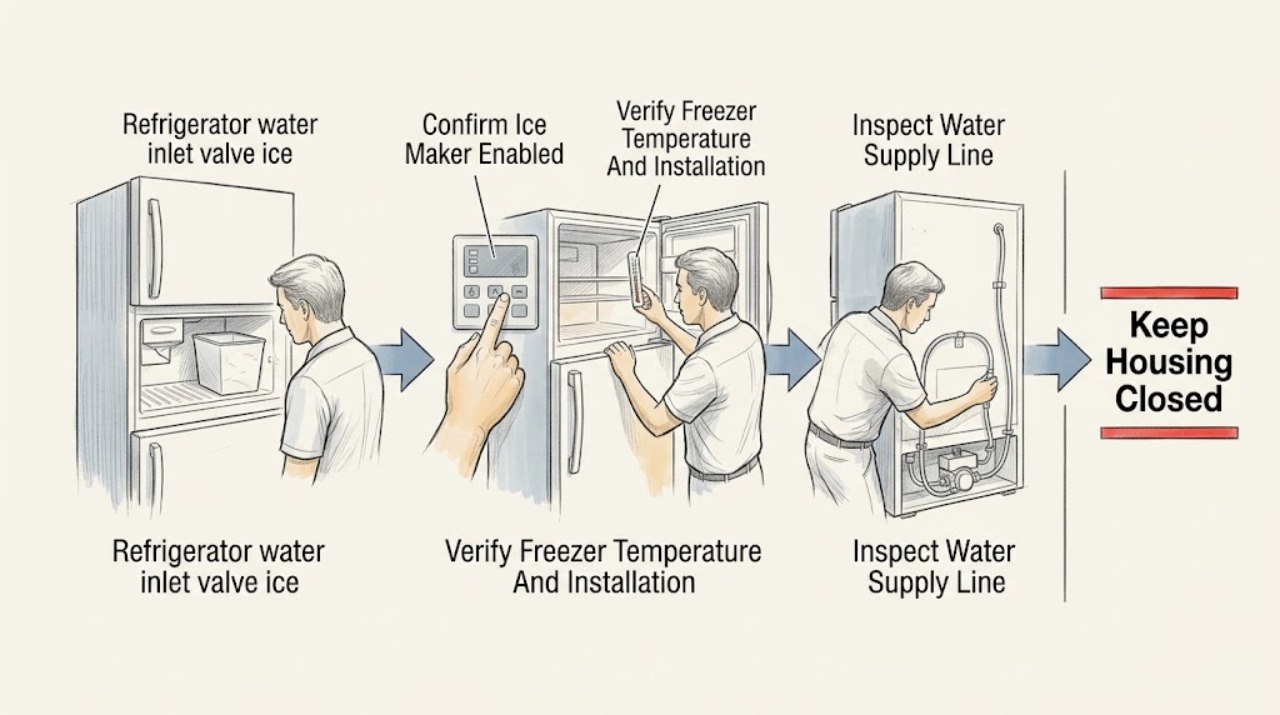
If a refrigerator ice maker is not making ice and the water inlet valve is suspected, first confirm that ice production is enabled, the feeler arm or paddle can move, and the freezer is at the model's ice-making temperature. Then check the accessible water shutoff, supply line, filter, dispenser flow, and fill-tube area without pulling the refrigerator or opening the rear panel. A kinked line, restricted filter, low water flow, frozen fill tube, failed inlet valve, warm freezer, or ice-maker control problem can look similar. Do not remove a water hose or service the inlet valve while pressurized; shut off the water first and use a qualified appliance technician when the fill tube is frozen, a connection leaks, or external checks do not restore ice production.
Work through in order
Diagnostic checks
Use only checks that match the exact appliance or system and its official guide.
-
Check 1
Check the refrigerator control panel or the ice maker's normal on/off control and confirm that the ice maker is enabled. Without forcing it, observe the feeler arm or paddle and the ice bin for cubes blocking its movement.
Expected result: Record ice maker off or locked controls; an on status with a free arm and empty bin; a full bin; a stuck arm or paddle; or cubes obstructing the ejector area.
Next step: Correct only an obvious off setting or remove loose cubes that are safely accessible from the bin. If the arm is stuck, the mechanism is jammed, or the control does not respond, arrange model-specific appliance service.
Stop if: Do not force the arm, pry frozen cubes from the mold, remove the ice maker, or reach behind an internal cover.
Why this matters
Why: An off control, active lock, full-bin signal, or blocked feeler arm can intentionally pause ice production. If the ice maker is on, the arm is free, and the bin is not full, continue to temperature and water-path checks rather than replacing the valve immediately.
-
Check 2
Read the refrigerator and freezer temperature display or use the appliance's normal indication, and note whether the refrigerator or ice maker was recently installed, moved, powered off, or loaded with warm food. Use the model manual's target settings rather than inventing a colder setting.
Expected result: Record a stable freezer at its specified ice-making range; a warm or fluctuating freezer; a recent installation or power interruption; or frost and food conditions suggesting restricted circulation.
Next step: Allow the model's documented startup or recovery period and keep vents and door seals clear. If the freezer cannot maintain its target or ice remains absent after recovery, request appliance diagnosis.
Stop if: Do not set the appliance to an extreme temperature, block vents with food, or remove interior panels to measure the ice-maker temperature.
Why this matters
Why: The ice maker may not begin or may slow when the freezer has not reached its required temperature, especially after installation or a power event. A warm or unstable freezer points toward cooling, airflow, door-seal, or control issues rather than the inlet valve alone.
-
Check 3
From an accessible position, confirm that the refrigerator water shutoff is identified and open, and visually inspect the exposed supply line and connections for a kink, crush point, leak, or loose fitting. Do not pull the refrigerator away from the wall or disconnect the line while it is pressurized.
Expected result: Record a fully open valve and straight, dry line; a closed or partially closed valve; a kinked or crushed line; moisture at a connection; or a supply point that cannot be reached safely.
Next step: Open only an obviously closed, easily accessible shutoff without forcing it and observe for leaks. Leave a damaged line, leaking connection, stuck valve, or inaccessible supply off and arrange appliance or plumbing service.
Stop if: Do not force a shutoff, disconnect a hose, tighten a pressurized fitting, or move the refrigerator across the supply line.
Why this matters
Why: A closed valve, kink, or damaged connection can reduce or stop flow before it reaches the inlet valve. A leak or inaccessible shutoff creates a water-damage risk and prevents a safe valve diagnosis.
-
Check 4
If the refrigerator has a water dispenser, compare its flow with the usual stream and read the filter indicator or replacement guidance. Replace a filter only through the appliance's normal access and only with the exact model-specified type; do not bypass a filter or open the valve housing.
Expected result: Record normal dispenser flow and an in-date filter; weak or intermittent flow; a filter warning or visibly overdue filter; no dispenser on this model; or water flow that improves only under a model-approved filter check.
Next step: Install the exact replacement filter if the manual identifies it as due, then allow the documented purge and ice-making period. If flow stays weak or the ice maker remains dry, stop and request service rather than testing the valve under pressure.
Stop if: Do not use an unknown filter, force a stuck filter, bypass the filter without model instructions, or disconnect water lines while pressurized.
Why this matters
Why: A clogged or improperly installed filter can reduce water to both the dispenser and ice maker, and a partially restricted filter may provide some dispenser water without enough timed fill for ice. Normal dispenser flow makes a complete supply blockage less likely but does not rule out the ice-maker branch, fill tube, valve coil, or control.
-
Check 5
With the ice bin removed only as the owner's manual permits, look at the accessible ice mold or fill cup and the visible end of the fill tube. Do not remove the ice maker or rear cover and do not chip or heat any ice.
Expected result: Record frozen cubes in the mold but no new fill; an empty, dry mold; a fill tube visibly blocked by ice; water overflowing or missing the cup; or no safe view of these parts.
Next step: Leave a frozen, leaking, overflowing, or inaccessible fill path alone and arrange appliance service. Do not melt ice with direct heat, remove the ice maker, or operate a leaking valve.
Stop if: Do not chip ice, use a heat gun or flame, probe the fill tube, remove panels, or reach near an energized ice-maker mechanism.
Why this matters
Why: Frozen cubes with no new fill can point toward a water-path or harvest issue. A visibly frozen fill tube can stop water before the mold and may require removal of the ice maker to verify; GE specifically directs that check to a service technician. Overflow or misalignment can indicate an ice-maker leveling, fill-cup, valve, or control problem.
-
Check 6
Prepare the service request with the refrigerator model if safely visible, ice-maker status, freezer temperature behavior, bin and feeler-arm position, dispenser flow, filter history, water-valve and supply-line observations, fill-cup or tube result, recent installation or move, and any leak.
Expected result: Confirm that the record contains external observations only and that no water hose, inlet valve, rear panel, fill tube, ice-maker assembly, wiring, or energized mechanism was disturbed.
Next step: Arrange qualified appliance service when the ice maker remains dry after safe checks, the fill tube is frozen, a water connection leaks, the shutoff cannot isolate the appliance, or the freezer cannot hold its target temperature.
Stop if: Stop homeowner troubleshooting when the next step requires water-hose removal, valve or rear-panel access, electrical testing, ice-maker removal, or sealed refrigeration work.
Why this matters
Why: This information helps separate an off or full-bin condition from warm temperature, restricted supply, filter, frozen fill tube, inlet-valve, ice-maker, or control faults without guessing at a replacement part.
Use your observations
Decision map
Find the observation that best matches what you see, then follow the next safe action.
-
PATH 01Next step
What you see
The ice maker is off, locked, sensing a full bin, has a stuck feeler arm, or the refrigerator was recently installed or powered up.
Do this next
Enable the ice maker or clear only a loose bin obstruction according to the manual, then allow the documented cooling and ice-making period. Call service if the control or arm remains stuck.
Why this path and its safety boundary
Why it matters: A control state, bin signal, or normal startup delay is more likely than a failed water inlet valve.
-
PATH 02Next step
What you see
The ice maker is on and cold enough, but dispenser flow is weak or intermittent, the filter is overdue or restricted, or the exposed supply line is kinked or the shutoff is not fully open.
Do this next
Correct only an obvious filter or accessible line/shutoff issue without pressurized hose work. If flow remains weak, leaking, or inaccessible, shut off water safely and obtain appliance or plumbing service.
Why this path and its safety boundary
Why it matters: A supply, filter, or line restriction is more likely than an inlet-valve failure, though the valve cannot be ruled out until adequate flow is restored.
-
PATH 03Next step
What you see
The ice maker is enabled and cold, the mold remains empty or dry, the dispenser has normal water flow, and the external line and filter are satisfactory.
Do this next
Arrange model-specific appliance diagnosis. Do not remove the ice maker or inlet valve, test a valve coil, or thaw the fill tube with direct heat.
Why this path and its safety boundary
Why it matters: An ice-maker fill command, frozen fill tube, inlet valve branch, or control fault becomes more likely than a whole-house supply problem.
-
PATH 04Next step
What you see
The fill tube is visibly iced, water cannot enter the mold, or ice returns at the fill path after a model-approved recovery period.
Do this next
Leave the fill path and panels intact and request appliance service. Protect the floor from any leak and do not chip, heat, or probe the tube.
Why this path and its safety boundary
Why it matters: A frozen or misaligned fill path is more likely; an inlet valve or temperature-control problem may be upstream and requires diagnosis.
-
PATH 05Next step
What you see
The mold contains frozen cubes but the ice maker does not eject them, the bin signal is abnormal, or the freezer temperature is unstable.
Do this next
Use the owner's manual for model-specific status information and arrange appliance service if the cycle does not resume. Do not force the ejector or replace the valve based only on a full mold.
Why this path and its safety boundary
Why it matters: The symptom is more consistent with the ice-maker harvest mechanism, control arm, temperature, or assembly than with the water inlet valve alone.
Helpful context
Understand the symptom
The water inlet valve is only one link in the ice-making chain
The ice maker must be enabled, cold enough to start a cycle, able to sense that the bin is not full, and able to receive water through the filter, supply line, inlet valve, and fill tube. A dispenser that still supplies water does not prove that the ice-maker branch is receiving enough flow; GE notes that a partially clogged filter can allow slow dispenser flow while failing to fill the ice maker. Start with control and water-flow observations before naming the valve.
Use the ice-maker result to separate supply from harvest
An empty mold or dry fill cup points toward the water path, while a mold that contains frozen cubes but does not eject them points toward the ice-maker harvest sequence, control arm, temperature, or assembly. A kinked supply line, clogged filter, closed shutoff, or frozen fill tube can stop water before it reaches the mold. The inlet valve can only be selected after the supply path and model-specific ice-maker operation are confirmed.
Water-line and valve work requires isolation and model identification
The water inlet valve is connected to the refrigerator supply and usually feeds more than one branch, so a water dispenser result can help but cannot prove valve health. If a hose, valve, or fill tube must be disconnected, shut off the refrigerator water supply first and relieve pressure according to the owner's manual. Do not pull the appliance out blindly, open the rear cover, or replace a valve from appearance alone; the model determines the correct valve, fill tube, and ice-maker assembly.
Safety boundary
Stop conditions
- Shut off the refrigerator water supply before removing any hose, servicing the water inlet valve, or opening a pressurized water path; use a technician if the shutoff is stuck or unknown.
- Do not remove the rear panel or ice maker, test energized valve coils, touch wiring, force the feeler arm, bypass controls, or operate a leaking connection.
- Do not chip or probe a frozen fill tube or use a heat gun, flame, or direct high heat to thaw it. Stop for flooding, water near electrical parts, damaged tubing, or food-temperature loss.
Only after diagnosis
Potential parts
- refrigerator ice maker assembly
Consider this only when a qualified technician confirms that the ice maker is not harvesting, sensing, or requesting a fill after temperature, control, water supply, filter, and fill-path causes are excluded.
Confirm the exact refrigerator and ice-maker model, electrical connection, mounting, and manufacturer-approved assembly before selecting a replacement. - refrigerator water inlet valve
Consider this only when service diagnosis confirms that adequate water supply reaches the valve but its ice-maker outlet does not deliver the required fill, or the valve leaks or fails its model-specific test.
Confirm the exact refrigerator model, valve outlets, tubing connections, electrical specification, and approved fit; shut off water before any valve service. - ice maker fill tube
Consider this only when a technician confirms a frozen, cracked, blocked, or misaligned fill tube as the cause of an empty mold or water leak.
Match the exact refrigerator model, tube length, routing, inlet connection, and insulation or heater arrangement; do not thaw or remove an internal tube with direct heat.
When checks do not resolve it
Need a professional?
Call qualified appliance service when the ice maker remains dry after it is enabled and the refrigerator has reached its model temperature, when the fill tube is frozen or inaccessible, when the inlet connection or supply line leaks, when the shutoff cannot isolate the appliance, or when normal water flow and filter checks do not restore ice production. Protect food and the floor promptly if cooling or water leakage is also affected.
Have this ready
- Provide the refrigerator model if safely visible, ice-maker status, freezer temperature behavior, bin and feeler-arm position, dispenser flow, filter history, supply-valve and line condition, fill-mold or tube observation, installation or move history, and any leak. State whether the water was isolated and whether any panel or component was disturbed.
Common questions
FAQ
Can a bad water inlet valve stop a refrigerator ice maker from making ice?
Yes, but a closed or kinked supply, clogged filter, low flow, frozen fill tube, warm freezer, off control, or ice-maker fault can look the same. Confirm the accessible water path and ice-maker status before treating the valve as the cause.
Why does the dispenser work but the ice maker stay empty?
A dispenser can still provide some water when the timed ice-maker fill is restricted. A partially clogged filter, ice-maker branch of the inlet valve, frozen fill tube, or ice-maker control may be involved. Normal dispenser flow does not prove the ice-maker fill path is healthy.
How do I know if the ice-maker fill tube is frozen?
You may see ice at the accessible end or find an empty mold despite an enabled, cold ice maker, but confirming an internal frozen tube can require removing the ice maker. Do not chip, probe, or heat the tube; have a technician inspect it.
Should I replace the water inlet valve first?
No. A valve should be considered only after confirming the ice maker is on, the freezer is cold enough, the supply valve and line are sound, the filter is not restricting flow, and the fill path is not frozen. Exact model diagnosis is needed before selecting a valve.
Do I need to shut off water before replacing an ice-maker valve?
Yes. Shut off the refrigerator water supply before removing a hose or servicing a water inlet valve, and relieve pressure according to the exact manual. If the shutoff is stuck, unknown, or leaking, stop and call an appliance or plumbing professional.
Read the exact guide
Official sources
- Fridge freezer ice maker not working - how to test & resetSamsung · Samsung refrigerator guidance used for general control and water-supply observations; model-specific procedures and thresholds are not generalized.
- Ice Maker Troubleshooting: How to Fix an Ice MakerWhirlpool · Whirlpool ice-maker guidance used for symptom branching and conditional valve or fill-tube reasoning; exact refrigerator model controls parts and procedures.
- Not Dispensing Ice or Water - RefrigeratorWhirlpool · Whirlpool refrigerator dispenser guidance used for general supply and filter checks; line material and model access vary.
- Refrigerator - Icemaker Not Producing IceGE Appliances · GE refrigerator ice-production guidance used for status and temperature branching; exact model settings and repair procedures remain specific.
- Refrigerator - Icemaker Does Not Fill With WaterGE Appliances · GE refrigerator ice-maker guidance used for general water-path and control observations; exact model instructions govern access and timing.
Community feedback
Share a repair observation
Share a plain-text repair observation. Accepted observations are published automatically; this page may take a moment to update.