
On this page
Start here
Quick answer
Do not cook on a Samsung cooktop with a cracked, chipped-through, broken, or uncertain glass surface. Turn the controls off, keep people away from sharp edges, and disconnect power only from a dry, safely accessible point if there is no need to touch damaged equipment. Do not test the zone, pour cleaner into the crack, scrape it, or remove the glass yourself. A mark can sometimes be food residue or a scratch, but an actual crack can worsen with heat, spills, or cookware and may create cut, shock, or fire hazards. Photograph the damage from a safe distance, record the exact model, and arrange Samsung-authorized or qualified appliance service for inspection and glass or related component replacement.
Before you begin
Safety first
- This article covers turning controls off, safe visual documentation, model identification without moving the unit, and power isolation only from a dry accessible point when safe. It does not authorize touching shards, cleaning a crack, moving or uninstalling the cooktop, opening panels, testing live parts, or replacing glass or related components.
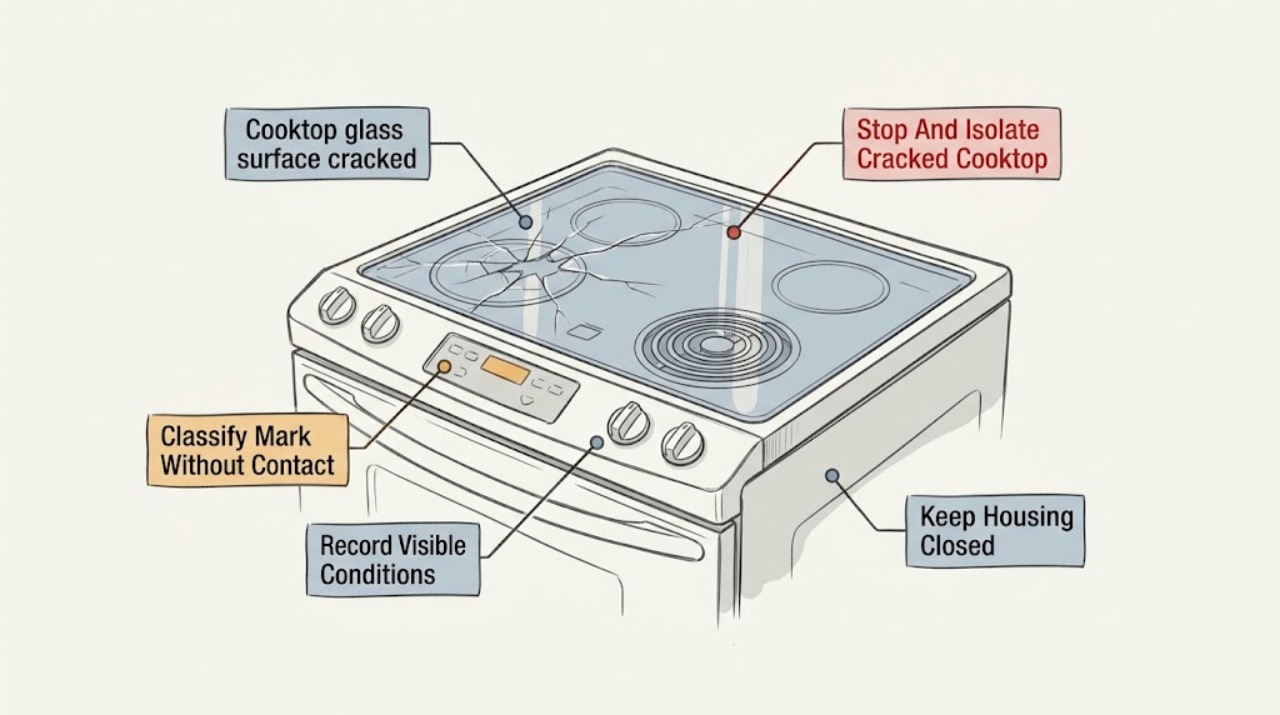
Work through in order
Diagnostic checks
Use only checks that match the exact appliance or system and its official guide.
-
Check 1
Turn every control to Off, keep hands and cookware away from the damaged area, and from a dry, safely accessible point disconnect the cooktop supply if there is no need to touch wet or damaged electrical equipment.
Expected result: The glass is cracked or broken, an edge is sharp, liquid has entered the damage, the surface is still hot, or the damage is near a control or heating zone.
Next step: Keep the cooktop off and allow it to cool without touching the damaged area. Arrange qualified service; do not use another zone on the same cracked surface unless the technician or model guidance specifically establishes it is safe.
Stop if: Stop immediately for smoke, sparks, burning odor, uncontrolled heat, a tripped breaker, exposed wiring, liquid under the glass, or a rapidly spreading break.
Why this matters
Why: Any confirmed break changes the task from cleaning to safety isolation and professional inspection. Heat, liquid, sharp edges, and proximity to controls increase the risk of burns, cuts, shock, fire, or further glass failure.
-
Check 2
After the surface is cool and power is off, inspect visually from above without pressing, rubbing, scraping, or wetting the area; note whether the mark is a line through the glass, a chip or missing fragment, a raised residue, a shallow surface scratch, or an uncertain pattern.
Expected result: The line catches the light through the glass, reaches an edge or element outline, has a chip or sharp edge, appears to be surface residue, or cannot be safely classified.
Next step: Photograph the pattern and keep the cooktop off. Only clean an area that the manual and service guidance establish is intact; do not use a blade or abrasive on or beside a suspected crack.
Stop if: Do not touch loose shards, push on the glass, scrape a crack, apply cleaner to an opening, or use cookware to test the surface.
Why this matters
Why: A through-line, edge extension, chip, or sharp edge is consistent with structural glass damage and needs service. A surface mark may be residue or a scratch, but uncertainty is not a reason to re-energize the cooktop.
-
Check 3
Read the model from the label, manual, or a safe visible location without removing the cooktop; record whether it is electric radiant, induction, or gas and map the damage relative to elements, burners, controls, edges, and the counter seal.
Expected result: The model is known, the damage crosses a heating zone or control area, the damage is at an edge or seal, or the model or location cannot be confirmed safely.
Next step: Give the model, appliance type, photos, and damage location to the service provider. If the model cannot be read without moving or dismantling the unit, leave it in place and arrange an inspection.
Stop if: Do not slide, lift, tip, uninstall, or dismantle the cooktop to find the label or inspect beneath the glass.
Why this matters
Why: The glass panel and underlying parts are model- and design-specific. Damage near a zone, control, edge, or seal may affect more than appearance and cannot be matched safely from a generic panel description.
-
Check 4
Without restoring power, note whether the last use involved an impact, a heavy or sliding pan, a spill or thermal shock, a control that would not turn off, or a breaker trip; record only what happened before the crack was noticed.
Expected result: There was a dropped or dragged pan, a boil-over or sugary spill, a sudden hot-to-cold event, an element that stayed on, a breaker trip, or no known event.
Next step: Include the event and any abnormal control behavior in the service request. Keep the unit isolated; do not recreate the event or test whether the damaged zone still heats.
Stop if: Do not energize a cracked cooktop to check a burner, reset a breaker that trips, or handle a spill while the surface is hot.
Why this matters
Why: Impact, sliding cookware, and thermal or spill events can explain when surface damage appeared, while an element or control that would not turn off raises concern about related electrical or heating damage. No known event does not make a crack safe to use.
-
Check 5
From a safe distance, check only whether the crack has spread, fragments are loose, moisture or debris is visible beneath the surface, the control display remains active, or the surrounding counter and seal are damaged.
Expected result: The break is spreading, shards are loose, liquid or debris is under the glass, controls remain powered, or the surrounding seal and counter are intact.
Next step: Keep people and pets away, do not cover the break with an improvised material, and arrange prompt qualified service. If only a superficial mark is confirmed by the service or model guidance, follow the documented care method instead.
Stop if: Do not sweep shards with bare hands, apply tape over a hot or energized break, pour liquid into the crack, or continue operation because the crack looks small.
Why this matters
Why: Spreading or loose glass, contamination beneath the top, or active controls raises urgency and can indicate damage beyond the glass panel. An intact surrounding area still does not permit cooking on a broken surface.
-
Check 6
Prepare the service handoff with the model, cooktop type, photos, crack location and length as observed without contact, suspected event, power-isolation result, and any control, heat, smoke, odor, or breaker symptom.
Expected result: The technician has the model and photos, the damage requires a glass panel or related assembly, or the model and repair scope remain unclear.
Next step: Keep the cooktop out of service until qualified inspection confirms a safe repair. Ask the technician to identify whether the glass, seal, heating element, control, or other related part is affected.
Stop if: Do not purchase a panel from a photo, remove the cooktop, or attempt glass, electrical, heating, or gas repair yourself.
Why this matters
Why: Glass replacement and any inspection beneath the top are model-specific and can involve heating, power, touch controls, seals, or gas components. A symptom alone cannot establish the correct replacement assembly.
Use your observations
Decision map
Find the observation that best matches what you see, then follow the next safe action.
-
PATH 01Safety boundary
What you see
A line goes through the glass, a chip or shard is present, the crack reaches an edge or element, or the mark cannot be safely distinguished from a crack.
Do this next
Keep the cooktop off, keep people away from sharp areas, record the model and photos, and arrange qualified service for the correct glass or related assembly.
Why this path and its safety boundary
Why it matters: Treat the surface as broken. The safe next step is isolation and professional inspection, not cleaning, a patch, or a trial cook cycle.
Safety stop: Do not cook, touch shards, scrape, tape, wet, lift, or dismantle the unit.
-
PATH 02Safety boundary
What you see
With power off and the surface cool, the mark is confirmed by model guidance or service inspection to be residue or a shallow scratch with no structural break.
Do this next
Use only the model-approved non-abrasive cleaning method on intact glass and monitor for a returning line, chip, or edge damage. Stop and arrange service if the classification changes.
Why this path and its safety boundary
Why it matters: A non-structural mark may follow the documented cleaning and care method, but the user should not assume a line is harmless from appearance alone.
Safety stop: Do not use a blade, abrasive, force, or cookware on an uncertain mark.
-
PATH 03Safety boundary
What you see
The crack is accompanied by a control that will not turn off, uncontrolled heating, a breaker trip, smoke, odor, sparks, moisture beneath the surface, or a display fault.
Do this next
Keep the cooktop isolated and arrange urgent service. If safe isolation requires touching wet or damaged equipment, do not do it; keep clear and seek emergency help appropriate to the hazard.
Why this path and its safety boundary
Why it matters: The glass may not be the only damaged part. This is an electrical, heating, or fire safety boundary and needs prompt qualified inspection.
Safety stop: Do not reset the breaker repeatedly, touch the glass or wiring, or attempt to make the burner operate or stop.
-
PATH 04Safety boundary
What you see
The glass is broken but the controls and surrounding counter appear normal, and the model and damage location are documented.
Do this next
Keep the unit off and schedule model-specific service. Provide the model, type, photos, damage event, and any prior power or control symptom.
Why this path and its safety boundary
Why it matters: The immediate safety issue may be limited to the surface, but only a qualified technician can confirm whether the glass, seal, heating elements, controls, or supports also require replacement.
Safety stop: Do not order a replacement panel or disassemble the appliance before diagnosis and fitment confirmation.
Helpful context
Understand the symptom
Treat an uncertain mark as damage until it is safe to identify
A food mark, mineral spot, or scratch can look different from a crack, but a user should not rub, scrape, or heat a questionable area to find out. Look from a safe position with the cooktop off and cool, photograph the pattern, and use the model manual or service inspection. If the line reaches an edge, heating zone, control area, or opening, treat it as a crack.
Broken glass changes the operating boundary
A cracked glass top is not a cosmetic issue to monitor through more cooking. Heat and cookware can extend the damage, while spilled liquid can reach the electrical or heating assembly. Samsung's safety information says not to cook on broken glass; the repair decision is therefore about safe isolation and correct replacement, not a temporary patch.
The exact model controls the repair path
Electric radiant, induction, and gas cooktops do not use the same glass, heating assembly, controls, or access method. Record the model and whether the damage affects a burner, touch panel, or seal. Do not order a glass panel by appearance or remove the cooktop from the counter; a technician must confirm the assembly and safe repair method.
Safety boundary
Stop conditions
- Do not cook on cracked, chipped-through, shattered, or uncertain glass; Samsung warns that broken glass can cause shock, fire, or cuts.
- Stop for smoke, sparks, burning odor, uncontrolled heat, a burner that will not turn off, repeated breaker trips, exposed wiring, or liquid under the surface.
- Do not touch loose shards, press the glass, scrape or tape the break, pour cleaner into it, or handle the surface while hot or energized.
- Do not slide, lift, tip, uninstall, or dismantle the cooktop or open the electrical or gas components to find a model label or inspect the damage.
- Do not order a glass panel, seal, element, sensor, control, or power module until the exact model and qualified diagnosis confirm the failed assembly and fit.
Only after diagnosis
Potential parts
- glass cooktop panel
Consider this category only after qualified inspection confirms structural glass damage and identifies the exact model-specific replacement assembly.
Confirm the exact Samsung model, cooktop type, element layout, glass revision, seal arrangement, and technician fitment before ordering. - surface seal or support trim
Consider this category only when inspection finds a damaged seal, trim, support, or mounting component in addition to or instead of the glass panel.
Confirm the exact model, counter installation, seal profile, heat rating, and manufacturer procedure before ordering. - heating element, sensor, touch control, or power module
Consider this category only when qualified diagnosis identifies related heating, sensing, control, or power damage after the glass break is documented.
Confirm the exact Samsung model, zone design, electrical configuration, connector arrangement, and diagnosis; do not choose a component from a similar-looking cooktop.
When checks do not resolve it
Need a professional?
Arrange qualified Samsung appliance service for any confirmed or uncertain crack, chip, loose shard, edge break, or damage near a heating zone, control, or seal. Seek urgent service for a burner that will not turn off, smoke, sparks, burning odor, repeated breaker trips, liquid beneath the glass, exposed wiring, or uncontrolled heat. Keep the cooktop out of service until inspection confirms a safe repair.
Safety scope: This article covers turning controls off, safe visual documentation, model identification without moving the unit, and power isolation only from a dry accessible point when safe. It does not authorize touching shards, cleaning a crack, moving or uninstalling the cooktop, opening panels, testing live parts, or replacing glass or related components.
Common questions
FAQ
Can I use a Samsung cooktop with a small crack?
No. Treat a confirmed or uncertain crack as unsafe and keep the cooktop off. Samsung safety information says not to cook on broken glass because shock, fire, or cuts may occur. Arrange qualified service for inspection and the correct repair.
How can I tell whether a Samsung cooktop mark is a crack or a scratch?
With power off and the surface cool, inspect visually without pressing, rubbing, or scraping. A line through the glass, edge extension, chip, or sharp fragment should be treated as a crack. If you cannot classify it safely, do not re-energize the cooktop; have service inspect it.
Can I cover a cracked cooktop with tape or sealant?
Do not patch or seal a cracked cooktop as a user repair. Heat, spills, and cookware can worsen the break, and an improvised cover can hide electrical or heating damage. Keep the unit off and arrange model-specific service.
Should I turn off the breaker for a cracked Samsung cooktop?
If the appliance is cool and the breaker is dry and safely accessible, disconnecting the dedicated supply can reduce risk. Do not touch wet or damaged electrical equipment or open the breaker panel. If the breaker trips, smoke, sparks, odor, or uncontrolled heat are present, seek urgent qualified help.
What information does a technician need for a cracked cooktop?
Provide the exact Samsung model, cooktop type, photos taken with power off, crack or chip location, whether it reaches an edge or heating zone, what happened before it appeared, power-isolation result, and any control, heat, odor, smoke, spark, or breaker symptom.
Read the exact guide
Official sources
- Clean and care for your Samsung electric cooktopSamsung Electronics America · Official Samsung care guidance used for cool-surface and spill boundaries; it does not authorize cleaning or operating a cracked surface.
- Home Appliance Terms and ConditionsSamsung Electronics America · Official Samsung safety and appliance information used for the no-cooking-on-broken-glass boundary, service isolation, and no-user-disassembly guidance; the exact cooktop manual controls model-specific procedures.
- Samsung cooktop cookware breakdownSamsung Electronics America · Official Samsung cookware guidance used to explain impact and sliding-cookware damage mechanisms; it does not establish that any cracked surface is safe to use.
- Cooktops & Hoods | Samsung Support USSamsung Electronics America · Official Samsung support hub used for model-specific manual and repair handoff; it does not replace the exact cooktop manual or technician diagnosis.
Community feedback
Share a repair observation
Share a plain-text repair observation. Accepted observations are published automatically; this page may take a moment to update.