
On this page
Start here
Quick answer
Treat a loose stove control knob as a possible loss of reliable OFF and heat control, not just a cosmetic fit issue. Stop cooking, turn every control to OFF, let the cooktop cool, and isolate electrical power as the owner manual directs before any authorized access; do not test a loose knob by energizing the burner. A knob that wiggles, spins without changing the setting, has a cracked opening, or will not stay aligned may need a model-matched replacement knob. If the exposed control shaft is loose or damaged, the knob does not control the burner reliably, the appliance is gas and you smell gas, or there is heat, sparking, smoke, or an electrical concern, leave the controls alone and arrange qualified appliance service.
Before you begin
Safety first
- Turn controls OFF and let the appliance cool. Isolate electrical power only as the owner manual directs before permitted external access; do not open the control area, perform live electrical testing, work on gas controls, force a knob or shaft, or return the stove to use when OFF is uncertain.
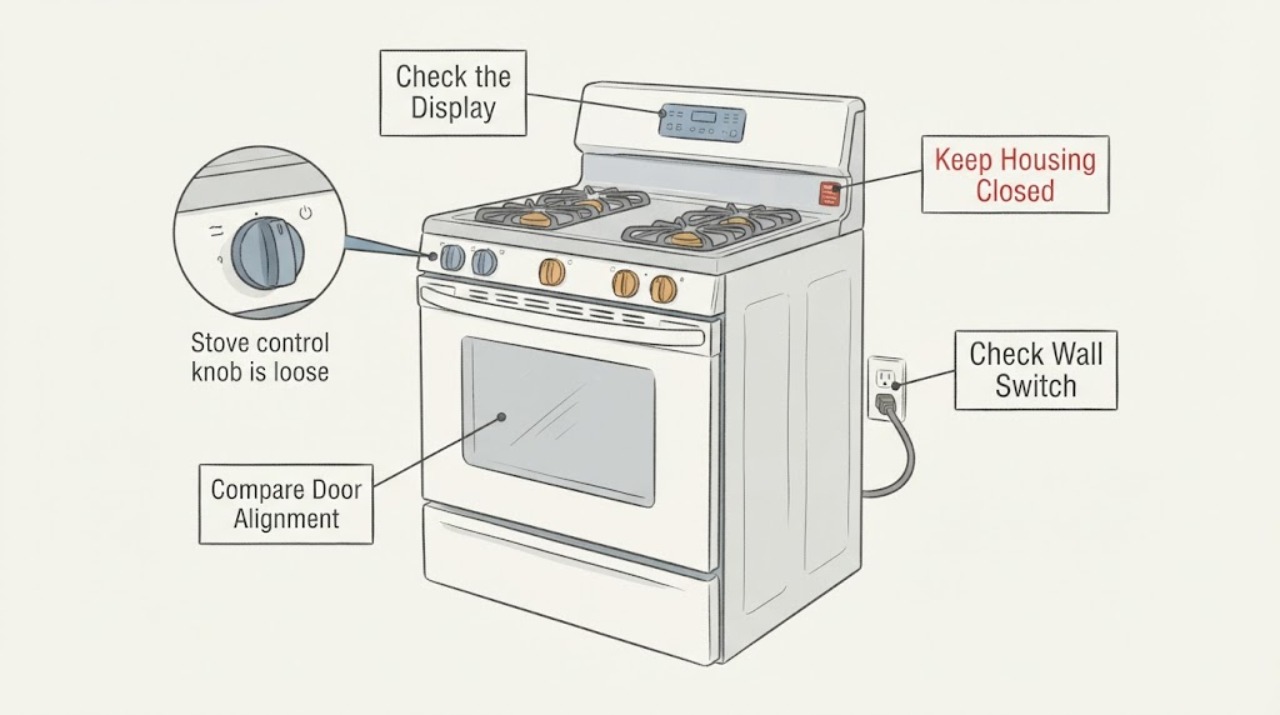
Work through in order
Diagnostic checks
Use only checks that match the exact appliance or system and its official guide.
-
Check 1
Stop cooking, turn every stove control to OFF, let the cooktop cool, and from a safe position identify whether the range is electric or gas; for an electric range isolate accessible power only as the owner manual directs, while for a gas range do not access the gas control assembly.
Expected result: The controls may all indicate OFF and the appliance may be cool, or a knob may sit between markings, remain difficult to turn, or leave a burner or element status uncertain.
Next step: Keep the range out of use and document the control position and appliance type before any external inspection; do not energize it to test the loose knob.
Stop if: Stop immediately and leave the area for a gas odor, visible flame outside the burner, smoke, sparking, abnormal heat, or any uncertainty about safe power or gas isolation.
Why this matters
Why: A control that cannot be trusted to reach or remain at OFF is a use-safety problem, even if the knob only looks loose. The appliance type determines which isolation guidance applies.
-
Check 2
With the appliance cool and isolated, inspect the loose knob from the front without prying: note rocking, a cracked or enlarged opening, a missing index mark, a wrong OFF alignment, free spinning, or a knob that no longer moves its control normally.
Expected result: The knob may be damaged while the panel and shaft look steady, or the knob may be intact but the shaft may wobble, sit crooked, or fail to follow the knob.
Next step: Photograph the knob in place and identify its control position; arrange service if the shaft or panel moves, or if the control does not reliably correspond to OFF.
Stop if: Stop if inspection would require opening the control panel, turning a seized control, touching exposed wiring, or applying force to the knob or shaft.
Why this matters
Why: A damaged knob can cause a poor fit, but movement at the shaft or panel indicates that the problem may involve the control stem or internal switch rather than the knob alone.
-
Check 3
Only when the exact owner manual permits external knob removal, and only with all controls OFF, the appliance cool, and power isolated as directed, pull the knob straight away from the panel for a visual check; do not remove a seal, cap, switch, or panel part.
Expected result: The knob may come off cleanly and show a cracked or worn opening, or it may resist, expose a bent or loose shaft, or reveal corrosion or contamination near the control.
Next step: Keep the knob and any loose pieces together, record the model marking and control location, and use the exact model documentation to decide whether a replacement knob is appropriate.
Stop if: Stop and call a qualified appliance technician for force, a stuck knob, a loose or bent shaft, corrosion, exposed electrical parts, or any gas-control access.
Why this matters
Why: A cleanly removable damaged knob supports considering a model-matched replacement. Resistance, shaft damage, corrosion, or an uncertain construction makes further access a professional task.
-
Check 4
Compare the recorded brand, full model, control type, shaft shape, and knob position with the manufacturer's model documentation before selecting a replacement; do not rely on appearance or assume another stove knob fits.
Expected result: The model may identify a matching knob, or it may show a different shaft, control family, orientation, or a control assembly that requires service.
Next step: Ask for a model-specific fitment decision using the intact-hardware photo and symptom record; if the shaft or switch is implicated, schedule appliance service rather than replacing the knob alone.
Stop if: Stop if the model is missing, the proposed part has no documented fit, the shaft is damaged, or selecting the part would require opening the control area.
Why this matters
Why: Model identity controls fit and function. A replacement knob can still leave an unsafe condition if the shaft or underlying switch is loose or damaged.
-
Check 5
Before returning the appliance to use, verify from the documentation and the external control position that the replacement or existing knob can be placed at a clear OFF mark without force; do not run a burner or element as a repeated test.
Expected result: The knob may sit securely and clearly indicate OFF, or it may remain loose, misaligned, spin freely, or leave the controlled burner or element state uncertain.
Next step: Keep power or gas isolated where safely possible and provide the technician with the model and observed control behavior; resume use only after qualified confirmation of safe operation.
Stop if: Stop all use for any uncontrolled heat, burner ignition, element activation, gas odor, sparking, smoke, abnormal heating, or inability to identify OFF.
Why this matters
Why: A clear, stable OFF position is a minimum control-safety check, not proof that the underlying valve, switch, or shaft is sound. Uncertain control means the stove is not ready for use.
Use your observations
Decision map
Find the observation that best matches what you see, then follow the next safe action.
-
PATH 01Next step
What you see
The knob is cracked or worn but the control shaft and panel remain steady and the exact model is known.
Do this next
Consider only the model-matched replacement knob described by the manufacturer, with the appliance isolated and cool before any permitted external replacement.
-
PATH 02Next step
What you see
The knob will not reliably reach or stay at OFF, or the burner or element state is uncertain.
Do this next
Keep the stove out of use and arrange qualified appliance service; do not energize the range to test it.
-
PATH 03Next step
What you see
The appliance is gas and there is a gas odor, or any flame or heat appears outside expected operation.
Do this next
Do not operate switches or controls in the area; leave and follow local gas utility or emergency instructions.
-
PATH 04Next step
What you see
The model, shaft style, or proposed replacement fit cannot be confirmed.
Do this next
Give the technician or manufacturer the model marking, photos, control position, and symptom timing for a fitment and repair decision.
Helpful context
Understand the symptom
Make the appliance safe before looking closer
Stop cooking and move cookware only when it is safe to do so. Turn every control to OFF and allow the cooktop to cool. For an electric range, disconnect power at the accessible breaker or plug only as the owner manual permits; for a gas range, do not work on the gas control assembly. If you smell gas, leave the area and follow the local gas utility or emergency instructions. A loose knob can be turned accidentally, so keep children, pets, and objects away from the controls.
Separate a damaged knob from a loose control
From the front of the cool, de-energized appliance, observe whether the knob rocks on the panel, sits at the wrong OFF mark, spins freely, or fails to move the corresponding control. A cracked or worn opening in the knob can explain a loose fit; a shaft that moves independently, sits crooked, or feels loose at the panel points beyond the knob. Do not use pliers, pry against the panel, open the control area, or turn the range back on to prove the diagnosis.
Use the exact model before choosing a part
Record the brand, full model and serial markings, appliance type, control position, and a photo of the intact knob and panel. Manufacturer instructions differ: some knobs pull straight off for cleaning, while replacement alignment and any seal below a knob can be model-specific. A replacement knob, shaft, or infinite switch must be selected from the exact model information; similar-looking controls are not proof of fit.
Know when the symptom is a service call
Do not continue cooking when the knob cannot reliably select or maintain OFF, or when a burner or heating element does not respond predictably. Leave the appliance isolated if it is safe to do so and provide the technician with the model, knob position, observed movement, gas or electric type, and any heat, odor, noise, or visible damage.
Only after diagnosis
Potential parts
- stove replacement knob
Consider this only when the visible knob is cracked, worn, or no longer grips the shaft while the control shaft and switch remain stable.
Confirm the full stove model, control position, shaft shape, OFF-index orientation, and manufacturer fit information; a similar-looking knob is not sufficient. - stove knob shaft
This may apply only when external observation shows the shaft is bent, loose, or damaged rather than the removable knob alone.
Shaft access and replacement are model-specific service work; do not select or install one without confirming the control assembly and appliance model. - stove infinite switch
An infinite switch may be relevant for an electric stove when qualified diagnosis links the symptom to the underlying control rather than the knob.
Confirm electric range model, control position, switch family, wiring requirements, and manufacturer fit through a qualified technician; no live electrical work.
When checks do not resolve it
Need a professional?
Call a qualified appliance technician when the knob cannot reliably indicate OFF, spins without controlling heat, the shaft or panel is loose or damaged, the knob is stuck, corrosion or exposed wiring is visible, model-specific fit cannot be confirmed, or any gas odor, sparking, smoke, or uncontrolled heat occurs. For a gas odor, leave the area and follow local gas utility or emergency guidance.
Safety scope: Turn controls OFF and let the appliance cool. Isolate electrical power only as the owner manual directs before permitted external access; do not open the control area, perform live electrical testing, work on gas controls, force a knob or shaft, or return the stove to use when OFF is uncertain.
Have this ready
- Provide the stove type, brand and full model marking, control position, photos of the intact knob and panel, whether the knob rocks or spins freely, whether the shaft moves with it, the last known OFF position, and any odor, heat, spark, or smoke observation.
Common questions
FAQ
Can I keep using a stove with a loose control knob?
Not if the knob can turn accidentally, cannot reliably reach or stay at OFF, spins without controlling heat, or leaves the burner or element state uncertain. Stop use and arrange qualified service.
Is a loose knob always the knob itself?
No. The knob may have a cracked or worn opening, but a loose shaft, panel, valve, or electric control can produce the same symptom. External observation and model identification help separate those cases without opening the control area.
Can I pull the control knob off to inspect it?
Only if the exact owner manual permits that external step, with controls OFF, the appliance cool, and electrical power isolated as directed. Pull straight away without prying; stop for resistance, corrosion, a loose shaft, or any need to access wiring or gas controls.
What information helps identify the right replacement knob?
Record the full stove model, the control position, the knob's OFF alignment, shaft shape, photos of the front and back if removal is safely permitted, and whether the shaft itself moves. Do not assume a generic knob fits.
Read the exact guide
Official sources
- Range Owner's ManualGE Appliances · Supports disconnecting power before service, allowing surfaces to cool, keeping controls OFF, and checking knob alignment; it is an example manual, so the reader must use the manual for the exact range model.
- Control Knobs or Control Panel - RangeWhirlpool · Supports keeping controls OFF and cool, pulling removable knobs straight away, and recognizing that some models have seals under knobs; it does not authorize panel or switch access.
- Replacing A Control Knob on a Cooking ProductGE Appliances · Supports upright OFF alignment, fitting the knob over the control stem, and model-specific instructions; it does not establish universal fit or authorize internal repair.
- Samsung Recalls Slide-In Electric Ranges Due to Fire HazardU.S. Consumer Product Safety Commission · Supports treating accidental knob activation as a fire hazard and checking whether a specific appliance is covered by a recall; the listed recall applies only to identified Samsung models, not all stoves.
Community feedback
Share a repair observation
Share a plain-text repair observation. Accepted observations are published automatically; this page may take a moment to update.