
On this page
Start here
Quick answer
Write down the complete displayed code or symbol, the affected cooking zone, and when it appears before trying to clear it. Without the make, model, and exact code, do not assign a code meaning. From a cool, dry surface, check that the cookware is magnetic, flat, correctly sized, and centered; remove objects or moisture from the controls, confirm the control lock is not active, and follow the owner's manual. If the manufacturer's guidance permits a power reset, perform only that documented reset once. A persistent or returning error, a code-specific fault, or any burning smell, smoke, cracked glass, heat damage, or repeated breaker trip calls for a qualified appliance technician; do not open the cooktop or perform electrical testing.
Before you begin
Safety first
- Do not open the cooktop, remove panels, expose wiring, test voltage, access the coil or sensor, bypass a control or safety device, or continue operating a damaged or electrically abnormal appliance.
Work through in order
Diagnostic checks
Use only checks that match the exact appliance or system and its official guide.
-
Check 1
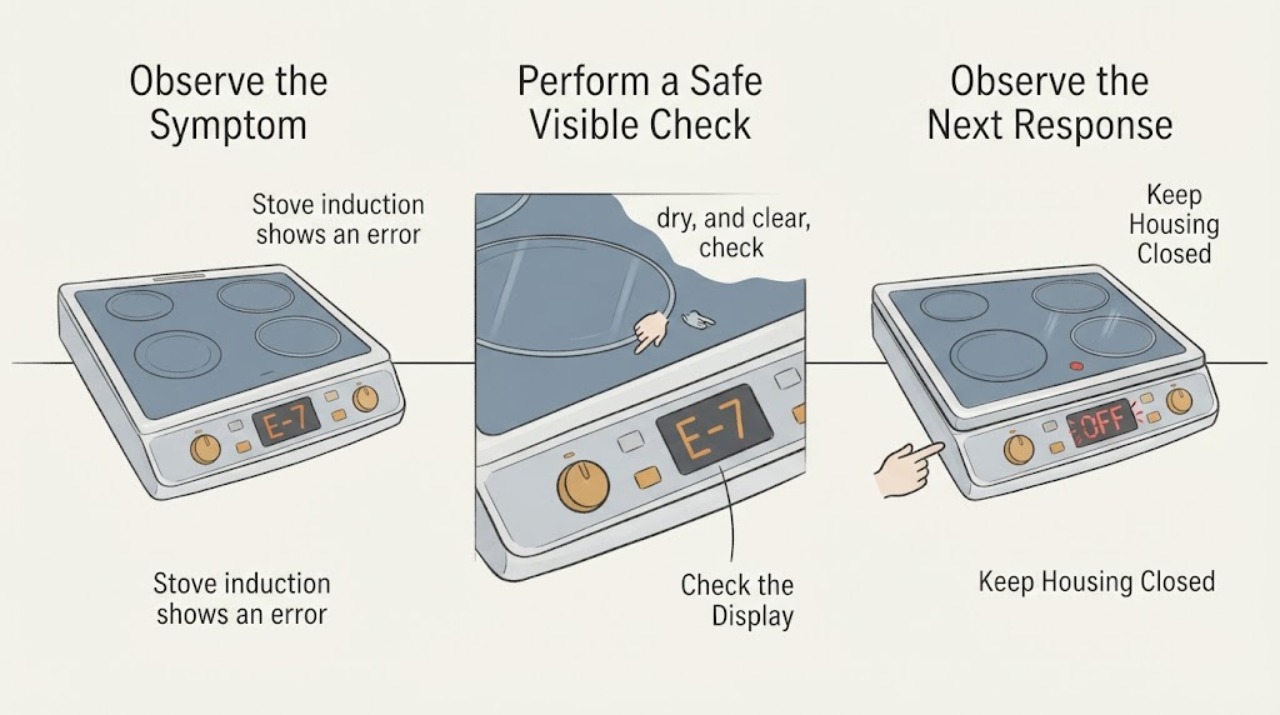
With the cooktop cool and safe to approach, photograph or transcribe the complete error code or symbol, identify the affected zone, and note whether it appears at power-up, when a pan is placed, during heating, or after cooking.
Expected result: Record the make and model from the rating label or manual, the exact display characters, any beeping, and whether one zone or the whole cooktop is involved.
Next step: Use the exact model manual or manufacturer support lookup for that code and preserve the photo for service; do not substitute a similar-looking code from another brand.
Stop if: Stop using the appliance immediately for smoke, burning smell, arcing, cracked glass, unusual heat, water entering controls, or another breaker trip.
Why this matters
Why: A code cannot be interpreted reliably without the exact display and model; the timing and affected zone help the manual or technician distinguish a control-state, cookware-detection, heat, or internal-fault path.
-
Check 2
After the surface is cool, dry, and clear, check the pan on the affected zone without forcing it: verify the bottom is flat and magnetic, then place it within the marked cooking area.
Expected result: See whether the message changes when a known induction-compatible pan is centered, and whether the same symptom follows one pan or stays with the zone.
Next step: Follow the manual's cookware guidance and document the comparison; do not infer a failed coil or sensor from this check alone.
Stop if: Stop if the glass is damaged, the pan or surface is dangerously hot, controls behave unpredictably, or the error is accompanied by smoke, odor, or electrical symptoms.
Why this matters
Why: A response that follows the pan points toward cookware material, size, contact, or placement; a response that stays with the zone or appears with no pan needs model-specific troubleshooting or service rather than a cookware purchase.
-
Check 3
Inspect the touch-control area visually and, only when the cooktop is off and cool, remove utensils and visible moisture or residue with a suitable soft cloth; check the display for a lock indicator.
Expected result: Note whether the error or beeping disappears after the control area is clear and dry, whether the lock indicator remains, and whether any key appears stuck without pressing it repeatedly.
Next step: Use only the model's documented lock/unlock operation and cleaning instructions, then record the result; do not pry controls or open the panel.
Stop if: Stop if moisture has entered the control area, the surface is cracked, a key remains active, or cleaning would require disassembly or liquid near energized parts.
Why this matters
Why: Objects or moisture over controls and an active control lock can prevent normal input or create an indicator message; a clean, unlocked panel with a returning error points toward the exact manual or service path.
-
Check 4
Check the manufacturer's instructions for the displayed code and for a user-permitted power reset; if the instructions allow it, turn the appliance off, remove cookware, and complete only that documented reset from a dry, safe position.
Expected result: Record whether the display clears, returns immediately, or returns when a particular zone or pan is selected.
Next step: Stop repeated resets and provide the code, model, timing, affected zone, cookware result, and reset result to a qualified appliance technician.
Stop if: Do not perform the reset if the manufacturer does not document it, if the appliance is wet or damaged, or if there is smoke, burning odor, arcing, unusual heat, or a breaker trip.
Why this matters
Why: A cleared display may have been a transient control state, but a returning or persistent code is not proof of a repair and may indicate a fault requiring diagnosis.
-
Check 5
Compare the symptom without opening the appliance: note whether another zone works normally, whether the error occurs with no pan, and whether it returns across a cool restart and a compatible-pan check.
Expected result: Record a zone-specific, whole-cooktop, pan-dependent, or repeatable code pattern without running the unit through repeated cycles.
Next step: Arrange service for a persistent or repeatable fault and bring the photo, model, manual code reference, and observations.
Stop if: Stop all testing for electrical smell, smoke, visible damage, hot spots, crackling, or repeated breaker operation.
Why this matters
Why: A single-zone or pan-independent pattern gives a technician a more focused lead; a whole-cooktop pattern raises the importance of power, control, or model-specific service guidance, but none of these observations identifies an internal component with certainty.
Use your observations
Decision map
Find the observation that best matches what you see, then follow the next safe action.
-
PATH 01Next step
What you see
The code or symbol is not fully legible, or the model is unknown.
Do this next
Do not explain the code from a generic list; capture the display and rating information and use the manufacturer's model-specific manual or a technician.
-
PATH 02Next step
What you see
The message changes or clears only with a magnetic, flat, centered pan, or follows one pan.
Do this next
Follow the manual's cookware requirements and document the result; if a compatible pan still produces the error, escalate rather than replacing an internal part based on guesswork.
-
PATH 03Next step
What you see
The controls are wet, obstructed, or locked and the indicator stops after the surface is cool, dry, clear, and correctly unlocked.
Do this next
Use the manufacturer's normal control instructions and monitor for recurrence without opening the appliance.
-
PATH 04Next step
What you see
The exact code returns after the documented user checks or is present with no pan on a clean, dry surface.
Do this next
Call a qualified appliance technician with the exact code, make, model, affected zone, timing, and results; do not infer a specific control board, coil, or sensor failure.
-
PATH 05Next step
What you see
There is smoke, burning smell, arcing, a cracked surface, unusual heat, water near controls, or another breaker trip.
Do this next
Stop using the cooktop, keep clear of damaged areas, and arrange urgent professional evaluation; do not continue resets or energized testing.
Helpful context
Understand the symptom
Start with the code, not a guess
An induction display can report cookware detection, a control-state issue, heat protection, or an internal fault, and the same-looking symbol does not have one universal meaning across brands. Photograph the full display and note the zone, timing, and whether the message appears with or without a pan. The model manual or the manufacturer's support page is the authority for interpreting that exact combination.
Separate user-state clues from a service fault
A magnetic pan that is centered and flat should make a different diagnostic path from a wet touch panel, a locked control, or a message that returns with no cookware. A test on a different compatible pan can identify a cookware or placement clue, but it cannot prove that the induction coil, sensor, or control board is defective.
Keep the boundary clear
This page covers external, user-observable checks only. Do not remove panels, expose wiring, test voltage, open the control area, or attempt coil or sensor repair. If the glass is cracked, the unit smells hot or burnt, produces smoke, trips the breaker again, or behaves unpredictably, stop using it and arrange professional service.
Only after diagnosis
Potential parts
- induction cooktop control board
Consider only if a qualified technician's model-specific diagnosis identifies the control board as the failed component after the exact code and external checks are documented.
Confirm the complete appliance model and manufacturer fit information; an apparently similar board is not assumed compatible. - induction coil
Consider only after professional diagnosis links a persistent zone fault to the induction coil rather than cookware, controls, power, or a sensor.
Use the exact model and service documentation to confirm fit; do not order from a symptom or generic code. - induction temperature sensor
Consider only when a qualified technician's model-specific testing identifies the sensor as the cause of the repeatable error.
Confirm model-specific fit and service requirements before any professional replacement; no universal sensor match is assumed.
When checks do not resolve it
Need a professional?
Arrange qualified appliance service for an unidentified or persistent code, a repeatable zone or whole-cooktop fault after the model-specific external checks, or any burning smell, smoke, arcing, cracked glass, unusual heat, water intrusion, or repeated breaker trip.
Safety scope: Do not open the cooktop, remove panels, expose wiring, test voltage, access the coil or sensor, bypass a control or safety device, or continue operating a damaged or electrically abnormal appliance.
Have this ready
- Provide the complete display photo or transcription, make and model, affected zone, when the message appears, cookware and placement result, control-lock or moisture observation, documented reset result, and any safety symptoms.
Common questions
FAQ
Can I identify the induction error without the model number?
Not reliably. Record the complete display, affected zone, timing, and appliance model, then use the model-specific manual or manufacturer support. Similar symbols can have different meanings.
Why does an induction stove show an error when a pan is present?
Cookware material, flat contact, size, centering, surface condition, and control state can all affect detection. Compare a known magnetic, flat, centered pan only while the surface is cool and safe, then escalate if the result follows the zone rather than the pan.
Is it safe to reset the induction cooktop at the breaker?
Only follow a reset that the exact manufacturer instructions document, and do not use repeated resets as a repair. Do not reset or continue testing when there is smoke, burning odor, arcing, damage, unusual heat, water near controls, or another trip.
Does an error prove the control board or induction coil failed?
No. A code or zone symptom can have several causes, including cookware, controls, power, heat protection, sensors, or an internal component. A qualified technician should diagnose the exact model before a part is selected.
When should I call an appliance technician?
Call for a persistent or returning code, a code that appears with no pan on a clean and dry surface, a zone-specific failure after the documented checks, or any electrical, heat, smoke, glass, or breaker-trip warning.
Read the exact guide
Official sources
- Electric Range & Cooktop - Induction Burners Not Working or Flashing Power LevelGE Appliances · Applies as general manufacturer guidance for external induction cookware and control observations; exact behavior and code meanings remain model-specific.
- Indicator or Display Flashing - Electric and Induction CooktopWhirlpool Product Help · Applies to external observations and the manufacturer's documented troubleshooting path; do not generalize its indicators or reset instructions to an unknown model.
- Cooktop - Error, Fault, or Function CodesGE Appliances · Applies to the principle that fault-code meaning is model-specific and persistent electronic codes may require trained service; it is not a universal code table.
Community feedback
Share a repair observation
Share a plain-text repair observation. Accepted observations are published automatically; this page may take a moment to update.