
On this page
Start here
Quick answer
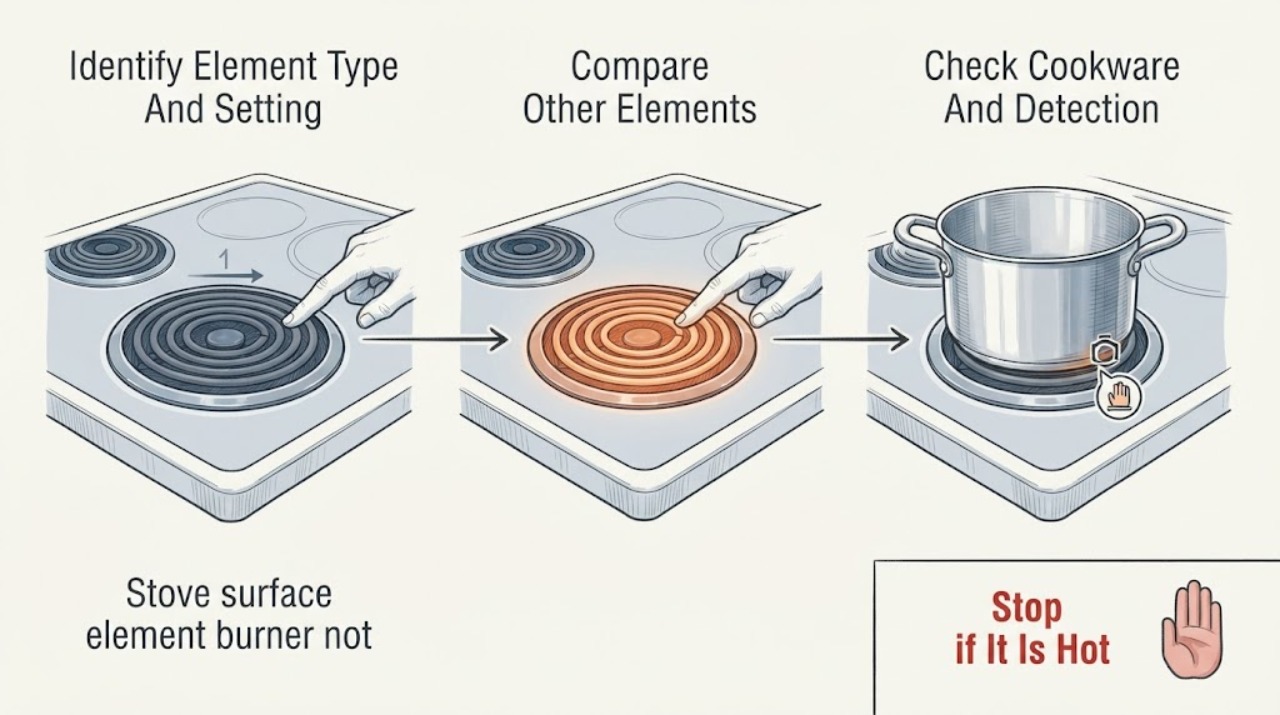
First determine whether the stove is electric coil, smooth-top radiant, or induction, because a coil that is not seated, a radiant element that cycles, and induction cookware that is not detected can look similar. Confirm the correct control and setting, let the surface cool, check only normal user-accessible seating or visible damage, and compare the affected element with another element. On an electric coil range, one element that stays cold after a safe comparison points toward the element or its receptacle; if the problem follows the control or affects several elements, the switch, control, power, or wiring path needs service. A smooth-top element may cycle rather than glow continuously, and induction requires compatible flat cookware. Check the breaker only once from a safe position, and stop for sparks, smoke, burning odor, a cracked glass surface, repeated breaker trips, or exposed wiring. Do not open the range, pull it out to inspect the cord, touch terminals, or perform live electrical tests.
Work through in order
Diagnostic checks
Use only checks that match the exact appliance or system and its official guide.
-
Check 1
Read the owner's manual or control labels and confirm that the affected zone is electric coil, smooth-top radiant, or induction; select that zone and the intended setting with the cooktop surface clear and cool.
Expected result: Record a normal cycling glow, an induction display that does not detect the pan, the wrong control selected, a locked or disabled control, or a zone that remains completely cold.
Next step: Correct only an obvious control or lock setting and perform one ordinary test with suitable cookware. If the zone remains cold, continue without opening the appliance.
Stop if: Stop for an error that persists with a hot surface, smoke, sparks, burning odor, a cracked glass top, or a control that is hot or damaged.
Why this matters
Why: Cycling can be normal on a temperature-limited element, while no-pan detection or a wrong control can prevent induction heat. A correct setting with a persistently cold zone needs comparison with other elements.
-
Check 2
Using the same safe control procedure, compare the affected surface element with one other element and, if appropriate, the oven or clock display; do not run a damaged burner or touch a hot surface.
Expected result: Record one cold element with other elements normal, several cold elements, an oven or clock that also lacks power, or an oven and clock that work normally.
Next step: Keep the affected zone off and use the result to guide service. If all surface elements fail after installation while the clock or oven works, contact the installer or a qualified appliance technician rather than inspecting the cord.
Stop if: Do not pull the range out, inspect the power cord connection, remove a drawer to reach wiring, or open the control panel.
Why this matters
Why: One cold zone focuses the investigation on that element, receptacle, sensor, or control. Several zones or other appliance functions failing together makes supply, breaker, wiring, or control issues more likely.
-
Check 3
On a smooth-top or induction stove, test the affected zone with a clean, flat-bottom pan that the owner's manual allows; keep the pan centered and use a normal cooking setting.
Expected result: Record the test pan heating normally, the original pan failing while the test pan works, a warped or very light pan, or an induction zone that still does not detect suitable cookware.
Next step: Use suitable cookware and do not alter the zone. Arrange service for a zone that fails with suitable cookware or for any damaged glass surface.
Stop if: Do not scrape a hot glass surface, use a cracked pan or cooktop, defeat induction detection, or place hands on the heating area to test temperature.
Why this matters
Why: If the result follows the pan, cookware compatibility or flatness is more likely than an element failure. If suitable cookware is not detected or remains cold only on one zone, the zone, sensor, or control needs diagnosis.
-
Check 4
After the removable coil is fully cool and the appliance is off at its normal control, look for obvious damage or a coil that is visibly not seated in its user-accessible receptacle; do not remove a coil unless the exact manual explicitly treats it as user-removable.
Expected result: Record a properly seated undamaged coil, visible scorching or cracking, a loose-looking coil, a damaged receptacle, or a smooth-top element with no user-accessible part.
Next step: Follow only the exact model manual for a simple, power-off reseating step. If damage is visible or the element remains cold, leave it off and arrange appliance service.
Stop if: Do not touch terminals, bend prongs, open the cooktop, remove a smooth-top element, or continue if the appliance cannot be safely de-energized.
Why this matters
Why: A removable coil that is visibly mis-seated can explain no heat, while scorching, cracking, or receptacle damage indicates a service boundary. A smooth-top unit should not be treated like a plug-in coil.
-
Check 5
From a dry, safe position, look at the labeled range breaker or fuse without removing a panel cover; if it appears tripped and there is no heat, odor, moisture, or visible damage, restore it only according to your household procedure.
Expected result: Record normal power, one apparent trip that restores the range, an immediate repeat trip, buzzing or warmth, or an inaccessible panel.
Next step: Test one ordinary control setting after one safe restoration. If the range remains affected or the breaker trips again, leave it off and request qualified appliance or electrical service.
Stop if: Do not remove the panel cover, test voltage, touch conductors, bypass protection, or reset a repeatedly tripping breaker.
Why this matters
Why: A single trip can explain several dead elements, but a repeat trip or any heat, odor, buzzing, or damage indicates an unresolved electrical fault rather than a reason to reset again.
-
Check 6
Record the stove model if safely visible, element type and location, selected setting, cookware used, which zones and controls work, breaker history, visible damage, and any spark, odor, or heat event.
Expected result: Confirm that the record contains external observations only and that no wiring, terminal, element lead, panel, or sealed control was disturbed.
Next step: Arrange qualified appliance repair and provide the model and comparison results. Ask the technician to verify the element and its control or receptacle before selecting a replacement part.
Stop if: Stop all homeowner troubleshooting when diagnosis requires opening the stove, moving the appliance, electrical measurements, or handling live or recently energized parts.
Why this matters
Why: The pattern helps a technician distinguish a failed surface element from a receptacle, infinite switch, sensor, control board, supply, or installation fault without unsafe testing by the owner.
Use your observations
Decision map
Find the observation that best matches what you see, then follow the next safe action.
-
PATH 01Next step
What you see
The element cycles normally or heats a suitable flat pan, while the original pan is warped, light, or not detected.
Do this next
Use the suitable cookware and the manual's setting guidance. Do not replace an element unless a technician identifies a component fault.
Why this path and its safety boundary
Why it matters: Normal temperature limiting or cookware compatibility is more likely than a failed burner.
-
PATH 02Next step
What you see
One zone stays cold with the correct control and suitable cookware, while other surface zones work normally.
Do this next
Leave that zone off and arrange appliance service; a technician should identify whether the element or its receptacle and control path failed before a part is ordered.
Why this path and its safety boundary
Why it matters: The affected element, its receptacle, sensor, or individual control is more likely than a whole-range power loss.
-
PATH 03Next step
What you see
Several surface elements fail together, especially when the clock or oven behaves differently, or the problem began after installation.
Do this next
Check the breaker once from a safe position if permitted, then contact the installer or qualified appliance electrician. Do not pull the stove out or inspect the cord.
Why this path and its safety boundary
Why it matters: Supply, breaker, installation wiring, or a shared control path becomes more likely than several unrelated element failures.
-
PATH 04Safety boundary
What you see
The coil or receptacle is scorched, the glass is cracked, the control is hot, or the burner produced sparks or a burning odor.
Do this next
Turn the range off, keep clear of the damaged area, and arrange qualified appliance or electrical service. Use emergency response for smoke or fire.
Why this path and its safety boundary
Why it matters: A damaged heating or electrical component can present a shock, fire, or further equipment-damage risk; visual appearance cannot make it safe to operate.
Safety stop: Do not restore power, touch the element or terminals, use the cracked surface, or open the range.
-
PATH 05Safety boundary
What you see
The range breaker trips again, the panel or cord is inaccessible without moving the appliance, or any wiring or voltage test would be required.
Do this next
Leave the range off and request qualified appliance or electrical service. Provide the model and which zones or functions were affected.
Why this path and its safety boundary
Why it matters: The fault is outside safe user checks and may involve supply wiring, internal controls, or a shorted component.
Safety stop: Do not reset repeatedly, move the range, remove covers, or perform live testing.
Helpful context
Understand the symptom
Confirm what kind of surface element you have
A removable metal coil, a smooth glass radiant zone, and an induction zone do not show heat in the same way. A radiant coil may cycle rather than glow steadily, and induction may not heat a pan that the cooktop cannot detect. Use the controls and owner's manual to identify the type before calling a normal glow pattern a failure. This article is for an electric stove surface element; a gas flame that will not light is a different diagnosis.
A comparison test is more useful than guessing at a part
If one surface element is cold while other elements heat normally, the affected element, its receptacle, or its control becomes the focused path. If several elements fail together, the range supply, wiring, control, or installation is more relevant. A control that heats a different element, or an interchangeable removable coil that fails in more than one position, gives a technician better evidence than the appearance of the element alone. Do not move a hot coil or open the appliance to prove the result.
Cookware can make a working element seem weak
For radiant and induction surfaces, test only with cookware that the manual permits. A flat, smooth bottom helps transfer heat on a smooth-top surface; induction also requires cookware the zone can detect. A pan that is warped, too light, too small, or incompatible can produce poor results even when the element is operating. Compare with a suitable flat pan and observe whether the problem follows the pan rather than the cooking zone.
Know when an element is a failed electrical part
GE notes that a failed surface element can open its circuit and stop heating, and in rare cases an element fault can produce sparks or a burning-plastic odor. A cold element after the correct setting, suitable cookware, and a safe comparison can be consistent with a failed element, but it does not identify the receptacle, switch, sensor, or wiring. Leave the affected burner off and arrange service rather than replacing an internal part by appearance.
Safety boundary
Stop conditions
- Stop immediately for sparks, smoke, burning odor, a hot control, a cracked glass cooktop, exposed wiring, moisture near electrical parts, a shock sensation, or a repeated breaker trip.
- Leave the affected burner and range off for scorching, a damaged coil or receptacle, severe control malfunction, or any fault that returns after one safe power restoration.
- Never open the range, remove a smooth-top assembly, touch terminals, pull the appliance out, perform live electrical tests, bypass a sensor, or defeat induction safety detection as a homeowner.
Only after diagnosis
Potential parts
- surface heating element or removable coil
An element is only a candidate when a technician or model-specific test distinguishes it from the receptacle, sensor, control switch, or supply; a cold burner alone does not establish compatibility.
Confirm the exact model, element type, size, connector or mounting arrangement, and manufacturer-approved fit before selecting a replacement. - surface-element receptacle, switch, sensor, or control board
These internal parts require qualified diagnosis because one dead zone and several dead zones can have different causes, and electrical symptoms may be hazardous.
Have a qualified technician identify the failed part and verify the exact model, electrical specification, control design, and approved replacement.
When checks do not resolve it
Need a professional?
Call qualified appliance repair or electrical service when one surface element stays cold after safe control, cookware, and comparison checks; several elements fail; a coil or receptacle is damaged; a breaker trips again; the range was recently installed; or internal access is needed. Use emergency help for smoke or fire and keep the range off for sparks, burning odor, heat, exposed wiring, moisture, or a cracked glass surface.
Have this ready
- Provide the model if safely visible, element type and location, controls and zones that work, cookware result, breaker history, visible damage, and any spark, odor, heat, or installation-related event.
Common questions
FAQ
Why is one stove surface element not heating?
Check the correct control, suitable cookware, and visible seating or damage only through normal access. If other zones work but one stays cold, the element, receptacle, sensor, or individual control is more likely and needs qualified diagnosis.
Why does an electric coil not glow red all the time?
Some temperature-limiting coils cycle and may appear less bright or switch off and on during normal use. Test heating with suitable cookware rather than relying only on glow; service is appropriate if the pan stays cold or the element shows damage.
Can a pan cause a smooth-top or induction burner not to heat?
Yes. A flat, suitable pan is important for radiant and induction surfaces, and induction needs cookware the zone can detect. Compare with a clean, flat pan allowed by the manual; if the zone still stays cold, arrange service.
When should I stop using a stove burner?
Turn it off and keep the range off for sparks, smoke, burning odor, a cracked glass surface, scorching, exposed wiring, moisture near electrical parts, a shock sensation, or a repeated breaker trip. Do not open the range or reset protection repeatedly.
Read the exact guide
Official sources
- Range Surface Unit FailureGE Appliances · GE Appliances technical support context used to define the safety boundary around failed surface elements; it does not authorize owner electrical diagnosis.
- Electric Range & Cooktop - Surface Burners Not Heating WellGE Appliances · GE Appliances consumer support used for general element and cookware checks, not model-specific replacement or wiring instructions.
- Electric Range - Surface Burners Not Heating or WorkingGE Appliances · GE Appliances support guidance used for general electric-range decision points; exact stove model instructions govern safe access and maintenance.
- Not Powering On - Electric CooktopWhirlpool Product Help · Whirlpool official support used for general electric-cooktop behavior and safe external checks, not for another manufacturer's model-specific repair.
- Ranges - No HeatingFrigidaire · Frigidaire official range guidance used for general electric-surface troubleshooting; model-specific instructions govern controls, access, and resets.
Community feedback
Share a repair observation
Share a plain-text repair observation. Accepted observations are published automatically; this page may take a moment to update.