
On this page
Start here
Quick answer
First separate normal high-setting cycling from a burner that is truly stuck on. Electric surface elements, including radiant elements beneath glass, can cycle on and off even at High as the control maintains heat; the surface may remain hot while the element is temporarily dark. If the burner continues glowing or heating after its knob is turned to OFF, the knob will not reach OFF, or the element stays at full heat when a lower setting is selected, stop using that burner and arrange qualified appliance service. From a cool surface, check only that the correct knob is seated and the control marking matches the burner. Do not open the console, probe live terminals, bypass the control, or keep cooking while a burner cannot be turned off.
Before you begin
Safety first
- This article supports ordinary-access observation and safe control identification only. Power isolation is a stop measure when the circuit control is safely accessible; it is not a repair. Do not perform live electrical testing, panel removal, wiring changes, limiter bypass, glass removal, or switch replacement.
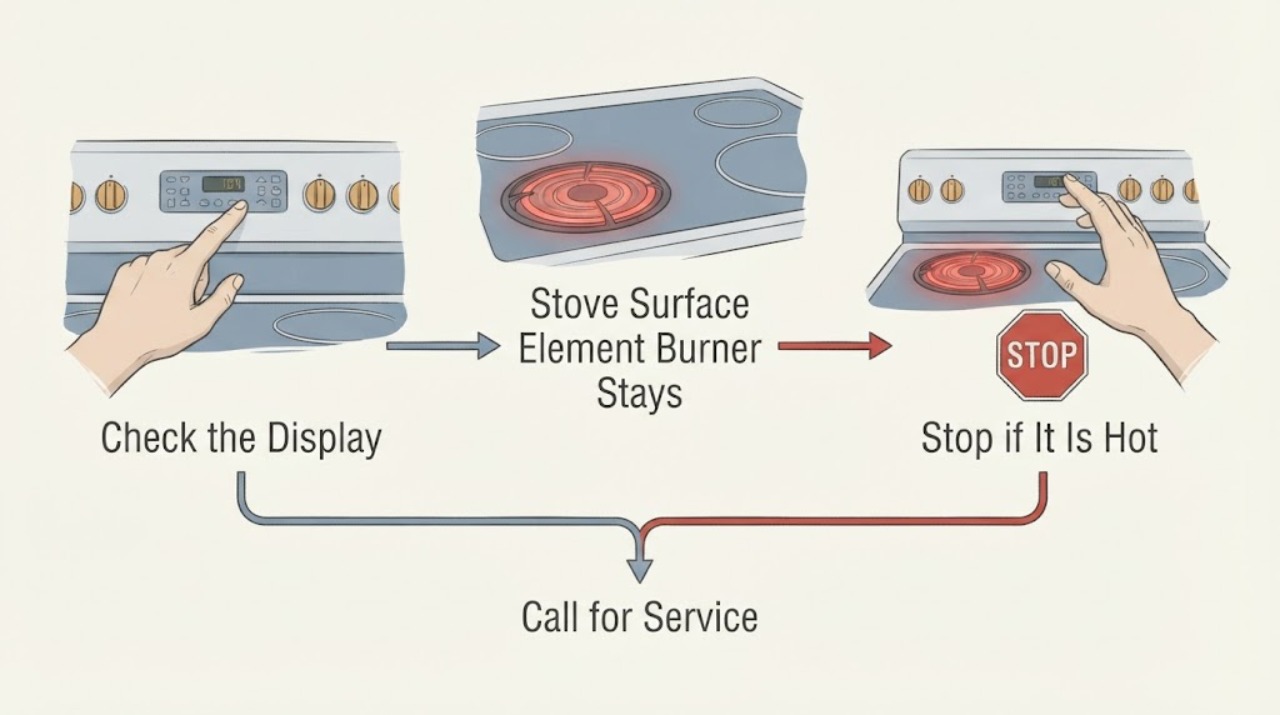
Work through in order
Diagnostic checks
Use only checks that match the exact appliance or system and its official guide.
-
Check 1
From the normal user position, observe the affected surface element with no hand or cookware near it and note the knob position; do not touch the element or try to force the control.
Expected result: Classify the element as glowing or heating continuously, cycling between active and dark while heat returns, remaining warm after being turned off, or unaffected by the knob position.
Next step: If heat cycles and returns at the selected setting, continue with the cool-control check; if the element stays active or ignores OFF, stop using the stove and follow the service boundary.
Stop if: Stop immediately for smoke, burning odor, arcing, uncontrolled heating, a damaged surface, or cookware that cannot be removed without touching a hot or damaged area.
Why this matters
Why: Frigidaire and Whirlpool identify on-and-off cycling, including at High, as normal for radiant or temperature-limited elements. Continuous active heat after OFF, no reduction at a lower setting, or a control position that has no effect is not explained by ordinary cycling and points toward a control or range-side fault.
-
Check 2
After the surface is fully cool, verify from ordinary access that the knob belongs to the affected burner, is seated on its shaft, and can reach the OFF marking without forcing or removing the console.
Expected result: Record a correctly seated knob that reaches OFF, a knob that is loose or spins without changing the control, a knob that will not reach OFF, or a control marking that does not match the burner.
Next step: If the knob was merely mis-seated, refit it only as the owner manual permits and verify the control remains OFF; otherwise leave the burner unused and arrange qualified service.
Stop if: Do not pry the knob shaft, remove the control panel, spray cleaner into the control, or continue using a knob that is cracked, loose, stuck, or unable to turn the burner off.
Why this matters
Why: A displaced knob or wrong control position can mimic a stuck-high complaint. A correctly seated knob that reaches OFF but leaves the element active makes an internal control, wiring, or element-path fault more likely; a knob that cannot reach OFF is itself a reason not to operate the burner.
-
Check 3
With the stove cool and no cookware present, turn the affected control to OFF once and observe the actual element or surface from a safe distance; do not use the hot-surface lamp alone as proof that the burner is powered.
Expected result: Record whether the element stops active heating, the element stops but a hot-surface indicator remains lit, the indicator shows an element-on state with continuing heat, or the surface remains too hot to judge safely.
Next step: Treat a stopped element with residual heat as a cool-down condition and monitor only after the surface is safe; treat continuing active heat after OFF as a stuck-control symptom and isolate the burner.
Stop if: Do not touch the surface to test temperature, place a pan on it to see whether heat continues, or reset and repeatedly re-test a burner that stays active after OFF.
Why this matters
Why: Frigidaire distinguishes an element-on indicator from a hot-surface indicator that can remain lit while the surface cools. If the element stops but the hot-surface lamp remains, residual heat is plausible. If active heating continues after OFF or the element-on state remains, the control path needs service.
-
Check 4
Once the affected area is cool and the suspect burner is left OFF, compare the other surface controls from the normal user position without turning the suspect burner back on or opening the stove.
Expected result: Record whether the problem affects only one burner, several burners, all burners, or one control group; note whether other elements cycle and regulate normally.
Next step: Keep the affected burner out of use and include the comparison in a service request; if several burners or the whole top are abnormal, include the range display and breaker history as well.
Stop if: Do not run multiple burners to reproduce the fault, move the range to access a cord, or continue after a breaker or fuse operates.
Why this matters
Why: One burner that stays active points toward its control, element, receptacle, or local wiring. Several burners with the same abnormal behavior suggest a common supply or control issue. Normal operation elsewhere helps describe the fault but does not prove which internal part failed.
-
Check 5
If the element truly remains active after OFF or the control cannot turn it off, keep the stove out of use and, only if the circuit control is safely accessible without approaching heat, isolate the range circuit once; record the model and symptom rather than opening any panel.
Expected result: Record whether the active heat stops after the range is safely de-energized, whether a breaker will not remain on, whether the surface or wiring shows damage, and whether the control resumes the same fault after service power is restored by a qualified person.
Next step: Leave the range isolated when safe to do so and provide the technician with the burner location, knob behavior, element-versus-indicator observation, comparison with other burners, model, and any protective-device event.
Stop if: Do not open the breaker panel beyond ordinary switching, probe terminals, remove the range back, bypass a control, restore a tripping breaker, or touch a hot surface or exposed conductor.
Why this matters
Why: Removing power can make an uncontrolled heating condition safer, but it does not identify or repair a stuck switch. A breaker that trips, visible damage, or a fault that returns indicates a range-side electrical or control problem requiring qualified diagnosis.
Use your observations
Decision map
Find the observation that best matches what you see, then follow the next safe action.
-
PATH 01Safety boundary
What you see
The element goes dark and returns to heat while the control remains at a selected setting, and it stops active heating when turned OFF.
Do this next
Use the correct cookware and the model's normal operating instructions; arrange service only if heat no longer regulates, the element never cycles, or the control stops responding.
Why this path and its safety boundary
Why it matters: This pattern matches normal infinite-control or radiant-element cycling rather than a burner stuck on High. A hot-surface indicator can remain lit during cool-down.
Safety stop: Stop for smoke, odor, arcing, uncontrolled heat, damaged glass, or a knob that cannot reach OFF.
-
PATH 02Safety boundary
What you see
The element continues visibly heating after the knob reaches OFF, or the control cannot reach or hold OFF.
Do this next
Keep people and combustible items away from the surface, isolate power only when safely accessible, and request qualified appliance service without further heat testing.
Why this path and its safety boundary
Why it matters: A failed control, wiring fault, damaged knob or shaft interface, or another local control-path problem is more likely than normal cycling.
Safety stop: Do not keep cooking, touch the element, open the console, probe wiring, or repeatedly restore power to see whether the fault clears.
-
PATH 03Safety boundary
What you see
The knob is loose, spins without changing heat, is on the wrong control, or cannot align with OFF even though the surface is cool.
Do this next
Leave the burner unused, photograph the knob and markings, and ask qualified service to verify the knob, shaft, and infinite-control assembly.
Why this path and its safety boundary
Why it matters: The user interface may not be transmitting the intended setting, but the underlying switch and shaft cannot be judged without model-specific inspection.
Safety stop: Do not force the shaft, substitute a knob by appearance, spray into the control, or remove the console.
-
PATH 04Safety boundary
What you see
Several burners stay active or regulate abnormally, the clock or display behaves unusually, or a breaker or fuse event occurs.
Do this next
Keep the range out of use and arrange qualified appliance or electrical service; include whether the range is newly installed or was recently moved.
Why this path and its safety boundary
Why it matters: A common supply, installation, or control issue is more plausible than one isolated surface-element switch. Partial supply can leave some appliance functions working while burners behave incorrectly.
Safety stop: Do not repeatedly reset a protective device, increase its rating, move the range to inspect wiring, or use an improvised connection.
-
PATH 05Safety boundary
What you see
The element is beneath glass, the active element stops but a hot-surface indicator remains lit, or the surface is cracked or damaged.
Do this next
Allow a normal surface to cool without touching it; keep a damaged glass surface out of use and request qualified service with the model and photos.
Why this path and its safety boundary
Why it matters: Radiant elements can cycle and a hot-surface indicator can persist during cool-down; a cracked or damaged glass surface is a separate stop condition and not a switch test.
Safety stop: Do not heat-test a crack, lift the glass, scrape the surface, or open the control area.
Helpful context
Understand the symptom
High heat can cycle normally, but OFF must still work
A knob-controlled electric stove uses an infinite control to vary heat rather than providing only a few fixed levels. The element may glow, go dark, and return while regulating the selected setting. Radiant glass elements also use a limiter that cycles even at High. A hot surface indicator can remain lit after the control is turned off because the surface is still hot, so the useful question is whether the element is still being energized and heating—not whether a warning lamp remains on.
Treat a genuine stuck-high symptom as a control fault
If the element stays visibly active after the knob reaches OFF, cannot reduce heat when the setting changes, or the knob is loose or cannot reach its detent, do not keep testing with cookware. A failed control, a damaged knob or shaft interface, wiring, or another range-side fault can produce a similar symptom. The visible behavior can narrow the service report, but it cannot identify the correct switch or element part.
The safe handoff is more useful than a live electrical test
Record the exact stove model, affected burner, control position, whether the element cycles, and whether the indicator changes after the control is turned off. If the burner cannot be turned off, keep people and combustible items away from the hot surface and isolate power at the range circuit only when it can be done safely from ordinary access. Leave internal diagnosis, electrical testing, and part selection to qualified appliance service.
Safety boundary
Stop conditions
- Stop using the affected burner immediately if it continues heating after OFF, cannot be set below High, the knob will not reach OFF, or the control has no effect.
- Stop for smoke, burning odor, arcing, exposed wiring, uncontrolled heat, damaged glass, a damaged receptacle, or a breaker or fuse that operates again.
- Do not open the console, probe live terminals, exchange switch wires, bypass a limiter or control, or choose a switch or element from the symptom alone.
- Do not touch a hot element or glass surface, place cookware on it to test whether it remains active, or heat-test a crack or damaged area.
- Do not repeatedly restore power, move the range to reach wiring, or keep cooking while an electrical or control fault is suspected.
Only after diagnosis
Potential parts
- model-specific infinite control switch
Consider this category only after qualified diagnosis confirms that the control path fails to regulate or disconnect the affected element and the knob interface is not the cause.
Confirm the complete stove model, burner position, control type, terminal arrangement, and manufacturer fit information before ordering or installing. - model-specific surface heating element or limiter
Consider this category only when service diagnosis isolates the abnormal heat to the element or limiter rather than the control switch or supply.
Verify the exact model, radiant or coil design, burner position, and manufacturer-approved fit; do not substitute by appearance or bypass a limiter. - model-specific control knob or shaft interface
Consider this category only when the cool-surface inspection finds a damaged, loose, or mismatched knob or shaft interface that prevents reliable OFF or setting selection.
Confirm the exact model, shaft profile, control marking, and manufacturer fit; do not force a knob or treat a replacement knob as proof that the internal switch is safe.
When checks do not resolve it
Need a professional?
Arrange qualified appliance service when the surface element remains active after OFF, cannot regulate below High, the knob is loose or cannot reach OFF, the active element differs from the indicator behavior, or the fault returns after a safe power isolation. Use qualified electrical or installation service when several burners are abnormal, a breaker or fuse operates, the display suggests partial power, or the range connection is uncertain. A hot-surface indicator that remains lit while the element has stopped can be normal cool-down, but a cracked glass surface or any uncontrolled heat requires the burner to remain out of use.
Safety scope: This article supports ordinary-access observation and safe control identification only. Power isolation is a stop measure when the circuit control is safely accessible; it is not a repair. Do not perform live electrical testing, panel removal, wiring changes, limiter bypass, glass removal, or switch replacement.
Common questions
FAQ
Is it normal for an electric burner to stay red on High?
A surface element can cycle on and off even at High, but it should still respond to the control and stop active heating when turned OFF. Continuous heat after OFF is not normal cycling.
Why does the hot-surface light stay on after I turn the burner off?
A hot-surface indicator can remain lit while the glass or element area is still hot. Check the actual element behavior only from a safe distance; do not touch the surface to test it.
What if the burner remains hot after the knob is set to OFF?
If the element is still actively heating rather than merely retaining residual heat, stop using that burner, isolate power only when safely accessible, and arrange qualified appliance service.
Can a loose knob make a burner seem stuck on High?
Yes, a loose, mismatched, or spinning knob can prevent the intended control position from reaching the switch. Inspect the knob only when the surface is cool, and do not open the console or force the shaft.
Should I replace the infinite switch myself?
Do not select or replace it from the symptom alone. A stuck-high burner can involve the knob, switch, element, limiter, wiring, or supply, and internal electrical work needs qualified model-specific diagnosis.
Read the exact guide
Official sources
- Relectric Range and Cooktop - Infinite vs Electroinc "No Pulse" BurnersGE Appliances · Official GE support explaining that traditional knob-controlled elements use infinite controls and cycle on and off as heat is regulated.
- Burners Not Glowing - Glass CooktopWhirlpool · Official Whirlpool support explaining normal glass-cooktop cycling, control-lock and reset context, and service escalation.
- Electric Range - Check Power SupplyGE Appliances · Official GE support for electric-range power-supply symptoms, including a clock that works while burners do not heat properly, and service escalation.
- Ranges - Why does my surface element appear to go on and off on my ceramic glass cooktop?Frigidaire · Official Frigidaire range support explaining that radiant elements can cycle on and off even at High to regulate heat and protect the glass surface.
- Ranges - What do the indicator lights on my range mean?Frigidaire · Official Frigidaire range support distinguishing the element-on indicator from the hot-surface indicator that remains while the surface cools.
- Range - Infinite Heat ControlsGE Appliances · Official GE support identifying infinite heat control as an electric-range control with a continuously variable choice of settings.
Community feedback
Share a repair observation
Share a plain-text repair observation. Accepted observations are published automatically; this page may take a moment to update.