
On this page
Start here
Quick answer
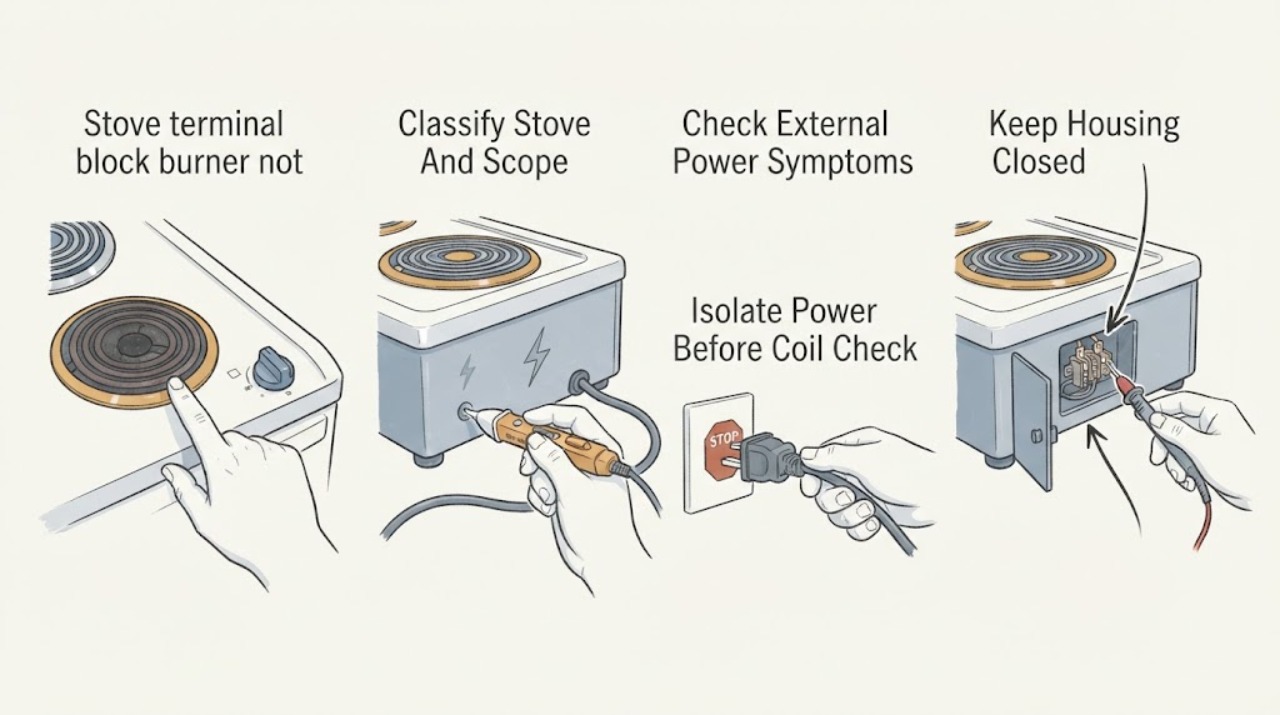
A stove terminal block or burner receptacle can interrupt power to a plug-in electric coil, but the same symptom can come from a failed coil, control switch, wiring, partial household power, or normal cycling on a radiant or sensor-equipped surface. First confirm that this is an electric coil burner and whether one burner or several are affected. With the range cool and power safely disconnected, use only the owner's manual's approved same-size coil-swap check: if the suspect coil also fails in a known-working receptacle, the coil is more likely; if it works there, the original receptacle, terminal block, wiring, or control circuit needs service. Do not open the terminal-block cover, tighten terminals, probe for voltage, or work inside the range as an ordinary user. Stop for a burned or melted connection, sparking, smoke, repeated breaker trips, a damaged cord, an unstable range, or any uncertainty about disconnecting power, and arrange qualified appliance or electrical service.
Before you begin
Safety first
- Owner checks are limited to cool-burner classification, external power-symptom observation, safe power disconnection, model-approved handling or same-size coil swap, and flashlight inspection of visible contacts without opening covers. A qualified appliance technician or electrician must handle terminal-block access, wiring, electrical testing, control or receptacle replacement, range movement, grounding, and power-supply work.
Work through in order
Diagnostic checks
Use only checks that match the exact appliance or system and its official guide.
-
Check 1
With all controls off and the cooktop cool, identify whether the stove has removable plug-in electric coils, a smooth radiant or induction surface, or gas burners. Count how many burners are affected and note whether the oven, clock, or other controls operate; do not light a gas burner just to test an electric fault.
Expected result: Record one dead removable coil, several dead burners, all burners dead with a working clock, a smooth-top zone that does not glow or heat, or a gas burner that does not produce a flame.
Next step: Continue only with the plug-in coil checks when that design is confirmed. For gas, induction, or smooth-top radiant equipment, follow the model manual or request service instead of treating it as a terminal-block repair.
Stop if: Stop for a gas odor, flame outside the burner, smoke, sparking, a hot or melted control, or any electrical damage visible without moving covers.
Why this matters
Why: One dead plug-in coil keeps the element, receptacle or terminal block, switch, and local wiring in consideration. Several dead electric burners or a working clock with no heat makes supply, terminal-block, or common control trouble more likely. Smooth-top and gas symptoms need their own model-specific path.
-
Check 2
From a dry, safe position, check whether the range's circuit protection has tripped and whether the power cord is visibly loose or damaged without pulling the range out. Reset a breaker only once if there is no damage, no moisture, no odor, and the panel can be operated safely; do not remove a panel or repeatedly restore power.
Expected result: Record normal power with one burner dead, a breaker that trips again, a clock that works while all burners are cold, a completely dead range, a loose or burned cord, or power that cannot be safely checked.
Next step: Leave the range off and request qualified appliance or electrical service for a repeated trip, partial-power symptom, damaged cord, or uncertain supply. Do not open the terminal block or attempt live testing.
Stop if: Do not reset a breaker repeatedly, touch a damaged cord, operate a wet panel, slide the range across the floor, or work near exposed conductors.
Why this matters
Why: A single dead burner points toward its coil, receptacle or terminal block, switch, or branch wiring. A working clock with cold burners can occur with partial supply or a range connection issue; repeated trips or damaged wiring indicate an electrical fault rather than a bad coil alone.
-
Check 3
Let the range cool completely, turn the control off, and disconnect power using the owner's manual's safe method before touching a removable coil or inspecting a receptacle. Confirm that no indicator suggests the surface is still hot; do not rely on a dark coil alone as proof of de-energization.
Expected result: Record power safely disconnected, a hot-surface or other indicator still active, no accessible disconnect, a cord or outlet that is wet or damaged, or a range that cannot be moved without anti-tip risk.
Next step: Wait for a cool, safe condition or call service. Do not remove the terminal-block cover or any internal wiring to prove that power is off.
Stop if: Stop immediately for heat that persists unexpectedly, moisture near the plug or outlet, damaged insulation, an ungrounded or questionable connection, or any uncertainty about power isolation.
Why this matters
Why: A cool, safely isolated coil can be handled for a model-approved visual or swap check. A hot surface, inaccessible disconnect, wet connection, or unstable range makes even a receptacle check unsafe.
-
Check 4
Only for a cool, removable plug-in coil and only when the exact manual permits it, place the suspect coil into a known-working receptacle of the same size after power is disconnected. Do not force the prongs, swap different sizes, or test with the range energized during insertion.
Expected result: Record the suspect coil heating in the known-working receptacle, remaining cold there, a loose fit, a damaged coil, or no receptacle that is safe and compatible for the comparison.
Next step: Return the coil to its proper position only if all contacts and the socket are intact and the manual allows it; otherwise leave the range disconnected and request service for the receptacle or terminal block circuit.
Stop if: Do not continue with a melted socket, bent or loose contacts, scorch marks, cracked coil, sparking, or any need to open the cooktop or terminal-block cover.
Why this matters
Why: If the coil remains cold in a known-working same-size receptacle, the coil is more likely failed. If it heats there but not in its original position, the original receptacle, terminal block, wiring, or control path becomes more likely. A loose or damaged fit is not safe to keep using.
-
Check 5
With power still disconnected and without removing a cover, use a flashlight to look only at the visible coil contacts and receptacle area for discoloration, melted plastic, loose fit, corrosion, or heat damage. Do not pull wires, tighten terminals, or touch the rear terminal block.
Expected result: Record clean and firm visible contacts, a melted or darkened receptacle, an exposed conductor, a loose connection, corrosion, or no safe view of the terminal block.
Next step: Leave power disconnected and arrange qualified appliance service for any damage, loose fit, exposed conductor, or inaccessible terminal block. Do not restore power to see whether a damaged connection arcs.
Stop if: Stop for melted insulation, a burned smell, soot, arcing marks, exposed metal, moisture, or any need to remove the terminal-block access cover.
Why this matters
Why: Visible heat damage or looseness supports a failed receptacle or terminal-block connection and can produce intermittent or no heat. No visible damage does not rule out an internal terminal, switch, wire, or supply fault.
-
Check 6
Compare the affected burner with a known-good burner using the same safe control setting and a suitable pan only after any connection concern is cleared. Note whether the control knob feels normal, the indicator responds, and the burner stays cold or cycles normally; do not bypass a switch or expose live parts.
Expected result: Record one burner dead with others normal, several burners dead together, a burner that cycles on and off, an indicator that disagrees with heat, or a control that feels loose or overheats.
Next step: Keep the range off when the symptom is abnormal, and provide the comparison to a qualified technician. Do not infer that a control switch or terminal block is safe to replace without model-specific diagnosis.
Stop if: Stop for a hot knob, smoke, crackling, repeated trip, indicator that remains on unexpectedly, or a control that cannot be operated normally.
Why this matters
Why: One dead burner after a coil swap points to the local receptacle or terminal block, control switch, or wiring. Several burners together point more toward shared supply, terminal, or control circuitry. Cycling can be normal on radiant or sensor designs, while a hot or abnormal control needs service.
-
Check 7
Prepare the service request with the stove brand and model if safely visible, burner type and position, number of affected burners, oven and clock behavior, breaker behavior, coil-swap result, receptacle condition, visible heat damage, and any odor or sound. Do not remove covers or parts to gather more details.
Expected result: Confirm that the record contains external observations and a safe coil comparison, not live voltage measurements, guessed terminal wiring, or an assumed replacement part.
Next step: Request qualified appliance service, and involve an electrician for a supply, cord, outlet, or branch-circuit concern. Keep the range disconnected if there is heat damage or an electrical warning.
Stop if: Stop all owner troubleshooting when the next step requires terminal-block access, wiring repair, electrical measurement, cooktop lifting, range movement, or bypassing a safety device.
Why this matters
Why: This pattern helps a technician separate a failed coil from the terminal block or receptacle, control switch, wiring, partial supply, or a normal cycling design.
Use your observations
Decision map
Find the observation that best matches what you see, then follow the next safe action.
-
PATH 01Next step
What you see
One removable electric coil stays cold in a known-working same-size receptacle, while the range has no visible socket damage or electrical warning.
Do this next
Keep power disconnected while handling the cool coil and use the exact model's approved replacement path. If any fit, contact, or model detail is uncertain, have an appliance technician identify it.
-
PATH 02Next step
What you see
The suspect coil heats in another known-working same-size receptacle, but the original position stays cold, or the original receptacle has looseness, discoloration, or melted plastic.
Do this next
Leave the range disconnected and request qualified appliance service for the receptacle, terminal block, wiring, switch, and local control circuit. Do not open the cover or restore power to test a damaged connection.
-
PATH 03Next step
What you see
Several electric burners are cold, the clock or controls still work, a breaker trips, or the power cord or rear connection appears damaged.
Do this next
Treat this as a shared supply or terminal connection concern. Stop resetting or using the range and arrange appliance or electrical service; partial power can leave controls working while heating fails.
-
PATH 04Next step
What you see
The stove is gas, induction, or smooth radiant rather than a removable coil, or the element cycles in a way the model describes as normal while retaining heat.
Do this next
Do not apply a terminal-block coil test. Follow the exact appliance manual or request service for the appropriate ignition, induction, sensor, control, or radiant circuit.
-
PATH 05Next step
What you see
There is a burned or melted terminal/receptacle, smoke, sparks, crackling, burning odor, exposed conductor, wet outlet, repeated breaker trip, hot control, or uncertainty about disconnecting power.
Do this next
Keep clear, leave the range disconnected if that is already safe, and arrange qualified appliance or electrical service. Do not touch, tighten, bypass, or re-energize the damaged connection.
Helpful context
Understand the symptom
Confirm which kind of burner you have
A terminal block or receptacle diagnosis applies most directly to an electric range with a removable plug-in coil. A smooth glass radiant surface, induction zone, or gas burner has a different heating and control path; a gas flame that does not heat is not a terminal-block problem. Even on a plug-in coil range, a dead burner can be the element, receptacle, control switch, wiring, or incoming power. The number of affected burners and whether the oven or clock still works help separate those paths.
Why terminal-block damage is a stop-and-service finding
The terminal block and its conductors carry range power and are usually behind a cover or inside the appliance. A loose, overheated, discolored, or melted connection can create resistance, intermittent heating, arcing, or shock and fire hazards. The safe owner-level distinction is whether a cool, removable coil follows the fault to another same-size receptacle; opening the cover, tightening a lug, replacing wiring, or measuring live voltage belongs to a qualified technician following the model manual.
A burner that cycles is not always failed
Radiant and sensor-equipped burners can cycle on and off to control temperature, and a surface may retain heat after the element darkens. A flat, suitable pan and the correct control matter on smooth-top or sensor designs. If the burner never heats, has a cold section, or behaves differently from the model's normal cycling, use the model-specific service path rather than assuming the terminal block is at fault.
Safety boundary
Stop conditions
- Disconnect power before handling a removable coil or performing maintenance, and never assume a dark burner or working clock means the terminal block is de-energized.
- Do not open the terminal-block cover, tighten lugs, probe for voltage, bypass a switch or safety device, repair wiring, or work inside the range as an owner check.
- Stop for melted or darkened connections, sparks, smoke, burning odor, exposed conductors, a repeated breaker trip, wet electrical parts, a hot control, or an unstable range; arrange qualified appliance or electrical service.
Only after diagnosis
Potential parts
- surface burner terminal block or receptacle
Consider this category only when a known-good same-size coil works elsewhere, the original position remains cold, or service confirms heat damage, looseness, or an open connection at that burner receptacle.
Confirm the exact stove model, coil design, receptacle geometry, wire harness, heat rating, and manufacturer-approved repair procedure before sourcing or installing. - electric coil surface element
Consider this category only when the removable coil remains cold in a known-working same-size receptacle and service or the model instructions support an element fault.
Confirm exact model, element diameter and connector, sensor or limiter design, and approved fit before replacement; do not substitute a different size or style. - surface burner control switch
Consider this category only after the coil, receptacle or terminal block, and incoming power have been separated and diagnosis confirms the local control is not supplying the expected heating path.
Verify exact model, burner position, switch type, control ratings, wiring connectors, and manufacturer service instructions; live testing is for qualified service. - range power cord or terminal connection
Consider this category only when several heating functions fail, partial power is suspected, or service confirms a damaged cord, terminal connection, outlet, or branch-circuit issue.
An electrician or qualified appliance technician must verify the appliance model, local code, grounding, cord or conduit configuration, and approved connection before replacement.
When checks do not resolve it
Need a professional?
Call qualified appliance service when the original terminal block or receptacle is suspected, a coil heats in another position but not its original one, several burners fail, a control behaves abnormally, the model is unknown, or the next step requires opening the terminal-block cover, lifting the cooktop, wiring, electrical measurement, or moving the range. Involve an electrician for a damaged cord, outlet, branch-circuit, partial-power, grounding, or repeated-breaker concern. Stop immediately for smoke, sparks, burning odor, melted plastic, exposed conductors, a hot control, moisture, or any uncertainty about power isolation.
Safety scope: Owner checks are limited to cool-burner classification, external power-symptom observation, safe power disconnection, model-approved handling or same-size coil swap, and flashlight inspection of visible contacts without opening covers. A qualified appliance technician or electrician must handle terminal-block access, wiring, electrical testing, control or receptacle replacement, range movement, grounding, and power-supply work.
Have this ready
- Provide stove brand and model if safely visible, electric coil or other burner type, burner position, number of affected burners, oven and clock behavior, breaker behavior, cool-coil swap result, visible receptacle or terminal damage, control response, and odors or sounds.
Common questions
FAQ
What does a terminal block do on an electric stove?
It is part of an electrical connection path that distributes or connects power to range circuits; a surface-coil receptacle is the local connection a removable coil plugs into. The exact layout varies, so the model manual and service diagnosis control.
How can I tell whether the coil or terminal block is bad?
For a cool, removable coil and only when the manual permits it, disconnect power and move the suspect coil to a known-working same-size receptacle. If it stays cold, the coil is more likely; if it heats there but not in its original position, the original receptacle, terminal block, wiring, switch, or control path needs service.
Why does the clock work but an electric burner will not heat?
A single dead burner can have a local coil, receptacle, terminal block, switch, or wiring fault. If several burners are cold while the clock works, partial supply or a shared connection can also be involved. Do not open or measure the terminal block yourself.
Can I tighten a loose terminal-block screw?
Do not tighten or open the terminal block as an owner check. Range connections carry hazardous power, and the model, grounding, wire arrangement, and service procedure matter. Disconnect power if safe and request qualified appliance or electrical service.
Is a burner that cycles on and off broken?
Not necessarily. Radiant and sensor-equipped burners may cycle to control heat and can retain heat while dark. If the burner never heats, behaves differently from the model's normal operation, or the control becomes hot, stop using it and arrange service.
Does this terminal-block check apply to a gas stove?
No. A gas burner that does not heat requires an ignition, gas-flow, cap, or burner-specific diagnosis. Do not apply electric-coil or terminal-block steps to a gas appliance; follow its manual or call service, especially for any gas odor.
What if the terminal block or receptacle looks melted?
Stop using the range and do not restore power to test it. Leave it disconnected only if that can be done safely, keep clear of exposed conductors, and arrange qualified appliance or electrical service.
When is a nonheating stove burner an emergency?
Treat smoke, sparks, crackling, burning odor, melted plastic, exposed conductors, water near the outlet, repeated breaker trips, a hot control, or uncertainty about power isolation as an urgent stop condition. Keep clear and use qualified help.
Read the exact guide
Official sources
- Electric Range - Check Power SupplyGE Appliances · GE power guidance used to distinguish common supply symptoms from a local burner fault; exact appliance and electrical installation govern.
- Electric Range - Surface Burners Not Heating or WorkingGE Appliances · GE manufacturer guidance used for general electric coil-burner triage; exact stove model instructions govern.
- Electric Range & Cooktop - Surface Burners Not Heating WellGE Appliances · GE manufacturer guidance used for plug-in coil fit and smooth-top distinctions; exact model instructions govern.
- ELECTRIC FREESTANDING RANGE OWNER'SWhirlpool · Whirlpool owner manual used to establish terminal-block electrical hazard and model-specific connection limits; it is not a universal terminal-block repair procedure.
- Electric Range & Cooktop - Sensi-Temp Coil Burners Not WorkingGE Appliances · GE Sensi-Temp guidance used only to explain normal sensor cycling and a model-specific coil comparison; other stove designs differ.
Community feedback
Share a repair observation
Share a plain-text repair observation. Accepted observations are published automatically; this page may take a moment to update.