
On this page
Start here
Quick answer
Do not guess what a washer-dryer error code means from the letters alone: codes vary by brand and model, and some displayed messages are reminders or normal cool-down states rather than failures. Record the exact code, when it appears, whether the drum is full of water, whether the door is locked, and whether it appears during washing, draining, spinning, or drying. Check only the external conditions that match the model manual, such as a closed door, open water supply, kinked drain hose, accessible filter, suitable load, or dry-cycle water supply on a ventless combo. If the code returns after the model-approved reset or is accompanied by leaking, smoke, burning odor, electrical damage, unusual noise, an unlocked or stuck door, or water that will not drain, stop the cycle and arrange qualified appliance service. Do not bypass a door lock, open live panels, force the door, or keep resetting an unresolved code.
Before you begin
Safety first
- This article supports recording the exact code and phase, checking accessible door, tap, hose, load, drain, and model-approved filter conditions, recognizing documented normal messages, and performing one model-approved reset when safe. A qualified professional must handle internal door locks, pumps, heaters, thermistors, valves, motors, control boards, wiring, live tests, and any unsafe water or electrical condition.
Work through in order
Diagnostic checks
Use only checks that match the exact appliance or system and its official guide.
-
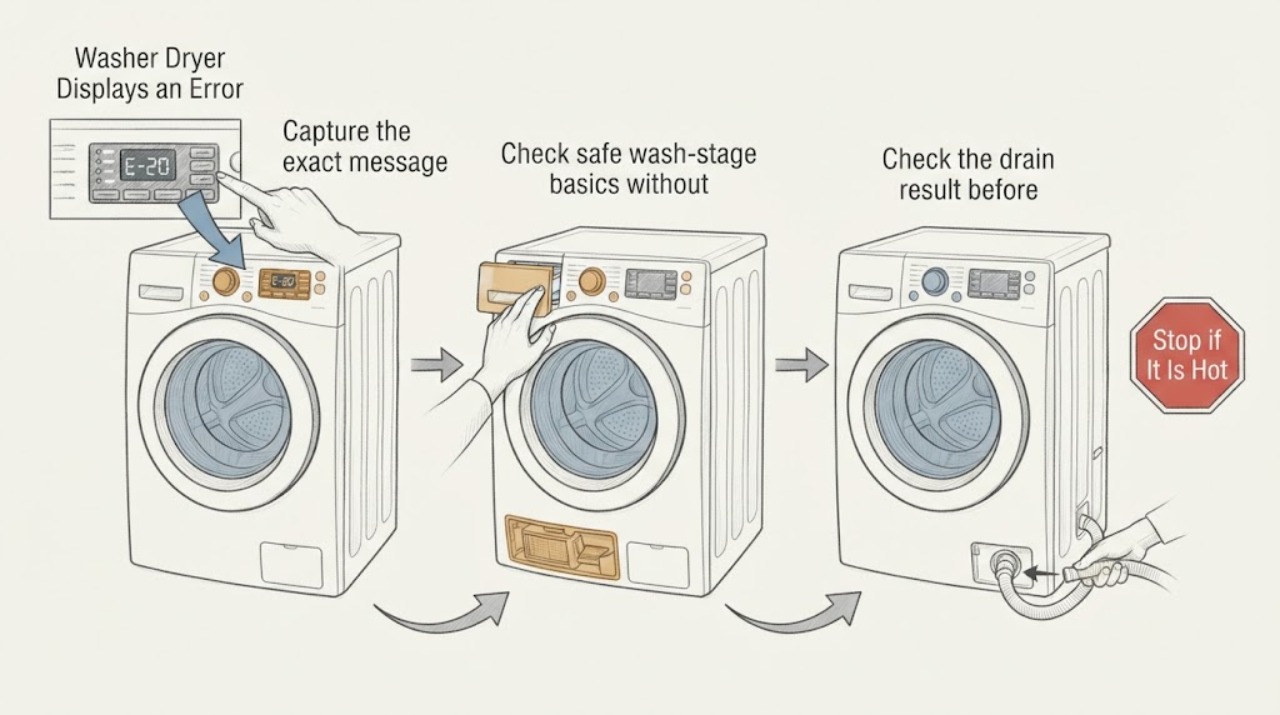
Capture the exact message and cycle stage
Photograph or write the complete display message exactly as shown, including capitalization or symbols, and record whether it appeared during filling, washing, draining, spinning, door locking, or drying. Note whether the drum contains water, whether the door is locked, and whether the unit stopped or continued safely.
Expected result: The display shows a code, a reminder such as a filter message, a cool-down message, or an unfamiliar symbol; and the event is tied to wash, drain, spin, or dry.
Next step: Use the exact model manual or manufacturer's code lookup before clearing the message. If water is leaking, the door is unsafe, smoke or odor is present, or the unit is electrically damaged, stop and arrange service immediately.
Stop if: Do not guess a code meaning, choose a code from a different model, or repeatedly restart before recording the original message.
Why this matters
Why: The exact code and phase determine which model-specific page applies. A reminder or cool-down message may not be a failure, while a code that stops a phase can indicate a door, water, drain, motor, heater, sensor, or control issue.
-
Check safe wash-stage basics without opening the appliance
If the code appears during wash or before spin, check the closed door and gasket area for trapped laundry, confirm the water taps are open and the external inlet hoses are not kinked, and look behind the unit for an accessible drain hose kink. Do not pull the machine forward if the hoses or power connection would be strained.
Expected result: Laundry blocks the gasket or door; a tap is closed; an inlet hose is bent; the drain hose is kinked; the tub will not drain; or all accessible conditions look normal.
Next step: Correct only a clearly trapped item, closed tap, or accessible hose position according to the model instructions, then use one model-approved retry. If the code returns or the tub remains full, stop and arrange service.
Stop if: Do not force the door, reach into a moving drum, remove a pump cover with water present unless the manual specifically directs a safe procedure, or open a service panel.
Why this matters
Why: Door closure or locking, water supply, and drain restrictions can prevent a wash or spin phase from completing. A normal external check does not rule out a failed lock, valve, pump, sensor, or control.
-
Check the drain result before considering a dry cycle
If the unit stopped with water present or reports a drain-related message, observe whether the accessible drain hose is kinked or visibly obstructed and whether the model provides an owner-cleanable pump filter. Keep the machine powered down while following the exact model instructions for any filter access, and do not remove a filter if doing so could release uncontrolled water or expose a hazard.
Expected result: Water drains after an accessible hose issue is corrected; water remains; the filter is blocked; the pump is silent or only hums; or the drain path looks normal but the code returns.
Next step: Leave the unit off and arrange service when water remains, the pump does not operate normally, the code returns, or the filter cannot be safely accessed. Do not start drying with a tub that has not drained.
Stop if: Do not tip the appliance, reach into standing water near a powered unit, force a filter, or disassemble the pump or drain assembly.
Why this matters
Why: A drain restriction or excess suds can keep a combo from completing wash or spin and can prevent effective drying. Persistent water or a returning drain code points toward a pump, sensor, hose, or control fault that should not be diagnosed by repeated cycles.
-
Separate a normal dry message from a dry-system fault
If the message appears during or after drying, compare it with the exact model manual and note whether the drum is periodically tumbling without heat, whether clothes are simply damp, or whether the cycle stops with a persistent code. For a ventless combo, confirm the external water supply is open and the drain hose is not holding water, using only accessible checks.
Expected result: The display indicates cool-down or another documented normal state; the load is damp but the cycle completes; the water tap or drain path is restricted; or a persistent dry, heater, temperature, or sensor code appears.
Next step: Allow a documented cool-down state to finish or use the model's normal exit instruction. Correct only an accessible water or hose condition; if the code persists, stop drying and arrange qualified service.
Stop if: Do not bypass a temperature or door safety, run a dry cycle with a fault code returning, or open the heater, sensor, or control area.
Why this matters
Why: A cool-down display can be normal, while damp loads can result from load size, spin performance, water supply, drain conditions, or a dry-system fault. A repeated heater or temperature code needs service rather than a guessed part.
-
Perform one model-approved reset only when the manual permits it
After recording the code and correcting only an obvious external condition, follow the exact model instructions for one power reset or code-clearing attempt. Use the appliance's controls and power connection as specified; do not use a reset sequence from another brand or model, and do not reset while water, smoke, heat damage, or an unsafe door condition is present.
Expected result: The message clears and the same phase completes; the message returns immediately; a different code appears; or the appliance remains locked, full, or unresponsive.
Next step: Stop resetting when the code returns or the appliance remains unsafe. Provide the original and returning codes, phase, load, water state, and prior checks to qualified appliance service.
Stop if: Do not factory-reset repeatedly, clear diagnostic history to hide the problem, or keep operating through a returning safety or heating code.
Why this matters
Why: A successful one-time reset can indicate a transient state, but recurrence or a new related code indicates an unresolved door, drain, water, motor, heater, sensor, or control condition.
-
Prepare a phase-specific service handoff
Record the complete model number, exact display message, cycle and stage, load description, water remaining, door behavior, whether the error cleared once, and any leak, odor, noise, vibration, or electrical symptom. Keep the affected wash or dry function unused if the code returns or a safety condition is present.
Expected result: The pattern is isolated to door locking, water fill, drain or spin, motor movement, dry water supply, heater or temperature, or an unknown control message.
Next step: Arrange qualified appliance service for a returning code, persistent lock or drain problem, heater or sensor message, electrical symptom, or a code that the exact manual cannot identify.
Stop if: Do not order a part from the code alone, bypass the door lock, or open internal panels to inspect a sensor or heater.
Why this matters
Why: A phase-specific record helps the technician inspect the relevant lock, inlet, drain, motor, heater, sensor, control, or installation path without repeated trial cycles.
Use your observations
Decision map
Find the observation that best matches what you see, then follow the next safe action.
-
PATH 01Next step
What you see
The exact model page identifies the display as a reminder or a normal cool-down state, and there is no leak, unsafe heat, odor, or other fault.
Do this next
Follow the model's normal exit or maintenance instruction. Escalate if the message will not clear as documented or the appliance develops a real operating fault.
Why this path and its safety boundary
Why it matters: The display is less likely to represent a failed component; it may be part of the programmed wash-dry sequence.
-
PATH 02Next step
What you see
The code appears during filling, door locking, or early wash and an item, tap, inlet hose, or door area is visibly out of position.
Do this next
Correct only the clearly accessible condition under the model instructions and make one approved retry. If the code returns, the door remains locked, or water still does not enter, arrange service.
Why this path and its safety boundary
Why it matters: A door-seal or lock condition, restricted water supply, or hose issue is more likely than a dry-system fault.
-
PATH 03Next step
What you see
The unit stops with water in the tub, a drain message returns, or it cannot complete spin before drying.
Do this next
Keep the unit off when water remains or the code returns and arrange qualified appliance service after recording the drain observations.
Why this path and its safety boundary
Why it matters: A drain hose, pump filter, pump, excess-suds, sensor, or control problem is more likely; drying should not be used as a workaround.
-
PATH 04Next step
What you see
A ventless combo reports a dry-stage problem or dries poorly while the water tap is closed, the inlet is restricted, the drain hose holds water, or the load did not spin out.
Do this next
Correct only the accessible tap, hose, filter, load, or spin condition described by the model guidance. If the dry message returns, arrange service.
Why this path and its safety boundary
Why it matters: The combo's condensation-water or drainage path, load size, or spin result is more likely than a standalone vent fault.
-
PATH 05Safety boundary
What you see
A heater, thermistor, motor, control, or unknown code returns after one model-approved reset, or the appliance remains unresponsive.
Do this next
Stop the affected function and arrange qualified appliance service with the exact code, phase, reset result, and any water or door state.
Why this path and its safety boundary
Why it matters: A component, wiring, or control fault remains possible and cannot be separated safely from external checks.
Safety stop: Do not test live components, bypass a safety interlock, or replace a heater, sensor, pump, or board solely from the code text.
Helpful context
Understand the symptom
The phase and the exact code matter
A code that appears while filling, washing, draining, or locking the door points to a different decision than one that appears during drying. Some messages are reminders or normal cool-down behavior, while others indicate a drain, door, water, heater, sensor, or motor problem. Use the exact model manual or manufacturer code page; do not transplant the meaning of a code from another brand or model.
A washer-dryer combo may need water during drying
Ventless washer-dryer combos can use water to condense moisture during the dry portion. A closed tap, reversed or restricted inlet hose, dirty inlet filter, or drain problem can therefore show up as a dry-performance or dry-stage complaint rather than a conventional vent blockage. Confirm the product type before applying standalone-dryer advice.
A code that returns is evidence, not something to erase
A model-approved power reset can clear a transient state, but it does not repair a blocked drain, failed lock, heater or sensor, water-supply restriction, wiring fault, or control problem. Record what happened before resetting. If the same code returns, follow the manufacturer's service boundary and keep the affected function out of use.
Safety boundary
Stop conditions
- Stop the cycle and seek qualified help for leaking water, smoke, burning odor, sparking, damaged power wiring, an unsafe or stuck door, repeated drain failure, or a returning heater or temperature code.
- Do not bypass a door lock, force the door, reach into a moving drum, open live panels, test live wiring, or disassemble a heater, pump, sensor, valve, or control as a homeowner diagnostic.
- Do not repeatedly reset or clear a code, use another model's code meaning, or run a dry cycle while the tub has not drained or a safety code returns.
- For a ventless combo, do not assume a dry-stage message is a conventional vent blockage; follow the exact model guidance for water supply, drain, filter, load, and spin conditions.
- Arrange qualified appliance service when the exact code is unknown, persists after one approved reset, returns in the same phase, or indicates a lock, motor, heater, sensor, control, or internal wiring issue.
Only after diagnosis
Potential parts
- washer-dryer drain pump or pump filter
Consider this category only when qualified diagnosis or a model-approved inspection confirms a persistent drain fault after accessible hose and filter checks.
Confirm the complete washer-dryer model and the technician's diagnosis; do not choose a pump from an error code alone. - washer-dryer door lock assembly
Consider this category only when a returning door or lock code persists with the door and gasket clear and qualified diagnosis identifies a failed lock or related control.
Confirm the exact model and door configuration; the lock and wiring require model-specific service. - washer-dryer inlet valve or inlet filter
Consider this category only when external tap and hose checks are normal and qualified diagnosis identifies restricted or failed water entry during wash or dry condensation.
Confirm the model, hose arrangement, and approved part specification before ordering. - washer-dryer heater or temperature sensor
Consider this category only after a returning heater or temperature code and qualified testing identify the heater or sensor as the cause.
Confirm the exact model and professional diagnosis; do not access or test heating components while energized.
When checks do not resolve it
Need a professional?
Arrange qualified appliance service when the exact code cannot be identified for the complete model, the code returns after one model-approved reset, the washer-dryer remains full or locked, the door or drain cannot be made safe, or a heater, motor, sensor, valve, control, or wiring fault is possible. Stop immediately for leaking water near power, smoke, burning odor, sparking, damaged wiring, an unsafe door, or a returning temperature or heating code. For a ventless combo, seek service when accessible water-supply and drain checks do not resolve a dry-stage message.
Safety scope: This article supports recording the exact code and phase, checking accessible door, tap, hose, load, drain, and model-approved filter conditions, recognizing documented normal messages, and performing one model-approved reset when safe. A qualified professional must handle internal door locks, pumps, heaters, thermistors, valves, motors, control boards, wiring, live tests, and any unsafe water or electrical condition.
Common questions
FAQ
Why is my washer-dryer showing an error code?
The code may indicate a door, water, drain, spin, motor, heater, sensor, control, or dry-stage condition, but its meaning depends on the exact model. Record the full message and the wash or dry phase, then use the manufacturer's model-specific code guide.
What should I check when the code appears during washing?
Record whether the door is locked, water is entering, the tub is draining, and the drain hose is kinked. Correct only an obvious accessible condition under the model manual and make one approved retry; a returning code or standing water needs service.
Why does an error appear during drying on a washer-dryer combo?
On ventless combos, drying can depend on water supply and drainage as well as the load and spin result. A closed tap, restricted inlet, drain-hose problem, heater or temperature fault, or control message can affect drying. Follow the exact model guidance rather than assuming it uses a conventional dryer vent.
Is a cool-down message an actual washer-dryer error?
Not always. LG describes the CD message on applicable combos as a cool-down state, during which the load may tumble without heat. Follow the model's normal exit instruction; seek service if the message will not clear as documented or another fault appears.
Can I reset a washer-dryer error code?
Only after recording the code and checking the model manual, and only once when there is no leak, smoke, odor, unsafe door, or electrical damage. A reset may clear a temporary state but cannot repair a blocked drain, failed lock, heater, sensor, valve, motor, or control. If the code returns, stop resetting and arrange service.
When should I call service for a washer-dryer error code?
Call when the exact code is unknown for the model, returns after one approved reset, leaves water in the tub, keeps the door locked, indicates a heater, motor, sensor, control, or drain fault, or appears with leaking, smoke, burning odor, unusual noise, or electrical damage.
Read the exact guide
Official sources
- Long Dry Time - Washer / Dryer Combo UnitLG USA Support · Official LG USA guidance for applicable ventless combo units; configuration and model-specific instructions vary.
- LG Washer – Troubleshooting An CD Display MessageLG USA Support · Official LG USA support guidance for the CD message on applicable washer-dryer combos; other model messages require the exact manual.
- LG Front Load Washer - Error Code List(New)LG USA Support · Official LG USA support library used for model-specific examples of wash and combo error handling; codes and procedures vary by product model.
- [LG Washer] Dryer Performance TroubleshootingLG USA Support · Official LG USA combo performance guidance used for accessible dry-stage checks; exact product manual controls safe access and settings.
- LG Dryer - Error Code ListLG USA Support · Official LG USA support library used for dry-stage and combo code examples; exact model manual controls the applicable message and procedure.
Community feedback
Share a repair observation
Share a plain-text repair observation. Accepted observations are published automatically; this page may take a moment to update.