
On this page
Start here
Quick answer
Do not guess what a washer-dryer combo display means from a generic code list. Record the complete code or message exactly as shown, the wash or dry stage, the door state, water level, drain behavior, load, and unusual sounds. Then use the exact model manual for low-risk checks of power, door closure, water supply, visible drain routing, and load balance. A single power reset is reasonable only when the model instructions allow it and there is no water, locked door, leak, burning smell, smoke, or electrical hazard. Stop and arrange appliance service for a persistent or unknown code, an overfill or drain problem, a door locked with water inside, repeated breaker trips, or any leak, burning odor, or smoke.
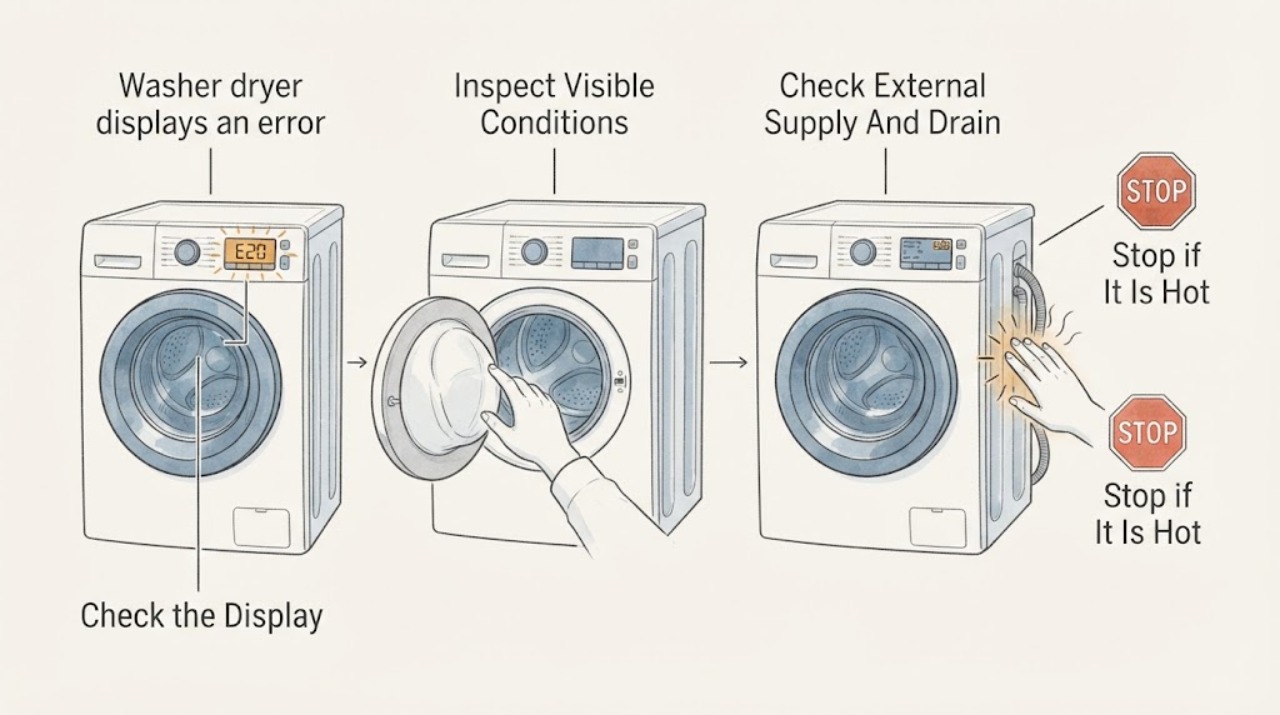
Work through in order
Diagnostic checks
Use only checks that match the exact appliance or system and its official guide.
-
Check 1
Photograph or write the complete display exactly as shown, including letters, numbers, symbols, beeps, and flashing indicators. Record whether the message appeared during fill, wash, rinse, spin, drying, or at the end, plus the model identification from a safely accessible label or paperwork.
Expected result: The message may be a true error, a maintenance reminder, a status message, or a code whose meaning changes by model; the stage often narrows which system was active.
Next step: Use the exact model manual or official support lookup to find the code. If the code is absent, ambiguous, or repeats, keep the appliance off as appropriate and provide the full record to an appliance technician.
Stop if: Stop if the display is accompanied by smoke, burning odor, arcing, a hot plug or cord, repeated breaker trips, or an unsafe wet area.
Why this matters
Why: An exact code and stage are required before consulting the model manual or requesting service. A partial code or a guessed interpretation can send the diagnosis down the wrong path.
-
Check 2
Without forcing the door, observe whether it is closed, locked, or able to open normally; note the visible water level through the door if present and look around the accessible floor and door seal for active leakage.
Expected result: A door message may occur before a cycle starts, while water remaining after a drain stage points to a different path. A wet floor, leaking seal area, or door locked with water inside changes the safety priority.
Next step: If the door is safely closed and no water or leak is present, follow only the model's normal door-closure check. If water remains, the door stays locked, or a leak is active, stop the cycle and arrange service; use the manual's safe water-isolation instruction if applicable.
Stop if: Stop immediately for an active leak, rising water, a door that will not release with water inside, a damaged seal, or any need to force the door or reach into the drum.
Why this matters
Why: Door-lock and water-state observations determine whether normal controls can be used safely. They do not justify bypassing the lock or opening a panel to release water.
-
Check 3
With the appliance stopped, inspect only the visible water-supply taps and hoses and the accessible drain hose for an obvious closed tap, kink, crushed section, disconnected end, or visible overflow. Clean an owner-accessible filter or drain component only if the exact model manual describes it and the appliance is made safe first.
Expected result: The display may occur during fill when a tap is closed or a hose is restricted, or during drain when water remains and the visible hose is kinked or obstructed. A normal external path does not rule out an internal valve, pump, sensor, or control fault.
Next step: Correct only a clearly visible, low-risk condition allowed by the manual, then follow the manual's one permitted retest. Do not remove hoses, open panels, probe a filter, or work near electrical parts without the model's explicit procedure and safe isolation.
Stop if: Stop for a burst or leaking hose, water near an outlet or power connection, an inaccessible or stuck shutoff, sewage exposure, or any need to disassemble the drain or water system.
Why this matters
Why: A visible external condition can explain a model-specific supply or drain message, while an unchanged path and persistent code require professional diagnosis rather than internal testing.
-
Check 4
Record the approximate load type and whether the drum was tightly packed, nearly empty, or mixed with one heavy item. From outside the appliance, note clicking, humming, grinding, repeated drain attempts, unusual vibration, or silence at the moment the code appeared.
Expected result: An unbalanced or overloaded load may interrupt spin, while a repeated hum without movement, grinding, or a new vibration points to a different service path. A code during drying may involve a heat or airflow condition rather than the wash load alone.
Next step: If the manual permits a normal pause and load adjustment, follow it without reaching into a moving or locked drum. If the sound is abnormal, the machine vibrates severely, or the code returns, leave the appliance off and provide the behavior record to service.
Stop if: Stop for grinding, smoke, burning odor, strong vibration, a drum that will not stop, repeated attempts to start, or a breaker that trips.
Why this matters
Why: Load and sound context helps distinguish a normal protective interruption from a recurring mechanical, motor, drain, or heating fault, but it does not identify a failed part by itself.
-
Check 5
Only when the model manual allows it and there is no water, active leak, locked door, heat, odor, smoke, or electrical concern, perform the manual's single power reset or restart sequence. Record whether the message clears before starting any cycle.
Expected result: The code may clear once after a temporary power or control interruption, or it may return immediately, return at the same stage, or be replaced by another message.
Next step: If the code stays cleared, run only the model-approved observation cycle while staying nearby and stop for any abnormal behavior. If it returns or the manual does not specify a reset, stop using the appliance and request service with the complete record.
Stop if: Stop and unplug or isolate power only as the model and safety situation permit for smoke, burning odor, electrical damage, repeated trips, active leakage, or any unsafe condition; do not repeat resets.
Why this matters
Why: A one-time clear is not proof that the underlying issue is fixed; a repeat at the same stage is stronger evidence that the model-specific fault needs service.
Use your observations
Decision map
Find the observation that best matches what you see, then follow the next safe action.
-
PATH 01Safety boundary
What you see
There is a leak, water near electricity, burning odor, smoke, arcing, hot cord or plug, repeated breaker trip, severe vibration, or a locked door with water inside.
Do this next
Stop the appliance, keep people away, make water or power safe only when the normal shutoff is accessible without contact with a hazard, and arrange urgent appliance service.
Why this path and its safety boundary
Safety stop: Do not restart, bypass the lock, open panels, or continue a cycle after a safety hazard appears.
-
PATH 02Safety boundary
What you see
The complete code is listed for the exact model and its instructions identify a low-risk external check.
Do this next
Follow only that model-specific check, then perform at most the permitted retest and record the result.
Why this path and its safety boundary
Safety stop: Do not apply another model's code meaning or procedure to this washer-dryer combo.
-
PATH 03Safety boundary
What you see
The code occurs during fill, drain, or spin and the visible water, hose, door, or load observation points to a clear condition allowed by the manual.
Do this next
Correct only that visible condition under the exact manual and observe one normal retest.
Why this path and its safety boundary
Safety stop: Do not disassemble valves, pumps, heaters, locks, or control electronics to continue the diagnosis.
Helpful context
Understand the symptom
An error display is a symptom, not a diagnosis. Washer-dryer combos use different messages for door locking, water supply, draining, load balance, motor or sensor conditions, heating, and communication. The same letters can mean different things on different models, so the full code, stage, and model identity are more useful than a remembered abbreviation.
Keep the checks external and model-led. Do not open panels, reach into a locked drum, test live wiring, bypass a door lock, or disassemble a pump, valve, heater, or control. If a manual calls for cleaning an accessible filter or checking an external hose, follow that manual's sequence and make the water and power safe first.
The goal is to give a technician a reproducible event record: what the display said, when it appeared, what the machine was doing, whether water remained, and what changed after the model-approved reset. That record helps separate a transient control state from a recurring door, fill, drain, load, motor, or sensor fault without replacing a part by guesswork.
Only after diagnosis
Potential parts
- washer dryer control board
Consider this category only after the exact model code and a professional diagnosis point to the control board; a generic display error is not enough.
Match the complete model and revision information to the manufacturer's fit and programming requirements before ordering. - washer dryer door lock
Consider this category only when the exact model code and door-state evidence support a failed lock or latch after safe external checks.
Confirm model-specific fit and safety interlock compatibility; do not bypass or replace the lock as a generic fix. - washer dryer drain pump
Consider this category only when a persistent model-specific drain condition and professional testing identify the pump rather than the hose, filter, sensor, or control.
Verify the exact model, pump design, and electrical ratings before ordering; keep water and power isolation within the model-approved or professional procedure.
When checks do not resolve it
Need a professional?
Request appliance service for an unknown or recurring code, a code that persists after the model-approved low-risk check, a locked door with water inside, active leaking, fill or drain failure, unusual grinding or vibration, repeated breaker trips, burning odor, smoke, or any need to access internal parts.
Have this ready
- Provide the exact model, complete display text or photo, cycle stage, door and water state, visible supply and drain observations, load, sound, leak or odor history, recent power event, and the result of the one permitted reset if one was safe to perform.
Common questions
FAQ
Can I use a generic washer error-code list for my combo machine?
Use the exact model manual or official support page. Codes and procedures can differ by model, and a partial or guessed code can point to the wrong system.
What should I record before requesting washer-dryer service?
Record the complete display, cycle stage, model, door and lock state, visible water level, leaks, drain behavior, load, sounds, recent power event, and whether one model-approved reset changed the message.
Is it safe to reset a washer-dryer combo?
Only use the exact model's permitted reset when there is no water, active leak, locked door, heat, burning odor, smoke, or electrical concern. Perform it once, observe the result, and do not repeat resets when the code returns.
When should I stop using the appliance?
Stop for leaking water, water near electricity, a locked door with water inside, burning odor, smoke, sparks, repeated breaker trips, severe vibration, grinding, or an unknown or persistent code. Arrange qualified appliance service.
Read the exact guide
Official sources
- LG Washer - Error Code ListLG Electronics · Use only for LG models covered by the page; it demonstrates the need to match the exact model and code rather than generalizing.
- GE Profile UltraFast Combo Washer/Dryer - Fault & Error Codes and Status MessagesGE Appliances · A model-family example; use the exact appliance model documentation for the applicable message and steps.
- Error Codes - All-In-One Washer DryerWhirlpool · Use the model number to locate the correct manual and code entry; do not transfer a Whirlpool code meaning to another brand.
- How to fix error codes in Front Load Washer Dryer ComboSamsung · An official manufacturer example showing that codes differ by model and that persistent codes require support; use the exact model manual for any procedure.
Community feedback
Share a repair observation
Share a plain-text repair observation. Accepted observations are published automatically; this page may take a moment to update.