
On this page
Start here
Quick answer
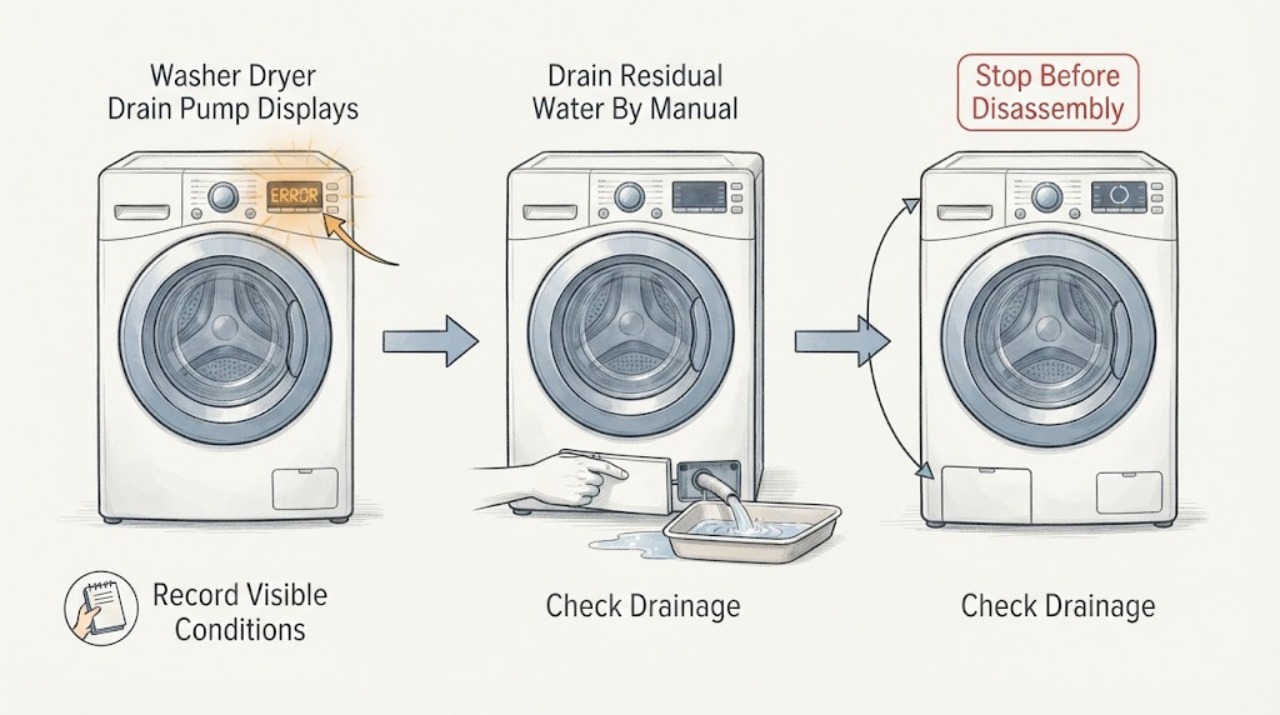
A washer dryer that displays a drain-pump error is usually reporting that water took too long to leave the drum, but the code alone does not identify a failed pump. Stop the programme and disconnect power before opening any pump-filter access; residual water can be hot, and opening the door while water is visible can spill it. Record the exact code, inspect the exposed drain hose and external drain for kinks or backflow, then follow the model manual to drain residual water and clean the pump filter if that access is provided. A filter or hose blockage that clears may restore operation. If the pump hums without moving water, makes a grinding sound, leaks after filter work, the error returns, or the pump has no safe user-service access, stop and arrange appliance service rather than replacing a pump by guesswork.
Work through in order
Diagnostic checks
Use only checks that match the exact appliance or system and its official guide.
-
Check 1
Note the exact display message, stop the programme, switch the washer dryer off, and disconnect its power before touching a filter, residual-water hose, or drain connection. Keep the door closed if water is visible through the glass or the machine is still hot.
Expected result: The code is a drain or pump message, the drum contains water, the door is locked, the load or glass is hot, or the appliance has a burning smell, smoke, or damaged power cord.
Next step: For a cool, stable appliance, continue only with the model manual. For smoke, burning odor, damaged wiring, or an unsafe hot or flooded area, keep power disconnected and arrange urgent qualified service.
Stop if: Do not force the door, reach into moving water, tilt the appliance, or reconnect power while water is contacting electrical parts.
Why this matters
Why: A drain-related code narrows the first checks to the drainage path, but water level and temperature create spill and scald risks. Burning, smoke, or electrical damage is an appliance-safety stop rather than a filter-cleaning task.
-
Check 2
With power disconnected and the water safe to handle, locate the model-specific residual-water hose or pump-filter access described in the owner's manual. Place a shallow container under the outlet, drain slowly, and keep the hose and cap controlled so water cannot run into the appliance or onto electrics.
Expected result: Water drains freely, only a small amount drains, the hose is blocked, the water is hot, no documented access exists, or removing the cover would require moving or opening the cabinet.
Next step: When the model procedure is available and the water has drained, continue to the documented filter inspection. Otherwise close the appliance, keep it disconnected, and call service with the code and remaining-water observation.
Stop if: Do not loosen an unidentified hose, open a filter while the tub is full, pour water into the machine, or use a tool to force a blocked cap.
Why this matters
Why: Free residual drainage supports a downstream filter, hose, or pump check. Little or no drainage can mean an obstruction or a different internal layout; hot water, absent access, or unsafe cabinet work means the user-level procedure has reached its boundary.
-
Check 3
Inspect the exposed drain hose from the washer dryer to the standpipe, laundry sink, or drain connection. Straighten an obvious kink, confirm the hose has not slipped out, and look for external drain backflow or a loose connection without pushing a tool into the hose or drain.
Expected result: The hose is kinked or compressed, the hose has slipped out, water backs up at the standpipe or sink, the drain connection is loose, or the hose and external drain appear open.
Next step: Correct only the obvious hose position or secure connection allowed by the installation instructions, then proceed to the model-specific filter check. Arrange plumbing help for a blocked standpipe, sink, or recurring backflow.
Stop if: Do not seal the hose into the drain with tape, force a snake into the appliance hose, dismantle plumbing, or run repeated cycles into a backing-up drain.
Why this matters
Why: A kink or loose hose can restrict flow or spill water. Backflow at the standpipe or sink points to an external drain restriction rather than proving the pump is defective. An open-looking path keeps the filter, pump, or internal hose in focus.
-
Check 4
If the owner's manual identifies a user-accessible drain-pump filter, drain residual water first, remove the filter only as directed, clear lint and foreign objects, inspect the filter opening for debris without forcing the impeller, and reinstall the filter, hose cap, and access cover fully.
Expected result: Lint, a small object, or residue blocks the filter; the filter is clear; the cap or filter was not fully seated; water leaks from the access cover; or the model has no user-accessible filter.
Next step: If debris was removed and all seals are correctly seated, keep the appliance empty and proceed to one controlled drain or spin test only if the manual permits. If the filter is clear, leaks, or is inaccessible, stop and arrange service.
Stop if: Do not open the filter with a full or hot tub, run the pump without the filter, force the filter, reach into a powered pump, or substitute a generic filter.
Why this matters
Why: Debris can restrict the drain pump, while an incorrectly reassembled cap or filter can cause a new leak. A clear filter or absent access does not rule out a blocked internal hose, pump fault, wiring issue, or external drain problem.
-
Check 5
After the drain path is reassembled, the appliance is dry, and the manual permits a test, run one empty drain or spin programme while watching the external hose and listening from outside the cabinet. Be ready to stop if water backs up, leaks, or the error returns.
Expected result: Water exits with a steady flow and the code clears, the pump hums but little water exits, the pump is silent, the pump grinds, the code returns, or a leak appears.
Next step: If the test succeeds, run only the model-recommended confirmation cycle and monitor. For weak or absent flow, abnormal noise, a returned code, or leakage, disconnect power and arrange appliance service.
Stop if: Do not repeat tests to force drainage, probe the pump while powered, bypass the door lock, or continue after a leak, burning smell, breaker trip, or abnormal noise.
Why this matters
Why: Steady flow with no recurring code supports a cleared restriction. Humming without flow can indicate a remaining blockage or pump problem; silence can indicate control, wiring, or pump failure; grinding, recurring errors, or leakage require service rather than more cycles.
-
Check 6
Record the model and serial information, exact error text, whether water remained in the drum, filter and hose findings, pump sound, external drain behavior, any leak location, and whether the error returned after the permitted test. Use this record when requesting appliance or plumbing service.
Expected result: The error returns after the filter and hose are clear, the pump is noisy or silent, the drain works only into a container, the external drain backs up, the appliance leaks, or the cause remains uncertain.
Next step: Keep the washer dryer out of service for recurring errors, leaks, or unsafe symptoms. Give the record to an appliance technician, and involve a plumber when the external drain backs up or causes backflow.
Stop if: Do not order a pump from the error text alone, open the cabinet, test live wiring, bypass safety devices, or continue using an appliance that leaks or trips power.
Why this matters
Why: A returned error or abnormal pump behavior keeps an internal pump, wiring, control, or hose fault possible. Drainage into a container with backup at the building drain points to plumbing. Leakage after filter work can come from an incorrectly seated cap or another appliance leak.
Use your observations
Decision map
Find the observation that best matches what you see, then follow the next safe action.
-
PATH 01Next step
What you see
The exact model procedure finds debris in the pump filter or a kinked hose, the path is restored and correctly reassembled, and one permitted empty drain test completes with steady flow and no error.
Do this next
Use the model's confirmation cycle once, monitor for leaks or a returned code, and stop using the machine if the drain error recurs.
Why this path and its safety boundary
Why it matters: A restricted drain path was more likely than a failed pump, although the result does not prove the pump will remain reliable under a full load.
-
PATH 02Next step
What you see
Water exits the washer-dryer drain hose during the model-approved test but backs up at the standpipe, laundry sink, or nearby drain.
Do this next
Stop running cycles into the backing-up drain and arrange plumbing service to clear or inspect the external drain. Keep the appliance off if water can reach the floor or electrical equipment.
Why this path and its safety boundary
Why it matters: The washer dryer is moving water, while the external drain or connection is restricting flow or causing backflow; this is not enough evidence to condemn the pump.
-
PATH 03Next step
What you see
The drain pump hums during one controlled test, but little or no water exits and the external hose is not kinked or backed up.
Do this next
Disconnect power and arrange appliance service unless the model manual provides a further safe, user-accessible check. Do not reach into the pump or replace it based on sound alone.
Why this path and its safety boundary
Why it matters: A remaining filter, internal hose, or pump obstruction is possible; a worn or damaged pump may also fail to move water even though its motor makes sound.
-
PATH 04Next step
What you see
The filter and exposed hose are clear, the pump is silent or the error immediately returns, or the appliance shows a different recurring display.
Do this next
Keep the appliance disconnected and request an appliance technician with the exact code and model information. Do not perform live electrical tests or bypass safety controls.
Why this path and its safety boundary
Why it matters: An internal pump, wiring, control, sensor, or model-specific fault remains possible. A different display must be interpreted from the exact appliance manual, not mapped to a generic code list.
-
PATH 05Next step
What you see
Water leaks from the filter access, hose, rear, or underside; residual water is hot; smoke or a burning odor appears; or water reaches electrical equipment.
Do this next
Disconnect power only from a dry, safe location, close the washer's water taps if accessible without entering water, keep the appliance out of service, and arrange urgent qualified service.
Why this path and its safety boundary
Why it matters: The appliance has a water-damage, scald, or electrical hazard in addition to the displayed error. Continuing to test can spread water or create a shock or fire risk.
Helpful context
Understand the symptom
The displayed error is a drainage symptom, not proof that the pump motor is bad
Washer-dryer brands use different code names and thresholds. A drain-pump message can result from a blocked filter, kinked or blocked hose, frozen hose, obstructed external drain, or a pump that cannot move water. Start with the exact model manual and the simplest safe observations; do not infer a pump replacement from a generic code or from a humming sound alone.
Residual water changes the safe order of work
Turn the appliance off and disconnect power before opening a lower access panel. Keep a shallow container and towels ready, and assume residual water may be hot. The door can remain locked when water level or temperature is high; use only the model's documented drain or emergency-release procedure after water has been made safe to handle.
A drain-pump error can be outside the washer
If water exits the drain hose during a controlled model-approved test but backs up at the standpipe or laundry sink, the appliance may be pumping and the external drain may be restricted. A loose hose can spill during draining, and a clogged drain can create backflow that looks like a washer leak. Correct only an obvious hose-position problem; plumbing blockages and recurring backflow need the appropriate service professional.
Safety boundary
Stop conditions
- Stop and disconnect power before opening a drain-pump filter or residual-water access. Keep the door closed when water is visible or hot. Stop troubleshooting for a recurring error after the documented filter and hose checks, no pump flow, abnormal pump noise, a leak, smoke, burning odor, damaged cord, breaker trip, water near electrics, or any cabinet/internal wiring work. Do not bypass the door lock, probe a powered pump, force a cap or impeller, run repeated cycles into a backing-up drain, or order a replacement pump from a generic error message.
Only after diagnosis
Potential parts
- drain pump filter
Consider this only if the model manual identifies a replaceable filter and inspection finds a damaged, missing, or sealing-compromised filter rather than removable debris.
Filter shape, thread, seal, and access vary by model; confirm the washer-dryer model and manufacturer documentation before selecting a component. - drain pump assembly
Consider this only after a qualified technician confirms that the drain path is clear and the pump fails to move water or has an electrical or mechanical fault.
Confirm the exact model, pump specification, connector, mounting, and manufacturer fit information; a drain error alone does not establish pump compatibility or failure. - drain hose
Consider this only when inspection finds a split, collapsed, obstructed, or incorrectly sized hose that cannot be safely corrected by repositioning.
Verify model routing, connection diameter, length, and installation requirements before replacement; do not use a hose that creates kinks or an unsafe drain connection. - pump-filter cap or residual-water hose seal
Consider this only if a correctly cleaned and reassembled filter access still leaks and a technician confirms a damaged cap, plug, or seal.
Confirm the model-specific cap, plug, and seal design; incorrect reassembly can cause leaks, so replacement does not replace the required sealing check.
When checks do not resolve it
Need a professional?
Call an appliance technician when the drain-pump error returns after the model-approved hose and filter checks, the pump is silent or only hums without flow, a foreign object cannot be removed safely, the filter access leaks, the machine shows a different recurring code, or the pump is not user-accessible. Call a plumber when the washer hose flows but the standpipe, sink, or external drain backs up. Use urgent service for hot water, smoke, burning odor, damaged wiring, or water near electrics.
Have this ready
- Provide the washer-dryer brand and model, exact display message, programme and load state, remaining-water level, filter and hose observations, pump sound, photos of any leak from a dry position, and whether water flowed from the hose or backed up at the external drain.
Common questions
FAQ
What does a drain-pump error on a washer dryer usually mean?
It usually means the appliance could not drain within its expected process, not that the pump is definitely defective. A kinked or blocked hose, clogged filter, frozen hose, external drain restriction, internal obstruction, or pump fault can produce similar messages. Record the exact code and follow the model manual.
Should I unplug the washer dryer before cleaning the drain-pump filter?
Yes. Switch the appliance off and disconnect power before opening a documented pump-filter or residual-water access. Drain slowly into a container and assume the water may be hot. Do not open the door or filter when water is visible or the machine is hot unless the model procedure makes it safe.
How do I know whether the washer dryer or the household drain is blocked?
Only use the model-approved test. If water flows from the appliance drain hose but backs up at the standpipe or sink, the external drain is more suspect. If little or no water leaves the hose after the filter and hose checks, the pump, internal hose, or appliance controls remain possible causes.
Can I clean the drain-pump filter on any washer dryer?
No. Filter access and residual-water procedures vary by model, and some appliances do not provide the same user-accessible filter. Use the exact owner's manual. If the access is missing, difficult to reach, full of hot water, or requires cabinet work, arrange service.
What if the drain pump hums but the washer dryer still shows the error?
Humming shows that a motor or electrical circuit may be active, but it does not prove that water is moving. A remaining obstruction, blocked internal hose, or worn pump can still prevent drainage. Disconnect power and arrange service if little water exits or the error returns; do not reach into the pump.
Why does the washer dryer leak after I clean the pump filter?
A residual-water hose cap, pump-filter cap, or seal may not be fully seated, or the drain hose or external drain may be loose or backing up. Disconnect power, stop using the appliance, and inspect only the documented external reassembly from a dry position. Persistent leakage needs service.
When should I replace the drain pump?
Do not replace it from the error text alone. A technician should first confirm that the filter, internal and external hoses, standpipe, and pump controls are not the cause. A pump becomes a conditional replacement only when the drainage path is clear and the pump is confirmed to have a mechanical or electrical fault for the exact model.
Read the exact guide
Official sources
- Cleaning the Drain Pump FilterWhirlpool · Official Whirlpool support stating that filter access depends on model and describing power disconnection, residual-water collection, filter cleaning, and full reassembly.
- Not Draining - Front Load WasherWhirlpool · Official Whirlpool support explaining filter blockage, drain-hose routing, siphoning, standpipe conditions, and the difference between appliance drainage and installation-related drainage problems.
- Instruction Manual and Installation InstructionsBosch Home · Official washer-dryer manual showing that a drain-pump blocked message directs the user to clean the drain pump and drainage hose, while recurring displays require customer service and water or temperature can make opening the door unsafe.
- [LG Front Load Washing Machine] Troubleshooting LeaksLG Electronics · Official LG support explaining that leaks can follow incorrectly reassembled filter access, loose or detached drain hoses, clogged external drains, or backflow during draining.
- Clean Filter - Error Code - Compact Front Load WasherWhirlpool · Official Whirlpool support identifying kinked, blocked, or frozen drain hoses, blocked filters, and blocked pumps as possible causes of a clean-filter or drain-pump error, with manual-based filter cleaning and service escalation.
- [LG Washing Machine] Water Not Draining (OE Error)LG Electronics · Official LG support for washer-dryer combos and washers identifying clogged pump filters, kinked hoses, frozen hoses, residual-water precautions, external drain checks, and service escalation.
Community feedback
Share a repair observation
Share a plain-text repair observation. Accepted observations are published automatically; this page may take a moment to update.