
On this page
Start here
Quick answer
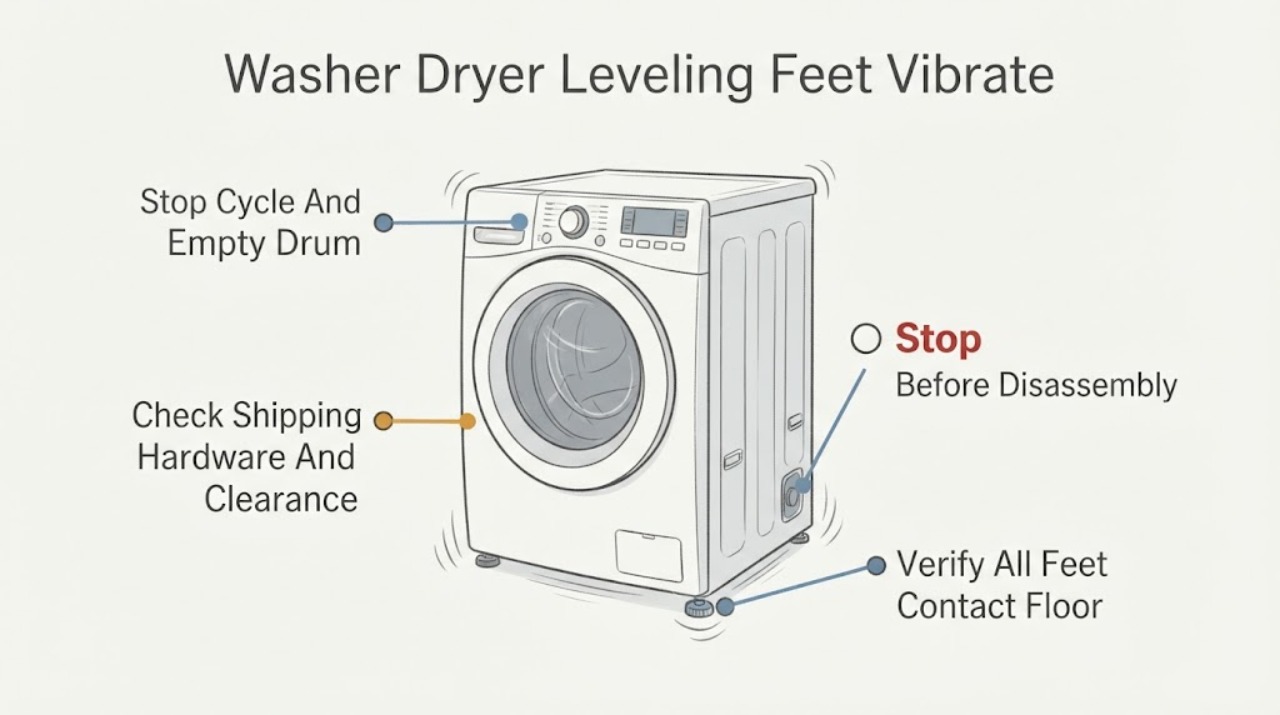
If a washer dryer vibrates because its leveling feet are not stable, stop the cycle and make sure the machine is on a firm, clean, level floor with every foot making firm contact. Check the leveling feet and lock nuts while the drum is empty, use a level across the top, and adjust only as the model's installation instructions allow; do not lift or tilt a heavy appliance alone. A foot that moves, a machine that rocks diagonally, a loose pedestal, leftover shipping hardware, a flexing floor, or a single bulky or overloaded load can all produce vibration. After the feet are secured, run one light, balanced test. If the machine still bangs, walks, vibrates with an empty drum, damages the floor, or shows drum, suspension, or bearing symptoms, stop using it and arrange appliance service.
Work through in order
Diagnostic checks
Use only checks that match the exact appliance or system and its official guide.
-
Check 1
Stop the programme, wait for the drum to stop, and remove the laundry when it is safe. Disconnect power before reaching around the feet or moving the appliance; keep the door closed if the drum is still rotating or the load is hot.
Expected result: Vibration occurs only during spin, the appliance walks across the floor, the cabinet hits a wall, the drum is still moving, or the cord and floor are wet or damaged.
Next step: Keep the appliance stopped while checking an empty, dry installation. If the floor, cord, or appliance is damaged, isolate power from a dry safe location and arrange service.
Stop if: Do not hold the cabinet during spin, reach into a moving drum, drag a heavy machine alone, or reconnect power near water.
Why this matters
Why: Spin-only vibration is commonly affected by load balance and installation stability. Walking, impact, wet electrics, or a moving drum adds safety and damage risk and should not be tested repeatedly.
-
Check 2
If the vibration began after installation or moving the washer dryer, inspect the exterior for shipping bolts, retainers, or packing material still installed, and check that the cabinet is not pressed against a wall, pipe, or neighboring appliance. Use the exact installation manual before removing any hardware.
Expected result: Shipping hardware remains, packing is caught under the unit, the cabinet touches another surface, or the installation is clear.
Next step: Remove only the documented shipping material with the model procedure and restore required clearance. Do not operate the appliance until the hardware and packing are correctly addressed.
Stop if: Do not remove cabinet panels, cut unknown restraints, force the tub, or pull a stacked or pedestal unit away from the wall without help and the installation instructions.
Why this matters
Why: Shipping hardware or packing can restrain the tub and cause severe vibration or damage. Contact with a wall or appliance can transmit vibration and prevent the cabinet from settling correctly. A clear installation shifts attention to feet, floor, load, or internal support.
-
Check 3
With the drum empty and the appliance in its final position, press gently across opposite top corners to see whether the cabinet rocks. Look at each leveling foot and lock nut without putting fingers under the machine; all feet should be firmly and evenly supported according to the model installation instructions.
Expected result: The cabinet rocks diagonally, one foot has a visible gap, a foot turns or lock nut is loose, all feet are firm, or the unit is on a pedestal or drip pan.
Next step: For a freestanding unit, follow the manual to adjust the affected foot and secure its lock nut. For a pedestal, stacked unit, or drip pan, use that installation's instructions or arrange service if the support arrangement is unclear.
Stop if: Do not place loose objects under a foot, reach beneath the cabinet, loosen every foot at once, or lift the appliance alone.
Why this matters
Why: Rocking or a gap means the load is not supported evenly and the leveling feet need adjustment. A loose lock nut can let a correct setting change. Pedestals and drip pans alter which feet support the load and cannot be treated as a standard freestanding setup.
-
Check 4
Place a level across the top of the empty washer dryer from side to side and front to back. With a second person and the model procedure providing the safe support method, adjust the leveling feet in small increments until the cabinet is level and stable, then tighten each foot's lock nut against the base as specified.
Expected result: The bubble remains off-center, the cabinet still rocks after adjustment, the lock nut will not secure, the floor is uneven or slippery, or the cabinet becomes stable and level.
Next step: Recheck the manual and foot contact rather than overextending a leg. If the floor is flexing, sagging, slippery, or outside the installation requirements, stop and obtain an appropriate installation or appliance assessment.
Stop if: Do not raise the unit beyond the manual's allowance, use improvised shims, tip a stacked appliance, or continue if the machine could fall.
Why this matters
Why: An off-center level or remaining rocking means the feet or supporting surface still need correction. A lock nut that will not hold, a damaged foot, or an unsuitable floor is not fixed by repeatedly turning the same leg. A stable level cabinet supports a controlled test.
-
Check 5
After the empty machine is level, inspect the supporting floor for flex, sagging, moisture, or a slippery surface. For a test load, avoid overloading and do not run one heavy bulky item alone; distribute items loosely according to the model capacity and programme instructions.
Expected result: The floor flexes, the unit slips, vibration is only with one bulky item, the load is tightly packed, or vibration remains with a light balanced load.
Next step: Correct only the documented floor or load issue, then perform one controlled test. Do not add a random pad or platform unless the installation instructions approve it; persistent vibration needs service.
Stop if: Do not exceed the model's load instructions, operate on a wet or unstable floor, or use a raised platform or anti-vibration product as a substitute for leveling.
Why this matters
Why: A flexible or slippery floor can amplify movement even when the feet are set correctly. A single bulky or tightly packed load can be unbalanced. Vibration with a light balanced load keeps installation, pedestal, shipping material, or an internal support problem possible.
-
Check 6
With the feet locked, clearance restored, and the installation dry, run one light, balanced wash or spin test while observing from outside. Stop immediately for walking, cabinet impact, scraping, loud repeated banging, abnormal mechanical noise, or a new leak.
Expected result: The test is smooth, vibration is reduced but not gone, the cabinet walks, vibration occurs with an empty drum, the drum makes a new noise, or the foot setting shifts.
Next step: If the test is smooth, monitor after the next move or load change. For recurring or empty-drum vibration, walking, impact, or mechanical noise, stop using the appliance and arrange qualified appliance service.
Stop if: Do not keep running cycles to see whether severe vibration settles, open the cabinet, test suspension parts, or continue after a leak, burning odor, or breaker trip.
Why this matters
Why: A smooth test supports a corrected installation or load issue. Residual or worsening vibration after leveling can indicate a flexing floor, pedestal problem, tub imbalance, suspension or bearing wear, or another internal fault. A foot that shifts needs a secure installation check.
Use your observations
Decision map
Find the observation that best matches what you see, then follow the next safe action.
-
PATH 01Next step
What you see
The empty washer dryer rocks diagonally, one foot has a gap, or a leveling-foot lock nut is loose, and the floor is otherwise firm and dry.
Do this next
Adjust the affected feet according to the model installation instructions, confirm all required feet contact the floor, tighten the lock nuts, and run one light test.
Why this path and its safety boundary
Why it matters: Uneven foot contact or a setting that has shifted is more likely than an internal fault.
-
PATH 02Next step
What you see
Vibration began after delivery or relocation, shipping bolts or packing remain, or the cabinet is pressed against a wall or another appliance.
Do this next
Keep the machine stopped, follow the exact installation procedure to remove shipping material and restore clearance, and obtain help for a heavy, stacked, or pedestal unit.
Why this path and its safety boundary
Why it matters: Installation restraint or contact is more likely than a worn internal component and can cause severe vibration if the appliance is operated.
-
PATH 03Next step
What you see
The feet are adjusted and locked but the floor flexes, the unit slips in a pan, the pedestal moves, or the support arrangement differs from the freestanding instructions.
Do this next
Stop if the unit can move or fall. Use the pedestal, drip-pan, flooring, and anchoring instructions for the exact model, or arrange installation service rather than adding loose blocks or a random platform.
Why this path and its safety boundary
Why it matters: The supporting surface or pedestal is transmitting movement or failing to support the appliance evenly; adjusting the appliance feet alone may not solve it.
-
PATH 04Next step
What you see
The cabinet is stable and level when empty, but vibration appears with a single bulky item, a tightly packed load, or a load that collects on one side.
Do this next
Stop the cycle, redistribute or reduce the load according to the manual, and use one light balanced confirmation load. Arrange service if vibration persists with balanced loads.
Why this path and its safety boundary
Why it matters: Load imbalance or overloading is more likely than a leveling-foot fault, although repeated imbalance can still damage the appliance.
-
PATH 05Next step
What you see
The washer dryer is level with all feet firmly supported, shipping materials are removed, the load is light and balanced, but it still walks, bangs, scrapes, or vibrates with an empty drum.
Do this next
Stop operating the appliance and arrange qualified appliance service. Provide the technician with the empty-drum result, foot and lock-nut observations, floor type, installation configuration, and any new noise.
Why this path and its safety boundary
Why it matters: A floor, pedestal, tub-support, suspension, bearing, drum, or other internal problem is more likely than a simple foot adjustment.
Helpful context
Understand the symptom
Vibration can be an installation problem or a load problem
A washer dryer can move when one leveling foot is not carrying weight, a lock nut has loosened, the floor flexes, or the unit is touching a wall. The spin load matters too: a tightly packed or single bulky load can become unbalanced even when the feet are correctly set. Start with an empty, powered-off machine so the foot and floor checks are not confused with a laundry-balance problem.
Freestanding and pedestal installations are not adjusted the same way
A freestanding washer dryer generally needs all appliance feet firmly on the floor. A pedestal installation may use pedestal feet and lock nuts, with the appliance feet arranged according to that model's installation instructions. Do not improvise blocks under a foot, remove pedestal hardware, or adjust a stacked appliance without the manual and appropriate help.
Persistent empty-drum vibration is a service boundary
If the unit remains level and stable but vibrates with no laundry, or if it bangs, walks, scrapes, or produces a new mechanical noise, the cause may be inside the tub or support system. Do not open the cabinet or test moving parts. Keep the appliance out of service and provide the technician with the load, foot, floor, and installation observations.
Safety boundary
Stop conditions
- Stop the cycle before checking feet, and disconnect power before reaching around the appliance or moving it. Do not lift or tilt a heavy, stacked, or pedestal washer dryer alone; do not reach beneath the cabinet, remove unknown shipping restraints, use loose objects under a foot, or operate on a wet or unstable floor. Stop using the machine for severe walking, cabinet impact, empty-drum vibration, scraping or mechanical noise, a foot or pedestal that will not stay secure, visible damage, a leak, burning odor, cord damage, or a breaker trip. Persistent vibration after correct leveling and a balanced test needs qualified appliance service.
Only after diagnosis
Potential parts
- washer dryer leveling foot
Consider this only if inspection confirms a bent, stripped, cracked, or missing leveling foot after the model's installation checks show that the foot cannot hold a stable setting.
Confirm the exact appliance model, thread, height range, base interface, and manufacturer fit information before selecting a foot; a loose setting may instead require adjustment or a lock-nut repair. - leveling-foot lock nut
Consider this only if the correct leveling adjustment is repeatedly lost because the model-specific lock nut or retaining hardware is damaged.
Verify the exact thread and retaining design for the appliance; do not substitute a generic nut that cannot secure the foot against the cabinet. - pedestal support hardware
Consider this only when a pedestal installation has confirmed loose or damaged mounting hardware and the model instructions identify the required replacement.
Pedestal hardware and foot arrangements are model-specific; confirm the pedestal and appliance pairing before replacement, and do not use hardware to compensate for a damaged floor. - washer suspension or tub-support component
Consider this only after a qualified technician confirms that vibration persists with a level, stable, correctly loaded machine and identifies an internal support fault.
Suspension and tub-support components require model-specific diagnosis and fitment; do not order one from vibration symptoms alone or access moving parts as a home test.
When checks do not resolve it
Need a professional?
Call appliance service when the washer dryer vibrates with an empty drum after all feet are level and locked, shipping material is removed, and the floor and load are appropriate; when the unit walks, bangs, scrapes, or makes a new mechanical noise; when a pedestal or stacked installation is unstable; or when a foot, lock nut, floor, or cabinet is damaged. Obtain installation help if moving or leveling the unit cannot be done safely with appropriate assistance.
Have this ready
- Provide the washer-dryer model, whether shipping hardware was removed, foot and lock-nut positions, level and rocking results, floor and pedestal or drip-pan configuration, load pattern, whether vibration occurs empty, and photos or video from a safe distance showing the movement.
Common questions
FAQ
Can loose leveling feet make a washer dryer vibrate?
Yes. If one foot has a gap, the cabinet rocks diagonally, or a lock nut has loosened, the machine may not be supported evenly during spin. With the drum empty and power disconnected, adjust the feet according to the model installation instructions and secure the lock nuts before testing.
How do I check whether a washer dryer is level?
Empty the drum, place a level across the top in both directions, and gently press opposite top corners to check for rocking. All required feet should contact the floor firmly. Do not put fingers under the cabinet or lift a heavy unit alone; use the model's installation procedure.
Should the washer dryer leveling feet be locked after adjustment?
Yes, when the model uses lock nuts, secure them against the cabinet or support as specified by the installation instructions. A foot that is correctly adjusted but not locked can shift and allow the machine to rock again.
Why does my washer dryer vibrate only with one blanket or bulky item?
A single bulky item can collect on one side and become unbalanced during spin, even when the feet are level. Stop the cycle, redistribute or reduce the load according to the manual, and use a light balanced confirmation load. Persistent vibration with balanced loads needs service.
Could shipping bolts cause vibration after installing a washer dryer?
Yes. Shipping bolts, retainers, or packing material can restrain the tub and cause severe vibration or noise. If vibration began after delivery or relocation, keep the machine stopped and follow the exact installation manual to identify and remove the documented shipping material.
Is a flexible floor enough to cause washer dryer vibration?
Yes. A flexing, sagging, slippery, wet, or otherwise unsuitable floor can amplify movement even when the feet are adjusted. Do not improvise a platform or loose pad; check the installation requirements and arrange installation help if the floor cannot safely support the machine.
When should I call for service instead of adjusting the leveling feet?
Call when the machine still walks, bangs, scrapes, or vibrates with an empty drum after the feet are level and locked, shipping material is removed, and the floor and load are appropriate. Also call for a damaged foot, unstable pedestal or stacked installation, new mechanical noise, cabinet damage, or a condition that would require opening the appliance.
Read the exact guide
Official sources
- What to do if your washing machine is noisy or vibratingSamsung · Official Samsung support explaining solid-floor and shipping-bolt checks, four-foot leveling and lock nuts, calibration, balanced loads, and service escalation for persistent movement or damage.
- Leveling a Front Load WasherWhirlpool · Official Whirlpool installation support explaining firm contact of all feet, diagonal rocking checks, pedestal-specific support, solid flooring, and tightening lock nuts.
- Washer Walking and/or Vibrating - Front Load WasherWhirlpool · Official Whirlpool support identifying shipping material, foot contact, levelness, floor flex, overload, and bulky single loads as distinct vibration checks and directing users to service when needed.
- [LG Front load washing machine installation] How can I do a level installation and adjust the level of the machine?LG Electronics · Official LG support for washer dryer combos and washers describing a clean firm surface, empty tub, leveling-leg adjustment, lock nuts, and support limits for a gap under a foot.
- LG Washer – Troubleshooting Vibration IssuesLG Electronics · Official LG support identifying shipping bolts or packing, level solid flooring, leveling feet and lock nuts, foot contact, load testing, and professional service boundaries for persistent vibration.
Community feedback
Share a repair observation
Share a plain-text repair observation. Accepted observations are published automatically; this page may take a moment to update.