
On this page
Start here
Quick answer
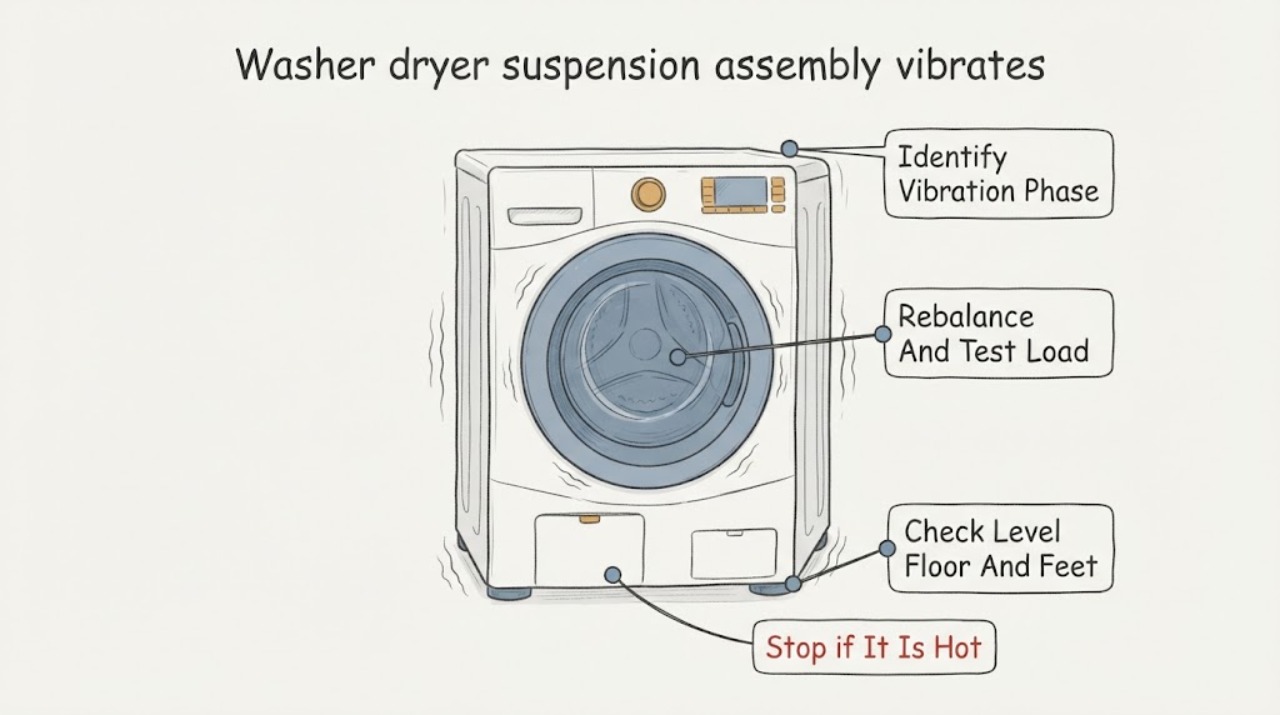
A washer-dryer suspension assembly is meant to let the wash tub move while limiting shock; the assembly itself may be reacting to an unbalanced load, an unlevel or weak floor, shipping restraints, or a worn spring, rod, damper, or mount. First identify whether movement happens only during washer spin, with particular loads, or even when the drum is empty. Rebalance a safe load, verify the unit is stable and level, and check for shipping bolts if it was recently installed. With power disconnected, look only for an unevenly sagging tub, a visibly displaced spring or rod, rubbing, or a repeated knock; do not remove panels or reach into the suspension. Stop the cycle for metal-on-metal grinding, a broken or loose support, cabinet movement, a water leak, burning odor, damaged cord, or vibration that persists on an empty test, and arrange appliance service.
Work through in order
Diagnostic checks
Use only checks that match the exact appliance or system and its official guide.
-
Check 1
Observe one normal cycle from a safe position and note whether the movement starts during filling, wash agitation, ramp-up to spin, high-speed spin, or the dry portion of an all-in-one combo. If the appliance is a stacked pair rather than a single combo, identify which cabinet moves and test each unit only according to its own manual.
Expected result: Record whether vibration occurs with every load or only certain loads, only during spin, throughout the cycle, or in the dryer drum; note thumps, scraping, a level change, an error, or a leak.
Next step: Stop and keep the symptom record if the cabinet walks, a hose strains, a leak appears, or the noise is grinding or scraping. Otherwise continue with the load and installation checks before judging the suspension assembly.
Stop if: Do not keep running a cycle with severe movement, exposed wiring, a burning odor, smoke, a damaged cord, water near electrical parts, or a cabinet that could tip.
Why this matters
Why: Spin-only movement that follows a load points first to balance, leveling, or shipping restraints. Movement with an empty drum, during low-speed motion, or in both wash and spin makes a support, mount, drive, or frame issue more relevant. A dryer-only symptom is not evidence that the washer suspension is at fault.
-
Check 2
Pause the washer using its normal controls and wait for the door or lid to unlock. Remove or spread laundry so it is not gathered on one side; for a combo, use a modest mixed load rather than one bulky item, and do not exceed the product's stated capacity.
Expected result: Run the model-approved rinse-and-spin or comparable test and record whether the tub settles and spins evenly, whether the problem follows one item or load type, or whether the same movement occurs with a light, evenly distributed load.
Next step: Use the load-size and fabric guidance in the exact user manual. If the balanced test still causes severe movement, stop testing and arrange service rather than selecting a higher spin speed.
Stop if: Do not reach through a locked door, defeat a lid interlock, hold the tub while it spins, or continue if laundry or water is being thrown out.
Why this matters
Why: Improvement after redistribution supports an off-balance load rather than a failed suspension assembly. Repeated vibration with a balanced test load shifts attention to floor contact, shipping hardware, a suspension component, or another mechanical fault.
-
Check 3
With the appliance empty and still, place a level on the cabinet surface if the manual permits, then gently rock the top from corner to corner. Check that the floor is solid and dry, all applicable feet contact it, and each accessible locking nut is secure; adjust feet only as the exact installation instructions describe.
Expected result: Record a level cabinet with firm four-corner contact, one rocking corner, loose feet or lock nuts, a slippery or soft floor, a pedestal or riser that moves, or a stacked unit that is not seated as specified.
Next step: Correct only the accessible leveling adjustment allowed by the manual, retighten the lock nuts, and repeat a small test. Do not shim an unstable pedestal, move a heavy stacked unit alone, or compensate for a damaged floor by extending feet excessively.
Stop if: Stop if the floor flexes, the pedestal or stack shifts, a foot or bracket is bent, water or detergent makes the surface slippery, or moving the appliance would strain hoses or the power cord.
Why this matters
Why: A rocking cabinet or poor floor contact can amplify tub motion and mimic a suspension defect. If the unit is stable and level but the empty tub still knocks, sags, or rubs, installation is less likely to be the main cause.
-
Check 4
If the vibration began after installation or relocation, use the exact installation manual to inspect the accessible rear area for front-load shipping bolts, spacers, or other tub packing material. Do not tilt or pull the appliance by yourself; use the manual's moving and removal procedure.
Expected result: Record whether all shipping restraints are documented as removed, whether a bolt or packing piece remains, whether the tub has the small amount of spring-supported give described by the manufacturer, or whether the restraint status is unknown.
Next step: Remove a confirmed restraint only by the model's installation instructions and retain it for future transport. If the hardware is inaccessible, damaged, or uncertain, leave the appliance off and request service or installation help.
Stop if: Do not operate the machine with shipping hardware partly removed, do not remove cabinet panels, and do not tilt a washer-dryer combo without appropriate help and the manufacturer's procedure.
Why this matters
Why: A remaining restraint can hold the tub rigid and cause severe vibration or damage. A correctly unrestrained tub with persistent empty-drum vibration points away from a simple installation omission and toward diagnosis of the support or drive system.
-
Check 5
Disconnect power, empty the drum, and wait until all motion stops. From the normal door or lid opening and other ordinary access only, gently press and release the tub as permitted by the manual; look for a visibly uneven sag, a loose or displaced spring, rod, damper, mount, or rubbing mark without removing a panel or part.
Expected result: Record even spring-supported movement and return to center, an asymmetric low side, excessive bounce, a hard or locked tub, a repeated knock, metal contact, a visible broken support, or no safe view of the assembly.
Next step: Leave the appliance unplugged and provide the observations to a qualified appliance technician. Service should inspect the suspension, tub mounts, bearings, drive, cabinet, and floor rather than replacing a spring or damper solely from a noise description.
Stop if: Do not reach below the tub, release a spring or rod, remove a damper, open the cabinet, bypass an interlock, or test-spin with a panel removed.
Why this matters
Why: Even movement that returns to center is consistent with a functioning suspension response, though it does not test the component under load. Asymmetric sag, excessive bounce, hard binding, rubbing, or a visible broken mount makes suspension or another mechanical fault more likely and cannot identify a replacement part by sight alone.
-
Check 6
After only the permitted load, leveling, or restraint correction, run one short manufacturer-approved test cycle while staying nearby. Keep the load modest and evenly distributed, and stop the cycle through normal controls if movement returns.
Expected result: Record a stable spin, mild normal movement that remains within the cabinet footprint, recurring severe shaking, a new scrape or bang, an error, a leak, or a failure to spin.
Next step: Keep the appliance out of service for persistent or severe symptoms and arrange a qualified diagnosis. Supply the model, whether it is a combo or stacked pair, cycle phase, load, correction made, and video or sound description if safe to capture.
Stop if: Stop immediately for cabinet walking, impact, grinding, smoke, burning odor, water leakage, a damaged cord, or any condition that could injure someone or damage the appliance.
Why this matters
Why: A stable test after a clear load or installation correction supports that cause. Recurrence with an empty or balanced load, failure to spin, or a new mechanical or water symptom requires service; it is not proof that the suspension assembly alone failed.
Use your observations
Decision map
Find the observation that best matches what you see, then follow the next safe action.
-
PATH 01Next step
What you see
The washer is stable when empty or lightly loaded, but shakes with a blanket, a single heavy item, a tangled load, or a particular cycle.
Do this next
Pause normally, redistribute or reduce the load according to the manual, and retest once. If it then shakes with ordinary balanced loads, continue to installation and mechanical checks.
Why this path and its safety boundary
Why it matters: An off-balance load or unsuitable cycle is more likely than a damaged suspension assembly. A healthy suspension cannot cancel every uneven mass at high speed.
-
PATH 02Next step
What you see
The cabinet rocks at a corner, feet do not all contact the floor, a pedestal or riser moves, or the floor is soft, slippery, damaged, or out of level.
Do this next
Correct accessible leveling only as directed by the exact manual, secure the feet, and run one modest test. Do not move a heavy stack alone or use improvised supports; obtain installation or appliance service if stability cannot be restored.
Why this path and its safety boundary
Why it matters: The installation is amplifying tub motion and can make a good suspension look defective. A stacked washer-dryer also needs the support platform and surrounding clearance specified for its design.
-
PATH 03Next step
What you see
Severe shaking began immediately after installation or relocation, and the front-load tub feels unusually rigid or shipping hardware is still present or unknown.
Do this next
Keep the appliance off and follow the exact installation guide, or request installation service when the restraints cannot be safely identified or removed.
Why this path and its safety boundary
Why it matters: Shipping bolts, spacers, or packing material may still be restraining the tub. This is an installation issue that can damage the suspension if the machine continues to run.
-
PATH 04Next step
What you see
The machine is level, the load is balanced, restraints are removed, and an empty or modest test still produces asymmetric sag, excessive bounce, rubbing, repeated impact, cabinet movement, or a visible loose support.
Do this next
Leave the appliance unplugged and arrange qualified appliance service for an internal inspection. Do not buy or install a suspension component based only on a generic image or sound.
Why this path and its safety boundary
Why it matters: A suspension spring, rod, damper, mount, bearing, drive, frame, or another mechanical part may be failing. The symptom does not identify a part or prove compatibility.
-
PATH 05Next step
What you see
Vibration is accompanied by scraping or grinding, smoke, burning odor, water leakage, exposed wiring, a damaged cord, an error that returns, or a cabinet that could tip.
Do this next
Stop the cycle, disconnect power only if it is safe to reach the plug without water or damage, keep people away, and obtain qualified appliance service. Follow local emergency guidance for smoke or fire.
Why this path and its safety boundary
Why it matters: The immediate concern is injury, electrical or water damage, or escalation of a mechanical fault, not fine-tuning the load or suspension.
Helpful context
Understand the symptom
A suspension assembly can move without being defective
The wash tub is intentionally supported so it can move as water and laundry rotate. A top-load guide from LG describes four springs that support the tub and reduce shock; a Whirlpool owner manual describes spring damper struts, a balance ring, and off-balance control as parts of a suspension system. A small, even movement is therefore different from a tub that hangs low on one side, bangs the cabinet, rubs, or continues to shake with no laundry. The exact arrangement depends on whether the appliance is a front loader, top loader, or all-in-one combo.
Separate a load problem from a support problem
If vibration follows a blanket, a single heavy item, an overloaded drum, or a tangled load, redistribute the load before judging the suspension. If the washer rocks when pushed at its corners, the feet or floor can amplify otherwise normal tub motion. Samsung and LG both direct owners to check firm floor contact, leveling, and a small test load. Those checks do not prove a spring, rod, or damper is good; they simply prevent a load or installation issue from being mistaken for a failed assembly.
Treat a persistent empty-drum symptom as a service diagnosis
An empty-drum test that still produces an asymmetric sag, repeated knocking, rubbing, or cabinet movement makes a support, damper, mount, bearing, frame, or drive problem more relevant. Do not infer which part has failed from sound or appearance alone. Disconnect power before any ordinary-access observation, keep the cabinet and base closed, and give the technician the appliance type, model, cycle, load, installation history, and exact symptom.
Only after diagnosis
Potential parts
- suspension spring, rod, strut, or damper assembly
Consider this category only if qualified testing finds abnormal tub movement, bounce, sag, or damping after load, leveling, and shipping-restraint causes are excluded.
Suspension designs differ by front-load, top-load, and combo model; confirm the exact model, position, mounting hardware, and manufacturer fit information before any order or repair. - tub support or suspension mounting hardware
Consider only when inspection confirms a bent, cracked, displaced, or worn tub support or mount rather than a load or floor problem.
Use the exact model documentation and technician-confirmed mounting arrangement; do not substitute a bracket or fastener by appearance alone. - leveling foot or lock-nut set
Consider only when a damaged or missing foot or lock nut prevents firm, level floor contact after the floor itself is confirmed suitable.
Match the exact appliance model, thread, height range, locking method, and any pedestal or stack requirements; a foot does not repair a weak floor or damaged cabinet.
When checks do not resolve it
Need a professional?
Arrange qualified appliance service when vibration persists with an empty or balanced drum after the unit is level and any shipping restraints are removed, or when there is asymmetric tub sag, excessive bounce, rubbing, repeated impact, failure to spin, a visible support problem, or an error. Stop immediately for smoke, burning odor, water near electrical parts, a damaged cord, severe cabinet movement, or a possible tip-over.
Have this ready
- Give the technician the full model, whether the unit is a washer-dryer combo or stacked pair, cycle phase, load type and size, installation or relocation date, shipping-restraint status, level and floor observations, error text, and any visible sag, rubbing, leak, odor, or abnormal sound.
Common questions
FAQ
Why does my washer dryer vibrate if the suspension assembly looks intact?
An unbalanced load, an unlevel or slippery floor, loose feet, a pedestal issue, or shipping hardware can create severe movement even when no spring or damper is visibly broken. Correct only the safe load or installation issue allowed by the model manual, then run one modest test.
How can I tell whether the suspension is worn?
With power disconnected and the drum empty, look only for asymmetric sag, excessive bounce, hard binding, rubbing, a loose visible mount, or repeated impact. These symptoms justify service but do not identify the failed part; panels should remain closed.
Can I run the washer with a bad suspension rod or spring?
Do not continue running it when the tub bangs, rubs, sags, the cabinet walks, or vibration persists with a balanced load. Severe movement can damage the cabinet, hoses, wiring, or tub. Leave it unplugged and arrange qualified appliance service.
Do shipping bolts cause washer-dryer vibration?
Yes, on applicable front-load designs, shipping bolts, spacers, or packing material can hold the tub rigid and cause severe vibration after installation or relocation. Check only the exact installation instructions and do not operate the appliance while restraint status is uncertain.
What should I tell the appliance technician?
Provide the full model, combo or stacked configuration, cycle phase, load type, installation date, shipping-restraint status, floor and level observations, error text, and whether an empty test still produces sag, bounce, rubbing, impact, leakage, odor, or cabinet movement.
Read the exact guide
Official sources
- LG Washer – Troubleshooting Vibration IssuesLG USA Support · Official LG guidance used for general washer and washer-dryer-combo diagnostic branches; exact steps vary by model and installation type.
- Samsung washing machine is shakingSamsung Support · Official manufacturer guidance used for cross-brand diagnostic reasoning; Samsung controls and mechanical layouts are not assumed for other models.
- LG top load washing machine - tub: The tub looks to be tilted downward Looks to be leaning to one sideLG USA Support · Official top-load guidance used only to explain suspension behavior; front-load and combo suspension layouts may differ.
- LG washer - How to Level an LG Front Load Washing MachineLG USA Support · Official front-load installation guidance used for stable-floor and leveling checks; foot designs vary by model.
- Owner's ManualWhirlpool Corporation · Official Whirlpool owner manual used to explain that suspension systems can combine spring damper struts, balance rings, and off-balance control; it is not a procedure for other models.
- Samsung washing machine spins poorlySamsung Support · Official manufacturer guidance used for safe test and escalation concepts; calibration controls are model-specific and not prescribed universally.
Community feedback
Share a repair observation
Share a plain-text repair observation. Accepted observations are published automatically; this page may take a moment to update.