
On this page
Start here
Quick answer
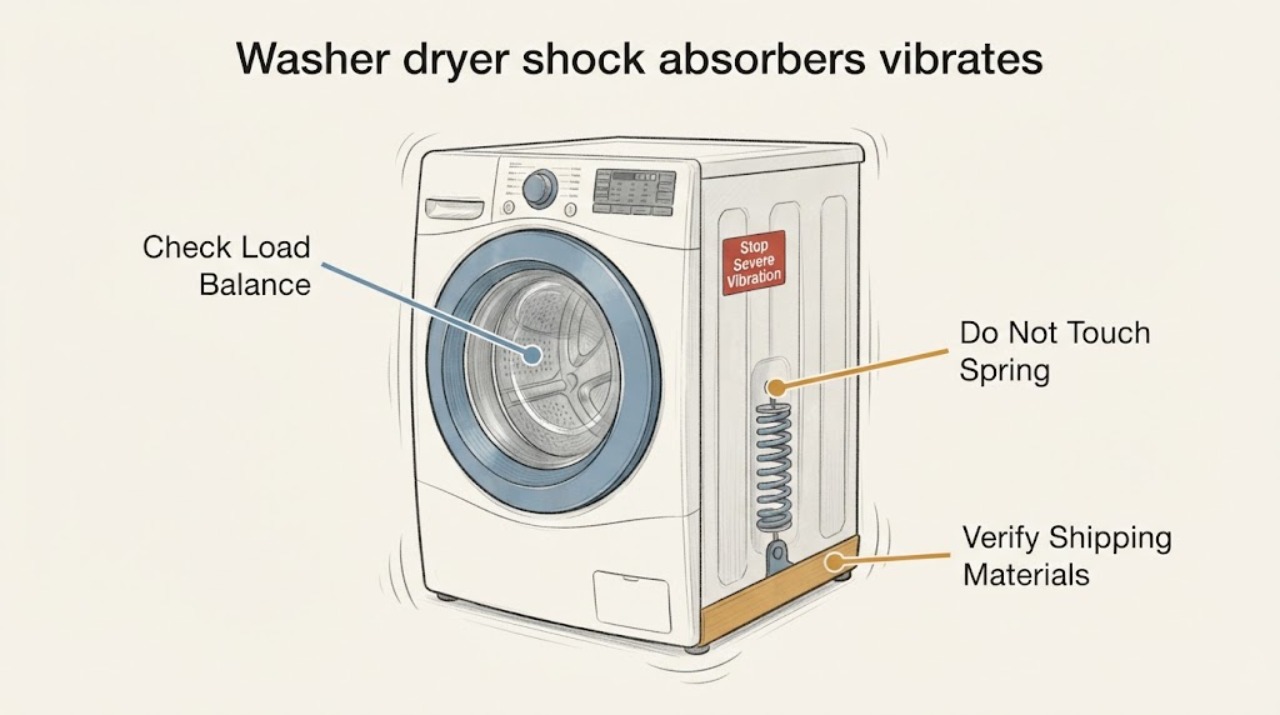
If a washer-dryer vibrates and you suspect its shock absorbers, first stop a violent or walking cycle and determine whether the movement follows one unbalanced load, a recent installation or move, an uneven floor, or every load. Redistribute the laundry, confirm the washer is on a firm level surface with all feet stable, and check the model instructions for shipping bolts before blaming an internal damper. With the drum empty and the machine off, a tub that is visibly sagging, repeatedly bounces, bangs, scrapes, or stays off-center across different loads makes worn shock absorbers or another suspension, bearing, or tub fault more likely. Shock absorbers are internal; do not open the cabinet or replace them based only on vibration. Persistent movement after the low-risk load, installation, and leveling checks needs qualified appliance service.
Before you begin
Safety first
- This article supports stopping a severe cycle, redistributing laundry, checking accessible leveling and installation information, and observing the empty drum without disassembly. Do not open the cabinet, release suspension springs, remove shock absorbers, pull apart stacked equipment, or lift or tip the appliance.
Work through in order
Diagnostic checks
Use only checks that match the exact appliance or system and its official guide.
-
Check 1
Pause the washer portion of the cycle if the unit walks, bangs violently, scrapes, or approaches a wall; keep the machine off and wait for the drum to stop before opening the door or handling laundry.
Expected result: Record whether the movement occurs during wash or spin, whether the machine changes position, whether water or a loose part is present, and whether the door or cabinet is being struck.
Next step: Remove or redistribute laundry only after the drum stops and the area is stable; arrange service instead of repeating the cycle when the machine walks, bangs, or shows damage.
Stop if: Do not hold the cabinet while it spins, place hands near a moving drum, wedge the machine against a wall, or keep running a cycle that moves across the floor.
Why this matters
Why: Walking, violent impact, scraping, or a damaged cabinet can worsen a suspension or floor problem and is not a normal balance correction. A brief movement only as a load ramps up may still be load-related, but it should be observed rather than ignored.
-
Check 2
With the drum stopped, remove excess items and spread the remaining laundry evenly; avoid testing with a single bulky or highly absorbent item, and use a light mixed load that the model allows.
Expected result: Compare the vibration with the original load: note whether clothes were tangled on one side, the drum was tightly packed, or the movement returns with an evenly distributed load.
Next step: Use balanced loads and an appropriate spin setting if the symptom stops; continue to the installation and empty-drum checks if it returns with normal loads.
Stop if: Do not compensate for severe movement by overloading the opposite side, running repeated high-speed tests, or using a damaged or loose drum.
Why this matters
Why: Vibration that disappears after redistributing a load makes imbalance or overloading more likely than a failed shock absorber. Persistent movement with a balanced load shifts attention to installation, floor stability, or the suspension.
-
Check 3
If the washer-dryer is new, was recently moved, or the vibration began after relocation, compare the rear and base with the model installation guide to confirm that all shipping bolts, braces, foam, and packing supports required for removal are no longer installed.
Expected result: Record whether transport hardware or packing remains, whether the drum can move as the model guide describes, and whether the rear is inaccessible because the unit is stacked, enclosed, or too heavy to move safely.
Next step: Follow only the exact model's installation instructions for an accessible, ordinary removal; otherwise leave the appliance in place and arrange installation or appliance service.
Stop if: Do not pull a stacked pair apart, tip the appliance alone, remove internal braces, or operate the washer with shipping hardware still installed.
Why this matters
Why: Shipping restraints left in place can prevent the tub from moving normally and cause severe noise and vibration. If they are absent, or if checking them would require unsafe moving or disassembly, installation hardware is less likely and the check ends at the professional boundary.
-
Check 4
With the washer empty and off, place a level across the top in both directions and gently rock the cabinet from diagonal corners; inspect whether every foot is firmly on a solid floor and whether a pedestal or platform is stable.
Expected result: Record whether the bubble is off-center, the cabinet rocks, a foot or lock nut is loose, the floor flexes or sags, or the appliance contacts a wall or neighboring unit.
Next step: Adjust the feet and lock nuts only as the model instructions allow, then recheck stability; do not use improvised blocks or alter a raised platform, and arrange service for a flexing floor or a machine that cannot be stabilized.
Stop if: Do not climb on the appliance, lift it to adjust a foot, place hands beneath its base, or continue if the floor or pedestal cannot safely support it.
Why this matters
Why: An unlevel cabinet, a foot not contacting the floor, a loose lock nut, or a flexible platform can amplify normal tub motion and mimic failed dampers. If the base is stable and the machine remains level but still vibrates on balanced loads, an internal fault becomes more likely.
-
Check 5
After the drum is empty and the machine is off, gently press the drum or basket through the open door only as the owner manual permits; observe its centered position and movement without removing panels or reaching below the tub.
Expected result: Note whether the tub settles and stops, repeatedly rebounds, hangs low or off-center, makes a grinding or clanking sound, or has unusual looseness compared with the model's normal unloaded position.
Next step: Stop at this external check and give the pattern to a qualified appliance technician; do not diagnose the exact internal part by feel or order shock absorbers without model-specific confirmation.
Stop if: Do not open the cabinet, remove the drum, release springs, disconnect dampers, or run the machine with a visibly loose or damaged tub.
Why this matters
Why: A repeated rebound, persistent off-center sag, grinding, or looseness after load, shipping, level, and floor checks makes worn shock absorbers, springs, bearings, tub supports, or counterweight problems more likely. A centered, quiet empty tub does not rule out a load-specific imbalance.
-
Check 6
Only after the load, installation, and level checks are satisfactory, run a short model-approved rinse-and-spin or equivalent test with a light, balanced load while staying nearby; stop if movement becomes severe.
Expected result: Watch whether the tub remains centered, whether the cabinet stays in place, and whether vibration occurs only during high-speed spin or throughout the cycle.
Next step: Use normal loads cautiously if the test stays stable; arrange service when vibration returns, the tub is not centered, or any abnormal noise or movement remains.
Stop if: Do not leave the test unattended, run a full load to prove the problem, or continue after walking, severe banging, scraping, or contact with the wall.
Why this matters
Why: A stable test supports a load or setup correction, while recurring high-speed movement with a balanced load points toward the suspension, shock absorbers, bearings, floor, or another mechanical fault. A new grinding, scraping, or banging sound is not a successful test result.
Use your observations
Decision map
Find the observation that best matches what you see, then follow the next safe action.
-
PATH 01Safety boundary
What you see
The machine vibrates only with one bulky, absorbent, tightly packed, or tangled load and becomes stable after the load is redistributed.
Do this next
Use smaller, mixed loads and an appropriate spin setting; monitor a later balanced load before pursuing internal parts.
Why this path and its safety boundary
Why it matters: Load imbalance or overloading is more likely than worn shock absorbers.
Safety stop: Do not keep using a load that makes the washer walk or strike nearby surfaces.
-
PATH 02Safety boundary
What you see
Severe vibration began immediately after installation or moving, and shipping hardware, packing, foot contact, or level has not yet been confirmed.
Do this next
Use the exact installation guide to verify shipping materials and stabilize the feet; have the installer or a technician handle inaccessible hardware or unsafe moving.
Why this path and its safety boundary
Why it matters: A transport restraint or installation instability is more likely than a suddenly worn shock absorber.
Safety stop: Do not operate with shipping bolts installed or move a stacked, pedestal-mounted, or tightly enclosed unit alone.
-
PATH 03Safety boundary
What you see
The cabinet rocks diagonally, one or more feet do not contact the floor, the lock nuts are loose, or the floor or pedestal flexes.
Do this next
Correct leveling only within the model instructions, or arrange professional correction for a flexing floor, raised platform, pedestal, or unsafe installation.
Why this path and its safety boundary
Why it matters: Base instability is amplifying tub motion and can mimic a damper fault.
Safety stop: Do not wedge the cabinet with improvised material, lift the machine alone, or continue high-speed cycles on an unstable base.
-
PATH 04Safety boundary
What you see
Balanced loads still cause repeated high-speed banging or walking after shipping materials are removed and the machine is level, or the empty tub rebounds, sags, grinds, or stays off-center.
Do this next
Keep loads light or stop using the machine and arrange qualified appliance service for an internal suspension diagnosis.
Why this path and its safety boundary
Why it matters: Worn shock absorbers, springs, bearings, tub supports, counterweights, or another internal mechanical fault is more likely than a simple load issue.
Safety stop: Do not open the cabinet, release suspension springs, replace dampers, or continue operating a machine with a loose or damaged tub.
-
PATH 05Safety boundary
What you see
The washer is level and stable but has grinding, scraping, or a new mechanical noise, or the vibration appears during wash as well as spin.
Do this next
Stop the machine if the noise is severe or worsening and provide the cycle stage and sound description to a qualified technician.
Why this path and its safety boundary
Why it matters: A bearing, foreign object, motor, tub, or other fault may be involved; a shock absorber is not confirmed by vibration alone.
Safety stop: Do not run repeated cycles to identify the noise or order a suspension part without locating the fault.
Helpful context
Understand the symptom
Shock absorbers are only one possible vibration cause
A washer's tub suspension limits how far the drum assembly moves as laundry and water shift during spin. A single blanket, an overloaded drum, a loose leveling foot, shipping hardware left after installation, or a flexible floor can create the same walking or banging symptom. The useful distinction is whether the vibration disappears after the load or installation is corrected, or whether the empty tub still moves abnormally and the problem returns with every load.
Look for a repeatable pattern before opening anything
Vibration confined to spin and one load is usually a load-balance or installation clue. Vibration on every load, a tub that repeatedly rebounds after a gentle press, a drum that hangs off-center, or a new grinding or clanking sound makes suspension, shock absorbers, bearings, or another internal fault more likely. These parts sit inside the appliance, so the external checks should end before cabinet disassembly.
Recent installation changes the decision path
If the washer-dryer was newly installed or moved, verify the model's shipping-material and leveling requirements before diagnosing worn parts. Shipping bolts hold a front-load tub during transport and can cause severe vibration if left installed; feet that do not contact the floor or a machine that rocks can do the same. A stacked pair or a combo in a tight space should not be pulled apart or moved by one person just to reach the rear.
When an internal suspension fault becomes likely
If a balanced light load still causes violent movement after the washer is level, all feet are stable, and shipping materials are confirmed removed, an internal suspension or tub problem deserves service. Shock absorbers may be worn, but springs, bearings, tub supports, counterweights, or a damaged cabinet can produce similar symptoms. A technician can identify the failed component and verify that the machine is safe to spin.
Safety boundary
Stop conditions
- Stop immediately for violent movement, walking, cabinet or wall impact, scraping, a visibly loose tub, or a damaged floor, pedestal, cord, or cabinet.
- Do not open the cabinet, release springs, disconnect shock absorbers, remove the drum, or reach beneath a washer-dryer as an ordinary-user check.
- Do not pull apart a stacked pair, tip a combo, or move a heavy appliance alone to reach shipping hardware or internal suspension.
- Do not use improvised blocks, wedges, or an unverified vibration fix to stabilize an unsafe or flexing floor.
- Keep the machine out of service and arrange appliance inspection when balanced loads still vibrate after model-approved installation and leveling checks.
Only after diagnosis
Potential parts
- washer-dryer shock absorber or damper
Consider this part only when a qualified diagnosis confirms worn or damaged internal dampers after load, shipping, leveling, floor, and other suspension causes are checked.
Match the exact washer-dryer model, damper length and resistance, mounting points, quantity, and manufacturer service instructions; do not infer fit from appearance alone. - washer-dryer suspension spring
Consider this class only when inspection confirms a broken, stretched, detached, or model-specific suspension spring rather than a damper or floor problem.
Match the exact model, spring position, load rating, attachment hardware, and approved repair procedure; spring removal can release stored mechanical force and is professional work. - washer drum bearing or tub support
Consider this class only when a technician confirms grinding, shaft play, tub support damage, or another bearing or tub fault after the suspension and installation checks.
Match the exact model and tub assembly; bearing or tub work often requires extensive disassembly and should not be ordered from vibration alone.
When checks do not resolve it
Need a professional?
Arrange qualified appliance service when balanced loads still produce walking, repeated high-speed banging, grinding, scraping, tub sag, repeated rebound, or off-center movement after the washer-dryer is level and shipping materials are confirmed removed. Service is also appropriate when the floor, pedestal, stacked installation, shipping hardware, or internal suspension cannot be safely checked. Do not assume the shock absorbers are the failed part until a technician distinguishes them from springs, bearings, tub supports, counterweights, or a damaged cabinet.
Safety scope: This article supports stopping a severe cycle, redistributing laundry, checking accessible leveling and installation information, and observing the empty drum without disassembly. Do not open the cabinet, release suspension springs, remove shock absorbers, pull apart stacked equipment, or lift or tip the appliance.
Common questions
FAQ
How do I know if washer shock absorbers are causing vibration?
You cannot confirm the dampers from vibration alone. First rule out a single unbalanced load, shipping bolts or packing, an unlevel washer, loose feet, and a flexing floor. If balanced loads still cause walking or banging and an empty tub repeatedly rebounds, sags, grinds, or stays off-center, shock absorbers or another internal suspension part becomes more likely and needs professional diagnosis.
Can a washer vibrate because the shock absorbers are worn?
Yes, worn shock absorbers can allow excessive tub movement, but springs, bearings, tub supports, counterweights, and installation problems can look similar. A technician should identify the failed component before a part is ordered or the cabinet is opened.
Should I replace washer shock absorbers myself?
Treat shock-absorber replacement as professional work for this troubleshooting path. The dampers are internal, and accessing them may require cabinet or tub disassembly. Use external load, installation, level, and empty-drum observations, then arrange qualified service for persistent vibration.
Why does my new washer vibrate violently?
A new or recently moved washer may still have shipping bolts or packing material, may not be level, or may have feet that do not contact a solid floor. Follow the exact installation guide and have the installer handle inaccessible hardware or unsafe moving; do not assume a new machine needs shock absorbers.
Read the exact guide
Official sources
- Bosch Washing Machine Troubleshooting & Repair GuideBosch Home Appliances · Bosch washing-machine troubleshooting guidance; exact washer-dryer design and service procedures vary by model.
- Samsung washing machine is shakingSamsung Support · Samsung washer guidance for shaking during spin; exact washer-dryer model instructions take precedence.
- Washer is Vibrating, Walking or Moving - Product HelpMaytag Product Help · Maytag front-load washer vibration guidance; the washer-dryer's own manual controls exact adjustment procedures.
- How to Stop a Washing Machine from ShakingMaytag · Maytag consumer guidance for washer vibration; exact washer-dryer model instructions control installation and internal repair.
- LG Washer – Troubleshooting Vibration Issues on an LG Washing MachineLG USA Support · LG washer and washer-dryer-combo vibration guidance; model-specific instructions control hardware removal and leveling.
- Leveling a Front Load Washer - Product HelpWhirlpool Product Help · Whirlpool front-load washer leveling guidance; washer-dryer combo and stacked installations require their model-specific instructions.
Community feedback
Share a repair observation
Share a plain-text repair observation. Accepted observations are published automatically; this page may take a moment to update.