
On this page
Start here
Quick answer
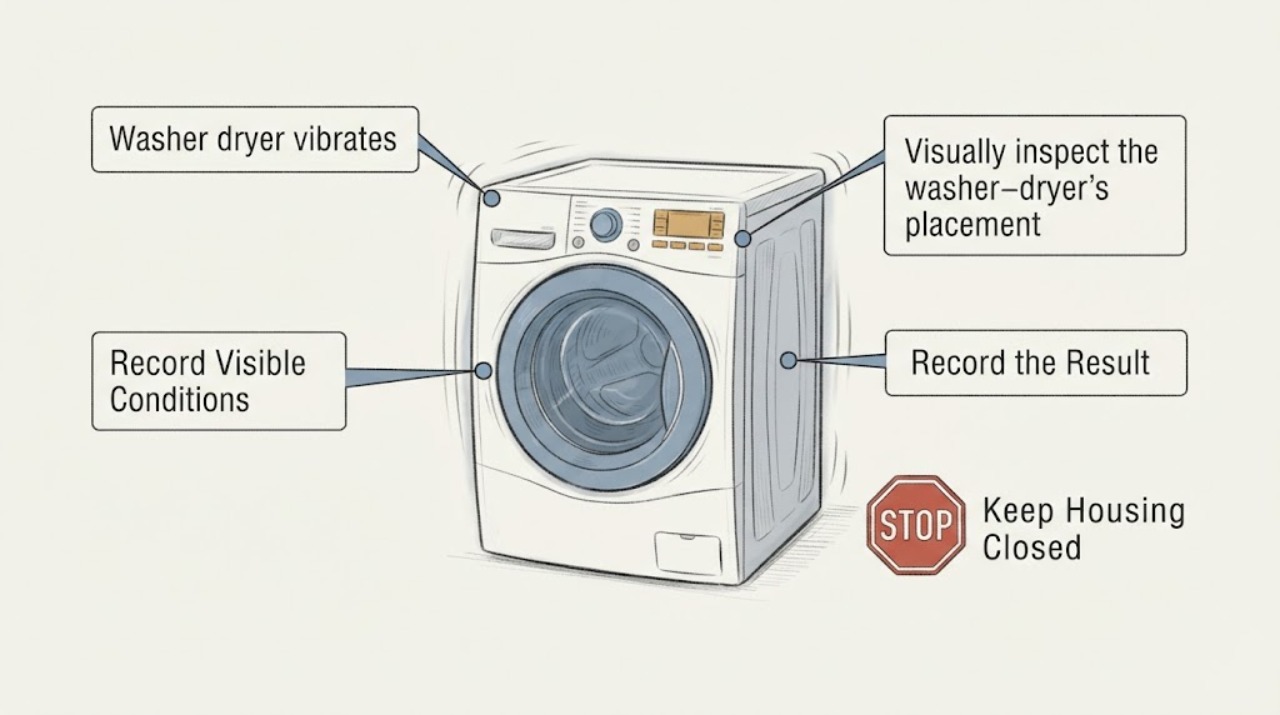
Start by deciding whether the washer-dryer vibrates only during high-speed spin or drying, or whether it rocks, walks, bangs, or moves the hoses and power connection. From a safe standing position, document the load pattern, floor and cabinet movement, level-looking placement, visible foot contact, shipping or relocation history, and hose or wall contact without moving the appliance, reaching behind it, opening panels, or adjusting suspension parts. A single bulky or unbalanced load, an unstable floor, incomplete installation, or a mechanical suspension fault can look similar. Stop using the unit if it walks, strains a hose or cord, leaks, smells hot or burnt, sparks, makes grinding or metal-on-metal noise, or could strike a wall or connection; arrange appliance service for persistent or severe vibration.
Before you begin
Safety first
- This guide is limited to observation. Do not move, tilt, lift, or shim the appliance; adjust feet; remove shipping bolts; open panels; reach behind or beneath the unit; handle hoses, cords, wiring, suspension, shocks, bearings, or drum supports; or run repeated high-speed tests.
Work through in order
Diagnostic checks
Use only checks that match the exact appliance or system and its official guide.
-
Check 1
From a safe standing position, record when the washer-dryer vibrates during wash, rinse, spin, or dry and whether the cabinet rocks, walks, bangs, or only makes a brief normal movement at startup; do not run repeated cycles to recreate the symptom.
Expected result: Note whether the vibration follows a single bulky item, a small or tightly packed load, every load, a particular speed, or the transition into spin or dry, and record any error or abnormal sound.
Next step: Write down the cycle, load type, sound, and movement and give that history to an appliance technician; stop using the unit if movement is severe or worsening.
Stop if: Stop immediately for walking, a leaking hose, a strained cord, smoke, burning odor, sparks, grinding, metal-on-metal noise, or movement toward a wall or connection.
Why this matters
Why: A load- or cycle-specific pattern is consistent with an imbalance or cycle interaction, while movement on every load or severe banging points toward installation, floor, or mechanical assessment; timing alone cannot identify a failed part.
-
Check 2
Visually inspect the washer-dryer’s placement from the front and sides without moving it, tilting it, pressing on the cabinet, or adjusting the feet.
Expected result: Record whether the unit appears to sit squarely, whether a visible foot is not contacting the floor, whether the floor flexes or sags, and whether the cabinet is touching a wall, pedestal, shelf, or another appliance.
Next step: Photograph the placement and provide the floor and clearance observations to the service provider; do not compensate with shims or improvised supports.
Stop if: Stop if the appliance is leaning, unstable, on a damaged or wet floor, stacked or elevated in a way you cannot assess safely, or would need to be moved or lifted.
Why this matters
Why: An uneven or unstable floor, a visible gap under a foot, or contact with nearby surfaces can amplify vibration. A level-looking cabinet does not rule out loose feet, internal suspension damage, or a floor problem beneath the appliance.
-
Check 3
Review the installation and relocation history from safe records or the owner manual without reaching behind the appliance or removing any transport hardware.
Expected result: Note whether the vibration began immediately after delivery, a move, stacking, flooring work, or a change in location, and whether records confirm that the installation was completed for this exact model.
Next step: Give the model identification, installation date, relocation history, and any manual notes to the technician and request a safe installation review.
Stop if: Do not remove transport bolts, tilt the machine, pull it from the wall, or begin installation steps without exact model instructions and safe access.
Why this matters
Why: A symptom that began after installation or relocation raises the priority of a model-specific setup and shipping-material check. Do not assume the number or position of shipping bolts from another model.
-
Check 4
From the front and each safely visible side, inspect the inlet hoses, drain hose, power cord, vent or duct connection if present, and nearby wall or cabinet for contact or tension without touching or repositioning them.
Expected result: Record a hose tapping the cabinet, a drain hose pulled tight, a cord under tension, a crushed or rubbing connection, water marks, or a cabinet moving toward a connection during vibration.
Next step: Stop operation, keep the area clear and dry, and tell the appliance technician exactly which connection is affected; obtain plumbing or electrical help if a leak or electrical damage is present.
Stop if: Stop for any active leak, wet electrical area, exposed conductor, hot cord, gas or exhaust concern, crushed hose, or connection that appears to be pulling apart.
Why this matters
Why: A moving appliance can damage or disconnect a hose, drain, vent, or cord even if the original vibration started elsewhere. Contact or tension changes the situation from noise to a stop-use and service issue.
-
Check 5
Observe the door opening, drum opening, gasket, and visible cabinet seams only from the front, without reaching into moving parts, removing panels, or trying to lift or rock the drum.
Expected result: Note a visibly displaced or damaged gasket, scraping mark, cabinet seam opening, loose-looking trim, drum sag, or a new rubbing or knocking sound; do not treat a small amount of normal drum movement as a part diagnosis.
Next step: Stop the appliance if the drum rubs, the door cannot close normally, or the cabinet is damaged, and provide photos and sound timing to the service provider.
Stop if: Do not insert tools, hands, or objects into the drum or gasket, open the cabinet, remove the door, or continue a test when scraping, smoke, odor, or structural movement appears.
Why this matters
Why: Visible rubbing, drum support concerns, or cabinet damage can indicate an internal mechanical or suspension issue that requires model-specific service rather than a leveling adjustment.
Use your observations
Decision map
Find the observation that best matches what you see, then follow the next safe action.
-
PATH 01Safety boundary
What you see
Vibration occurs only with a particular bulky, single, tightly packed, or visibly uneven load and the appliance remains stationary with no connection stress.
Do this next
Stop repeated testing, record the load and cycle, and follow the exact owner manual’s load guidance; arrange service if the same behavior returns with ordinary balanced loads.
Why this path and its safety boundary
Safety stop: Do not overload, run repeated high-speed tests, or keep using the machine if it begins walking or contacting a wall or connection.
-
PATH 02Safety boundary
What you see
The appliance rocks or the visible placement suggests an unstable floor, poor foot contact, contact with a wall, or an installation/relocation issue.
Do this next
Arrange model-specific appliance service or installation assessment; provide placement photos and history rather than moving or leveling the unit yourself.
Why this path and its safety boundary
Safety stop: Do not tilt, lift, pull out, shim, adjust feet, or work beneath the appliance without safe equipment and exact model guidance.
-
PATH 03Safety boundary
What you see
Vibration is present on most loads, the drum or cabinet rubs or bangs, the machine walks, or the symptom is worsening.
Do this next
Stop using the washer-dryer and arrange appliance repair to assess shock absorbers, suspension, bearings, drum support, and other model-specific mechanical causes.
Why this path and its safety boundary
Safety stop: Do not open panels, reach into the machine, replace suspension parts, or continue spin or dry cycles to compare the noise.
-
PATH 04Safety boundary
What you see
A hose, drain, vent, cord, wall, cabinet, or other connection is being pulled, struck, or exposed to water as the unit vibrates.
Do this next
Stop operation and keep people away from the area; request appliance service and plumbing or electrical assistance as applicable before using the unit again.
Why this path and its safety boundary
Safety stop: Do not move the appliance while connections are under tension, handle wet electrical equipment, or reconnect a damaged hose or cord yourself.
Helpful context
Understand the symptom
A washer-dryer combination can vibrate normally during drum acceleration, but excessive shaking, walking, repeated banging, or a cabinet that rocks is not something to correct by guessing at a part. Manufacturer guidance commonly points to load balance, level and stable flooring, feet in contact with the floor, shipping materials after installation, and mechanical issues as separate possibilities. The same symptom can therefore require a different next step depending on when it occurs and whether the appliance itself moves.
The safest first pass is visual and observational. Record the cycle stage and what moves, then check the surrounding floor and connections without pulling the appliance away from the wall. Do not tilt the machine, reach behind it, remove shipping bolts, adjust feet, open a cabinet, or inspect suspension components unless the exact model instructions and a qualified technician make that work appropriate.
If the machine is walking into a water hose, drain hose, vent, cord, wall, or cabinet, the priority is to stop operation and prevent a secondary leak or electrical hazard. A technician can determine whether the cause is loading, installation, floor movement, shock absorbers, suspension, bearings, drum support, or another model-specific condition.
Only after diagnosis
Potential parts
- washer dryer shock absorbers
Consider this category only after a technician confirms a worn or damaged damper or shock absorber is responsible for vibration across ordinary loads; a load imbalance or floor issue can look similar.
Confirm the exact model, mounting style, resistance specification, and manufacturer fit information before ordering. - washer dryer suspension assembly
Consider this category only if model-specific service identifies a damaged suspension component, spring, support, or related drum-support part rather than an installation issue.
Confirm the exact appliance model and complete assembly configuration; do not infer compatibility from appearance or a generic vibration symptom. - washer dryer leveling feet
Consider this category only when the correct model documentation or technician confirms a damaged or missing leveling foot; replacing a foot will not repair a flexing floor or internal suspension fault.
Confirm thread, height, base shape, lock-nut arrangement, and exact model compatibility before ordering.
When checks do not resolve it
Need a professional?
Arrange appliance service for vibration that persists with ordinary loads, occurs across cycles, began after installation or relocation, or is accompanied by rocking, banging, scraping, cabinet damage, or drum-support concerns. Stop use and escalate promptly when the unit walks into a hose, drain, vent, cord, wall, or cabinet, or when there is a leak, hot or damaged electrical connection, smoke, burning odor, or severe vibration.
Safety scope: This guide is limited to observation. Do not move, tilt, lift, or shim the appliance; adjust feet; remove shipping bolts; open panels; reach behind or beneath the unit; handle hoses, cords, wiring, suspension, shocks, bearings, or drum supports; or run repeated high-speed tests.
Common questions
FAQ
Is some washer-dryer vibration normal?
Brief movement during drum acceleration can occur, but walking, repeated banging, severe shaking, or a machine that strains hoses or cords is not a normal reason to keep testing. Record the cycle and load, then stop and arrange service if movement is excessive.
Can one load make a washer-dryer vibrate?
Yes. A single bulky item, tightly packed load, or uneven distribution can create a cycle-specific imbalance. If vibration returns with ordinary loads or the cabinet moves, installation or mechanical causes need professional assessment.
Should I adjust the leveling feet myself?
Do not move, tilt, lift, shim, or adjust the appliance as a generic fix in this observation guide. Exact access and leveling procedures vary by model and installation; provide placement photos to an appliance technician.
When should I stop using the washer-dryer?
Stop when it walks, strikes a wall or cabinet, pulls a hose, drain, vent, or cord, leaks, smells hot or burnt, sparks, grinds, or shows cabinet or drum damage. Keep the area safe and arrange appliance service.
Read the exact guide
Official sources
- Samsung washing machine is shaking too muchSamsung · Samsung distinguishes shipping-bolt, load, floor, clearance, and leveling conditions and notes that continuing vibration after those checks requires service; this article uses the observations without instructing disassembly or adjustment.
- LG Washer – Troubleshooting Vibration IssuesLG · LG identifies unlevel installation, unbalanced or bulky loads, shipping materials, and solid flooring as possible vibration causes and emphasizes model-specific guidance and service when the symptom continues.
- Vibration - All-In-One Washer DryerWhirlpool · Whirlpool identifies firm foot contact, leveling, unbalanced or oversized loads, shipping bolts, and stable flooring as separate checks for all-in-one washer-dryer vibration and directs persistent issues to service.
Community feedback
Share a repair observation
Share a plain-text repair observation. Accepted observations are published automatically; this page may take a moment to update.