
On this page
Start here
Quick answer
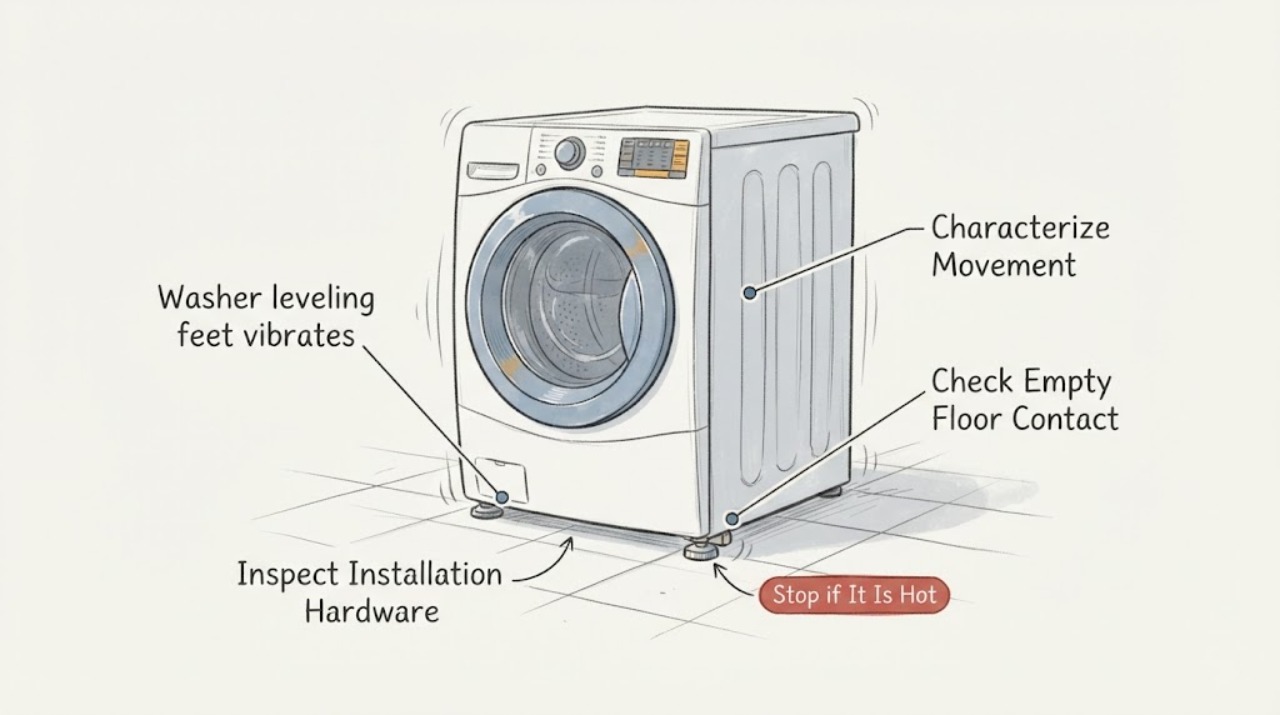
A washer that vibrates or walks often has one or more leveling feet not firmly contacting the floor, a loose foot lock nut, or a floor that flexes or lets the appliance slide. An unbalanced load, shipping bolts left in place after installation, a pedestal or riser issue, and a hose or cabinet touching a wall can produce similar movement. Empty the washer, check the floor and clearance, and confirm that all four feet contact the floor; adjust the feet and secure their lock nuts only as described for the exact model. Keep the feet as short as practical and do not lift or tilt a heavy washer alone. Stop if the washer moves violently, leaks, damages a hose, trips power, smells hot, or has exposed or damaged wiring, and arrange qualified appliance service if external checks do not make it stable.
Work through in order
Diagnostic checks
Use only checks that match the exact appliance or system and its official guide.
-
Check 1
From a safe position, note whether the washer moves only during high-speed spin, during filling or draining, or throughout the cycle; stop the cycle if the cabinet is striking nearby objects or moving toward a hose or wall.
Expected result: Movement is confined to spin, begins during drain, occurs with every cycle, or is accompanied by a leak, impact, unusual noise, odor, or electrical symptom.
Next step: Record the pattern, stop for any hazard, and continue with an empty, externally observed stability check only when the washer is safe and stationary.
Why this matters
Why: Spin-only movement makes load distribution, leveling, floor stability, or suspension behavior more likely. Drain-time movement keeps a pump or hose issue in question, while a leak, impact, odor, or electrical symptom is a stop condition rather than a leveling adjustment.
-
Check 2
With the tub empty and the washer off, check from above whether the cabinet rocks diagonally and look at each corner to see whether all four feet sit on the same firm floor; do not put hands under the appliance or tilt it.
Expected result: The cabinet rocks, one foot appears off the floor, the floor flexes or is slippery, or all four corners feel stable on a firm surface.
Next step: If the washer is stable enough to adjust safely, follow the exact model's external leveling procedure; if the floor, pedestal, or riser is unstable, stop at observation and arrange installation or appliance service.
Why this matters
Why: Rocking or a gap at one foot supports a leveling or floor-contact problem. Flex, carpet, a slick surface, or a pedestal and riser that is not stable can make a correctly adjusted foot appear ineffective. Stability with an empty washer shifts attention toward the load or cycle.
-
Check 3
For a newly installed or recently moved front-load washer, compare the visible rear installation hardware and setup condition with the exact model manual; do not remove shipping hardware by guesswork or open the cabinet.
Expected result: The washer is new or was moved, shipping bolts or packing are visibly still present, the manual confirms they were removed, or the installation history is unknown.
Next step: Use the model-specific installation instructions or have the installer or qualified appliance technician verify the setup. Do not force the washer to run while suspected shipping hardware remains installed.
Why this matters
Why: Movement that starts after delivery or relocation keeps shipping hardware and installation error high on the list. Hardware confirmed removed makes leveling, floor, load, or a later mechanical fault more likely; an unknown history cannot be resolved safely from appearance alone.
-
Check 4
If the empty washer is stationary and the model instructions permit external adjustment, adjust the leveling feet in small increments so every foot contacts the floor, recheck for diagonal rocking, and tighten each foot's lock nut as directed; keep the legs as short as practical and do not lift or tilt the washer alone.
Expected result: Rocking stops and all four feet remain in contact after the lock nuts are secured, one foot still will not contact, or a foot or lock nut spins, slips, bends, or is damaged.
Next step: Run only the model-approved test described in the manual when the washer is stable. If adjustment cannot be completed without lifting the machine or the hardware is damaged, stop and arrange service.
Why this matters
Why: Stable contact after locking supports a leveling-foot problem. A foot that will not stay adjusted, cannot reach the floor, or is damaged needs a part or installation assessment rather than more force; excessive adjustment can make the cabinet less stable.
-
Check 5
After the washer is externally stable, use a small, model-approved test load and observe from a safe position through the normal rinse or spin sequence; do not hold the cabinet or redistribute laundry while the drum is moving.
Expected result: The test load spins quietly, movement returns only with a bulky or very small load, or the washer still walks with the small balanced load.
Next step: Follow the load-size and distribution guidance in the model manual for a load-related pattern. For repeat movement with a balanced load, stop repeated tests and arrange appliance diagnosis.
Why this matters
Why: A stable test load with movement limited to certain loads supports load distribution or cycle selection rather than a foot fault. Continued walking with a balanced test load makes floor, installation, contact, pump, suspension, or drive faults more likely.
-
Check 6
With the washer off, inspect the accessible sides and rear for a drain hose, water hose, cabinet, wall, pedestal, or riser touching or pulling on the machine; do not pull a loaded washer or reach behind it while it is connected and running.
Expected result: A hose is taut or rubbing, the cabinet contacts a wall, the washer sits on a pedestal or riser, or clearance and connections look normal.
Next step: Stop if a hose is strained, pinched, or leaking and arrange service or safe installation correction. Otherwise use the earlier results to decide between a model-specific adjustment and professional diagnosis.
Why this matters
Why: External contact or hose tension can convert normal vibration into noise, apparent walking, or water damage and is not corrected by changing foot height alone. A stable installation with clearances intact keeps internal suspension, pump, drive, or floor problems in question if movement persists.
Use your observations
Decision map
Find the observation that best matches what you see, then follow the next safe action.
-
PATH 01Next step
What you see
Do this next
Use the exact model's external leveling procedure, keep all four feet in contact, and secure the lock nuts. If the floor flexes or the feet cannot stay adjusted, arrange installation or appliance service.
-
PATH 02Next step
What you see
Do this next
Use the model manual's load and cycle guidance, avoid repeated extreme test loads, and seek service if ordinary balanced loads also cause movement.
-
PATH 03Next step
What you see
Do this next
Have the installer or a qualified appliance technician verify the shipping hardware, floor, clearance, leveling feet, and lock nuts using the exact model documentation before further use.
-
PATH 04Next step
What you see
Do this next
Stop repeated spin tests and arrange qualified appliance diagnosis. Do not open the cabinet or replace internal parts based only on the walking symptom.
-
PATH 05Next step
What you see
Do this next
Stop the cycle, keep clear of moving equipment and water, disconnect power only from a safe accessible point if that can be done without contact with water or damage, and arrange qualified service; use emergency help for active smoke or fire.
Helpful context
Understand the symptom
What the feet are supposed to do
The leveling feet transfer the washer's weight into the floor and keep the cabinet stable while the tub accelerates. If one foot is short, loose, or on a different surface, the cabinet can rock and the spin cycle can turn that rocking into a walk. A firm, flat, clean floor matters as much as the adjustment; a foot cannot compensate for a soft or badly flexing surface.
Separate a leveling problem from a load problem
A washer that rocks when empty points toward contact, feet, floor, or installation. A washer that is stable empty but moves only with a particular load points more toward distribution, load size, or cycle behavior. Front-load machines that were recently delivered or moved also need their installation hardware checked against the exact manual, because shipping hardware and leveling are separate checks.
The safe user boundary
Keep checks external and de-energized. Do not reach under a running washer, remove a cabinet or wall cover, alter wiring, or force a heavy machine across the floor. If movement is severe or there is a leak, hose strain, burning odor, smoke, repeated electrical trip, or structural damage, stop the cycle and arrange qualified service.
Only after diagnosis
Potential parts
- washer leveling foot and lock nut
Consider this only if an external inspection finds a missing, bent, stripped, or self-loosening foot or lock nut after the washer's model-specific adjustment procedure.
Confirm the exact washer model and the manufacturer's fit information; do not substitute a generic foot without checking thread and load compatibility. - non-slip floor support
Consider floor support only when the documented installation permits it and the washer slides on a sound but unusually slick surface after all feet are correctly adjusted.
Verify the floor type, clearance, moisture conditions, and exact model instructions; a pad cannot correct a flexing or damaged floor. - pedestal or riser hardware
Consider this only when a pedestal or riser is installed and a technician or model-specific installation check identifies loose, incompatible, or unstable support hardware.
Match the washer and support system by exact model documentation; do not add or remove a riser as a trial while the machine is loaded or unstable. - washer suspension or drain component
Consider an internal suspension or drain component only after feet, floor, load, shipping hardware, and external contact checks are cleared and qualified diagnosis supports it.
Internal parts are model-specific and require diagnosis and safe access; do not order from the walking symptom alone.
When checks do not resolve it
Need a professional?
Arrange qualified appliance service if the washer walks with a balanced load after all four feet are adjusted and locked, a foot will not stay in contact, the floor or pedestal is unstable, shipping hardware is uncertain, or movement continues with hoses and clearances normal. Stop immediately for violent movement, a leak, hose strain, cabinet impact, smoke, burning odor, repeated power trips, exposed damage, or structural instability; keep clear and use only a safe accessible disconnect point.
Common questions
FAQ
Why does a washer walk if its leveling feet look adjusted?
A foot may not actually be carrying weight, its lock nut may be loose, or the floor, pedestal, or riser may flex or slide. Confirm all four corners are firmly supported on a sound surface and that the lock nuts remain secure; a balanced-load walk after that needs service diagnosis.
Should all four washer feet touch the floor?
Yes. Manufacturer instructions describe adjusting the washer so all four feet contact the floor and then securing the feet or lock nuts. Do not make the machine level by lifting or tilting a heavy washer alone.
Can an unbalanced load make a correctly leveled washer walk?
Yes. A bulky item, a very small load, or laundry gathered on one side can create high spin movement even when the empty washer is stable. If movement is limited to particular loads, follow the exact model's load and cycle guidance; movement with ordinary balanced loads points back to installation, floor, external contact, or a mechanical problem.
Why did the washer start walking after it was moved?
Relocation can leave the washer unlevel, put a foot on an uneven surface, change hose or wall clearance, or leave transport hardware in an incorrect state. Compare the setup with the exact installation manual and have the installer or a qualified technician verify it if the history is uncertain.
When is washer vibration unsafe to keep testing?
Stop for violent movement, cabinet impacts, a leaking or stretched hose, smoke, burning odor, repeated power trips, exposed damage, or structural instability. Keep clear, use a safe accessible disconnect point only when it can be reached without contact with water or damaged equipment, and arrange qualified service.
Read the exact guide
Official sources
- [LG Front load washing machine installation] How can I do a level installation and adjust the level of the machine?LG USA Support · LG front-load installation guidance; use the exact model manual for hardware and installation differences.
- Washer is Vibrating, Walking or MovingWhirlpool Product Help · Whirlpool product-help guidance; confirm the exact washer model's installation instructions.
- Samsung washing machine is shaking too muchSamsung Support · Samsung washing-machine troubleshooting guidance; use the exact model's instructions for installation and testing.
- Front Load Washer - Walking, Vibrating, Shaking, or MovingGE Appliances Support · GE front-load support guidance; exact model installation instructions control.
Community feedback
Share a repair observation
Share a plain-text repair observation. Accepted observations are published automatically; this page may take a moment to update.