
On this page
Start here
Quick answer
Suspension rods can contribute to a washer that vibrates or walks, but load balance, leveling, a flexible floor, shipping material left after installation, and loose installation hardware are common look-alikes. First stop the cycle and note whether movement occurs only with one load or with an empty tub. Then check the selected cycle and load, confirm the washer is stable on a solid floor with all feet making contact, and consider whether it was recently moved or installed. A visibly tilted or excessively bouncing tub, repeated walking with a balanced load, clunking from the cabinet, damaged rods or springs, leaks, or movement that requires cabinet access calls for appliance service. Do not reach under the washer, remove the cabinet, stretch or replace suspension rods, defeat a lid lock, or run an exposed-part test.
Before you begin
Safety first
- This article supports observing cycle and load patterns, redistributing a load, checking visible clearance and floor contact, and comparing accessible shipping hardware with the exact installation guide. It does not authorize lifting or tilting, cabinet removal, underside access, suspension-rod or spring handling, lid-lock bypass, or powered tests with exposed parts.
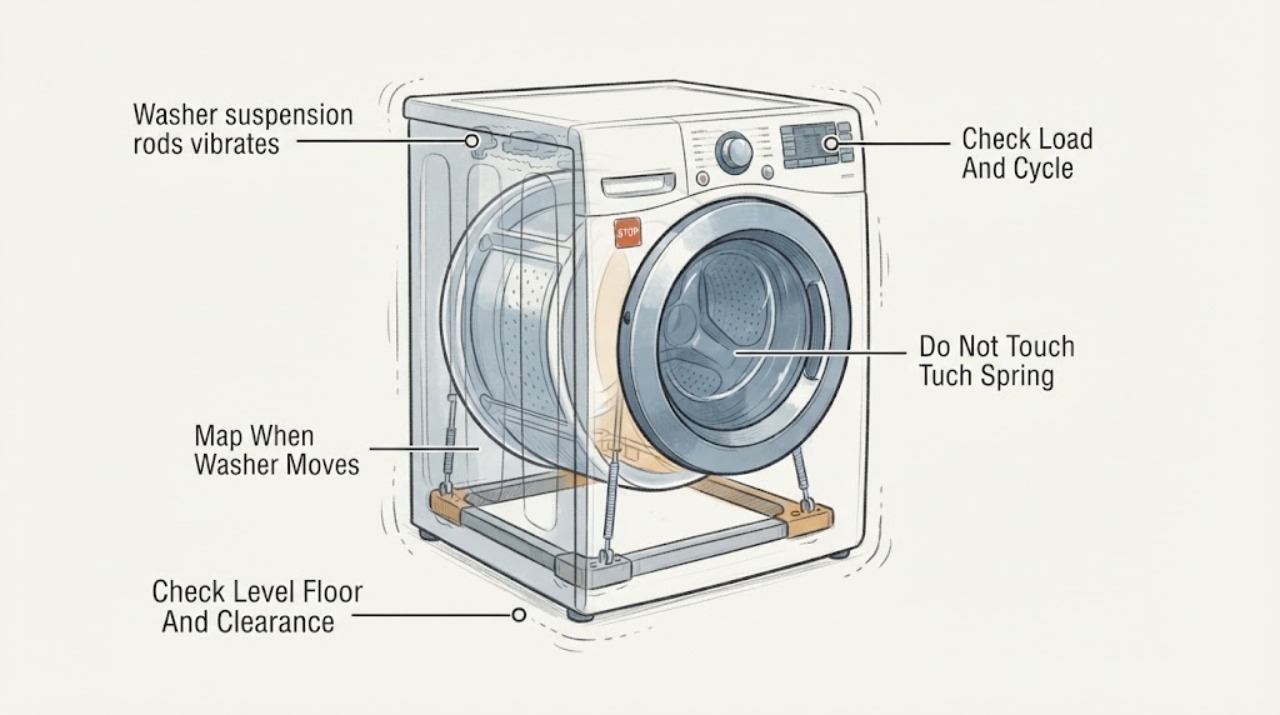
Work through in order
Diagnostic checks
Use only checks that match the exact appliance or system and its official guide.
-
Check 1
Stop the cycle and note when the washer vibrates or walks: during fill, agitation or tumble, drain, ramp-up, or high-speed spin. From a safe position, record whether the movement occurs with one bulky item, a normal load, a balanced load, or an empty tub. Do not hold the cabinet or lid while the drum or basket is moving.
Expected result: Record the cycle stage, spin setting, load type, direction and distance of movement, unusual banging, and whether the movement stops when the load is redistributed.
Next step: Use the matching load, installation, or suspension branch. Keep the washer out of high-speed use if it walks into walls, hoses, or other appliances, or if the movement is accompanied by a leak or harsh mechanical noise.
Stop if: Do not restrain the washer by hand, wedge it against a wall, or continue a high-speed cycle to see how far it moves.
Why this matters
Why: Movement limited to one bulky or uneven load points first toward load distribution or cycle conditions. Repeated movement with a balanced or empty tub makes leveling, floor support, shipping hardware, cabinet contact, or suspension and tub-support faults more likely; the pattern alone does not identify a rod.
-
Check 2
With the washer stopped, redistribute clothes evenly and remove an obviously single bulky item or tightly packed load. Select the cycle and spin option recommended for that load in the owner's guide; do not add weight simply to force balance. Run one supervised, normal test only if there is no structural, water, or electrical warning.
Expected result: Record whether the washer stays stable with a mixed, balanced load, still vibrates at the same spin stage, or shows an imbalance message or repeated correction attempt.
Next step: Use smaller, mixed loads and the appropriate cycle if the test is stable. If the washer still walks or bangs with a balanced load, stop repeated tests and arrange service.
Stop if: Do not run a visibly unstable washer, wash a single heavy item repeatedly to reproduce the fault, or continue after the tub strikes the cabinet.
Why this matters
Why: Whirlpool says unbalanced or overloaded loads can cause vibration, reduced spin, and walking. Stability after redistribution makes a damaged suspension rod less likely, while repeat movement with a balanced load shifts attention toward installation, floor, or mechanical support.
-
Check 3
With the washer idle, inspect the visible floor contact and surrounding clearance. Check from the top whether the cabinet rocks, whether all visible feet appear to contact the floor, whether the appliance is pressed against a wall or another appliance, and whether the floor flexes or sags. Adjust feet only as the model's installation instructions allow and only without reaching under the cabinet.
Expected result: Record a rocking cabinet, a visibly uneven stance, a flexible or damaged floor, loose pedestal or installation hardware, contact with a wall, or no obvious installation issue.
Next step: Correct only an accessible installation issue explicitly covered by the owner's guide, then perform one cautious test. If leveling would require lifting, moving, or opening the appliance, use a service professional.
Stop if: Do not place hands under the washer, lift it by the cabinet, loosen inaccessible hardware, or use improvised wedges or platforms as a suspension repair.
Why this matters
Why: Whirlpool identifies firm foot contact, level installation, and a solid floor as prerequisites for stable operation; wall contact can transfer vibration and make walking appear worse. If the installation is sound but the tub still moves excessively, the suspension or tub-support system becomes more plausible.
-
Check 4
If the vibration began after delivery, installation, or a move, compare the visible rear or front installation state with the exact installation guide. Look only for shipping bolts, rods, braces, or packing material that the guide says should have been removed; do not remove hardware unless the guide clearly identifies it and it is safely accessible from the specified position.
Expected result: Record a recent move or first-use complaint, shipping material that appears present, missing or damaged installation hardware, or no recent installation change.
Next step: Follow the model-specific installation guide or ask the installer to correct the shipping-material condition. If the washer has already operated with suspected hardware in place, or the tub remains unstable after the documented correction, arrange inspection.
Stop if: Do not reach behind a powered washer, remove a suspension rod or spring as if it were shipping material, move the appliance alone, or operate it with known shipping hardware still installed.
Why this matters
Why: Whirlpool and GE both warn that shipping hardware or material can restrain the tub and cause excessive noise or vibration. A recent installation issue can mimic failed suspension rods; hardware that is damaged, inaccessible, or unclear requires a technician rather than trial removal.
-
Check 5
With power off and the washer idle, look from the normal loading opening for a tub or basket that sits visibly off-center, leans toward the cabinet, hangs unusually low, or continues to bounce or clunk after a gentle, manual settling motion permitted by the owner's guide. Do not remove the top, front, or rear panel and do not reach into the suspension area.
Expected result: Record a centered stable tub, visible tilt, tub contact with the cabinet, excessive free movement, a broken or displaced part visible without disassembly, a leak, or an observation that requires panel access.
Next step: Stop using the washer for persistent tilt, cabinet contact, leaks, or abnormal mechanical movement and arrange appliance repair. Provide the model number, photos from outside the cabinet, movement pattern, and whether the floor and load checks were normal.
Stop if: Do not pull on rods or springs, disassemble the cabinet, reach beneath the tub, support the tub yourself, or run a cycle with exposed components.
Why this matters
Why: A stable tub after load and installation checks makes a rod failure less likely. Persistent tilt, excessive free movement, cabinet contact, or a visible suspension part problem can indicate a rod, spring, damper, tub support, bearing, or cabinet issue, but those parts and their attachment points are model-specific.
Use your observations
Decision map
Find the observation that best matches what you see, then follow the next safe action.
-
PATH 01Safety boundary
What you see
The washer moves only with one bulky, single, tightly packed, or visibly uneven load and is stable with a balanced load.
Do this next
Redistribute the load, combine a single bulky item with suitable items, reduce the load, and select the recommended cycle. If movement begins with ordinary balanced loads, reassess installation and arrange service.
Why this path and its safety boundary
Why it matters: Load distribution or the selected cycle is more likely than a failed suspension rod. The suspension system can be working while the load exceeds the machine's ability to balance.
Safety stop: Do not keep running a load that makes the cabinet strike walls, hoses, or nearby appliances.
-
PATH 02Safety boundary
What you see
The washer rocks when idle, feet do not appear to contact the floor evenly, the floor flexes, the pedestal or cabinet is loose, or the washer touches a wall or another appliance.
Do this next
Use the model's installation instructions to correct an accessible leveling or clearance issue; arrange professional leveling or floor assessment when moving or lifting is required. Test only after the cabinet is stable.
Why this path and its safety boundary
Why it matters: Installation, floor support, or clearance is a stronger explanation than suspension rods. A good suspension assembly cannot keep an unstable cabinet from walking.
Safety stop: Do not lift the appliance alone, reach under it, build an improvised platform, or replace rods to compensate for a weak or uneven floor.
-
PATH 03Safety boundary
What you see
Walking or severe vibration began after delivery or relocation, and shipping bolts, rods, braces, or packing material may still be installed.
Do this next
Compare the visible hardware with the exact installation guide and have the installer or a qualified technician remove or correct it. Do not remove an unclear rod or spring by appearance alone.
Why this path and its safety boundary
Why it matters: The tub may be restrained by transport hardware rather than supported normally. This can mimic suspension trouble and may damage the washer if high-speed cycles continue.
Safety stop: Do not operate at high spin with known shipping material installed, move the washer alone, or confuse transport hardware with a suspension component.
-
PATH 04Safety boundary
What you see
The load is balanced, the washer is level on a firm floor, shipping hardware is not implicated, and the tub remains tilted, bounces excessively, contacts the cabinet, or clunks repeatedly.
Do this next
Stop high-speed use and arrange model-specific appliance service. Provide photos from outside the cabinet and the exact movement pattern; ask the technician to inspect the full suspension and tub-support system.
Why this path and its safety boundary
Why it matters: A suspension rod, spring, damper, tub support, bearing, cabinet, or another mechanical part may be damaged or displaced. The component cannot be identified safely from the symptom alone.
Safety stop: Do not pull, stretch, lubricate, or replace rods or springs, remove panels, or run a powered test with the cabinet open.
-
PATH 05Safety boundary
What you see
Walking or vibration is accompanied by a leak, exposed wiring, smoke, burning odor, arcing, violent banging, a tub striking the cabinet, or a breaker that trips.
Do this next
Stop the washer, keep clear of water and electrical parts, and disconnect power only from a safe dry location if there is no arcing. Close the water supplies if safely accessible and arrange urgent appliance or electrical service; use emergency services for smoke or fire.
Why this path and its safety boundary
Why it matters: This is a safety or equipment-protection condition, not a leveling adjustment. Water, electrical, structural, and moving-part damage can worsen if the washer continues running.
Safety stop: Do not touch wet electrical parts, restart the washer, open panels, reach under the cabinet, or try to restrain the tub by hand.
Helpful context
Understand the symptom
Walking is a symptom, not proof of a bad rod
A washer can shake or walk because the load is uneven, the cabinet is not level, the floor flexes, shipping hardware remains installed, or the appliance is touching a wall. On models that use suspension rods or related springs and dampers, a damaged or displaced suspension part can also let the tub move too far or settle unevenly. The useful distinction is whether movement follows one load and spin speed or repeats with a balanced or empty tub.
Use model-specific installation guidance
Whirlpool advises firm foot contact, leveling, and checking shipping hardware for vibration complaints; GE similarly directs owners to the model's installation instructions for shipping material and leveling. Suspension layouts vary by top-load and front-load design, so do not assume that a rod kit, spring, shock, or foot from another washer fits yours.
Keep the suspension assembly professional-only
Suspension rods and dampers are loaded mechanical parts attached to the tub and cabinet. Access may require moving the washer, supporting the tub, and removing panels. A qualified appliance professional should determine whether a rod, spring, damper, tub support, bearing, cabinet, or floor is responsible and should verify safe spin operation after repair.
Safety boundary
Stop conditions
- Do not reach under the washer, lift or tilt it alone, remove the cabinet or console, or access rods, springs, dampers, belts, motors, bearings, or tub supports without qualified service.
- Do not defeat a lid lock, hold an interlock closed, or run the washer with exposed moving or electrical parts.
- Stop repeated cycles for cabinet contact, violent shaking, a leak, smoke, arcing, burning odor, a breaker that trips, or a tub that sits visibly tilted or unusually low.
- Do not remove a rod, spring, bolt, brace, or shipping part by appearance alone. Use the exact installation and parts documentation; suspension layouts and compatibility vary by model.
- Arrange appliance repair when a balanced washer on a firm, level floor still walks, the tub remains tilted or bounces excessively, movement began after a move and hardware is unclear, or diagnosis requires suspension or cabinet access.
Only after diagnosis
Potential parts
- washer suspension rod or suspension kit
Consider this category only after the exact model documentation shows suspension rods and a qualified technician confirms a rod, spring, or kit component is damaged or displaced.
Rod length, spring rate, mounting hardware, kit contents, and tub design vary by model. An official GE suspension-rod listing states that fit must be checked by model number; its component description does not establish fit for another washer. - washer damper, spring, or tub-support component
Consider this category only when diagnosis shows that the washer uses the relevant component and that it, rather than the load, floor, or leveling, causes the excessive movement.
Suspension architecture differs between top-load and front-load washers. Confirm the exact model, mounting points, and repair procedure before selection; do not substitute a rod kit for a damper or support. - washer leveling foot or installation hardware
Consider this category only if the model's installation instructions and inspection identify damaged or missing leveling hardware after floor and load causes are addressed.
Foot design, lock nuts, pedestal hardware, and floor requirements vary. Correcting an unstable floor or cabinet is not the same as replacing suspension rods.
When checks do not resolve it
Need a professional?
Arrange appliance repair when the washer still vibrates or walks with a balanced load on a firm, level floor, when the tub is visibly tilted or contacts the cabinet, when a suspension rod or related part appears damaged, or when inspection requires moving or opening the appliance. Stop immediately for leaks near electrical parts, smoke, arcing, burning odor, violent banging, or repeat breaker trips; use emergency services for fire.
Safety scope: This article supports observing cycle and load patterns, redistributing a load, checking visible clearance and floor contact, and comparing accessible shipping hardware with the exact installation guide. It does not authorize lifting or tilting, cabinet removal, underside access, suspension-rod or spring handling, lid-lock bypass, or powered tests with exposed parts.
Common questions
FAQ
Do bad suspension rods make a washer walk?
They can contribute on models that use suspension rods, because the rods support and stabilize the tub, but walking also commonly comes from an unbalanced load, leveling, floor flex, shipping hardware, or cabinet contact. A repeated problem with a balanced load on a firm level floor needs an exact-model suspension and tub-support diagnosis.
What should I check before replacing washer suspension rods?
Check when the movement occurs, redistribute the load, use the correct cycle, confirm the washer is level with firm foot contact, check floor and wall clearance, and consider shipping hardware if the problem began after installation or a move. If the washer still walks or the tub is tilted, arrange service rather than ordering a generic rod kit.
Why does the washer vibrate only with one blanket or bulky item?
A single bulky or uneven load can prevent the tub from balancing during spin. Redistribute it or use the cycle recommended for that load, and do not tightly pack the washer. If vibration continues with an ordinary balanced load, installation, floor, or mechanical suspension causes become more likely.
Can I replace suspension rods without opening the washer?
No. Rods, springs, dampers, and their mounts are mechanical parts inside or under the cabinet, and access can require moving or supporting the appliance. Do not remove panels, pull on rods, bypass the lid lock, or run the washer with exposed parts; have the exact model diagnosed and repaired by a qualified professional.
Could shipping bolts or rods cause a washer to walk?
Yes. Shipping material is intended to restrain the tub during transport and must be handled according to the model's installation instructions. If vibration began after delivery or a move, compare the visible hardware with that guide or call the installer; do not remove an unclear spring or rod by appearance alone.
Read the exact guide
Official sources
- Whirlpool Washer Owner's Manual: TroubleshootingWhirlpool Corporation · Official Whirlpool owner manual for a specified washer family; safety instructions and controls vary by model.
- WASHING MACHINE SUSPENSION ROD - 3PKGE Appliances · Official GE part page for model WH17X10017; the listed kit's description is not a compatibility or failure diagnosis for other washers.
- Washer is Vibrating, Walking or MovingWhirlpool Product Help · Whirlpool consumer guidance; exact leveling procedure, installation hardware, and suspension design vary by model.
- Washer Walking and/or Vibrating - Front Load WasherWhirlpool Product Help · Whirlpool front-load guidance; it is useful for installation and movement patterns but does not establish a suspension-rod fault on a top-load or another model.
- Top Load Washer - Walking or VibratingGE Appliances · GE top-load washer guidance; shipping hardware and leveling details are model-specific and should be checked against the owner's installation instructions.
- Maytag Owner's ManualMaytag · Maytag owner manual for a specified washer family; suspension parts and operating behavior vary by model.
Community feedback
Share a repair observation
Share a plain-text repair observation. Accepted observations are published automatically; this page may take a moment to update.