
On this page
Start here
Quick answer
A firm floor does not rule out a washer that walks. The machine can still move when one or more feet are not firmly locked to the floor, the surface is slippery, the load is tangled or concentrated, shipping bolts or packing material remain, a pedestal is not secured, or an internal suspension or drive problem is developing. Empty the washer, inspect for a pan or object underneath, check that the tub is centered, rock the cabinet gently from diagonal corners, and confirm every foot is firmly in contact with a clean, dry floor. If the washer is new or was moved, verify model-specific shipping hardware removal. Redistribute a suitable load and run one supervised test only after the machine is stable. Stop for violent movement, cabinet impact, smoke, burning odor, a hot electrical connection, leaking water, or a damaged foot, hose, cord, or cabinet; persistent walking on a firm, level setup requires qualified service.
Before you begin
Safety first
- Keep the washer off for violent movement, cabinet impact, smoke, burning or electrical odor, arcing, a hot plug or outlet, a leak near electrical parts, damaged wiring, or repeated breaker trips. Do not open the cabinet, lift the appliance alone, bypass safety devices, or repeat spin tests.
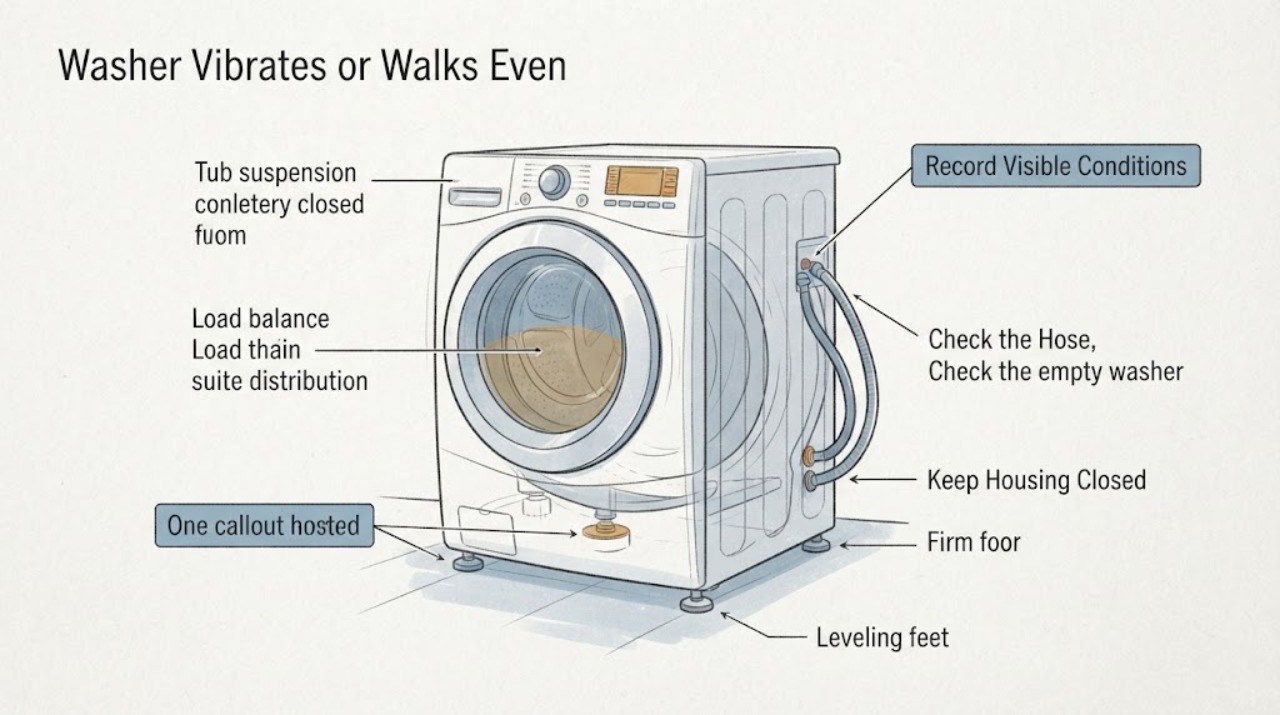
Work through in order
Diagnostic checks
Use only checks that match the exact appliance or system and its official guide.
-
Check 1
Pause the washer and wait until the drum is completely still. Record whether the walking starts during agitation or only as spin speed rises, and look from a safe position for cabinet impact, violent movement, smoke, burning odor, a hot plug or outlet, a leak, or a repeated breaker trip.
Expected result: The washer moves violently, strikes the cabinet, produces smoke or burning odor, heats an electrical connection, leaks, or only rocks briefly during spin.
Next step: Stop immediately for a safety symptom, keep clear, and arrange qualified or emergency help. If the washer is cool, dry, and still, unload it before any installation checks.
Why this matters
Why: Violent movement or a safety symptom is an injury, fire, electrical, or water event rather than an ordinary balance adjustment. Brief movement only at spin points to load, foot contact, leveling, or suspension behavior.
-
Check 2
With the drum empty, inspect beneath and around the washer for a drain pan, shipping pad, loose object, debris, water, or a hose and cord that can contact the cabinet. Check that the tub is centered in its opening and that a pedestal or platform is assembled according to its exact instructions.
Expected result: A pan or object touches the cabinet, debris or water is under a foot, the tub leans, the pedestal shifts, or the space beneath and around the washer is clear.
Next step: Remove only a loose, accessible object after the washer is still and dry. Do not drag the appliance across connected services; arrange help for a heavy move, a damaged platform, a leak, or a tub that remains off-center.
Why this matters
Why: An object, pan, unstable pedestal, debris, or water can reduce foot contact or transfer motion even when the structural floor is firm. A leaning tub or shifting platform needs installation correction before testing.
-
Check 3
Check the empty washer for level from side to side and front to back, then press opposing top corners diagonally to detect rocking. Confirm every leveling foot firmly contacts the clean, dry floor and that its lock nut or retaining hardware is tight according to the model instructions.
Expected result: The cabinet rocks, one foot lifts or slides, the bubble is off level, a lock nut is loose, or the washer remains stable and level when empty.
Next step: Use only the model's leveling procedure to make the smallest needed adjustment and secure the retaining hardware. Do not place improvised paper or wood under the machine; stop if adjustment requires lifting, excessive movement, or a damaged foot.
Why this matters
Why: A firm floor cannot stabilize a cabinet that is not level or has a loose foot. If the empty washer is level and stable, shift attention to load behavior, shipping hardware, surface slip, or an internal fault.
-
Check 4
If the washer was recently purchased, installed, or moved, read the exact installation manual and inspect only the accessible rear or base area for shipping bolts, retainers, foam, or other packing material that the manual says must be removed before use.
Expected result: Shipping hardware or packing remains, it was removed and the bolt holes are capped as directed, or the washer's installation history is unknown.
Next step: Remove or retain hardware only as the exact manual directs and only when the appliance can be handled safely. If access requires tilting or moving the washer alone, or the parts are damaged or missing, request qualified installation or service.
Why this matters
Why: Transport hardware can hold the tub and cause severe vibration if left in place. Unknown history does not prove the hardware is present; use the model instructions rather than guessing from appearance.
-
Check 5
For a stable, empty washer, use a suitable load rather than a single bulky item. Pause only after the tub stops, spread tangled or concentrated laundry evenly, and select the model-approved cycle and spin setting before one supervised test.
Expected result: The washer is quiet with an even load, moves only with a single or bulky item, repeatedly redistributes, or walks with a normal evenly spread load.
Next step: Continue only with suitable loads when the washer remains stable. Stop repeated tests for walking, cabinet impact, unusual noise, or a returning vibration and arrange qualified service.
Why this matters
Why: Improvement after redistribution supports an unbalanced load. Repeated correction or walking with a suitable load points to installation slip, drainage or spin behavior, or an internal suspension, drive, or sensor problem.
-
Check 6
After the washer is level, stable, correctly installed, and loaded appropriately, run one supervised model-approved test and note the exact phase, speed change, sound, and whether the floor or machine moves. Do not hold the washer, raise the spin speed to provoke the symptom, or run repeated tests.
Expected result: The test is stable, vibration returns only during high-speed spin, the tub makes scraping or knocking sounds, the washer walks despite a balanced load, or a vibration code appears.
Next step: Stop using the washer for recurring movement or abnormal sound and provide service with the phase, load, installation checks, and any code. Do not open the cabinet or replace suspension or drive parts based on symptoms alone.
Why this matters
Why: A stable test supports a corrected load or installation issue. Persistent high-speed movement with a firm, level setup may involve suspension, bearing, drive, sensor, pedestal, or another model-specific fault.
Use your observations
Decision map
Find the observation that best matches what you see, then follow the next safe action.
-
PATH 01Next step
What you see
The empty washer rocks diagonally, a foot lifts or slides, or a lock nut is loose even though the floor is firm.
Do this next
Use the exact model's leveling procedure, ensure all feet contact the clean, dry surface, and tighten the retaining hardware. Test only after the empty cabinet is stable; request help if the unit must be lifted or moved.
Why this path and its safety boundary
Why it matters: The problem is machine-to-floor contact or leveling, not necessarily the floor structure.
-
PATH 02Next step
What you see
The washer is stable when empty but walks with one bulky, tangled, or concentrated load and settles after the load is spread evenly.
Do this next
Use suitable mixed loads and the model-approved cycle or spin setting. Stop for repeated walking, cabinet impact, or movement with a balanced load.
Why this path and its safety boundary
Why it matters: Load imbalance is more likely than a structural floor problem.
-
PATH 03Next step
What you see
The washer was recently installed or moved and shipping bolts, a shipping block, or packing material may remain.
Do this next
Follow the exact installation manual and use assistance for any tilt or move. Do not run the washer until required restraints are removed or a qualified installer confirms the setup.
Why this path and its safety boundary
Why it matters: Transport restraints can keep the tub from moving normally and create severe vibration.
-
PATH 04Next step
What you see
The cabinet is level and stable, but the washer still slides on a smooth surface or shifts on a pan or pedestal.
Do this next
Clean and dry the contact area, remove only accessible loose objects, and secure the pedestal or accessory according to its instructions. Do not improvise shims or drag the washer with connected hoses.
Why this path and its safety boundary
Why it matters: Foot slip, poor contact, an unstable accessory, or a loose object can transfer spin force into walking without a weak floor.
-
PATH 05Next step
What you see
A firm, level, empty washer with shipping material removed still vibrates or walks with a suitable load, or produces scraping, knocking, or a returning vibration code.
Do this next
Stop using the washer and arrange qualified service. Provide the model, installation history, load type, phase of vibration, sounds, code, and checks already completed; do not open the cabinet or keep testing.
Why this path and its safety boundary
Why it matters: A suspension, tub support, bearing, drive, sensor, pedestal, or other internal condition is possible and cannot be confirmed safely from external checks.
-
PATH 06Next step
What you see
The washer moves violently, strikes the cabinet, leaks, smokes, smells of burning, heats a plug or outlet, arcs, or trips the breaker repeatedly.
Do this next
Stop immediately, keep clear, close the water supply only if safe, and isolate power only from a dry safe location. Obtain qualified appliance or emergency help and do not restart to test.
Why this path and its safety boundary
Why it matters: Continued operation could cause injury, shock, fire, or water damage.
Helpful context
Understand the symptom
A firm floor is only one part of the installation
The floor can feel solid while the washer still rocks on an incorrectly adjusted foot, slides on a smooth surface, or sits over a drain pan or object. Check the washer itself with an empty tub: press opposing top corners gently and watch for movement, then look at whether the tub is centered in its opening. A level floor cannot compensate for loose lock nuts, a foot that is not touching, or a pedestal that is not secured according to its instructions.
The load can create walking on a good installation
A single heavy item, a bulky blanket, tangled clothing, or a load concentrated on one side can become unbalanced as the drum accelerates. Pause only after motion stops, spread a suitable load evenly, and use the cycle and spin setting that the manual allows. Do not add random weight, hold the cabinet, or keep running a load that repeatedly strikes or walks.
Recent installation changes the first branch
If the washer is new or was moved, check the exact model installation instructions for rear shipping bolts, retainers, foam, or other packing pieces. These parts hold the tub during transport and can create severe vibration if left installed. Do not tilt a heavy washer alone; if checking underneath or behind it requires lifting or moving the appliance, use qualified help.
When a stable setup still shakes
Once the empty washer is level, all feet are firmly locked, the load is suitable, and shipping material is removed, persistent movement is no longer explained by the firm floor alone. A damaged foot, pedestal connection, suspension or tub support, bearing, drive, or vibration sensor may need inspection. Repeated high-speed tests can worsen damage, so stop and document when the vibration starts and what the drum is doing.
Safety boundary
Stop conditions
- Stop immediately for violent walking, cabinet impact, smoke, burning or electrical odor, arcing, a hot plug or outlet, repeated breaker trips, or a damaged cord. Do not restart the washer to test.
- Stop for a leak, pooled water, a damaged hose, a damaged foot or pedestal, a tub that is visibly off-center, or any movement near electrical parts. Close the water supply only if safe and arrange qualified service.
- Do not hold the washer while it spins, reach into a moving tub, tilt or move a heavy appliance alone, open the cabinet, make live electrical tests, or replace suspension or drive components based on vibration alone.
- Do not use improvised paper or wood shims, run repeated high-speed tests, add random weight to balance a load, or apply another model's shipping-bolt or leveling instructions.
Only after diagnosis
Potential parts
- leveling foot or foot-lock hardware
Consider this category only when inspection or qualified diagnosis identifies a damaged foot or retaining hardware after the floor and cabinet are correctly leveled.
Foot shape, thread, and lock hardware vary by washer and pedestal. Confirm exact model and diagnosis before selecting a part. - suspension or tub-support component
Consider this category only after qualified testing finds a suspension or tub-support fault with a level cabinet and suitable load.
Suspension parts are model-specific and may require heavy-appliance handling. Do not order from walking symptoms alone. - drive, bearing, or vibration-sensor component
Consider this category only when qualified diagnosis links persistent movement or abnormal sound to the drive, bearing, or sensing system after installation and load checks pass.
These components and service procedures vary substantially by model. Confirm the exact model and technician diagnosis before any replacement decision.
When checks do not resolve it
Need a professional?
Arrange qualified appliance service when a firm, level, empty washer with shipping material removed still vibrates or walks with a suitable load; when the vibration returns with scraping, knocking, a code, a damaged foot or pedestal, or a suspected suspension, bearing, drive, or sensor fault; or when the washer cannot be safely moved or leveled. Treat violent movement, leaks near electrics, smoke, burning odor, arcing, a hot plug or outlet, and repeated breaker trips as immediate safety issues.
Safety scope: Keep the washer off for violent movement, cabinet impact, smoke, burning or electrical odor, arcing, a hot plug or outlet, a leak near electrical parts, damaged wiring, or repeated breaker trips. Do not open the cabinet, lift the appliance alone, bypass safety devices, or repeat spin tests.
Common questions
FAQ
Why does my washer walk if the floor is solid?
A solid floor does not ensure firm contact at all four feet. A loose foot, unlevel cabinet, slippery contact surface, unbalanced load, shipping restraint, pan, pedestal, or internal suspension issue can still create movement. Check the empty washer first, then the load and installation history.
Can an unbalanced load make a washer walk?
Yes. Single, bulky, tangled, or concentrated laundry can shift as the drum accelerates and cause vibration or walking. Pause after the tub stops, spread a suitable load evenly, and stop if movement returns with a balanced load.
Should I check shipping bolts if the washer was moved?
Yes, use the exact installation manual when the washer is new or was moved. Shipping bolts or packing material left in place can cause severe vibration. Do not tilt or move a heavy washer alone; request installation help when access is unsafe.
How do I check whether the washer itself is level?
With the tub empty, place a level across the top and press opposing corners gently to check for rocking. Confirm all feet contact the clean, dry floor and that the model's retaining hardware is tight. Use only the exact model's adjustment procedure.
Are non-slip pads safe for a washer that walks?
Some manufacturer guidance mentions non-skid pads when a smooth surface lets the feet slide, but the correct accessory and installation depend on the model and floor. Do not use improvised shims or pads that prevent the feet from sitting correctly; persistent movement needs service.
When should a walking washer be serviced?
Arrange service when a firm, level, empty washer with shipping material removed still walks with a suitable load, or when it makes scraping or knocking sounds, shows a vibration code, leaks, or has a damaged foot, pedestal, cord, or cabinet. Stop immediately for smoke, burning odor, arcing, violent movement, or repeated breaker trips.
Read the exact guide
Official sources
- LG Washer - How to Level an LG Top Load Washing MachineLG Electronics · Manufacturer top-load guidance; installation details and adjustment limits vary by model.
- LG Washer – Troubleshooting Vibration IssuesLG Electronics · Manufacturer troubleshooting guidance; exact washer model and regional installation instructions control.
- LG washer - How to Level an LG Front Load Washing MachineLG Electronics · Manufacturer installation guidance for front-load examples; use the exact model manual for other washer designs.
Community feedback
Share a repair observation
Share a plain-text repair observation. Accepted observations are published automatically; this page may take a moment to update.