
On this page
Start here
Quick answer
When a washer still vibrates or walks with a balanced load, check the installation before assuming the tub or motor has failed. Stop the cycle if the cabinet is moving sharply, striking a wall, pulling a hose, or making a new grinding sound. From a stationary position, confirm all feet are firmly on a solid floor, the lock nuts are tight, and the cabinet does not rock; use the exact installation guide for adjustments. If the unit is a recently installed or relocated front-loader, verify that shipping restraints were removed, but do not move a stacked or built-in unit yourself. A stable, correctly leveled washer that still walks with a small balanced test load needs appliance service to inspect the pedestal, tub suspension, bearings, drive system, or frame.
Before you begin
Safety first
- This article covers stationary observations, visible installation checks, and model-documented accessible leveling or restraint checks. It does not authorize lifting or tipping the washer, moving a stacked or built-in unit, opening panels, testing live parts, bypassing safety devices, or replacing internal components.
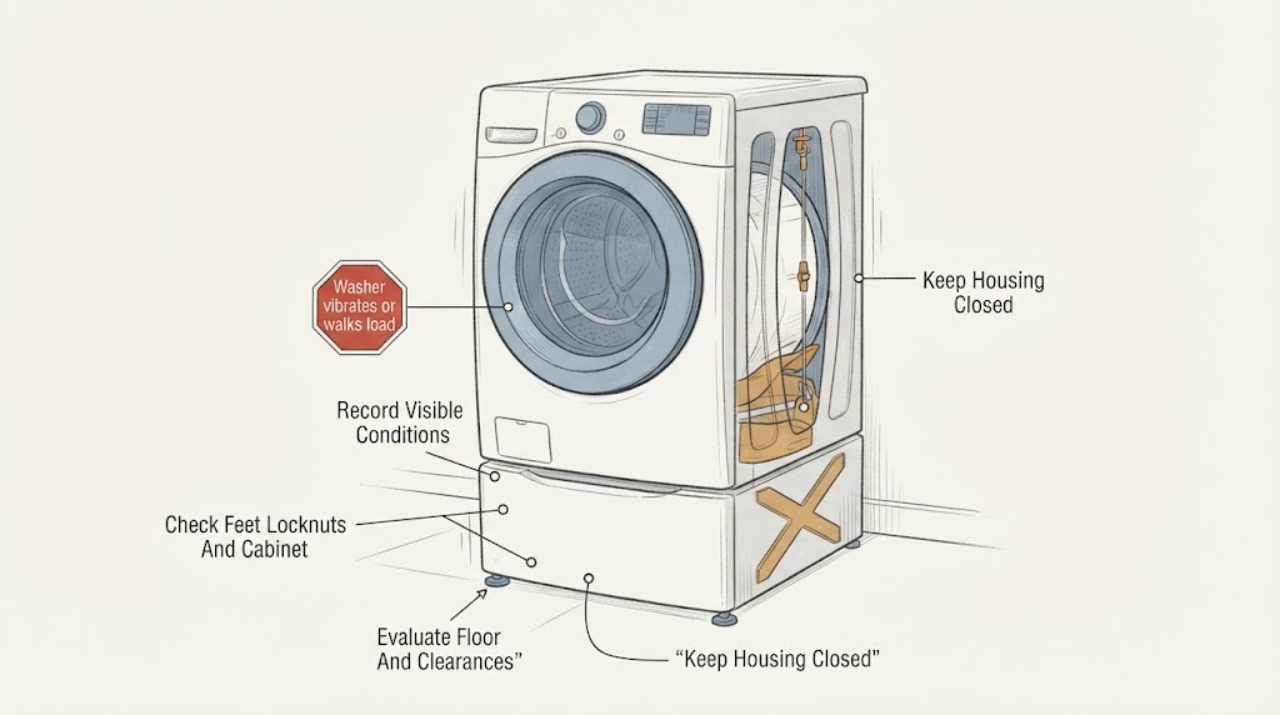
Work through in order
Diagnostic checks
Use only checks that match the exact appliance or system and its official guide.
-
Check 1
Stop the washer from the controls and record when the movement occurs, whether it is limited to high-speed spin, whether the cabinet strikes a wall or appliance, and whether there is grinding, scraping, leaking, or a displayed fault.
Expected result: Movement occurs only during spin, starts at the same point every cycle, began after installation or relocation, or is accompanied by impact, abnormal sound, a leak, or a fault.
Next step: Keep the washer off for a hazard or severe impact. If the movement is mild and there is no hazard, proceed with stationary installation checks rather than running more full loads.
Stop if: Stop immediately for smoke, burning odor, sparks, a damaged cord or hose, uncontrolled movement, water near electrical parts, or a cabinet that is striking nearby objects.
Why this matters
Why: Spin-only movement is often related to balance, leveling, floor flex, or tub isolation. A new impact, leak, grinding sound, fault, or post-relocation onset raises the priority of installation and mechanical inspection.
-
Check 2
With the washer empty and off, gently press the top at opposite corners to see whether the cabinet teeters; visually check that every foot touches the floor and that each foot's lock nut is tight against the washer or pedestal frame.
Expected result: The cabinet rocks, one foot has a gap, a foot turns freely, a lock nut is loose, or the unit is firm and does not teeter.
Next step: If the installation is accessible and non-stacked, adjust feet only as described by the exact manual, then tighten the lock nuts and repeat the stationary rock check. Do not use improvised shims or overextend a foot.
Stop if: Do not crawl under a running washer, lift or tip the appliance, adjust a stacked pedestal without its instructions, or continue if the cabinet is unstable.
Why this matters
Why: Rocking or a gap means the load is not carried evenly even though the laundry itself is balanced. A firm cabinet shifts attention to floor flex, transport restraints, pedestal hardware, or an internal mechanical fault.
-
Check 3
Inspect the floor around the washer for flexing, sagging, slipperiness, raised platforms, or an unsecured pedestal; check that the cabinet is not pressed against a wall, dryer, cabinet, or hose connection.
Expected result: The floor visibly flexes, the surface is slippery or uneven, the pedestal moves, the washer is wedged against another object, or the floor and clearances are stable.
Next step: Correct only an obvious clearance issue without pulling the washer or stressing hoses. Use the installation manual for floor reinforcement or pedestal requirements; arrange help for a built-in, stacked, or heavy-unit adjustment.
Stop if: Do not pull a connected or stacked washer, place loose boards or pads under a moving unit, or alter a raised platform without an installation plan.
Why this matters
Why: A flexible or slippery support can turn normal spin forces into walking even with a balanced load. Contact with a wall or appliance can amplify noise and make movement appear worse. A stable floor and clearances make a washer-side mechanical cause more likely.
-
Check 4
If the front-load washer was recently installed or moved, compare the rear transport-bolt or restraint area with the exact installation instructions and confirm that all required shipping hardware and packing material were removed; do not tilt or dismantle the unit.
Expected result: The washer is newly installed or relocated and transport hardware may remain, the hardware was removed as documented, or the washer is not safely accessible for this check.
Next step: Follow the exact manual or installer documentation for any restraint correction. If access requires moving a stacked, built-in, or heavy washer, stop and arrange qualified help.
Stop if: Do not remove unidentified fasteners, tilt the washer alone, pull a stacked unit, or operate a front-loader when transport hardware may still be installed.
Why this matters
Why: Retained transport restraints can hold the tub and cause severe vibration or noise. If restraints were removed correctly, or the unit is inaccessible, the cause is more likely leveling, the support structure, or an internal suspension or drive issue.
-
Check 5
Only after the washer is stable by hand, clear of nearby objects, and free of hazard, run one small, balanced, model-approved rinse-and-spin or spin test while observing from a safe distance; note whether it accelerates smoothly, rocks, walks, bangs, or stops with a fault.
Expected result: The test is stable, movement returns during spin, the tub or cabinet bangs, the washer stops with a fault, or water or a hose moves abnormally.
Next step: Stop the test at the first severe movement or abnormal sound. If movement returns, leave the appliance off and give the technician the cycle, load, speed, sound, and exact installation observations.
Stop if: Do not stand over the machine, hold it down, add weight to counter movement, or run repeated high-speed tests after a failed test.
Why this matters
Why: A stable test after setup correction supports an installation or floor issue that was resolved. Repeat movement with a small balanced load makes a suspension, damper, bearing, drive, frame, pedestal, or control problem more likely than laundry distribution.
-
Check 6
Compare the corrected installation with one normal, balanced load and record whether movement is gone, occurs only on a flexible floor or pedestal, or returns despite firm feet, clearances, and removed restraints.
Expected result: The washer stays in place, movement depends on the support surface, or movement returns on every suitable load.
Next step: Keep the washer out of service for persistent movement, impact, leaks, or abnormal noise. Arrange appliance service and provide the recorded pattern rather than ordering a part from the symptom alone.
Stop if: Do not keep using a walking washer, bypass a safety or lid control, open the cabinet, or replace suspension or drive parts without model-specific diagnosis.
Why this matters
Why: Improvement after leveling or support correction points to installation. Movement that remains on a stable support with a balanced load is less likely to be a laundry issue and more likely to need mechanical diagnosis.
Use your observations
Decision map
Find the observation that best matches what you see, then follow the next safe action.
-
PATH 01Safety boundary
What you see
The load is balanced, but the empty cabinet teeters, a foot has a gap, a lock nut is loose, the floor flexes, or the unit touches nearby objects.
Do this next
Correct accessible leveling and clearances using the model installation guide, then perform one small test. Arrange installation help for a pedestal, stacked, built-in, or heavy-unit adjustment.
Why this path and its safety boundary
Why it matters: The support system is more likely than the washer's internal drive or tub. A balanced load cannot compensate for uneven foot contact or a flexible or slippery floor.
Safety stop: Do not lift, tip, pull, or hold down the washer while it is connected or running.
-
PATH 02Safety boundary
What you see
Severe vibration began after first installation or relocation, and a front-loader may still have shipping bolts, a shipping block, or other transport material.
Do this next
Use the exact installation instructions or installer to verify and correct the restraint setup. Do not move a stacked or built-in unit to reach the rear.
Why this path and its safety boundary
Why it matters: Retained transport hardware can restrain the tub and produce excessive vibration or noise. The timing makes an installation error more likely than a sudden load problem.
Safety stop: Do not operate repeatedly while restraints may remain or remove unidentified hardware.
-
PATH 03Safety boundary
What you see
The washer is level and the load is balanced, but a pedestal shifts, its feet or mounting hardware are loose, the floor flexes, or movement changes when the unit is clear of a wall or appliance.
Do this next
Follow the model's pedestal and floor requirements, correct only safely accessible hardware or clearances, and arrange qualified installation help when the unit must be moved.
Why this path and its safety boundary
Why it matters: The support structure or clearance is amplifying normal spin forces. The washer may be mechanically sound, but the installation is not providing a stable platform.
Safety stop: Do not place loose pads or boards under a running washer or alter a platform without a suitable installation procedure.
-
PATH 04Safety boundary
What you see
All feet are firm, the floor is stable, restraints are removed, clearances are adequate, and a small balanced test load still causes walking, banging, grinding, leaks, or a recurring fault.
Do this next
Leave the washer off and arrange qualified appliance service. Provide the model, installation age, load, cycle, speed, movement direction, sound, and any code or leak details.
Why this path and its safety boundary
Why it matters: A tub suspension or damper, bearing, drive, frame, pedestal connection, hose or counterweight, or control fault is more likely than an unbalanced load.
Safety stop: Do not open panels, test live parts, bypass a lid or door safety, hold the washer down, or keep running failed spin tests.
Helpful context
Understand the symptom
A balanced load does not rule out installation
A load can be evenly distributed and the cabinet can still move if one foot is not carrying weight, a lock nut has loosened, the floor flexes, or a front-loader still has a transport restraint. The timing matters: movement that began after installation or relocation points toward setup, while movement on every load after a stable setup raises concern about the pedestal, suspension, drive, or frame.
Check the floor and the washer as one system
Leveling is not just a bubble reading. All four feet need firm contact, the cabinet should not teeter when gently checked from the corners, and the floor must support the high-speed spin without flexing. A washer on a pedestal has additional feet and mounting hardware, so the pedestal and washer must be checked together using the model's installation instructions.
Persistent movement is a stop point
Do not keep running full loads to see whether the washer settles. Severe shaking can damage hoses, cabinets, flooring, or internal parts. If the unit remains stable by hand but walks during a small, balanced test load after installation checks, record the sound and movement pattern and arrange qualified appliance service.
Safety boundary
Stop conditions
- Stop and keep the washer off for uncontrolled walking, cabinet impact, smoke, burning odor, sparks, a damaged cord or hose, a leak, or water near electrical parts.
- Do not lift, tip, pull, or dismantle a connected, stacked, built-in, or pedestal-mounted washer to inspect the floor, feet, restraints, or internal parts.
- Do not remove unidentified fasteners, open cabinet or suspension areas, test live circuits, bypass lid or door safety devices, or hold the washer down during spin.
- Do not use loose shims, boards, pads, or added weight as a substitute for correcting the installation requirements in the exact manual.
- Do not order leveling feet, pedestal hardware, suspension parts, bearings, drive parts, counterweights, or controls until the exact model and qualified diagnosis identify the failed component and fit.
Only after diagnosis
Potential parts
- leveling foot or lock-nut hardware
Consider this category only when the exact model's installation parts list and inspection identify a damaged or missing foot or lock nut after the floor and leveling procedure are confirmed.
Confirm the exact model, foot thread, lock-nut design, pedestal configuration, and manufacturer fit information before ordering. - pedestal mounting or support hardware
Consider this category only when a pedestal is present and qualified installation inspection confirms loose, damaged, or missing model-specific mounting or foot hardware.
Confirm the exact washer and pedestal models, mounting points, hardware specification, and installation procedure before ordering. - tub suspension, damper, bearing, or drive component
Consider this category only when firm feet, stable flooring, clearances, and transport setup are verified and qualified diagnosis identifies an internal mechanical cause.
Confirm the exact model, load design, component revision, repair procedure, and technician diagnosis; do not select a mechanical part from a similar-looking washer.
When checks do not resolve it
Need a professional?
Arrange appliance service when the washer still vibrates or walks with a balanced load after firm foot contact, correct leveling, stable flooring, adequate clearances, and model-documented removal of shipping restraints; when there is banging, grinding, leaking, a recurring fault, or movement on every suitable load; or when access requires moving a stacked, built-in, or heavy unit. Arrange qualified installation or floor support help when the pedestal, platform, or floor is unstable.
Safety scope: This article covers stationary observations, visible installation checks, and model-documented accessible leveling or restraint checks. It does not authorize lifting or tipping the washer, moving a stacked or built-in unit, opening panels, testing live parts, bypassing safety devices, or replacing internal components.
Common questions
FAQ
Why does my washer walk even when the load is balanced?
Check the washer as an installation system: a foot may not contact the floor, a lock nut may be loose, the floor may flex or be slippery, the unit may touch a wall, a pedestal may shift, or a front-loader may retain transport restraints. If those checks pass, internal suspension or drive service becomes more likely.
How can I tell whether washer feet are causing vibration?
With the washer empty and off, gently press opposite top corners. Rocking or a visible foot gap indicates uneven support. Follow the exact installation guide to adjust accessible feet and tighten lock nuts; do not lift, tip, or move a stacked or built-in unit.
Can a floor cause a balanced washer to vibrate?
Yes. A flexible, sagging, uneven, or slippery floor can amplify spin movement even when laundry is evenly distributed. Check the support and pedestal requirements in the installation guide, and arrange qualified help for floor or heavy-unit changes.
Could shipping bolts cause a washer to shake after moving it?
Yes, on designs that use transport restraints. If severe vibration began after installation or relocation, compare the rear restraint area with the exact installation instructions. Do not remove unidentified hardware or move a stacked washer to reach it.
When should I stop using a washer that still walks?
Stop for uncontrolled movement, cabinet impact, banging or grinding, smoke, burning odor, sparks, leaks, water near electrical parts, damaged hoses or cords, or a repeated fault. Keep the washer off and arrange qualified appliance or installation service.
Read the exact guide
Official sources
- Washer is Vibrating, Walking or Moving - Product HelpWhirlpool Corporation · Official Whirlpool product-help guidance used for general installation and movement checks; exact washer and installation manual controls model-specific procedures.
- Vibration - All-In-One Washer Dryer - Product HelpWhirlpool Corporation · Official Whirlpool all-in-one guidance used for support-surface and pedestal principles that also inform washer installations; the assigned topic is a washer, so the exact washer manual controls.
- LG Washer – Troubleshooting Vibration IssuesLG Electronics USA · Official LG support guidance used as a cross-brand comparison for restraint, leveling, and test-load decisions; exact model instructions control and no LG-specific fact is assumed for an unbranded washer.
- Leveling a Front Load Washer - Product HelpWhirlpool Corporation · Official Whirlpool installation guidance used for stationary support and pedestal branches; exact model installation instructions control.
Community feedback
Share a repair observation
Share a plain-text repair observation. Accepted observations are published automatically; this page may take a moment to update.