
On this page
Start here
Quick answer
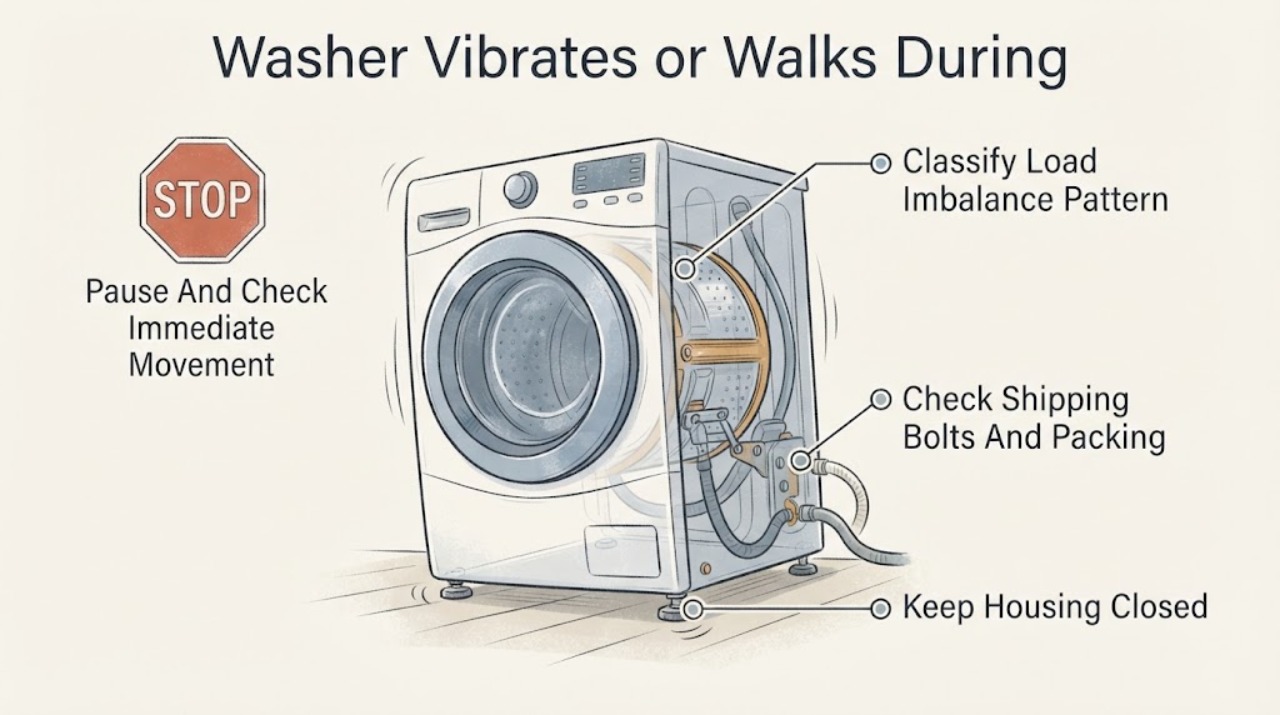
A washer that vibrates or walks during spin is usually responding to an unbalanced load, an unlevel or unstable installation, shipping hardware left in place after installation, or contact with a hose, wall, shelf, or cabinet. Pause the machine and keep clear of the moving tub. When it is stopped, empty enough clothing to inspect the load and redistribute it evenly; bulky, waterproof, single, or tangled items can shift weight to one side. From the floor, gently check whether the cabinet rocks diagonally and whether all feet contact a firm, level floor. If the washer was recently installed, use the exact manual to confirm shipping bolts or packing material were removed; do not move or tilt a heavy or stacked machine to reach them. Check that nearby hoses and objects are not striking the cabinet. If it still walks after the load and safe installation checks, or the drum, cabinet, floor, or suspension appears damaged, stop using it and arrange qualified appliance service.
Before you begin
Safety first
- This article supports only stopping the cycle, ordinary-access load observation, model-manual checks, and gentle floor-level stability and clearance inspection. Do not move or tilt the washer, open panels, bypass a lock, reach under the cabinet, or restrain a moving appliance.
Work through in order
Diagnostic checks
Use only checks that match the exact appliance or system and its official guide.
-
Check 1
Pause or stop the washer using its normal control and stand clear of the moving tub, door, hoses, and power connection; do not hold the cabinet or try to push it back while it spins.
Expected result: Record whether the cabinet walks across the floor, strikes a wall or shelf, pulls a hose or cord, opens a door gap, leaks, makes grinding or banging sounds, or shows smoke, a burning odor, or visible damage.
Next step: For a leak, strained connection, smoke, odor, or structural damage, keep the washer off and arrange qualified service. Otherwise wait until the tub and cabinet are fully still before inspecting the load and installation.
Stop if: Do not catch, restrain, drag, tilt, or climb on the washer while it is moving, and do not touch a wet power connection.
Why this matters
Why: Walking that strains hoses, cords, doors, or nearby objects can create a secondary leak or damage. Grinding, repeated hard impacts, smoke, odor, or visible structural damage is not a leveling experiment and may indicate a mechanical or electrical fault.
-
Check 2
With the washer stopped and the door or lid safely open, inspect the load and how the problem relates to the cycle; do not reach into a moving basket or force a locked door.
Expected result: Record whether the load is a single heavy item, blanket, rug, mat, waterproof fabric, laundry net, tangled bundle, very small load, tightly packed load, or ordinary mixed load, and whether walking happens only with that load or on every load.
Next step: Pause and redistribute or remove only the unsuitable load as the manual allows; use the model-appropriate cycle for bulky items. If the washer walks with a suitable balanced load, continue to the installation checks and plan service if it persists.
Stop if: Do not reach under the drum, force a lock, wash a load that already causes hard impacts, or add random items to conceal a repeated imbalance.
Why this matters
Why: A load that shifts to one side can make the tub lopsided and cause vibration or a reduced spin. Bulky, waterproof, single, tangled, or unusually small loads are more likely to concentrate weight; walking on every load points more toward level, floor, installation, or mechanical support.
-
Check 3
If the washer was recently installed, moved, or repaired, read the exact installation manual and inspect only the accessible rear area for shipping bolts or packing material; do not move, tilt, or disassemble the machine to reach them.
Expected result: Record whether the manual shows shipping hardware that should have been removed, whether the rear hardware appears present, whether the tub has the movement described by the manual, or whether this cannot be checked safely.
Next step: Follow the exact manual only when the hardware is safely accessible and removal does not require moving the washer; otherwise request qualified installation or appliance service. Do not run the machine while shipping hardware is suspected.
Stop if: Do not remove rear hardware from a stacked, confined, wet, or unstable washer, tilt the unit alone, or substitute tools or bolts.
Why this matters
Why: Shipping bolts or packing left in a newly installed front-loader can restrain the tub and create excessive vibration. A machine that cannot be checked without moving or supporting it needs a safe installation review; older machines with a new walking problem may have a different cause.
-
Check 4
When the washer is empty, stopped, and stable, press two diagonal top corners gently from the floor to see whether the cabinet rocks; check that the floor is firm and level and that all feet appear to contact it, without lifting or tipping the appliance.
Expected result: Record whether the cabinet rocks in one direction, a foot is visibly off the floor, the floor flexes or slopes, the tub appears off-center, or the washer is stable at all corners.
Next step: Use only the model manual's leveling-foot procedure when it can be completed without moving or tilting the machine, then confirm all feet are firmly supported. Request service when the floor is unstable, the unit is stacked, or leveling does not stop the movement.
Stop if: Do not place hands under feet, remove a stacking kit, lift the washer, use loose blocks or improvised anti-vibration parts, or level a moving or loaded machine.
Why this matters
Why: Rocking or a foot not contacting the floor supports a leveling or installation problem. A raised, uneven, or flexible foundation can transmit excessive vibration even when the feet are adjusted; a stable cabinet with persistent walking points toward load behavior or an internal mechanical issue.
-
Check 5
From the sides and front, inspect whether the washer, drain or inlet hoses, cord, shelf, cabinet, wall, or storage item can contact each other during normal vibration; do not pull the washer forward or reach behind it.
Expected result: Look for scuff marks, a hose tapping the cabinet, a cord or hose stretched by movement, a shelf or wall touch point, or clear space around a stable washer.
Next step: Restore only visible clearance or hose placement that can be corrected without moving the appliance and that matches the manual; request service when the machine must be moved, is stacked, or continues to walk.
Stop if: Do not reach behind, use a strap to restrain the cabinet, permanently pin a hose under the unit, or operate with a strained cord, hose, wall, or cabinet contact.
Why this matters
Why: A nearby object or hose can make a normal vibration sound like a mechanical fault and can eventually damage a connection. A hose or cord being pulled as the unit walks is a stop condition, not a reason to tie it tighter while the machine is operating.
-
Check 6
Only after the load and installation checks are complete and the washer is stable, use the exact manual's brief empty or light rinse-and-spin verification while observing from a safe position; stop immediately if it walks, bangs, leaks, or strains a connection.
Expected result: Record whether the washer remains stable, vibrates only briefly while balancing, walks again with a suitable load, makes a new mechanical sound, or shows an error or incomplete spin.
Next step: Do not run further cycles when the problem returns. Provide the model, load, installation history, video or notes, and result to qualified appliance service for diagnosis.
Stop if: Do not perform a full-load or unattended test, bypass a lid or door lock, hold the washer in place, or continue after a leak, impact, odor, or protection trip.
Why this matters
Why: A stable verification after correcting load or feet supports an installation or load imbalance. Repeat walking with a suitable load, vibration when empty, hard impacts, a persistent error, or a new mechanical sound makes a suspension, drum, motor, control, or structural fault more likely.
Use your observations
Decision map
Find the observation that best matches what you see, then follow the next safe action.
-
PATH 01Safety boundary
What you see
Walking happens only with a single, bulky, waterproof, tangled, very small, or uneven load and the empty or suitable-load verification is stable.
Do this next
Use the model-appropriate cycle, redistribute or remove the unsuitable load, and avoid repeating the load pattern; arrange service if the machine later walks with ordinary balanced loads.
Why this path and its safety boundary
Why it matters: Weight concentrated on one side of the tub is more likely than a failed suspension or level installation.
Safety stop: Do not keep running a load that causes hard impacts or attempt to balance it while the basket is moving.
-
PATH 02Safety boundary
What you see
Excessive vibration began immediately after installation or relocation and shipping bolts or packing material may still be present.
Do this next
Stop using the washer and follow the exact installation manual or request qualified installation service to verify and remove the hardware safely.
Why this path and its safety boundary
Why it matters: Shipping hardware that still restrains the tub is more likely than a sudden load imbalance, particularly on a recently installed front-loader.
Safety stop: Do not tilt, lift, or move a heavy or stacked washer alone, and do not run it while shipping hardware is suspected.
-
PATH 03Safety boundary
What you see
The cabinet rocks at diagonal corners, one foot is not firmly supported, the floor flexes or slopes, or a hose, wall, shelf, or cabinet is being struck.
Do this next
Correct only visible, manual-approved leveling or clearance issues without moving or tilting the unit; request service when the floor, stacking arrangement, or access prevents safe correction.
Why this path and its safety boundary
Why it matters: Installation support or clearance is more likely than a defective internal part; the contact can also damage hoses or the cabinet.
Safety stop: Do not use loose blocks, restraints, stacking-kit parts, or improvised pads, and do not operate while a hose or cord is strained.
-
PATH 04Safety boundary
What you see
The washer is level and clear, shipping hardware is accounted for, but it walks or vibrates strongly with a suitable load or during an empty verification.
Do this next
Stop using the washer and arrange qualified appliance service; provide the model, history, cycle, load, sound, and movement pattern rather than replacing a part by guesswork.
Why this path and its safety boundary
Why it matters: A suspension, drum, motor, control, structural, or other internal fault is more likely than a simple load or floor issue.
Safety stop: Do not open the cabinet, remove the tub, test live components, or continue cycles to force a diagnosis.
-
PATH 05Safety boundary
What you see
Walking is accompanied by hard banging, a cracked or bent cabinet, damaged door, water leak, strained hose or cord, burning odor, smoke, or an error that returns.
Do this next
Keep the washer off, isolate it only from a safe dry position if the manual and conditions permit, and request urgent qualified inspection.
Why this path and its safety boundary
Why it matters: The movement may have caused or exposed mechanical, water, or electrical damage beyond a leveling adjustment.
Safety stop: Do not restrain the cabinet, touch wet electrical parts, reset protection repeatedly, or operate the washer after impact or a leak.
Helpful context
Understand the symptom
Walking is a setup or load clue before it is a parts diagnosis
A drum naturally vibrates as it accelerates, but the cabinet should remain supported by its feet. Laundry stuck to one side, a single heavy item, a blanket or waterproof material, or a floor that flexes can amplify that movement. A washer that rocks when pressed at diagonal corners has a support or leveling problem. Do not immediately replace suspension parts or add improvised pads; first record whether the behavior follows the load, occurs on every cycle, or began after installation or relocation.
Recent installation changes the first check
Front-load machines are shipped with hardware that holds the tub during transport. If shipping bolts or packing material remain after installation, the tub can produce excessive vibration. Their location and removal procedure vary by model, and reaching the rear may require moving a heavy appliance. Use the exact manual and have service remove inaccessible hardware rather than tilting a stacked or tightly fitted washer.
Separate washer vibration from a rattling room
A drain or inlet hose, shelf, cabinet, wall, or storage item can strike a vibrating washer and make the movement sound worse. A loose floor can transmit vibration through the room even when the washer is level. Observe from a safe position, leave clearance as the manual requires, and keep hands away from the cabinet while the tub is spinning. Persistent walking with no load or after a stable installation check points toward service rather than a household object.
Safety boundary
Stop conditions
- Stop immediately for a leak, strained hose or cord, hard impacts, cracked or bent cabinet, damaged door, smoke, burning odor, or a protection trip; do not touch wet electrical parts.
- Do not hold, drag, tilt, lift, or climb on the washer while it is moving, loaded, stacked, or confined, and do not reach beneath the cabinet or basket.
- Do not bypass a door or lid lock, run unattended or full-load tests, open the cabinet, remove the tub, or test live wiring to diagnose walking.
- Do not remove shipping bolts from an inaccessible or stacked machine, use loose blocks or restraints, or improvise pads or supports under the feet.
- Do not replace suspension, drum, motor, control, or leveling parts from a generic symptom; persistent vibration with a suitable load requires qualified diagnosis.
Only after diagnosis
Potential parts
- leveling foot or installation hardware
Consider only when the exact manual and inspection show a damaged or missing foot, lock nut, stacking component, or installation part that prevents firm support.
Confirm the exact model, installation arrangement, floor support, and manufacturer procedure; do not use improvised blocks or pads. - suspension, shock absorber, tub support, or drum component
Consider only when the washer is level, the load is suitable, shipping hardware is accounted for, and qualified diagnosis finds an internal movement or support fault.
Match the exact model and configuration through qualified service; persistent walking alone does not identify a specific internal part. - door, lid, hose, control, or cabinet component
Consider only when movement caused or exposed visible damage, a strained hose, recurring error, or a control or structural fault confirmed by service.
Confirm exact model, load path, safety interlock, and installation requirements before ordering or replacing any component.
When checks do not resolve it
Need a professional?
Arrange qualified appliance service when the washer walks with a suitable or empty load, shipping hardware cannot be safely checked, leveling and clearance do not correct the movement, the floor or stacking arrangement is unstable, or the drum, cabinet, door, hoses, or controls appear damaged. Call urgently for a leak, smoke, burning odor, hard impact, strained electrical connection, or repeated protection trip. Provide the model and serial if safely visible, front- or top-load configuration, installation or relocation date, load type, cycle, movement pattern, sounds, floor and foot observations, shipping-hardware status, and photos or video from a safe position.
Safety scope: This article supports only stopping the cycle, ordinary-access load observation, model-manual checks, and gentle floor-level stability and clearance inspection. Do not move or tilt the washer, open panels, bypass a lock, reach under the cabinet, or restrain a moving appliance.
Common questions
FAQ
Why does my washer walk only during the spin cycle?
The spinning tub creates the most movement, so an unbalanced load, unlevel feet, unstable floor, shipping hardware, or contact with a wall or hose can make the washer walk. If it happens with every suitable load or when empty, stop using it and request service for a possible installation or internal fault.
Can one blanket or a small load make a washer vibrate?
Yes. A single heavy item, blanket, waterproof material, tangled bundle, or very small load can concentrate weight on one side and prevent a stable spin. Pause only when the tub is stopped, redistribute or remove the load as the manual allows, and do not keep running a load that causes hard impacts.
What should I check if the washer was just installed?
Use the exact installation manual to confirm that shipping bolts and packing material were removed and that the washer is level on a firm floor with all feet supported. Do not move or tilt a heavy, stacked, or confined washer to reach the rear; request installation service if the check is not safely accessible.
Should I put rubber pads under a walking washer?
Do not add improvised pads, blocks, straps, or restraints before identifying the cause. They can hide an unlevel floor, change the machine's support, or strain hoses and the cabinet. Follow only the exact manual's installation procedure and request service when level and clearance checks do not correct the movement.
When does washer vibration need a repair technician?
Request service when the washer walks with a balanced suitable load or empty check, persists after safe leveling and clearance checks, was installed with suspected shipping hardware, or has hard banging, a leak, damaged cabinet or door, strained hose or cord, smoke, odor, or a returning error.
Read the exact guide
Official sources
- LG Washer – Troubleshooting Vibration Issues on an LG Washing MachineLG Electronics · LG support guidance covering front- and top-load washers and related laundry products; exact model installation instructions control.
- LG Front Load Washing Machine - Vibrations FloorLG Electronics · LG installation guidance for front-load washers; exact model and building conditions control any relocation or floor work.
- LG Front Loader] Noise During Spin DryLG Electronics · LG front-load and washer-dryer support guidance; exact model procedures control.
- LG Washer - Troubleshooting Noises During the CycleLG Electronics · LG support decision flow for front- and top-load washers; cycle controls and safe access vary by model.
Community feedback
Share a repair observation
Share a plain-text repair observation. Accepted observations are published automatically; this page may take a moment to update.