
On this page
Start here
Quick answer
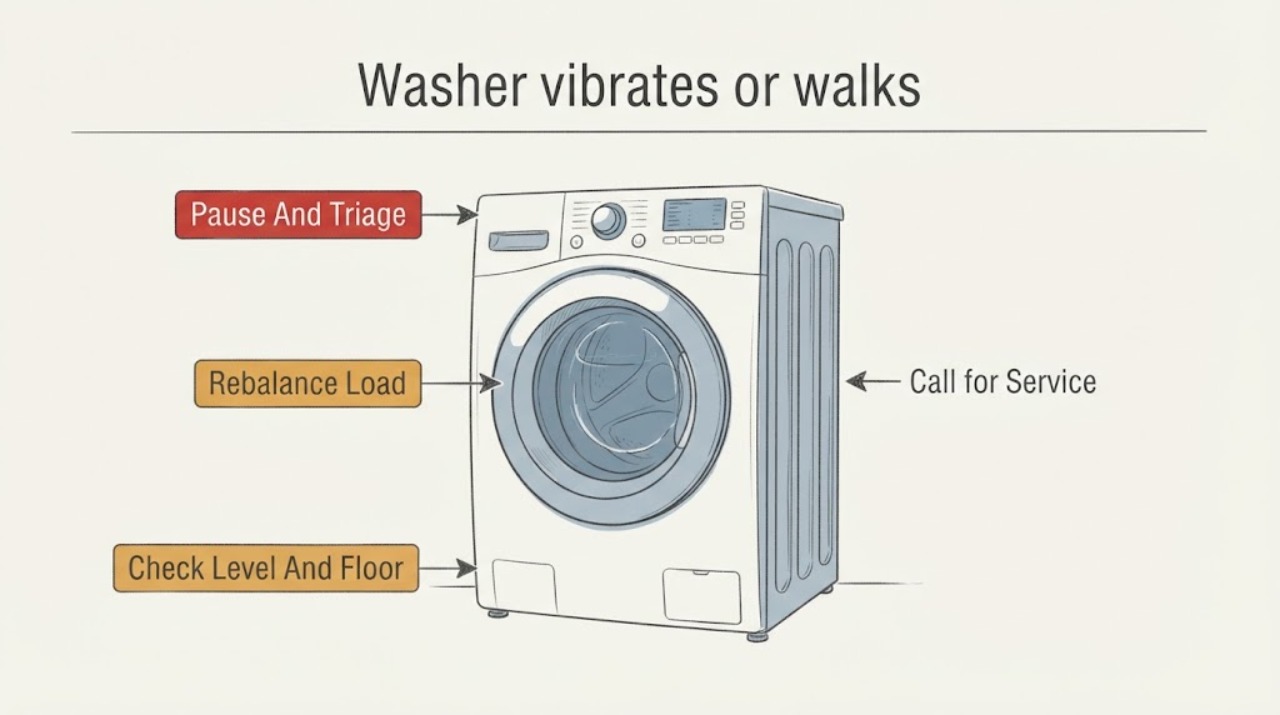
A washer that vibrates during spin may have an uneven load, an overloaded or single bulky item, loose contact at one or more feet, an uneven or flexible floor, or shipping hardware that was not removed after installation. Pause the cycle, wait for the drum to stop, and correct only a clearly accessible condition described by the model manual. Rebalance the load, check that the washer is level and all feet are firmly planted, and check installation hardware after a recent move. If it still walks with a balanced load, if the basket or drum seems loose, or if there is a leak, burning smell, exposed wiring, or other hazard, stop using it and arrange qualified service.
Work through in order
Diagnostic checks
Use only checks that match the exact appliance or system and its official guide.
-
Check 1
If the cabinet is walking, banging, or moving toward an edge, use the model's normal Pause or Cancel control and wait for the drum to stop before approaching it. From a safe position, note whether the symptom occurs only during spin and whether there is water, smoke, a burning smell, exposed wiring, or damage.
Expected result: The washer stops safely and shows no hazard, or it continues moving, leaks, smells hot or burned, exposes wiring, or cannot be approached safely.
Next step: For a hazard or unsafe movement, keep people clear, stop using the washer, and arrange qualified service. Otherwise continue with the load check while the tub is stopped.
Stop if: Do not touch a wet plug or exposed wiring, reach into a moving tub, or restart the washer just to reproduce a hazardous symptom.
Why this matters
Why: A spin-only symptom without a hazard can proceed to low-risk load and installation checks. Continued movement or a hazard is not a normal balancing problem and can damage the washer or surrounding area.
-
Check 2
With the washer stopped, pause the cycle as the manual directs and look at the load. Remove excess items if the tub is tightly packed, spread clothing evenly, and avoid testing with one heavy or highly absorbent item by itself. For a front-load model, LG recommends leaving room for the laundry to move rather than packing the tub full.
Expected result: The load is tightly packed, gathered on one side, tangled, or a single bulky item is present; or the load is loose and reasonably distributed.
Next step: Redistribute or reduce the load, then use the model's suitable spin setting. If the washer still walks with a balanced load, continue to the level and floor check.
Stop if: Do not exceed the capacity or loading pattern in the model manual, and do not keep retrying a load that makes the cabinet move violently.
Why this matters
Why: An uneven, overloaded, or single bulky load can create off-balance movement during spin. If the load is already loose and balanced, the load is less likely to be the main cause.
-
Check 3
When the tub is empty and the washer is in its normal position, place a level across the top in both directions if the manual permits. Gently press opposite top corners to check for rocking, and verify that all four feet make firm contact with a clean, dry, solid floor. Adjust the feet only as the installation instructions show, then tighten the lock nuts or jam nuts.
Expected result: The level changes from side to side or front to back, the cabinet rocks diagonally, one foot is not firmly planted, the floor flexes or sags, or a pedestal is loose; or the cabinet is level and stable.
Next step: Correct a small, manual-approved foot adjustment and recheck all directions. If the floor is flexible, damaged, significantly uneven, or the pedestal cannot be secured, stop and have the installation evaluated.
Stop if: Do not lift a heavy washer alone, put improvised materials under it, extend feet farther than the manual allows, or alter a raised platform without qualified help.
Why this matters
Why: An unlevel cabinet, loose foot, slippery surface, weak floor, or loose pedestal can turn a normal spin force into vibration or walking. A stable, level installation makes a load-only cause more likely than a setup fault.
-
Check 4
If the washer was recently installed or moved, use the exact installation manual to identify its transport hardware. On a front-load model, the drum should have some spring-supported movement when gently checked through the door; a drum that feels rigid can indicate that rear shipping bolts remain. Some top-load models instead use a shipping rod or other packing material.
Expected result: The washer is new or recently moved and the manual's shipping hardware appears present, the front-load drum has almost no give, or the installation hardware is confirmed removed; or the history is unknown.
Next step: If hardware may remain, do not run the washer. Follow the model installation procedure or have the installer or a qualified technician remove or verify it. Keep shipping hardware for a future move when the manual requires it.
Stop if: Do not tip, drag, or disassemble the washer to reach transport hardware, and do not guess whether a bolt, rod, or packing piece belongs to your model.
Why this matters
Why: Transport hardware holds the tub or suspension still during shipping. Running with the wrong hardware still installed can cause severe vibration, noise, or damage; a confirmed correct installation removes this as a likely cause.
-
Check 5
After only a safe, manual-approved correction, run one short test with a light, evenly distributed load from a clear position. Watch for continued walking, loud banging, a basket or drum that hangs off-center, or grinding or clanking; do not remove panels or test hidden components.
Expected result: The washer completes the test without excessive movement, or the symptom remains with a balanced load and stable installation; the basket or drum also appears loose or makes grinding or clanking sounds.
Next step: If the test is stable, return to normal use while following the model loading guidance. If movement or internal noise remains, leave the washer out of use and arrange a qualified diagnosis rather than ordering a part by symptom.
Stop if: Do not open the cabinet or attempt suspension, shock-absorber, bearing, electrical, or structural work as an ordinary-user repair.
Why this matters
Why: A quiet test after correcting the load or setup supports that condition as the immediate cause. Persistent movement, a loose basket, or harsh internal noise makes worn shock absorbers, suspension parts, bearings, or another concealed fault more likely, but the symptom alone does not identify a part.
Use your observations
Decision map
Find the observation that best matches what you see, then follow the next safe action.
-
PATH 01Safety boundary
What you see
The washer moves only during spin, especially with a single bulky item, a tightly packed tub, or clothing gathered on one side.
Do this next
Pause, redistribute or reduce the load according to the manual, and perform one controlled test. If it walks with a balanced load, use the installation branch.
Why this path and its safety boundary
Why it matters: The pattern makes an unbalanced or overloaded load more likely than a failed part.
Safety stop: Stop if movement is violent, repeats after a balanced load, or creates a leak or other hazard.
-
PATH 02Safety boundary
What you see
The cabinet rocks when empty, one corner is not planted, the level is off, the floor flexes, or a pedestal is loose.
Do this next
Use the model installation instructions to make a small leveling correction and secure the feet or pedestal. Get qualified help for a weak, damaged, or substantially uneven floor.
Why this path and its safety boundary
Why it matters: The installation or supporting surface is contributing to the vibration, even before laundry imbalance is considered.
Safety stop: Do not compensate by extending feet excessively or by moving the appliance alone.
-
PATH 03Safety boundary
What you see
The problem began immediately after delivery, installation, or relocation, and the front-load drum feels rigid or the model's transport material is not accounted for.
Do this next
Keep the washer off and use the exact installation manual or a qualified installer to verify and remove the correct transport material. Reinstall it for a future move when required.
Why this path and its safety boundary
Why it matters: Shipping bolts, a shipping rod, or packing material may still be restraining the tub or suspension.
Safety stop: Do not operate the washer with suspected transport hardware still installed.
-
PATH 04Safety boundary
What you see
A balanced load and stable, level installation do not stop the walking, or the basket or drum is visibly loose or makes loud clanking or grinding noises.
Do this next
Leave the washer out of use and arrange qualified service with the model number, symptom timing, load, installation history, and observations.
Why this path and its safety boundary
Why it matters: A concealed suspension, shock-absorber, bearing, or other internal problem becomes more likely, and the symptom does not identify a safe replacement part by itself.
Safety stop: Do not remove panels or attempt to repair the suspension or drum assembly.
-
PATH 05Safety boundary
What you see
There is an active leak, smoke, burning odor, exposed wiring, a damaged power connection, structural instability, or movement that could strike a person or pull a hose loose.
Do this next
Stop operation, keep people clear, and contact qualified appliance or electrical help. Shut off water or power only from a dry, safely accessible control point and only when the model and site make that safe.
Why this path and its safety boundary
Why it matters: The situation exceeds a safe observation and load-balancing check.
Safety stop: Do not touch wet electrical parts, open the cabinet, or restart the washer to test the hazard.
Helpful context
Understand the symptom
A little spin movement is different from walking
Some brief movement can occur while a washer senses or redistributes a load, but the cabinet should not travel across the floor, bang loudly, or threaten nearby hoses and walls. Treat repeated walking or loud impact as a reason to pause and inspect the safe, visible causes before running another load.
The installation details matter
Front-load and top-load washers do not use identical transport hardware or suspension designs. A front-load washer may still have rear shipping bolts after a move, while some top-load models use a shipping rod. The exact installation manual controls which hardware your model has and how it should be handled.
Keep the boundary safe
Use a dry, stable position and work only from normal, accessible locations. Do not remove cabinet panels, reach into a moving drum, tilt or move a heavy washer alone, bypass a lid or door lock, or attempt suspension, bearing, wiring, or structural work. The owner or installation manual takes priority over general guidance.
Safety boundary
Stop conditions
- Stop the cycle and keep people clear for violent movement, active water leakage, smoke, burning odor, exposed wiring, a damaged power connection, or structural instability.
- Do not reach into a moving tub, touch wet electrical parts, tilt or move a heavy washer alone, bypass a door or lid lock, or open the cabinet.
- If one safe, manual-approved load or leveling correction does not resolve the walking, leave the washer out of use and arrange qualified service.
- Suspension, shock-absorber, bearing, wiring, and structural work belongs to a qualified technician rather than an ordinary-user check.
Only after diagnosis
Potential parts
- washer leveling foot or foot hardware
Consider this category only if the installation check shows a damaged or missing foot and the model manual or a qualified diagnosis identifies it as the cause.
Confirm the exact washer model and the manufacturer's fit information before selecting any replacement. - washer suspension rods or shock absorbers
Consider this category only after a qualified diagnosis finds a loose basket, worn suspension, or related internal fault after load and installation causes are excluded.
Suspension parts vary by washer design; verify the exact model and manufacturer instructions rather than matching by appearance.
When checks do not resolve it
Need a professional?
Arrange service for persistent or recurring walking, loose or noisy basket or drum behavior, suspected transport damage, or any required concealed access.
Have this ready
- Exact brand and model if visible
- Whether the washer is front-load or top-load and whether it was recently moved
- When the movement occurs and whether the tub was full, balanced, or holding one bulky item
- Photos or observations of the floor, feet, pedestal, hoses, transport hardware, and any visible damage from a safe position
- What you did not open, move, disconnect, or test
Common questions
FAQ
Why does my washer walk only during the spin cycle?
Spin is when an uneven or overloaded load creates the greatest movement. Pause the washer, spread the clothes evenly, remove excess items, and avoid testing a single bulky or highly absorbent item by itself. If it still walks with a balanced load, check level, feet, floor, and recent installation hardware.
How can I tell whether leveling is part of the problem?
With the tub empty and the washer in its normal position, check the top in both directions and gently press opposite corners. Rocking, one foot not touching, a slippery or flexible floor, or a loose pedestal supports an installation problem. Adjust only as the model manual directs and secure the lock nuts.
What should I do if the washer was just moved?
Do not run it until the exact installation manual confirms the transport hardware is handled correctly. Front-load models may use rear shipping bolts, while some top-load models use a shipping rod. Do not tip or disassemble the washer to investigate; use the installer or qualified service if the hardware is inaccessible or uncertain.
When should I stop troubleshooting and call a professional?
Stop for violent movement, a leak, smoke, burning odor, exposed wiring, a damaged power connection, or unsafe access. Arrange qualified service if a balanced load and stable installation do not resolve the walking, or if the basket or drum is loose or makes loud clanking or grinding sounds. Do not open the cabinet or replace suspension parts based only on the symptom.
Read the exact guide
Official sources
- How to Stop a Washing Machine from ShakingMaytag · Manufacturer general guidance; model-specific owner and installation manuals take priority.
- LG Washer – Troubleshooting Vibration IssuesLG USA Support · Manufacturer guidance for LG washers; exact model installation instructions govern.
- Vibration or Out of Balance loads - Product HelpMaytag Product Help · Manufacturer guidance for Maytag top-load washers; model instructions govern capacity and loading.
- Washer Walking and/or Vibrating - Front Load WasherMaytag Product Help · Manufacturer guidance for Maytag front-load washers; use the model installation instructions for exact procedures.
- Top Load Washer - Walking or VibratingGE Appliances · Manufacturer guidance for GE top-load washers; model installation instructions govern shipping-material handling.
- Top Load Washer - Tub Movement / Auto Balance SystemGE Appliances · Manufacturer explanation for GE top-load washer suspension; exact model design may differ.
- HOW TO LEVEL A WASHING MACHINEMaytag · Manufacturer general leveling guidance; exact make and model instructions govern.
- Moving a Front Load WasherWhirlpool Product Help · Manufacturer guidance for Whirlpool front-load washers; exact model instructions and qualified installation support apply.
Community feedback
Share a repair observation
Share a plain-text repair observation. Accepted observations are published automatically; this page may take a moment to update.