
On this page
Start here
Quick answer
Do not cut, grind, demolish, or immediately coat a spalling driveway based only on its appearance. From a stable ground-level position, document whether the surface is flaking, pitted, peeling as a film, cracking, or losing aggregate; note whether damage is isolated or widespread and whether water, deicing material, drainage, or freeze-thaw weather may be involved. A sealer treats the surface and is only a possible fit for limited surface deterioration, so have a concrete professional assess severity, depth, drainage, and the cause before selecting sealer, patching, resurfacing, or replacement.
Before you begin
Safety first
- Do not cut, grind, chip, demolish, pressure-wash, scrape, chemically test, coat, lift slabs, or use vehicles to test a questionable area. Keep people and vehicles away from unstable or hazardous concrete.
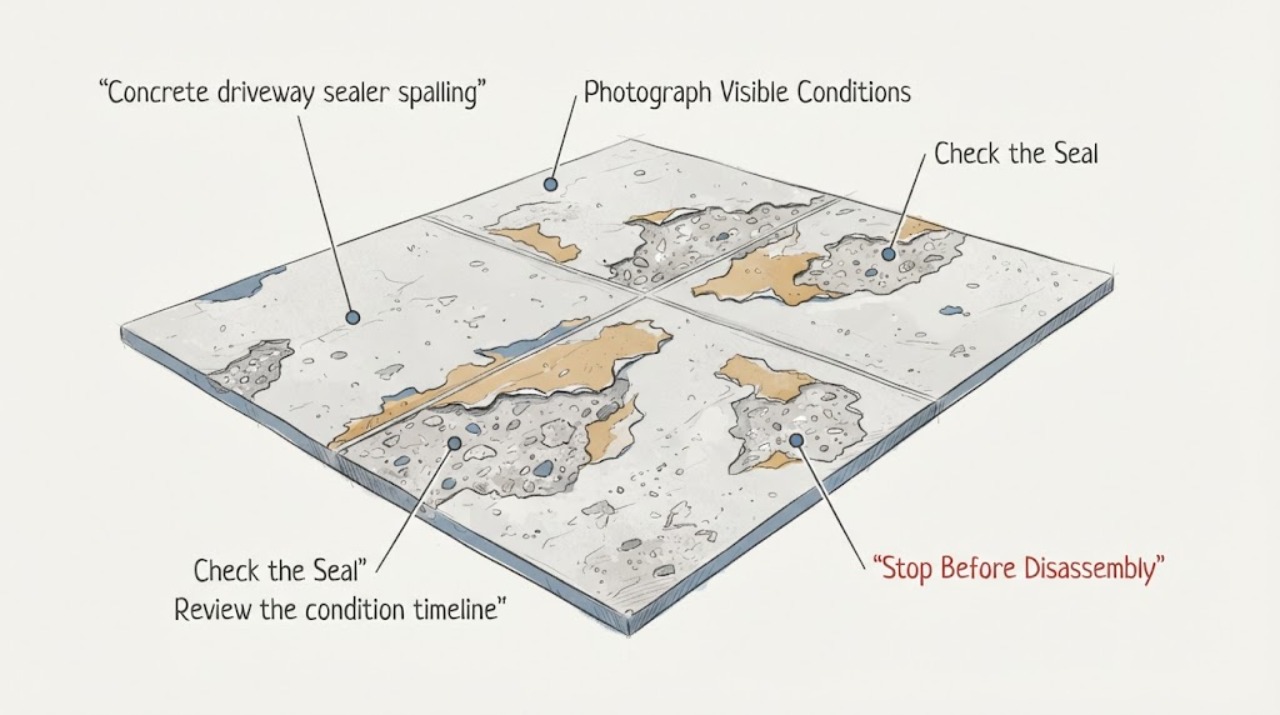
Work through in order
Diagnostic checks
Use only checks that match the exact appliance or system and its official guide.
-
Check 1
From a stable, dry ground-level position, look across the affected driveway surface and photograph it without scraping, chipping, grinding, cutting, or applying a cleaner or sealer.
Expected result: Describe whether the material is a thin film peeling from intact concrete, a rough or pitted surface with aggregate showing, loose flakes, isolated popouts, or cracking with material loss.
Next step: Send the photos and description to a concrete professional and ask for the surface condition and likely cause to be assessed before any coating or patch is selected.
Stop if: Stop and keep people away if the surface is crumbling under normal foot traffic, contains exposed sharp material, has a sudden void or collapse, or you would need to disturb it to see more.
Why this matters
Why: A peeling film may be a coating problem, while loss of the concrete surface suggests spalling or scaling that a new coating cannot be assumed to correct. Similar appearances can have different causes.
-
Check 2
Map the visible damage from the edge of the driveway or another safe position, noting whether it follows joints, cracks, slab edges, wheel paths, low spots, or broad sections.
Expected result: Record whether damage is isolated, repeated at joints, concentrated where water stands, or distributed across much of the slab. Do not lift a cover, remove joint material, or use a tool to measure depth.
Next step: Provide the pattern map to the professional so they can determine whether surface treatment, a localized repair, broader resurfacing, or another approach is appropriate.
Stop if: Stop if a joint or slab edge is moving, a void creates a fall risk, the driveway is unstable, or traffic cannot be kept away from the damaged area.
Why this matters
Why: Localized surface distress may have different treatment options from widespread or joint-related deterioration. A pattern at joints, edges, or low spots can indicate that water movement or joint condition matters more than the sealer alone.
-
Check 3
Review the condition timeline from safe observations: note when spalling appeared or worsened and whether it followed freeze-thaw weather, deicing-material use, heavy rain, standing water, or a previous coating.
Expected result: Write down the season or weather event, where water remains after rain, whether a coating peeled before the concrete broke away, and whether the change is continuing. Do not reproduce damage with chemicals, impact, or added water.
Next step: Give the timeline and photographs to a concrete professional and ask them to consider drainage, joints, surface condition, and the material history before recommending a sealer.
Stop if: Stop observation if the surface is actively collapsing, water undermines a walking path, or a severe weather event makes the driveway unsafe to approach.
Why this matters
Why: A relationship to wet-freezing conditions or deicing material can support a moisture-related surface distress hypothesis, while peeling over a stable surface may point toward a coating issue. Timing is evidence to discuss, not a standalone diagnosis.
-
Check 4
From the driveway perimeter, observe drainage and adjacent grades without excavating, drilling, lifting slabs, or entering traffic lanes.
Expected result: Note visible downspout discharge, puddles, soil washout, water flowing toward the slab, blocked surface drainage, or dampness at edges. Record the observation after ordinary rain rather than creating a hose test.
Next step: Tell the professional where water collects and request that drainage and slab-edge conditions be considered along with the spalling pattern.
Stop if: Stop if drainage observation would require excavation, moving heavy covers, approaching energized equipment, or entering pooled or contaminated water.
Why this matters
Why: Persistent water at or beneath the slab can contribute to ongoing deterioration and may limit what a surface sealer can accomplish. A dry surface on inspection day does not rule out intermittent moisture.
-
Check 5
Ask whether the damaged area is safe for normal walking and parking, without testing it by striking the concrete, driving over loose material, or placing weight on a questionable edge.
Expected result: Look for a trip edge, loose pieces, exposed aggregate or reinforcement, a widening crack, a hollow-looking void, displacement, or a surface that is visibly breaking down. Keep children, pedestrians, and vehicles away from unsafe areas.
Next step: Mark or isolate the area without drilling or anchoring anything, photograph it, and arrange a concrete service assessment with the safety observations.
Stop if: Stop using the area and seek prompt professional help for a trip hazard, slab movement, exposed reinforcement, rapid progression, or any collapse or void.
Why this matters
Why: An unsafe or progressively changing driveway needs an in-person assessment rather than a cosmetic sealer decision. A stable, limited surface condition still needs cause and extent reviewed before treatment.
Use your observations
Decision map
Find the observation that best matches what you see, then follow the next safe action.
-
PATH 01Next step
What you see
Only a thin coating is peeling while the concrete below appears stable from safe viewpoints.
Do this next
Have a professional identify the existing coating and evaluate preparation, moisture, and compatibility before recoating.
Why this path and its safety boundary
Why it matters: This may be a coating failure rather than concrete spalling, but do not assume a new coating will bond or solve the cause without surface and moisture assessment.
-
PATH 02Next step
What you see
The concrete itself is flaking, pitted, or exposing coarse aggregate.
Do this next
Request a condition assessment that distinguishes limited surface distress from deeper or progressive deterioration before patching, resurfacing, or sealing.
Why this path and its safety boundary
Why it matters: Treat it as concrete surface deterioration, not just a sealer problem. A surface sealer is not automatically suitable, especially when severity or depth is uncertain.
-
PATH 03Next step
What you see
Spalling is concentrated at joints, cracks, edges, or places that stay wet.
Do this next
Provide the pattern and drainage observations to a concrete professional for a cause-and-extent review.
Why this path and its safety boundary
Why it matters: The pattern suggests that water movement, joint condition, or the slab edge may influence the damage. Surface coating alone may not address that pathway.
-
PATH 04Next step
What you see
Damage is widespread, progressing, displaced, or creates a trip or vehicle hazard.
Do this next
Isolate the area and arrange prompt professional evaluation before normal use or repair work.
Why this path and its safety boundary
Why it matters: Do not attempt cosmetic sealing, impact testing, cutting, grinding, or demolition. The decision may require broader repair planning and an assessment of slab condition.
-
PATH 05Next step
What you see
The surface is stable and damage appears limited, with no active drainage concern visible.
Do this next
Ask the professional whether a compatible sealer or localized repair is appropriate for the observed condition and exposure.
Why this path and its safety boundary
Why it matters: A surface treatment may be considered only after the material, moisture history, and extent are confirmed; even limited distress can recur if the underlying cause remains.
Helpful context
Understand the symptom
Spalling is not always a sealer failure
A driveway can show a thin surface film peeling away, or the concrete itself can flake and expose coarse aggregate. Those conditions can look similar from a distance but lead to different decisions. Water, freeze-thaw exposure, deicing salts, weak near-surface concrete, joint distress, drainage, and reinforcement-related deterioration are all possible contributors. A new sealer may hide a symptom without addressing deterioration below the surface.
What surface sealing can and cannot do
Federal Highway Administration guidance describes sealers as a way to limit moisture and chloride entry from the pavement surface, not as a repair of every cause or depth of distress. Surface sealing is most appropriate only after the condition is understood and when deterioration is limited to the surface. The slab can still receive moisture from its sides or underside, so drainage and the extent of damage matter.
Keep the assessment observational
This page covers safe documentation for a service assessment. Do not pressure-wash, scrape, grind, cut, chip, remove sound concrete, apply chemicals, or spread a coating to test a theory. Keep vehicles and pedestrians away from an unsafe area, and let a qualified concrete professional choose any preparation or repair method after evaluating the slab and its surroundings.
Only after diagnosis
Potential parts
- concrete patch
Only consider a patch category after a professional confirms that deterioration is localized, the substrate is suitable, and patching addresses the assessed condition rather than masking ongoing damage.
Confirm material suitability for the existing driveway, exposure, repair depth, and manufacturer's application requirements before any purchase or use. - concrete sealer
Only consider a sealer when the professional determines that deterioration is limited to the surface and that moisture, drainage, coating history, and surface preparation support sealing.
Confirm compatibility with the existing concrete and any prior coating, intended exposure, and manufacturer guidance; a sealer is not a guarantee against deeper or underside moisture. - concrete cleaner
Only consider a cleaning category if a professional identifies a compatible, low-risk preparation need; do not use chemicals or pressure to test or conceal spalling.
Confirm compatibility with the concrete, existing sealer, runoff constraints, and the professional's preparation plan before use.
When checks do not resolve it
Need a professional?
Arrange a concrete service assessment when the driveway surface itself is flaking or pitted, damage is recurring or widespread, joints or edges are deteriorating, drainage remains wet, or a sealer has failed. Request prompt help for movement, collapse, voids, exposed reinforcement, or a serious trip hazard.
Safety scope: Do not cut, grind, chip, demolish, pressure-wash, scrape, chemically test, coat, lift slabs, or use vehicles to test a questionable area. Keep people and vehicles away from unstable or hazardous concrete.
Have this ready
- Provide safe ground-level photos, the distinction between film peeling and concrete loss, the location pattern, weather and deicing history, visible drainage or standing-water observations, prior coating information, and any use restriction already in place.
Common questions
FAQ
Can I just apply another sealer over the spalling?
Not before the condition is identified. A sealer acts at the surface and may be appropriate only for limited surface deterioration; it will not automatically correct deeper damage, water entering from below, or an unsuitable existing coating.
How do I tell sealer peeling from concrete spalling?
From a safe viewpoint, note whether a thin film separates while the concrete remains intact, or whether the concrete itself is rough, pitted, flaking, cracking, or losing aggregate. Do not scrape or chip to find out; have a professional assess the surface.
Can deicing material or standing water cause this condition?
They can be relevant contributors, especially when damage follows wet-freezing conditions or remains concentrated where water collects. Record the weather, drainage, and material-use history and provide it to the concrete professional rather than trying to reproduce the damage.
When should the driveway stop being used?
Keep people and vehicles away when there is a trip edge, slab movement, a void or collapse, exposed sharp material, rapid progression, or an area that is unsafe to approach. Arrange prompt professional assessment before normal use resumes.
Read the exact guide
Official sources
- Section 3 - Guidelines for Detection, Analysis, and Treatment of Materials-Related Distress in Concrete Pavements, Volume IIFederal Highway Administration · Used to explain that sealers act at the pavement surface, cannot block all moisture from sides or bottom, and are conditional on severity and extent.
- 2.0 Selection of Candidate Projects - Partial-Depth RepairsFederal Highway Administration · Used to explain why spalling at joints or cracks can have causes beyond a surface coating and why repair selection depends on deterioration depth and condition.
- Chapter 4 - High-Performance Concretes, 1989-1994Federal Highway Administration · Used for the distinction between rough or pitted surface scaling and possible moisture/deicing-related deterioration.
Community feedback
Share a repair observation
Share a plain-text repair observation. Accepted observations are published automatically; this page may take a moment to update.