
On this page
Start here
Quick answer
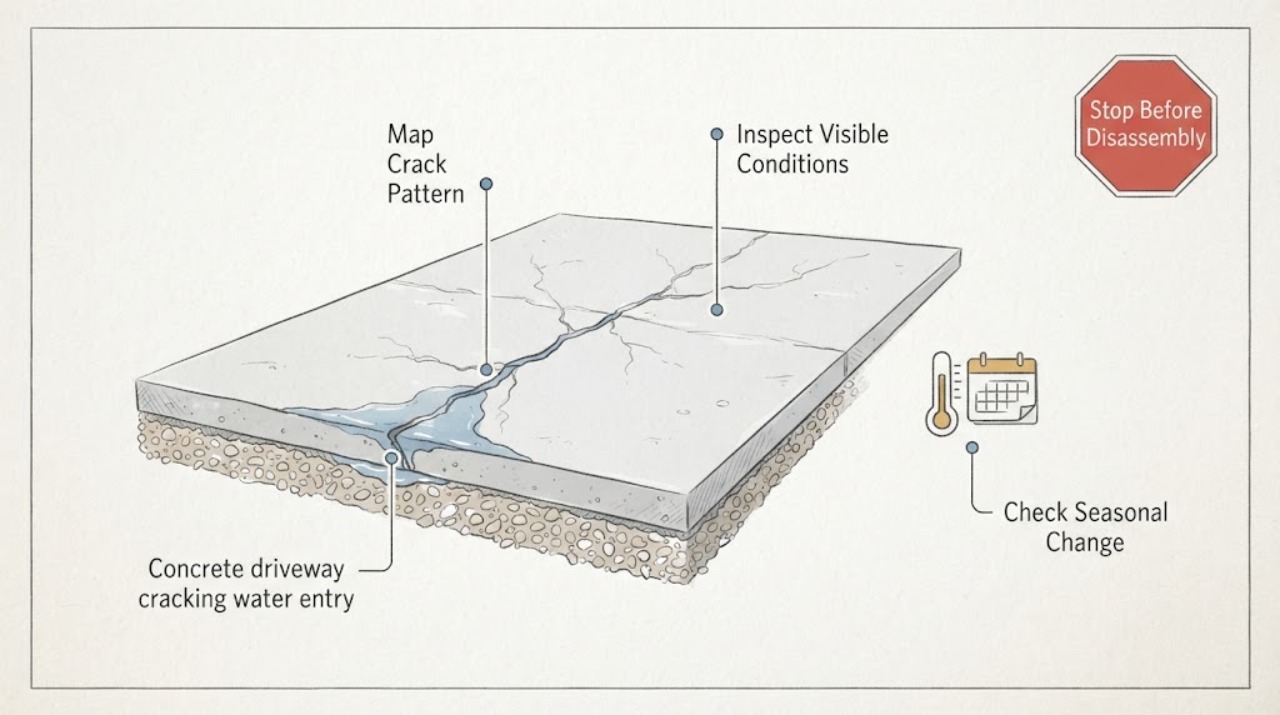
Concrete driveway cracks that admit water need a drainage and condition assessment before filler or sealer. From a safe walking position, map crack direction and width visually, note ponding and runoff, photograph edges and adjacent soil, and record seasonal change. Do not widen cracks, remove concrete, inject material, or use a repair product as a diagnostic test. Arrange concrete or drainage service when cracks are moving, widening, undermining the slab, or allowing water toward the structure.
Before you begin
Safety first
- This article provides observation-only guidance. Professionals determine drainage, base support, crack treatment, slab repair, and compatible products.
Work through in order
Diagnostic checks
Use only checks that match the exact appliance or system and its official guide.
-
Check 1
Photograph the full driveway and close-ups of each crack, joint, edge, and nearby slab; visually note direction, branching, offset, and apparent change without inserting a tool or material.
Expected result: Cracks may be isolated, parallel to joints, map-like, at slab edges, accompanied by spalling, or associated with vertical offset.
Next step: Keep the map and dates and request a concrete assessment before filling.
Stop if: Stop for a sinkhole, undermined edge, severe offset, loose fragments, or an unsafe walking surface.
Why this matters
Why: Pattern and offset help the professional distinguish surface distress from movement or broader deterioration, but appearance alone cannot establish depth or cause.
-
Check 2
After ordinary rain, observe from a safe position where water ponds or flows in relation to the cracks, driveway slope, downspouts, and foundation; do not create a hose test.
Expected result: Water may drain away, pond at a crack, flow toward the structure, or enter soil at an undermined edge.
Next step: Photograph the runoff and ask for drainage plus slab evaluation before applying a sealant.
Stop if: Stop near moving water, undermined ground, flooding, or any need to excavate or redirect buried services.
Why this matters
Why: The route indicates a possible drainage contribution, while a dry day does not rule out seasonal or subsurface water.
-
Check 3
Compare current photos with prior seasons and note freeze-thaw, heavy-rain, vehicle-load, or settlement timing; do not load-test or drive over a visibly unstable area.
Expected result: The crack may be stable, widen seasonally, develop spalling, or show a new vertical step.
Next step: Provide the timeline and keep heavy loads away from unstable areas until assessed.
Stop if: Stop for rapid change, deep voids, major displacement, or a hazard to people or vehicles.
Why this matters
Why: Change over time or slab movement raises the need for professional repair design rather than cosmetic filling.
-
Check 4
From accessible ground, inspect the foundation-facing edge, garage threshold, walls, and downspout discharge for staining, soil washout, dampness, or water path; do not dig or open the slab.
Expected result: Adjacent areas may be dry, show ponding or washout, show dampness at the structure, or be inaccessible.
Next step: Share photos and request an evaluation of slope, joints, base support, crack cause, and water management.
Stop if: Stop for undermined foundation soil, structural movement, flooding, or buried-utility uncertainty.
Why this matters
Why: Water reaching the structure or washing out the edge increases urgency and suggests drainage and concrete scope should be coordinated.
Use your observations
Decision map
Find the observation that best matches what you see, then follow the next safe action.
-
PATH 01Safety boundary
What you see
Is there widening, vertical offset, spalling, or rapid change?
Do this next
Keep traffic away and arrange prompt concrete or structural assessment before any patching.
Why this path and its safety boundary
Safety stop: Do not widen, grind, inject, or fill the crack yourself.
-
PATH 02Safety boundary
What you see
Does water pond or flow toward the foundation or garage?
Do this next
Arrange drainage and concrete evaluation and protect the structure from further water entry where safe.
Why this path and its safety boundary
Safety stop: Do not excavate or alter grading without checking buried services and the drainage plan.
-
PATH 03Safety boundary
What you see
Is soil washed out or the driveway edge undermined?
Do this next
Keep vehicles and people away from the edge and request prompt professional assessment.
Why this path and its safety boundary
Safety stop: Do not place a vehicle over a visibly unsupported slab.
-
PATH 04Safety boundary
What you see
Is the crack visually stable, with no offset, ponding, or structural symptom?
Do this next
Ask a concrete professional whether a compatible filler or sealer is appropriate after confirming the cause and surface condition.
Why this path and its safety boundary
Safety stop: Do not treat a product label as proof of compatibility or cause.
Helpful context
Understand the symptom
Water entry can be a symptom of movement
Water can enter through cracks and worsen freeze-thaw or saturation damage, while settlement, poor drainage, joint movement, and concrete durability can also create the crack. FHWA guidance describes moisture and environmental exposure as important contributors to concrete cracking, spalling, and deterioration.
Map the drainage before choosing a product
A filler may be suitable only for a confirmed, stable, localized condition. If water ponds, flows toward the house, or the slab is moving, the drainage or concrete system needs professional evaluation before surface treatment.
Only after diagnosis
Potential parts
- concrete-crack-filler
Consider this category only after a professional confirms the crack is stable, localized, and suitable for surface treatment.
Confirm crack movement, width, moisture, temperature, surface preparation, and manufacturer instructions; filler cannot correct settlement or drainage. - concrete-sealer
Consider this category only after concrete condition and water management are addressed and a professional approves a compatible sealer.
Verify existing coating, moisture, surface condition, exposure, and application requirements before purchase. - moisture-meter
Consider this category only if a professional recommends screening accessible concrete or adjacent materials.
Readings vary with concrete and surface conditions and cannot establish crack depth or structural cause.
When checks do not resolve it
Need a professional?
Arrange concrete and drainage assessment when a driveway crack admits water, changes over time, has offset or spalling, ponds water, directs runoff toward the structure, or undermines an edge. Escalate promptly for foundation exposure, flooding, or an unsafe slab.
Safety scope: This article provides observation-only guidance. Professionals determine drainage, base support, crack treatment, slab repair, and compatible products.
Have this ready
- Full-driveway and crack close-up photos with dates
- Crack pattern, offset, spalling, and seasonal-change notes
- Rain and runoff observations
- Downspout, soil washout, foundation, and garage-threshold photos
- Prior repairs, sealers, traffic changes, and access limitations
Common questions
FAQ
Does filling a driveway crack stop water entry permanently?
Not necessarily. If the slab moves, water ponds, or the base and drainage are failing, surface filler may fail. Have the condition and water route assessed first.
What crack changes matter most?
Widening, vertical offset, spalling, rapid seasonal change, undermined edges, and water toward the foundation all increase the need for professional assessment.
Can I use a hose to find the leak path?
Do not create a hose test. Observe ordinary rain from a safe position and record ponding and runoff for the concrete or drainage professional.
When is a driveway crack unsafe?
Keep people and vehicles away for major offset, loose fragments, sinkholes, undermined edges, flooding, rapid movement, or any hazard to the foundation or garage.
Read the exact guide
Official sources
- Partial-Depth Repairs: Selection of Candidate ProjectsFederal Highway Administration · Supports the relationship between moisture, environmental exposure, cracking/spalling, and the need to assess deterioration depth before repair.
- Guidelines for Detection, Analysis, and Treatment of Materials-Related Distress in Concrete PavementsFederal Highway Administration · Supports documenting crack/spall patterns, environmental exposure, moisture, and history before assigning a repair cause.
Community feedback
Share a repair observation
Share a plain-text repair observation. Accepted observations are published automatically; this page may take a moment to update.