
On this page
Start here
Quick answer
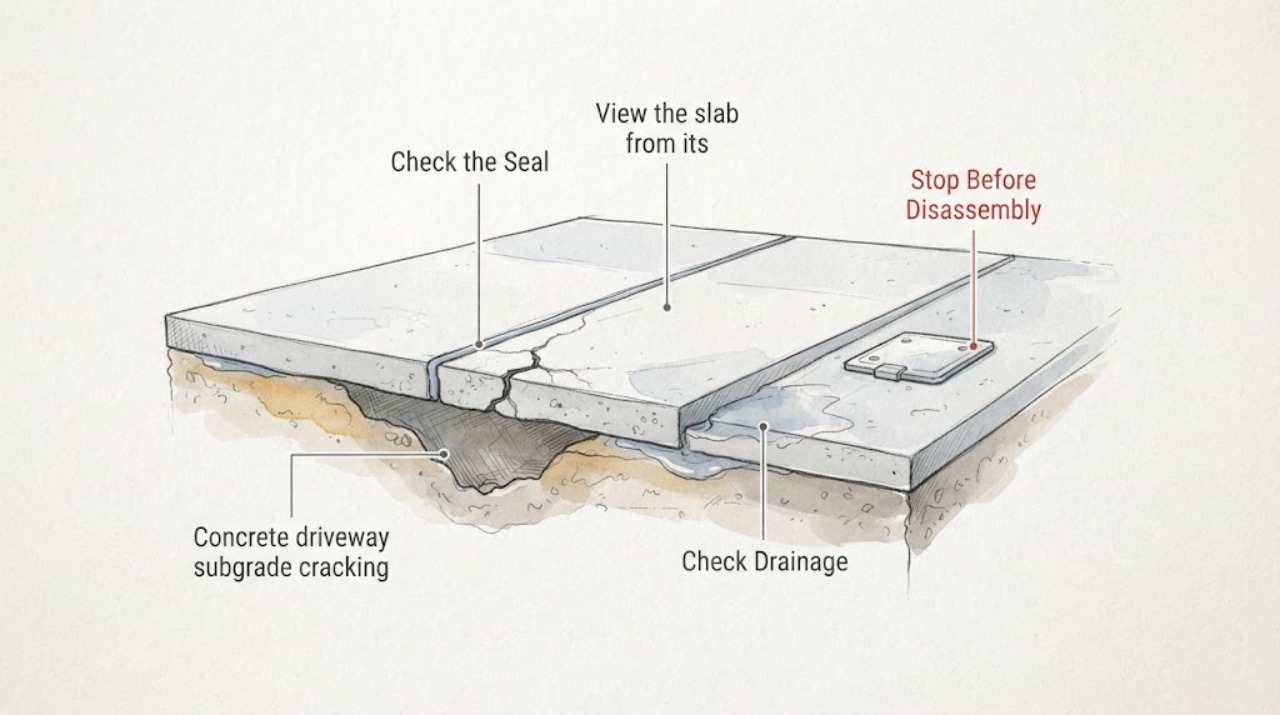
Cracks in a concrete driveway do not prove that the subgrade failed, but cracking combined with settlement, a rocking or uneven slab, edge erosion, standing water, or a void-like appearance needs more than a surface filler. Inspect only from a safe position, record the crack pattern and drainage context, and keep vehicles and pedestrians away when the surface is unsafe. Do not drill, excavate, cut, grind, inject, or attempt structural repair. A qualified concrete or pavement professional should determine whether the cause is surface distress, loss of support, water movement, expansive soil, frost action, or another condition before recommending a repair.
Work through in order
Diagnostic checks
Use only checks that match the exact appliance or system and its official guide.
-
Check 1
From the driveway edge, visually map the crack pattern without walking on an unstable section; note whether the crack is isolated, follows a joint, branches, intersects another crack, reaches an edge, or is accompanied by chipped or missing concrete.
Expected result: The crack is a narrow isolated line with no visible displacement, or it branches, intersects, reaches an edge, and has visible spalling or separated pieces.
Next step: Photograph the full slab and close views from a safe location, then ask a concrete professional to assess the crack pattern and the condition below it before selecting filler or sealer.
Stop if: Stop and isolate the area if pieces are loose, the crack edge is sharp, the surface shifts, or the condition creates a trip hazard.
Why this matters
Why: Pattern and severity help a professional distinguish a surface symptom from distress that may involve support below the slab. A pattern alone cannot identify a subgrade failure or determine the correct repair.
-
Check 2
View the slab from its side and from the driveway entrance to compare the visible surface with adjacent pavement, garage threshold, walkway, or curb; note settlement, lifting, rocking-looking sections, or a raised edge without stepping onto the questionable area.
Expected result: The slab appears level with its surroundings, or one section appears lower, higher, tilted, or separated from the adjoining surface.
Next step: Keep vehicles and foot traffic off the affected section when safe passage is uncertain, document the boundary, and arrange an in-person pavement assessment.
Stop if: Do not cross or load a section that rocks, has a sharp step, or appears close to collapse; use an alternate route and obtain professional help.
Why this matters
Why: A visible elevation change can indicate movement or loss of support, but it does not show whether soil, base material, drainage, or the slab itself is responsible. The difference may also create an immediate access risk.
-
Check 3
From dry ground, inspect visible driveway edges and nearby drainage paths for soil washout, sediment, ponding, downspout discharge, or water flowing toward the slab; do not move soil, open the pavement, or conduct a water test.
Expected result: Water collects near the crack or edge, soil appears washed away, a drain or downspout directs water toward the driveway, or no drainage relationship is visible.
Next step: Photograph the drainage context during or after a normal weather event only from a safe location, and tell the professional where water collects, exits, or changes direction.
Stop if: Stay away during flooding, severe weather, or unstable edges; do not enter moving water or attempt to redirect drainage yourself.
Why this matters
Why: Water can weaken or erode supporting layers and can accelerate pavement distress, but the same visual sign can have multiple causes. A professional needs to trace the drainage path and evaluate the slab and support together.
-
Check 4
Observe the crack and surrounding slab over time from the same safe viewpoint, noting new branches, widening appearance, additional settlement, surface breakup, or changes after ordinary wet or freezing weather.
Expected result: The appearance remains unchanged, or the crack and displacement are visibly progressing or recurring after weather changes.
Next step: Keep dated photographs and a short observation log for the professional; do not use the log as a substitute for an assessment when the driveway is unsafe or the condition is progressing.
Stop if: Stop using the section and arrange prompt service if new displacement, rapid expansion, a broken edge, or a sudden change appears.
Why this matters
Why: A changing pattern is more concerning than a stable cosmetic mark and may indicate ongoing movement, moisture, or support changes. A stable appearance still does not rule out concealed voids or an older support problem.
-
Check 5
From the property edge, note whether the cracked area lies in a regular wheel path, near a garage entrance, beside a walkway, or across the only vehicle route, and identify any visible restriction needed to keep people and vehicles away.
Expected result: The crack is outside normal traffic with no visible trip issue, or it crosses a wheel path, entry, walkway, or route needed for safe access.
Next step: Use a safer alternate route or keep vehicles off the affected section, communicate the restriction to household members, and provide the access context to the concrete professional.
Stop if: Do not walk or drive across a section that is displaced, rocking-looking, sharply broken, or otherwise unsafe.
Why this matters
Why: Traffic and foot loading can worsen an unsupported or displaced slab, while a sharp or uneven transition can cause a fall or vehicle-control hazard. The access context affects how urgently the area should be isolated.
Use your observations
Decision map
Find the observation that best matches what you see, then follow the next safe action.
-
PATH 01Next step
What you see
The crack is isolated, stable-looking, and has no visible displacement, drainage issue, or access hazard.
Do this next
Schedule a professional review before choosing a crack filler or sealer; the professional can decide whether a surface treatment is appropriate for the actual concrete condition.
-
PATH 02Next step
What you see
The slab is settled, lifted, rocking-looking, or separated from an adjoining surface.
Do this next
Keep traffic away when safe passage is uncertain and request an assessment of slab support, subgrade, drainage, and the full extent of deterioration.
-
PATH 03Next step
What you see
Cracks coincide with washout, ponding, concentrated discharge, or another drainage path.
Do this next
Have the water path and pavement support evaluated together. Do not fill the crack or redirect water as a substitute for finding the underlying cause.
-
PATH 04Next step
What you see
The crack pattern is branching, intersecting, rapidly changing, or accompanied by spalling or separated pieces.
Do this next
Treat the area as a higher-priority professional assessment and keep pedestrians and vehicles away from unsafe sections.
-
PATH 05Next step
What you see
The driveway crosses a required walking or vehicle route and the crack creates a step, sharp edge, or uncertain support.
Do this next
Use an alternate route, isolate the hazard, and arrange prompt concrete service rather than attempting a temporary structural repair.
Helpful context
Understand the symptom
Why subgrade cracking is an assessment question
The visible slab is supported by layers beneath it, and the crack alone cannot reveal which layer is involved. Federal Highway Administration guidance links some severe pavement distress to inadequate subgrade support, voids, erosion, moisture, or movement, while also noting that the type, frequency, and severity of deterioration affect the repair decision. A residential driveway may differ from a roadway, so use the guidance as context for a professional assessment rather than as a do-it-yourself repair specification.
Keep the inspection observational
Photograph the driveway from the edge and from a stable, dry location. Do not test a suspected void by probing it, place a vehicle over a questionable slab, or expose the base and soil yourself. The most useful handoff includes the crack map, visible changes in elevation, where water collects or exits, recent weather or drainage changes, and whether the condition is a trip or vehicle-access hazard.
Only after diagnosis
Potential parts
- concrete-crack-filler
Consider only if a professional confirms the crack is a suitable surface-level repair and the slab, support, and water conditions are sound.
Match the filler to the crack type, concrete condition, exposure, and manufacturer's use instructions; a filler cannot correct settlement or a subgrade void. - concrete-sealer
Consider only after the source of distress is understood and a professional confirms that sealing is appropriate for the existing concrete and repair plan.
Confirm surface condition, moisture, previous coatings, exposure, and the product system before selecting a sealer; do not use it to conceal active movement or drainage damage. - moisture-meter
Consider only as a professional assessment aid when moisture is suspected; a consumer reading cannot establish subgrade condition or repair scope.
Confirm that the instrument is appropriate for the concrete and intended measurement, and have a qualified professional interpret readings with the drainage and pavement evidence.
When checks do not resolve it
Need a professional?
Call a qualified concrete or pavement professional when cracking is accompanied by settlement, displacement, void-like edge conditions, drainage or washout, branching or intersecting cracks, rapid progression, spalling, or a trip or vehicle-access hazard.
Have this ready
- Provide the driveway location, photographs from safe positions, crack pattern and progression notes, visible elevation changes, drainage and weather context, traffic or walkway risk, and any previous repair history.
Common questions
FAQ
Does a driveway crack automatically mean the subgrade failed?
No. The crack may be a surface distress, or it may be associated with settlement, water, erosion, expansive soil, frost action, or loss of support. Pattern, displacement, drainage, and progression need to be assessed together.
Can I fill a crack before checking the subgrade?
Do not use filler to hide an active or displaced condition. Have a professional assess support, moisture, drainage, and the slab first, then select a surface treatment only if it fits the diagnosis.
What does a settled or rocking-looking slab mean?
It suggests movement or uneven support, but the visual sign does not identify the cause. Keep traffic away when unsafe and arrange an assessment of the slab, base or subgrade, and drainage.
When should I stop using the driveway?
Keep people and vehicles away when there is a sharp edge, visible displacement, rocking or uncertain support, rapid progression, loose concrete, flooding, or a trip or vehicle-control hazard.
Read the exact guide
Official sources
- Design Considerations for Full-Depth RepairsFederal Highway Administration · Repair-design context for qualified professionals; it does not authorize a homeowner to remove or structurally repair a driveway.
- Selection of Candidate Projects for Full-Depth RepairsFederal Highway Administration · Federal pavement guidance used as technical context; a residential driveway requires project-specific professional judgment.
- Technical Advisory on Continuously Reinforced Concrete PavementFederal Highway Administration · Pavement engineering guidance used to explain why drainage and support need professional evaluation; it is not a residential driveway repair procedure.
Community feedback
Share a repair observation
Share a plain-text repair observation. Accepted observations are published automatically; this page may take a moment to update.