
On this page
Start here
Quick answer
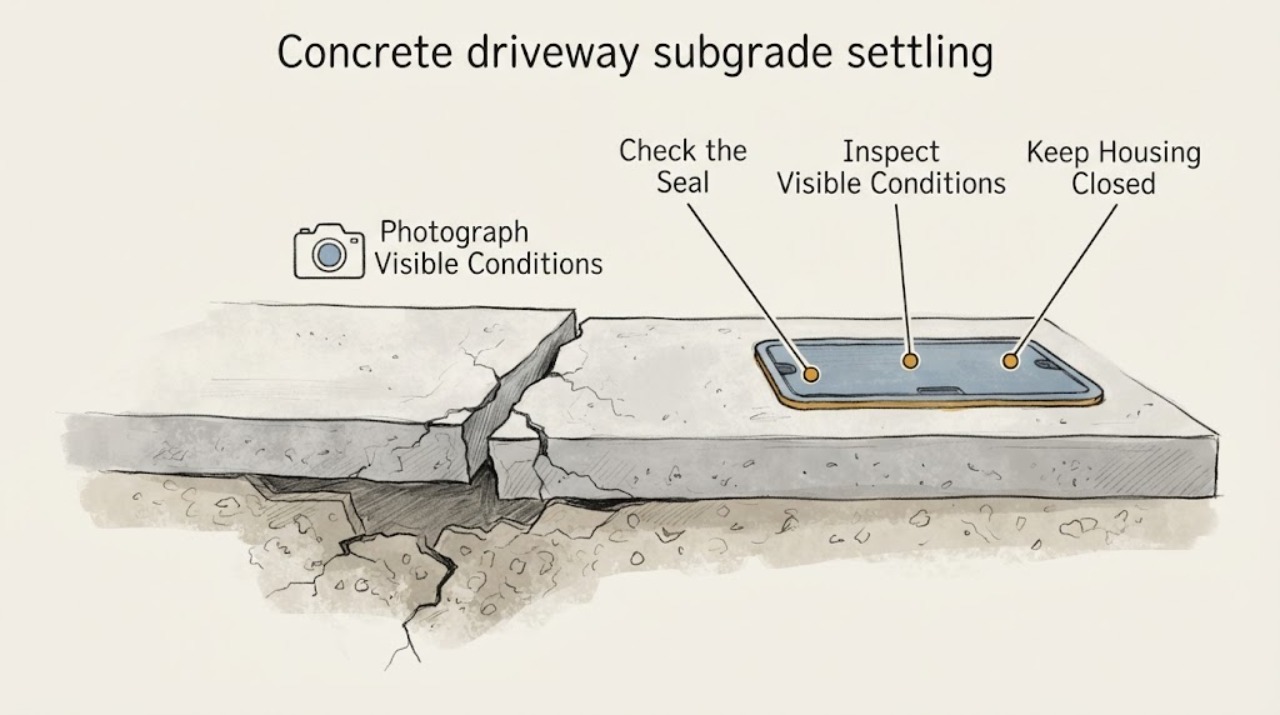
A settling concrete driveway can reflect loss of support below the slab, drainage or erosion, poorly compacted fill, a buried utility issue, soil movement, or a surface-only distress. Do not try to lift, break, cut, drill, or excavate the driveway to find the cause. From a safe ground position, document the depression, cracks, joint offsets, edge conditions, drainage and water timing, and whether the change is progressing. Keep vehicles and people away from unstable or trip-prone areas and arrange a professional concrete or geotechnical assessment before choosing leveling, replacement, or any structural remedy.
Work through in order
Diagnostic checks
Use only checks that match the exact appliance or system and its official guide.
-
Check 1
From the driveway edge or another stable ground position, photograph and outline the settled area relative to the garage, street, property edge, joints, and nearby structures. Do not step onto a broken or visibly moving slab just to mark its center.
Expected result: The depression is isolated, follows a joint or edge, spans a wheel path, extends across multiple panels, or cannot be approached safely.
Next step: Keep the photos and a simple sketch, restrict traffic over the affected section, and provide the location to a concrete or geotechnical professional.
Stop if: Stop entering the area if the slab shifts, an edge is undermined, a void is visible, the surface is slick, or documenting it would require crossing an unsafe section.
Why this matters
Why: The pattern helps a professional understand the extent and whether movement is localized or distributed. It cannot reveal the depth or condition of the subgrade without appropriate assessment.
-
Check 2
Look across the surface for crack and joint patterns without probing or widening them: note diagonal cracks from corners, intersecting cracks, open joints, vertical offsets between panels, spalled edges, or a low area with no visible cracking.
Expected result: Cracks are tight and stable-looking, widening or offset, concentrated at a corner or joint, accompanied by broken concrete, or absent despite visible settlement.
Next step: Photograph the pattern with a nearby fixed reference and note whether it changes over time. Do not fill, seal, grind, cut, or patch the cracks before professional assessment if settlement is suspected.
Stop if: Stop if an edge is sharp or loose, a void is open, concrete is crumbling under normal observation, or any measurement would require contact with an unstable slab.
Why this matters
Why: Crack pattern and vertical offset can indicate different forms of distress or loss of support, but they do not establish whether the cause is subgrade, drainage, frost, load, or concrete material condition.
-
Check 3
After ordinary rainfall has ended and the area is safe, observe where water rests or flows around the depression, joints, driveway edge, downspouts, and nearby soil. Do not dig, probe the subgrade, remove concrete, or enter a saturated area.
Expected result: Water drains normally, pools in the settled area, stains or erodes a joint or edge, appears near a downspout or utility route, or the ground remains soft after rain.
Next step: Record rainfall timing, water locations, and any change in the depression. Keep runoff from being deliberately directed into the area and give the observations to the professional.
Stop if: Stop if the surface becomes slippery, soil is undermined, water exposes a hole, a utility feature is damaged, or observation requires excavation or entering standing water.
Why this matters
Why: Water movement can weaken support or carry fine material away, but the visible route does not prove the underground cause. Persistent ponding or erosion raises the priority of drainage and subgrade assessment.
-
Check 4
Inspect the driveway perimeter and visible transitions from ground level: look for a separated edge, a sunken utility patch, a gap at the garage threshold, displaced soil, tree-root uplift nearby, or a change where fill meets undisturbed ground.
Expected result: The settlement is near a utility patch, driveway edge, garage, tree, recent trench, or other transition, or there is no visible transition clue.
Next step: Photograph the transition and note construction, utility, landscaping, or drainage history. Have the professional coordinate any utility or structural investigation before disturbance.
Stop if: Stop if soil is collapsing, a utility cover is unstable, a trench or void is exposed, or the inspection would require lifting, digging, cutting, or moving heavy material.
Why this matters
Why: Transitions and buried routes can be associated with uneven support or water movement, while an absent clue does not rule out concealed causes. Do not infer a repair method from the nearest visible feature.
-
Check 5
Record progression and use history without load testing: when the low area first appeared, whether it changes after wet or freeze conditions, whether vehicles have crossed it, and whether any nearby wall, garage, walkway, or drainage feature has changed.
Expected result: The condition is stable, slowly progressing, rapidly changing, associated with water or seasonal weather, or accompanied by a new trip or vehicle hazard.
Next step: Keep a dated photo record, restrict unsafe use, and arrange high-priority professional assessment. Do not attempt to level, support, demolish, cut, or conceal the affected slab.
Stop if: Stop use and isolate the area immediately if movement accelerates, a void opens, a vehicle could lose stability, or the driveway threatens an adjacent structure or public path.
Why this matters
Why: Time and environment help the professional prioritize soil, water, freeze, fill, or load-related questions. Rapid movement or a new safety hazard should not wait for a cosmetic repair decision.
Use your observations
Decision map
Find the observation that best matches what you see, then follow the next safe action.
-
PATH 01Next step
What you see
The slab is moving, a void or undermined edge is visible, or a vehicle or person could fall or lose stability.
Do this next
Isolate the area, keep vehicles and people away, and request urgent professional assessment. Do not load or test the section.
-
PATH 02Next step
What you see
Settlement is accompanied by ponding, erosion, a wet subgrade clue, or a nearby drainage change.
Do this next
Arrange a concrete and drainage assessment before selecting a surface remedy; do not direct more water into the depression or excavate to investigate.
-
PATH 03Next step
What you see
A utility patch, trench, garage transition, tree, or property-edge transition aligns with the low area.
Do this next
Provide the location history and photos to the professional and coordinate any utility or geotechnical investigation without disturbing the site yourself.
-
PATH 04Next step
What you see
The driveway has tight, non-progressing surface cracks and no visible settlement, water, offset, or safety issue.
Do this next
Continue dated visual monitoring and seek professional advice if the pattern widens, settles, ponds, or develops a trip hazard.
-
PATH 05Next step
What you see
The cause or extent cannot be determined from safe ground-level observations.
Do this next
Do not guess at leveling or replacement. Request a professional assessment of slab, base, subgrade, drainage, and adjacent conditions.
Helpful context
Understand the symptom
Surface settlement does not identify the failed layer
A driveway is a layered system: the concrete slab sits over base or subbase and prepared subgrade. The same low area can result from water movement, voids, fill settlement, soil changes, or slab distress. FHWA guidance treats foundation uniformity and drainage as site-specific engineering concerns, so a visual depression is a reason to document and assess, not a diagnosis for a homeowner repair.
Use the driveway without loading the suspect area
Choose daylight and dry, stable conditions for observation. Do not park on a visibly unstable section, drive across a broken edge, use a vehicle or jack to test movement, or repeatedly walk on a slab that shifts. Keep children away from open joints, sharp breaks, and areas where soil or concrete may give way.
The professional decision follows the cause and extent
A qualified concrete or geotechnical professional can distinguish a surface crack from loss of support and check drainage, utilities, soil, and adjacent slabs. The eventual remedy may be limited or extensive, but it should follow an assessment of the entire affected area rather than a patch over a continuing void or water path.
When checks do not resolve it
Need a professional?
Arrange professional concrete and subgrade assessment for visible driveway settlement, especially when cracks, offsets, ponding, erosion, voids, utility transitions, or progression are present. Escalate promptly for unstable edges, sinkhole-like openings, rapid movement, or a trip or vehicle hazard.
Common questions
FAQ
Does a low spot prove the driveway subgrade has failed?
No. Settlement can involve support below the slab, water or erosion, fill, soil movement, utilities, or surface distress. Document the pattern and history and have a professional assess the slab and supporting layers.
Can I lift the settled slab or fill the void myself?
No. Do not lift, drill, cut, excavate, or inject material based only on a visual depression. The cause and extent must be assessed before a professional selects a remedy.
What photos help a concrete professional?
Take safe ground-level views showing the full driveway, the settled panel, crack and joint patterns, edges and transitions, drainage or water marks, and nearby structures. Add dates and note changes after rain or freeze conditions.
When is driveway settlement urgent?
Treat it as urgent when a void or undermined edge is visible, movement is accelerating, a vehicle or person could lose stability, water is eroding support, or the driveway threatens an adjacent structure or public path.
Read the exact guide
Official sources
- Selection of Candidate Projects - Full-Depth RepairsFederal Highway Administration · Supports documenting crack patterns, offsets, corner breaks, and loss of support without prescribing homeowner repair work.
- Track 10. Concrete Pavement Foundations and DrainageFederal Highway Administration · Supports treating subgrade settlement and drainage as site-specific foundation concerns requiring professional evaluation.
- Chapter 8 - Geotechnical Aspects of Pavement DistressFederal Highway Administration · Supports using surface distress and progression as clues while reserving subsurface diagnosis and correction for qualified professionals.
Community feedback
Share a repair observation
Share a plain-text repair observation. Accepted observations are published automatically; this page may take a moment to update.