
On this page
Start here
Quick answer
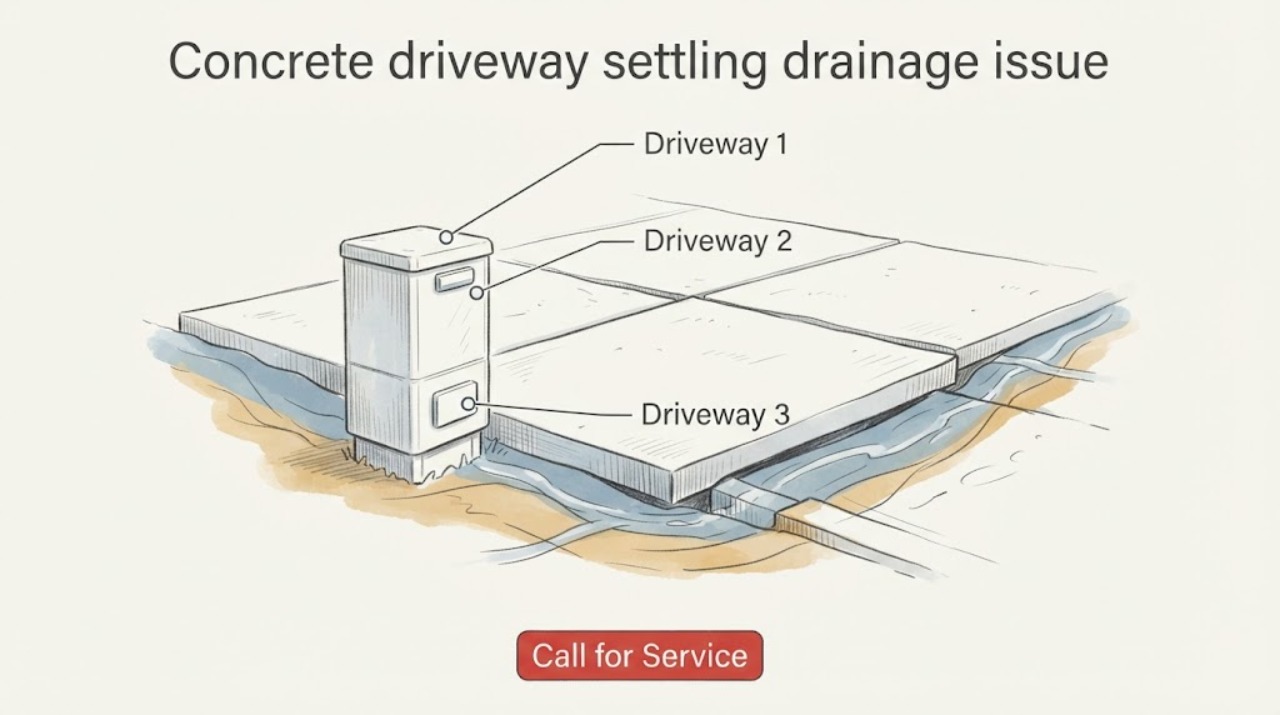
A settling concrete driveway with a drainage issue needs the water path and slab support assessed together. From stable ground, observe low spots, ponding, edge erosion, cracks, joint separation, and where roof or surface water flows. Do not lift, cut, demolish, or inject the slab yourself. A concrete or drainage professional should identify the cause before recommending leveling, stabilization, replacement, or drainage work.
Before you begin
Safety first
- Observation only; support, leveling, drainage, and concrete work are professional tasks.
Work through in order
Diagnostic checks
Use only checks that match the exact appliance or system and its official guide.
-
Check 1
From stable ground, photograph the driveway profile, low points, cracks, joints, edges, and transitions to the garage, sidewalk, and street without walking on unstable sections.
Expected result: Record ponding, uneven lips, widening cracks, rocking-looking slabs, edge drop-off, or a localized depression.
Next step: Map the affected area for a concrete professional.
Stop if: Stop on unstable edges, deep voids, or a trip hazard.
Why this matters
Why: Uneven settlement with cracking or edge loss may involve subgrade or support, not only a surface patch.
-
Check 2
Observe water movement during or after ordinary rain from a safe location; do not hose the area or enter traffic.
Expected result: Note roof downspout discharge, ponding, flow toward the slab, erosion, clogged inlets, or no obvious path.
Next step: Photograph the drainage path and request drainage and slab assessment.
Stop if: Do not excavate, redirect buried drains, or cut concrete.
Why this matters
Why: Persistent moisture or redirected runoff can contribute to support loss and recurring settlement.
-
Check 3
Compare the driveway with adjacent ground, curb, garage threshold, and nearby slabs using a visual reference rather than a level or load test.
Expected result: Record relative drop, water entry toward the garage, vehicle scraping, or movement under normal use.
Next step: Keep vehicles and pedestrians away from unsafe areas and give the comparison to the professional.
Stop if: Stop if the route is a fall or vehicle hazard.
Why this matters
Why: A drop at a threshold or broad movement raises access and structural-scope concerns.
Use your observations
Decision map
Find the observation that best matches what you see, then follow the next safe action.
-
PATH 01Next step
What you see
Water ponds, flows toward the garage, or erosion is active.
Do this next
Arrange drainage and concrete assessment before cosmetic repair.
-
PATH 02Next step
What you see
Settlement is localized with a stable surrounding surface.
Do this next
Request evaluation for leveling or stabilization, subject to cause and support findings.
-
PATH 03Next step
What you see
Cracks, lips, voids, or movement create a trip or vehicle hazard.
Do this next
Mark and isolate the area and seek prompt professional assessment.
Helpful context
Understand the symptom
FHWA guidance notes that pavement settlement and support loss can involve moisture, foundation conditions, and drainage; treating the surface alone may not prevent recurrence. A driveway is site-specific, so this page focuses on observations for a professional scope.
Safety boundary
Stop conditions
- No slab lifting, demolition, cutting, drilling, injection, or excavation.
- Stop for voids, active erosion, traffic hazards, or garage water entry.
When checks do not resolve it
Need a professional?
Call concrete/drainage service for active ponding, settlement, erosion, garage water entry, broad cracking, or unsafe elevation change.
Safety scope: Observation only; support, leveling, drainage, and concrete work are professional tasks.
Common questions
FAQ
Can I fill the low spot with concrete?
Not before the drainage and underlying support are assessed; a surface fill may not stop settlement.
Does ponding prove the slab caused the issue?
No. Observe the full water path, including runoff and subgrade clues, for professional assessment.
Read the exact guide
Official sources
- Design & Analysis - PavementsFederal Highway Administration · Supports assessing drainage and underlying support rather than treating a settled surface alone.
Community feedback
Share a repair observation
Share a plain-text repair observation. Accepted observations are published automatically; this page may take a moment to update.