
On this page
Start here
Quick answer
A driveway slab that has sunk, tilted, or developed a new trip edge is usually a drainage, erosion, support, or soil-movement problem rather than a surface defect to hide. From a safe position, document the slab's profile, cracks, ponding, edge washout, and changes after rain; keep people and vehicles off any unstable area; and arrange a qualified concrete or site-drainage assessment. Do not lift the slab, drill or cut the concrete, excavate beside it, or bring heavy equipment onto an uncertain surface. A professional needs the observed pattern to decide whether leveling, localized repair, drainage work, or replacement is appropriate.
Work through in order
Diagnostic checks
Use only checks that match the exact appliance or system and its official guide.
-
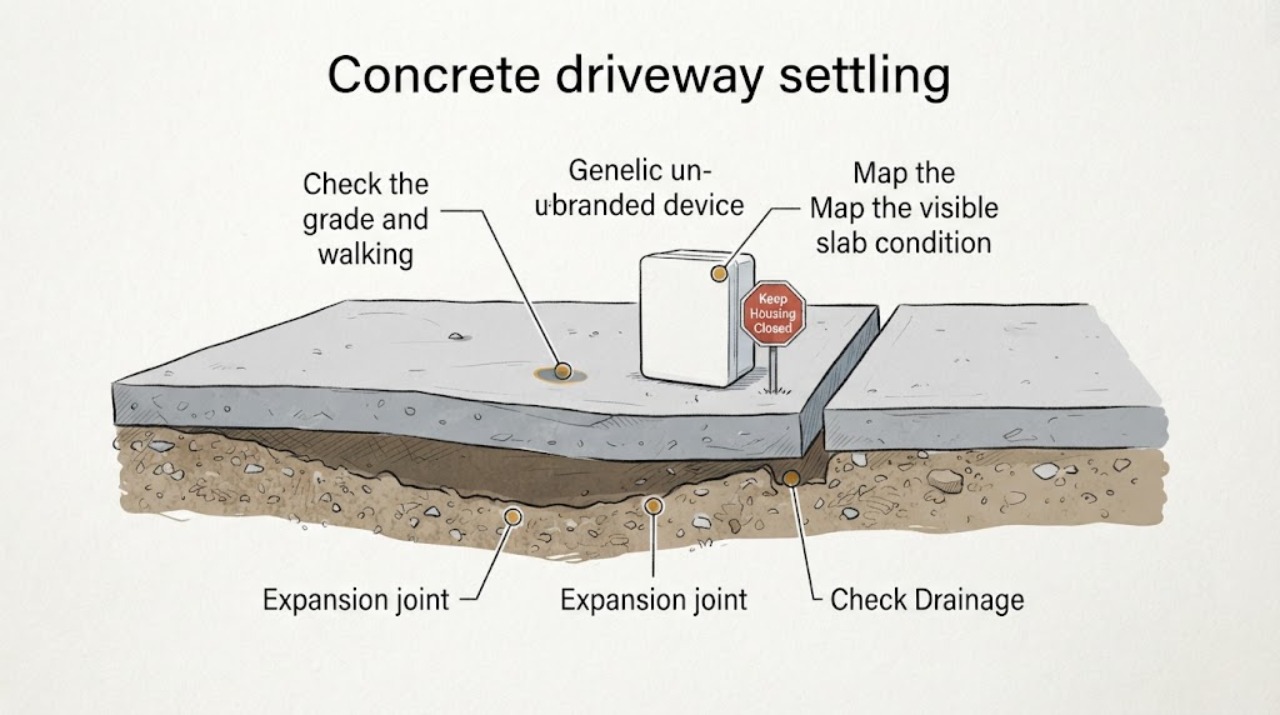
Map the visible slab condition from stable ground
From the driveway edge, sidewalk, or another stable location, photograph the full approach and each affected panel without stepping onto a visibly unstable section. Note which edge is low or high, the approximate location of cracks or joints, spalling, tilted transitions, and whether the change affects one panel or several.
Expected result: A single low corner or joint may be localized, while several panels with matching settlement, widening joints, or edge breakup indicate a broader support or drainage issue. A crack pattern alone cannot identify the cause.
Next step: Save dated photos and a simple sketch, then compare the same views after rain or over time. Keep people and vehicles off any section that shifts, has a void, or presents a clear trip edge.
Stop if: Stop the inspection if the slab moves, an edge is undermined, a crack opens under normal access, debris is unstable, or reaching the area would require lifting, climbing, crossing traffic, or using equipment. Call a qualified professional instead.
Why this matters
Why: The location, severity, and extent help a professional choose an evaluation method and distinguish a localized repair question from a broader base, soil, or replacement question.
-
Check the grade and walking transition without stepping over the defect
View the driveway from the garage threshold, sidewalk, curb, and side edge. Look along the surface for a raised or dropped transition, a wheel-path depression, a tilted slab, ponding, or a route that now forces people around the defect. Do not place a straightedge, vehicle, jack, or other load on the suspect area.
Expected result: A pronounced lip at a garage, sidewalk, or curb is an immediate trip concern; a broad low area that collects water changes the drainage and access picture; an apparent slope change that is visible only from one direction may need professional measurement rather than a guess.
Next step: Keep the affected route clear of foot traffic and document the transition with a person-free photo that shows nearby reference features. Tell the service professional whether the trip risk is at the garage, walk, curb, or another access point.
Stop if: Stop if the route is slippery, the edge can crumble, the slab rocks, visibility is poor, or documenting it would require walking on the damaged section. Do not lift, brace, shim, cut, or grind the slab.
Why this matters
Why: OSHA identifies damaged or wet walking-working surfaces as slip and trip hazards in workplace settings. For a home driveway, the practical response is to avoid the unsafe route and have the surface and transition assessed, not to improvise a leveling method.
-
Look for drainage, washout, and moisture clues
From the perimeter, inspect where roof downspouts, sprinklers, driveway runoff, and surface water meet the driveway. Compare a dry-weather view with a safe observation after rain, looking for ponding, flowing water toward an edge, soil loss, exposed aggregate or base material, damp joints, or a void-like shadow under an edge. Do not dig or probe beneath the slab.
Expected result: Water that repeatedly collects beside or below a settled edge, visible soil washout, or a change after storms suggests that drainage or support conditions may be contributing. If the area stays dry and the condition is stable, settlement or material history still cannot be ruled out without a professional assessment.
Next step: Photograph the water path, downspout or irrigation discharge, and any edge erosion from stable ground. Share recent storms, leaks, grading changes, and utility work with the contractor so source control is considered before surface repair.
Stop if: Stop near standing or contaminated water, exposed utilities, an undermined edge, a sinkhole-like depression, active erosion, or any place that would require excavation, drilling, cutting, or heavy equipment. Keep people and vehicles away and request professional site evaluation.
Why this matters
Why: FHWA notes that inadequate subsurface drainage can contribute to distress in portland-cement concrete pavements and that drainage assessment documents moisture conditions, slopes, inlets, and outlets. The observation points to what a professional should investigate; it does not establish a repair design.
-
Decide whether the condition needs urgent professional access control
Using the photos and observations, answer yes or no: is there a moving or undermined slab, a severe trip transition, a deep-looking depression or void, rapidly spreading cracking or settlement, multiple affected panels, blocked emergency access, or a risk to a nearby wall, curb, drain, or utility?
Expected result: Yes means the driveway should be treated as a safety and structural assessment issue; no means it may still need a planned concrete evaluation, especially if the condition is changing or water is involved.
Next step: For yes, keep the affected area out of service as practical and request a qualified concrete/site professional. For no, continue to monitor from stable ground and schedule an assessment before attempting any cosmetic patch or load test.
Stop if: Do not attempt slab lifting, pressure injection, drilling, concrete cutting, excavation, demolition, or heavy-equipment access. Stop and escalate immediately for movement, undermining, utility exposure, structural impact, or an unsafe trip route.
Why this matters
Why: A visible survey can document type, severity, and extent, but it cannot verify hidden support or soil conditions. A professional may need non-destructive or engineering evaluation before selecting leveling, repair, drainage work, or replacement.
Use your observations
Decision map
Find the observation that best matches what you see, then follow the next safe action.
-
PATH 01Safety boundary
What you see
The settled edge affects the garage threshold, sidewalk, curb, emergency route, or another frequently used path, or the surface is wet, unstable, or crumbling.
Do this next
Keep people and vehicles off that route, use a clearly safer alternate path if available, and request prompt professional evaluation. Describe the location and show a wide photo rather than trying to measure or level it yourself.
Why this path and its safety boundary
Safety stop: Do not cross the defect to place a marker, move a vehicle across it, or work on it with lifting, cutting, drilling, or heavy equipment.
-
PATH 02Safety boundary
What you see
Ponding, downspout or irrigation discharge, repeated runoff, damp joints, soil loss, or edge washout appears near the settled slab.
Do this next
Ask the professional to assess the drainage path and supporting material before choosing a concrete repair. Provide photos from dry and wet conditions and the history of leaks, grading, or prior drainage changes.
Why this path and its safety boundary
Safety stop: Do not excavate, probe, redirect buried utilities, seal over active water, or assume a surface patch will correct loss of support.
-
PATH 03Safety boundary
What you see
Several panels are affected, the slab rocks or shifts, an edge is unsupported, cracks are rapidly changing, or nearby structures, drains, or utilities may be involved.
Do this next
Treat the driveway as a professional structural/site assessment. Keep loads off the area and ask for a written explanation of the suspected cause and the proposed repair or replacement scope.
Why this path and its safety boundary
Safety stop: Stop all ordinary inspection at signs of collapse, a sinkhole-like void, utility exposure, unstable retaining conditions, or a route that cannot be kept away from pedestrians.
Helpful context
Understand the symptom
Why the pattern matters
FHWA pavement guidance treats a visual condition survey and a drainage survey as separate but related parts of evaluating concrete pavement. A low corner, a joint that has opened, edge washout, or ponding can point to different support or water conditions. Photos taken from stable ground and a short history of when the change appeared give a contractor more useful information than a guessed repair method.
Keep the temporary response simple
Until the area is assessed, keep foot traffic and vehicles away from a pronounced lip, cracked or moving panel, void at an edge, or standing-water area. Mark or block the route without entering the damaged section. Do not attempt manual slab lifting, pressure injection, drilling, cutting, excavation, or demolition; those activities can worsen support loss and introduce equipment, dust, or collapse hazards.
What to give the service professional
Share overview and close-up photos, the location of the low or raised edge, whether more than one panel is affected, the direction water takes during rain, nearby downspout or irrigation history, and any prior patching or utility work. Tell the professional whether the condition is changing and whether the driveway is needed for emergency or accessibility access.
When checks do not resolve it
Need a professional?
Call a qualified concrete or site-drainage professional when settlement is changing, creates a trip hazard, affects multiple panels, shows washout or ponding, leaves an apparent void, or is near a wall, drain, utility, or essential access route. A professional assessment is also appropriate when the cause is not visible from stable ground.
Have this ready
- Provide dated overview and close-up photos, the affected edges and panels, whether the slab moves, water-flow and drainage observations, recent storms or leaks, downspout or irrigation changes, prior repairs or utility work, and any access or trip-safety concern.
Common questions
FAQ
Can I lift or level a settled driveway myself?
Do not attempt it. Slab lifting, drilling, injection, cutting, and excavation require equipment and an assessment of support, drainage, utilities, and surrounding structures. Document the condition from stable ground and call a qualified professional.
Does a low driveway section always mean the concrete must be replaced?
No. The cause and extent determine whether a professional considers leveling, localized repair, drainage or support work, or replacement. A visual check cannot confirm the condition below the slab.
Why should I check downspouts and drainage before repairing the surface?
Repeated water or erosion can contribute to loss of support and renewed distress. Record the water path and share it with the professional so the source is considered before a surface repair is selected.
When should I stop using the driveway?
Keep people and vehicles away when the slab moves, an edge is undermined or crumbling, a pronounced trip hazard blocks access, a void or rapidly changing crack appears, or utilities or nearby structures may be affected. Request professional evaluation.
Read the exact guide
Official sources
- Final Rule to Update General Industry Walking-Working Surfaces and Fall Protection StandardsOccupational Safety and Health Administration · slip, trip, and fall hazard awareness on walking-working surfaces
- Continuously Reinforced Concrete Pavement Manual: Guidelines for Design, Construction, Maintenance, and RehabilitationFederal Highway Administration · concrete pavement visual condition and drainage surveys
- Design & Analysis - PavementsFederal Highway Administration · pavement drainage and concrete pavement distress considerations
Community feedback
Share a repair observation
Share a plain-text repair observation. Accepted observations are published automatically; this page may take a moment to update.