
On this page
Start here
Quick answer
A settled driveway panel is a pedestrian and vehicle-surface hazard, and the visible low edge does not reveal whether soil, drainage, erosion, tree roots, frost, or a failed slab caused it. Keep people and vehicles away from the uneven area, mark or route around it, and document the height change, water path, cracking, and movement from a safe standing position. Do not jack, grind, cut, lift, demolish, or pour over the panel yourself. A concrete professional should assess the base and drainage and compare leveling, repair, or replacement options.
Before you begin
Safety first
- Do not walk on an unstable panel, drive over it, jack or lift it, grind or cut concrete, excavate, cut roots, move utilities, pour a cosmetic overlay, or use loose temporary coverings.
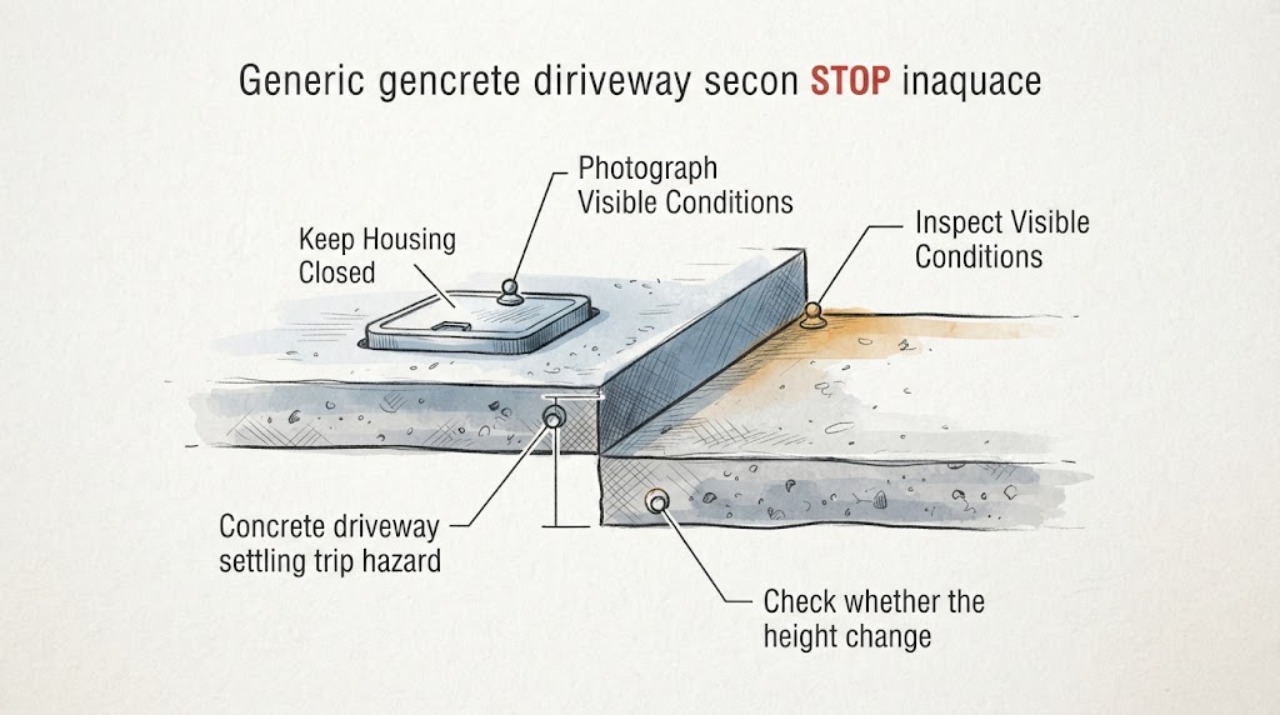
Work through in order
Diagnostic checks
Use only checks that match the exact appliance or system and its official guide.
-
Check 1
From the side and from both travel directions, photograph the settled panel and the adjacent concrete without stepping across the uneven edge.
Expected result: Record a low panel, raised edge, tilted slab, broken corner, spalling, open crack, or no obvious deformation, plus the approximate affected length.
Next step: Keep the area marked and route people and vehicles around it while sending dated photos to a concrete professional.
Stop if: Stop if the surface is unstable, an edge is collapsing, a void is visible, or traffic cannot be safely separated.
Why this matters
Why: A level change is a trip hazard; cracking, spalling, or a tilted panel suggests the professional must assess slab integrity as well as elevation.
-
Check 2
Observe the driveway after normal rain or irrigation from a safe edge, without directing a hose at the slab or walking through pooled water.
Expected result: Note ponding, water running toward the house, erosion at the edge, a washed-out joint, a blocked drain, or no visible drainage change.
Next step: Photograph the flow path and ask for drainage and subgrade assessment before choosing a leveling or replacement method.
Stop if: Stop for deep erosion, undermining, fast-moving water, flooding, or water near exposed electrical or utility equipment.
Why this matters
Why: Drainage and erosion can remove support and cause recurring settlement; a dry day does not rule out a water-related cause.
-
Check 3
Check whether the height change or cracking is still progressing by comparing dated photos and marks made beside, not on, the driveway.
Expected result: Answer yes if the lip, gap, tilt, crack, or ponding is visibly increasing; answer no if it is unchanged over the observation period; use unknown when records are insufficient.
Next step: Give the timeline to the professional and keep the area closed if movement is active; do not attempt to stabilize it with jacks or fill.
Stop if: Stop immediately for rapid movement, a widening void, a suddenly raised or dropped panel, or structural concern near the garage or foundation.
Why this matters
Why: Continuing movement raises urgency and makes a cosmetic patch or isolated edge treatment less reliable; no observed movement does not prove the base is sound.
-
Check 4
Inspect the surrounding edges, joints, curb, garage threshold, downspouts, irrigation, trees, and recent utility work from safe ground.
Expected result: Record concentrated runoff, a leaking downspout, roots, soil washout, new excavation, displaced curb, joint separation, or no nearby change.
Next step: Share the context and photos and request a scope that addresses cause, base support, water management, and surface remedy separately.
Stop if: Stop if digging, root cutting, utility locating, or work near a foundation or buried service would be required.
Why this matters
Why: Nearby drainage or ground changes can explain uneven support, and the repair may fail if the cause is left in place.
-
Check 5
Document how the hazard affects walking, wheelchair or stroller passage, vehicle clearance, doors, and water access without asking anyone to cross it for a test.
Expected result: Note whether the route is blocked, slippery, narrow, ponded, or difficult to see at night, and whether a safe alternate route exists.
Next step: Keep a clear marked detour and request written options for professional leveling, replacement, joint and drainage work, and site protection.
Stop if: Stop and escalate for an unavoidable access route, a fall, a wheelchair or mobility-device obstruction, or a hazard that cannot be isolated.
Why this matters
Why: The use impact determines immediate barriers and helps the professional prioritize a stable, firm, durable correction rather than a cosmetic fill.
Use your observations
Decision map
Find the observation that best matches what you see, then follow the next safe action.
-
PATH 01Next step
What you see
The settled area is stable, isolated, and not progressing, with a safe alternate route.
Do this next
Schedule a concrete assessment and keep the marked detour in place; do not patch or alter the slab while waiting.
-
PATH 02Next step
What you see
The panel is moving, undermined, severely cracked, or has a visible void or sinkhole-like depression.
Do this next
Keep people and vehicles away and obtain prompt concrete and ground/drainage assessment; do not walk, jack, or fill the area.
-
PATH 03Next step
What you see
Water ponds or flows toward the home, garage, or slab edge, or erosion is visible.
Do this next
Request drainage and subgrade diagnosis before surface work; control access and avoid excavating or redirecting flow without a plan.
-
PATH 04Next step
What you see
The hazard blocks the only entrance or an accessible route.
Do this next
Create a stable alternate route or restrict access immediately and arrange prompt professional repair planning; do not use loose mats or boards that can move.
-
PATH 05Next step
What you see
Roots, recent excavation, utilities, a retaining edge, or foundation movement may be involved.
Do this next
Stop digging or cutting and have the appropriate concrete, drainage, utility-locating, arboricultural, or structural professional define safe scope.
-
PATH 06Next step
What you see
A contractor recommends leveling, grinding, patching, or replacement.
Do this next
Ask what caused settlement, how the base and drainage will be addressed, how the chosen method handles the panel condition, and what access and curing restrictions apply.
Helpful context
Understand the symptom
Why settlement needs more than a patch
Concrete can subside or tilt when the subgrade compacts unevenly or when water, erosion, frost, roots, or adjacent excavation changes support. A trip lip may be the symptom, while ponding or a failed edge may be the cause. The appropriate remedy depends on panel condition, soil and drainage, access, load, and local requirements.
Observation-only scope
Inspect from a stable standing position with photos and a simple visual reference; keep the driveway closed to pedestrians and vehicles while observing. Do not drill, cut, grind, jack, pressure-wash, excavate, add fill under the slab, or attempt to hide the edge with patch material.
Stop and call a professional
Arrange prompt help for a rapidly moving slab, undermined edge, sinkhole-like void, exposed utilities, major cracking, standing water near a foundation, or any task involving lifting, cutting, demolition, or heavy equipment. Provide a safe alternate route for everyone in the meantime.
When checks do not resolve it
Need a professional?
Call promptly for a driveway trip hazard, increasing settlement, undermining, major cracks, ponding toward the home, a blocked accessible route, or any work requiring lifting, cutting, grinding, excavation, demolition, or heavy equipment.
Safety scope: Do not walk on an unstable panel, drive over it, jack or lift it, grind or cut concrete, excavate, cut roots, move utilities, pour a cosmetic overlay, or use loose temporary coverings.
Have this ready
- Provide dated photos from both directions, approximate affected length and level change, movement timeline, rain and drainage observations, roots or excavation, utility concerns, route impact, and safe alternate access.
Common questions
FAQ
Can I fill the low side with concrete?
Do not pour over the hazard without a diagnosis. If the base or drainage is failing, a surface fill can hide the cause and leave an unstable edge.
Is a settled driveway only cosmetic?
No. Uneven concrete can trip pedestrians, impede mobility devices, affect vehicles, and hold water. Isolate it and arrange an assessment.
Should I jack up the slab?
No. Lifting equipment and unstable concrete can cause sudden movement, crushing, utility damage, or a worse grade. Have a professional choose the method.
What if water runs toward the garage?
Keep the area clear and document the flow after normal rain. Ask for drainage and subgrade diagnosis before any leveling or replacement work.
What should the contractor compare?
Ask for cause, slab and subgrade condition, drainage, access impact, and written alternatives for professional leveling, repair, or replacement with site protection.
Read the exact guide
Official sources
- Solutions for Five Common ADA Access Problems at Polling PlacesU.S. Department of Justice · Accessibility guidance for public routes; it helps frame the hazard but does not prescribe a private driveway repair.
- Environmentally Sensitive Maintenance For Dirt and Gravel RoadsU.S. Environmental Protection Agency · Road and driveway drainage guidance; site geometry and local requirements vary.
- FHWA Guide for Maintaining Pedestrian FacilitiesFederal Highway Administration · Pedestrian-facility guidance; a private driveway needs site-specific professional assessment.
Community feedback
Share a repair observation
Share a plain-text repair observation. Accepted observations are published automatically; this page may take a moment to update.