
On this page
Start here
Quick answer
A crack in a concrete driveway is not automatically a structural emergency, but its pattern and behavior matter. First record whether it follows a planned joint or crosses the slab, whether it is a tight surface line or is widening, and whether there is spalling, a height difference, ponding, edge settlement, or a void beneath the slab. Concrete normally contracts as it hardens and planned joints help control where cracking occurs, while movement, poor support, weathering, or repeated loads can produce a more consequential failure. Do not cut, chisel, widen, or demolish the driveway as a diagnostic step. A crack filler or sealer is conditional: identify the crack type and any active movement or drainage problem before choosing a product. Have a concrete professional assess cracks with displacement, recurring water or soil loss, broken edges, trip hazards, or rapid change.
Before you begin
Safety first
- Do not cut, chip, widen, demolish, excavate, lift, or use heavy equipment on the driveway as a homeowner diagnostic step.
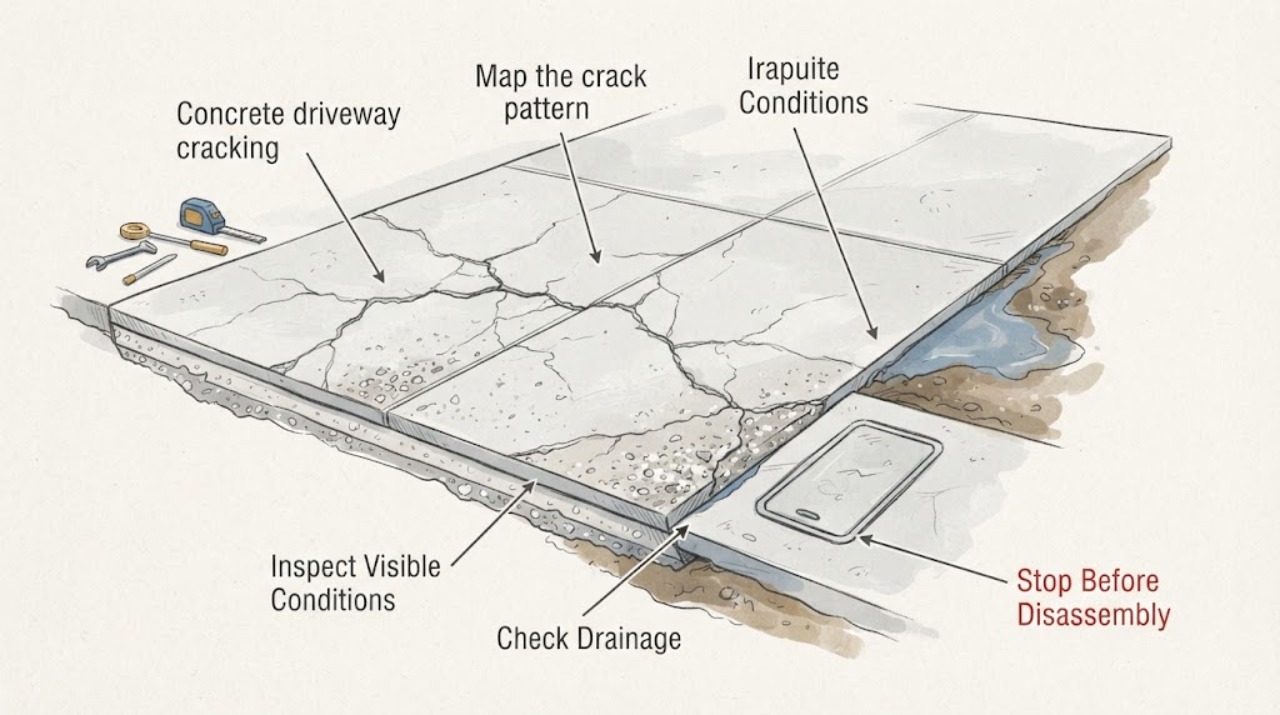
Work through in order
Diagnostic checks
Use only checks that match the exact appliance or system and its official guide.
-
1. Map the crack pattern from a safe standing position
Photograph the full driveway and trace the visible pattern without scraping, cutting, drilling, or widening the crack. Note whether it follows an existing contraction or control joint, runs across the middle of a slab, branches into a map-like pattern, or reaches an edge, corner, step, or drain path.
Expected result: The line follows an existing joint; it is a single isolated crack; several cracks form a branching or map pattern; or the pattern reaches an edge or corner.
Next step: Keep the photos and mark the date and location. Continue with the surface and movement checks before considering any filler or sealer.
Stop if: Stop the inspection if evaluating the crack would require traffic control, entering an unsafe driveway area, or using tools to expose its depth.
Why this matters
Why: A crack at a planned joint can reflect the joint doing its intended job, although an opened or deteriorated joint still needs condition review. An uncontrolled mid-slab or branching pattern has more possible causes than a surface joint line. Edge and corner patterns can be associated with support, drainage, or load effects and should not be judged by appearance alone.
-
2. Look for widening, displacement, and surface breakup
Visually compare both sides of the crack and the nearby concrete. Note whether the edges remain at the same height, whether one side is raised or settled, whether the edges are breaking away, and whether the line appears different after weather or vehicle use. Do not use a hammer, chisel, saw, or other tool to test it.
Expected result: The crack remains tight with no visible height change; it has an open or changing gap; the slab edges are spalling or crumbling; or the two sides are at different heights.
Next step: Treat visible movement, edge breakup, or a trip hazard as a professional assessment item. If the crack remains visually stable and the slab is sound, document it and move to drainage and history checks.
Stop if: Stop and keep vehicles and pedestrians away from a raised, broken, unstable, or trip-producing area until it is assessed.
Why this matters
Why: A tight surface crack is a different maintenance decision from a working or displaced crack. Spalling, a height difference, or a changing gap can indicate movement, loss of support, load-transfer problems, or deterioration that a surface product will not correct.
-
3. Check surrounding drainage and slab-edge support clues
After normal wet weather, look from the surface and driveway edge for ponding, erosion, washed-out soil, a sunken edge, gutter discharge at the crack, or an opening beneath an accessible slab edge. Record the observation without excavating, lifting concrete, or directing water into the crack.
Expected result: The area drains normally and the edge appears supported; water repeatedly collects at the crack; soil is washing out or the edge is settling; or the underside/support cannot be observed safely.
Next step: Photograph drainage paths and give them to the concrete professional. Keep downspouts, irrigation, and vehicle loading from concentrating water or stress at the damaged area while awaiting an assessment.
Stop if: Stop DIY diagnosis if there is a void, erosion, undermining, sudden settlement, or any need to excavate or lift the slab.
Why this matters
Why: Water and loss of support can contribute to recurring movement and cracking, so filling the visible line alone may leave the cause in place. The absence of an obvious surface clue does not prove that the base is sound.
-
4. Compare the crack with the driveway history
Gather the driveway's approximate installation or resurfacing date, recent freeze-thaw or drought conditions, heavy vehicle use, drainage changes, and any prior patch, filler, or sealer work. Compare current photos with older photos or a dated observation rather than relying on memory.
Expected result: The crack is new or rapidly changing; it reopened after a prior repair; it appeared in a repeated seasonal pattern; or it has remained visually unchanged.
Next step: Give the history and photographs to the professional and ask whether the proposed work addresses the crack's movement and support, not only its visible opening. Do not select a product solely from the previous repair label.
Stop if: Stop and escalate when the crack is changing quickly, repeats after repairs, or coincides with settlement, drainage changes, or a new load.
Why this matters
Why: Timing and recurrence can help a professional separate a stable surface defect from ongoing movement, water, support, or material distress. A failed patch does not establish which product was wrong; it may mean the crack was moving or the underlying cause remained.
Use your observations
Decision map
Find the observation that best matches what you see, then follow the next safe action.
-
PATH 01Safety boundary
What you see
The crack follows a planned joint, remains tight, and has no spalling, height difference, or drainage concern.
Do this next
Document it and review the joint maintenance guidance for the actual driveway system; a professional can confirm whether a compatible joint sealer is appropriate.
Why this path and its safety boundary
Why it matters: A planned joint is intended to accommodate controlled movement, but its condition and sealant requirements are system-specific.
Safety stop: Do not fill it blindly if the joint is deteriorated or the guidance is unknown.
-
PATH 02Safety boundary
What you see
The crack crosses the slab, is branching, widens, or has a visible height difference or broken edge.
Do this next
Arrange a concrete or pavement professional assessment before buying filler, sealer, or patch material.
Why this path and its safety boundary
Why it matters: The visible line may be a working crack, support issue, slab distress, or more than a surface maintenance defect.
Safety stop: Keep traffic and people away from an unsafe or unstable section until assessed.
-
PATH 03Safety boundary
What you see
Water ponds, soil is washed out, the edge is settling, or a void is visible near the crack.
Do this next
Address the drainage and support investigation with the professional before sealing the crack.
Why this path and its safety boundary
Why it matters: A surface repair cannot by itself restore missing support or redirect concentrated water.
Safety stop: Do not excavate, lift, cut, or demolish the slab as a homeowner diagnostic step.
-
PATH 04Safety boundary
What you see
The crack is stable, the slab is sound, and no support or drainage warning is visible.
Do this next
Use the documented crack type and the product instructions to decide whether a compatible crack filler or sealer is even applicable, or monitor it with dated photos.
Why this path and its safety boundary
Why it matters: A low-risk maintenance choice depends on the crack and product, not on the word concrete alone.
Safety stop: Escalate if the crack changes, reopens, or develops spalling, water, or movement.
Helpful context
Understand the symptom
Why driveway cracks differ
Concrete hardens by volume changes, and planned joints can concentrate a controlled crack. Other cracks can reflect drying or thermal movement, traffic, freezing and thawing, poor support, drainage, or deterioration. A visual inspection can classify warning signs but cannot prove the internal cause without professional evaluation.
Do not turn a crack into a repair experiment
This workflow is observation-only. Do not cut a new groove, widen the crack, chip out edges, break concrete, excavate the base, or use heavy equipment to test the slab. Those tasks can create dust, damage the slab, or hide the original failure pattern. A professional can select the assessment and repair method after considering access, traffic, drainage, support, and local requirements.
When to call a concrete professional
Arrange service when the driveway has a raised or settled section, spalling, a trip hazard, a crack that is rapidly changing or reopening, multiple connected cracks, water or soil loss, a visible void, or any concern about vehicle safety. Provide dated photos, crack location and pattern, weather and loading history, drainage observations, and details of prior repairs.
Only after diagnosis
Potential parts
- concrete-crack-filler
Only consider a filler after the crack is classified as a suitable surface-maintenance condition with no active movement, support loss, or water-management problem.
Confirm the crack type, joint function, product instructions, surface condition, and local requirements before selecting a filler. - concrete-sealer
Only consider a sealer when the professional or applicable system guidance identifies a sealable joint or surface and the underlying concrete is sound.
A sealer is not a substitute for correcting displacement, spalling, drainage, or loss of slab support. - moisture-meter
Only consider moisture measurement when a professional needs supplementary information about surface moisture before a compatible coating or sealer decision.
Readings depend on the instrument, surface, environment, and method; they do not diagnose subgrade support or structural cracking by themselves.
When checks do not resolve it
Need a professional?
The crack has visible displacement, spalling, a trip hazard, or an unstable edge., The crack is widening, rapidly changing, recurring after repair, or part of a branching or widespread pattern., Water ponds, soil washes out, the slab edge settles, or a void or undermining is visible., The repair would require cutting, demolition, excavation, heavy equipment, or an assessment beyond safe observation.
Safety scope: Do not cut, chip, widen, demolish, excavate, lift, or use heavy equipment on the driveway as a homeowner diagnostic step.
Have this ready
- Dated photos showing the full driveway, crack pattern, and close context
- Approximate installation or resurfacing history and prior repair materials
- Whether the crack changes after wet weather, seasonal change, or vehicle loading
- Drainage, erosion, settlement, edge support, and safety observations
Common questions
FAQ
Are cracks in a concrete driveway always structural?
No. Some tight surface or planned-joint cracks can be maintenance concerns, while widening, displaced, spalled, branching, or support-related cracks need professional assessment. A visual pattern helps triage the problem but does not prove the internal cause.
Should I fill a driveway crack right away?
Not before checking whether it is moving, carrying water, or associated with settlement and edge breakup. Filling can be appropriate only for a compatible, stable condition identified by the crack type and product guidance; it cannot restore missing support or correct drainage.
What does a crack at a control joint mean?
A control or contraction joint is intended to help concentrate concrete movement, so a line there is not automatically a failure. If the joint is open, deteriorated, displaced, or allowing water and debris to affect the slab, have its condition and sealing requirements assessed.
What driveway crack signs require a professional?
Arrange service for a raised or settled slab, spalling, a trip hazard, rapid widening, repeated reopening, connected cracking, ponding, washed-out soil, a void, or uncertainty about safe repair. Provide dated photos and the driveway's weather, loading, drainage, and repair history.
Read the exact guide
Official sources
- 2.0 Selection of Candidate Projects - Full-Depth RepairsFederal Highway Administration · FHWA pavement guidance used as a pattern-and-severity reference; residential driveway conditions and local repair decisions require site-specific professional judgment.
- Chapter 4. Cracks - Petrographic Methods of Examining Hardened ConcreteFederal Highway Administration · Technical government reference for distinguishing possible concrete crack mechanisms; destructive examination described by the source is not a homeowner diagnostic instruction here.
- Applications of CementAmerican Cement Association · Industry association guidance on concrete pavement joints and cracking control; used for general mechanism context, not a site-specific driveway repair specification.
Community feedback
Share a repair observation
Share a plain-text repair observation. Accepted observations are published automatically; this page may take a moment to update.