
On this page
Start here
Quick answer
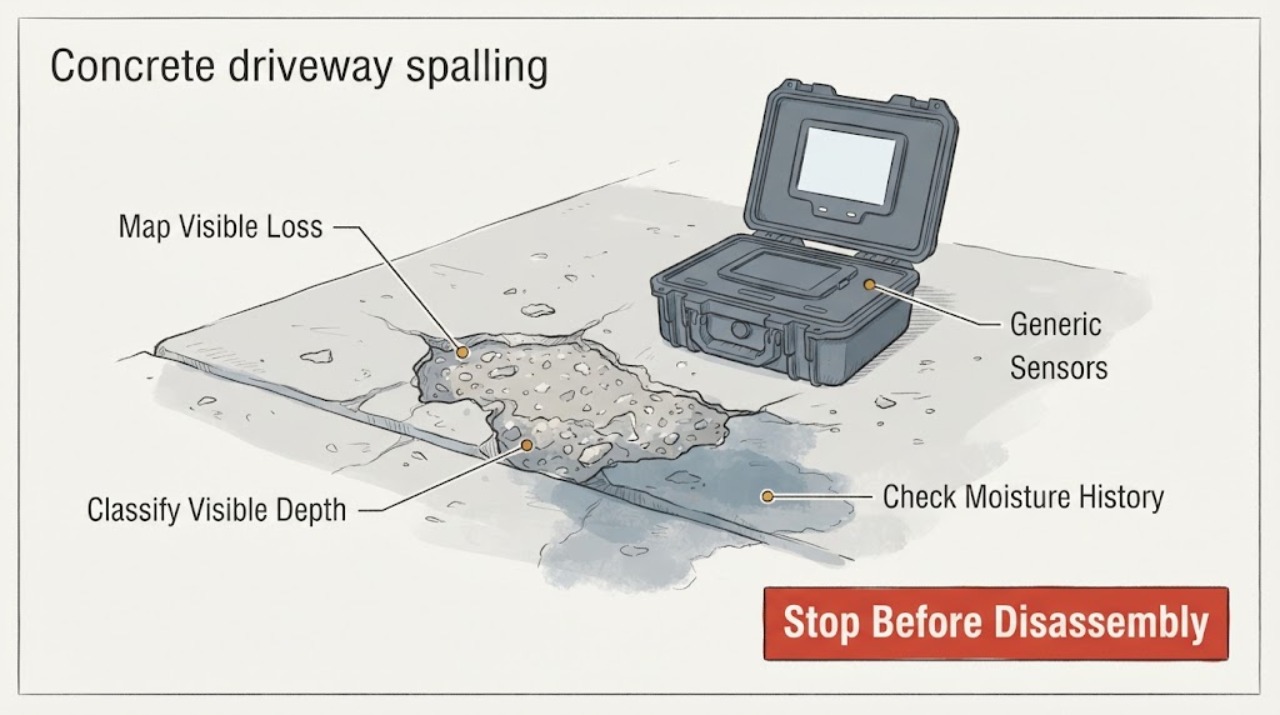
Concrete driveway spalling is surface material flaking, peeling, or breaking away, but the visible pattern does not by itself prove whether the damage is cosmetic or deeper. From a safe standing position, document the affected area, note exposed aggregate, cracks, moisture, freeze/deicer history, drainage, and whether traffic crosses it. Keep people and vehicles off an active trip hazard, and have a concrete professional assess widespread, deepening, settling, or rapidly changing damage before anyone attempts a repair. Do not chip, grind, drill, cut, demolish, or pressure-test the driveway to investigate it.
Work through in order
Diagnostic checks
Use only checks that match the exact appliance or system and its official guide.
-
Check 1
From a stable standing position, photograph and map every visible area of flaking, peeling, pits, pop-outs, exposed aggregate, or open cracks without scraping or breaking the concrete.
Expected result: Record whether the loss is a small isolated patch, follows a joint or free edge, forms a broad field, or appears in several separated areas. Note loose fragments only if they are already detached and can be left alone safely.
Next step: Keep the photographs and outline for a professional; continue to the depth-and-aggregate observation before choosing any product.
Stop if: Stop at the boundary of the damaged area if loose pieces, an unstable edge, or a trip hazard makes closer viewing unsafe.
Why this matters
Why: A localized surface pattern may support a limited repair assessment, but repeated areas or damage that follows joints and edges can indicate moisture or freeze-thaw exposure rather than a single blemish.
-
Check 2
Look across the affected surface from ground level and compare it with an undamaged part of the same driveway; do not probe, chip, drill, grind, or cut to estimate depth.
Expected result: Note whether the texture change appears limited to the finish, whether coarse aggregate is visibly exposed, whether there are deep-looking cavities, and whether cracks or delamination-like boundaries extend beyond the obvious flaking.
Next step: Send the comparison photographs and a plain-language description of the apparent extent to a concrete professional; do not select patch depth or sealer from appearance alone.
Stop if: Stop the inspection and restrict access if the surface is breaking away under ordinary foot traffic or an edge appears unsupported.
Why this matters
Why: Surface-only texture change and visible aggregate loss are not interchangeable. The latter, a broad field of cavities, or signs that deterioration continues below the surface should be treated as an assessment issue rather than assumed to be a thin cosmetic layer.
-
Check 3
Review the driveway from a dry, safe position and record visible water or weather clues, including pooling, damp joints, runoff paths, staining, recent freeze-thaw cycles, and deicer use.
Expected result: Compare the damaged locations with places where water collects or crosses the slab, and note whether the problem appeared or expanded after winter weather or repeated deicing. Do not add water, salts, cleaners, or other chemicals as a test.
Next step: Give the weather, drainage, and deicer history to the professional who evaluates the driveway, and ask whether the source of moisture must be addressed first.
Stop if: Stop and keep clear if runoff is actively undermining an edge, the slab is heaving, or water is entering a building or affecting electrical equipment.
Why this matters
Why: Moisture, freezing, and deicers can contribute to surface scaling, but the same appearance can have other causes. A moisture pattern means any future treatment must address the exposure and not only cover the surface.
-
Check 4
From outside the traffic path, note whether the spalling crosses a walking route, vehicle tire path, parking point, doorway approach, or driveway edge; do not repeatedly drive or walk over it to test it.
Expected result: Record any raised or missing area, loose debris, sharp exposed aggregate, rocking edge, or change that could catch a foot, tire, or mobility aid. Mark or block the affected route only from a safe position.
Next step: Use an alternate route and arrange an assessment when traffic cannot be kept away from the damaged area; include the location and safety concern in the request.
Stop if: Stop using the driveway immediately if a person, vehicle, or edge could fall, slip, catch, or lose support.
Why this matters
Why: A condition in an active travel path changes the priority even when the cause is uncertain. A hazard should be isolated while a professional determines whether a surface repair, slab repair, or broader correction is appropriate.
-
Check 5
From ground level, compare the affected slab with adjacent joints, edges, and nearby surfaces for visible settlement, heave, widening cracks, edge washout, or a change in slope; do not excavate, lift, or disturb the slab.
Expected result: Note whether the driveway remains visually aligned and stable, or whether the damaged area is accompanied by displacement, growing cracks, or loss of supporting soil at an edge.
Next step: Provide the photographs and a simple sketch of the movement or support concern to a concrete or appropriately qualified structural professional.
Stop if: Do not approach or load the area if movement is active, the slab edge is undermined, or the surface has become unstable.
Why this matters
Why: A stable-looking surface may still need a repair assessment, but movement, settlement, heave, or support loss raises the possibility of a subgrade or structural issue that a surface product cannot resolve.
Use your observations
Decision map
Find the observation that best matches what you see, then follow the next safe action.
-
PATH 01Next step
What you see
The loss appears localized and surface-level, with no visible movement, exposed reinforcement, active water problem, or travel hazard.
Do this next
Ask a concrete professional whether a compatible localized repair or resurfacing evaluation is appropriate for this substrate and exposure.
-
PATH 02Next step
What you see
Spalling is widespread, reaches multiple joints or edges, exposes aggregate over a broad area, or is visibly progressing.
Do this next
Arrange a professional condition assessment before buying or applying a surface product, and limit traffic if the surface is unsafe.
-
PATH 03Next step
What you see
Damage clusters where water collects or follows freeze-thaw and deicer exposure.
Do this next
Ask the professional to evaluate moisture entry and drainage together with the concrete condition; a sealer alone may not address water entering from other directions.
-
PATH 04Next step
What you see
There is visible settlement, heave, widening cracking, edge washout, exposed reinforcement, or loss of support.
Do this next
Stop loading the area and request an appropriately qualified concrete or structural assessment; do not chip, cut, demolish, or attempt to stabilize it yourself.
Helpful context
Understand the symptom
Why the pattern matters
Surface scaling is a local flaking or peeling of mortar. Federal Highway Administration guidance describes it as a near-surface distress commonly associated with freezing and thawing or deicing chemicals, while noting that similar-looking deterioration can have different mechanisms. Damage that starts near joints or free edges, exposes coarse aggregate, follows repeated wet-freezing weather, or keeps progressing deserves more than a cosmetic patch decision. The observations below are for documenting the condition, not proving a laboratory diagnosis.
Keep the inspection observational
Use daylight and a phone camera from a stable, ground-level position. Do not scrape loose material, tap the slab, lift pieces, take a core, apply chemicals, operate a pressure washer, or enter a traffic path just to test the surface. A contractor can choose appropriate examination methods after reviewing the photographs and the driveway history.
Only after diagnosis
Potential parts
- concrete patch
Consider this category only after a professional confirms that the observed damage is a compatible, localized surface repair rather than progressive or movement-related deterioration.
Confirm the existing concrete condition, exposure, preparation requirements, and product compatibility with the professional and the product documentation before ordering. - concrete sealer
Consider this category only if the evaluated surface is suitable for sealing and the moisture and deicer exposure have been addressed; a sealer cannot correct structural movement or unsupported concrete.
Verify the substrate condition, moisture limitations, finish, climate exposure, and compatibility with any existing coating before selection. - concrete cleaner
Consider this category only when a professional-approved repair or coating plan specifically requires compatible surface preparation; do not use a cleaner as a diagnostic test.
Confirm that the cleaner is appropriate for the driveway finish, surrounding landscaping, drainage, and the planned treatment, and follow the product safety information.
When checks do not resolve it
Need a professional?
Call a concrete professional before repair when spalling is widespread, deep-looking, progressive, located in a travel path, paired with movement or edge washout, or associated with persistent water, freezing, or deicer exposure. Seek prompt help for an unstable edge, a serious trip hazard, exposed reinforcement, or water affecting a building or electrical equipment.
Have this ready
- Provide overview and close photographs taken from safe ground, a simple map of affected areas, when the damage appeared or changed, winter and deicer history, drainage or pooling observations, and whether people or vehicles must cross the area.
Common questions
FAQ
What does concrete driveway spalling look like?
It can look like flaking or peeling mortar, pits, pop-outs, exposed aggregate, or pieces breaking away from the surface. The visible pattern should be documented without scraping or breaking the slab, because similar appearances can have different causes.
Is driveway spalling only cosmetic?
Not necessarily. A small stable surface defect may be limited, but broad or progressing loss, deep-looking cavities, movement, exposed reinforcement, or support loss can require a professional assessment before any surface treatment.
Can I simply patch or seal a spalled driveway?
Do not choose a patch or sealer from appearance alone. First have the substrate, moisture exposure, movement, and intended traffic evaluated; a surface product cannot correct an unstable slab, active water problem, or subgrade issue.
Why do winter weather and deicer history matter?
Repeated moisture and freezing can contribute to surface deterioration, and deicing chemicals can aggravate scaling. Those clues help a professional decide whether the moisture source and exposure need attention along with the visible surface loss.
When should I stop using the driveway?
Keep people and vehicles away when loose or missing concrete creates a trip or tire hazard, an edge is unstable or undermined, the slab is moving, or water is affecting a building or electrical equipment. Call a qualified professional and do not test the area by loading it.
Read the exact guide
Official sources
- Chapter 3 - Guidelines for Detection, Analysis, and Treatment of Materials-Related Distress in Concrete PavementsFederal Highway Administration · The guidance links surface scaling and exposed aggregate with moisture, freeze-thaw, and deicer contexts, while emphasizing that positive diagnosis may require professional or laboratory analysis.
- Chapter 4. Cracks - Petrographic Methods of Examining Hardened ConcreteFederal Highway Administration · The chapter defines surface scaling as local flaking or peeling and discusses freezing, thawing, and deicing exposure; it supports cautious visual classification but not a driveway-specific diagnosis.
Community feedback
Share a repair observation
Share a plain-text repair observation. Accepted observations are published automatically; this page may take a moment to update.