
On this page
Start here
Quick answer
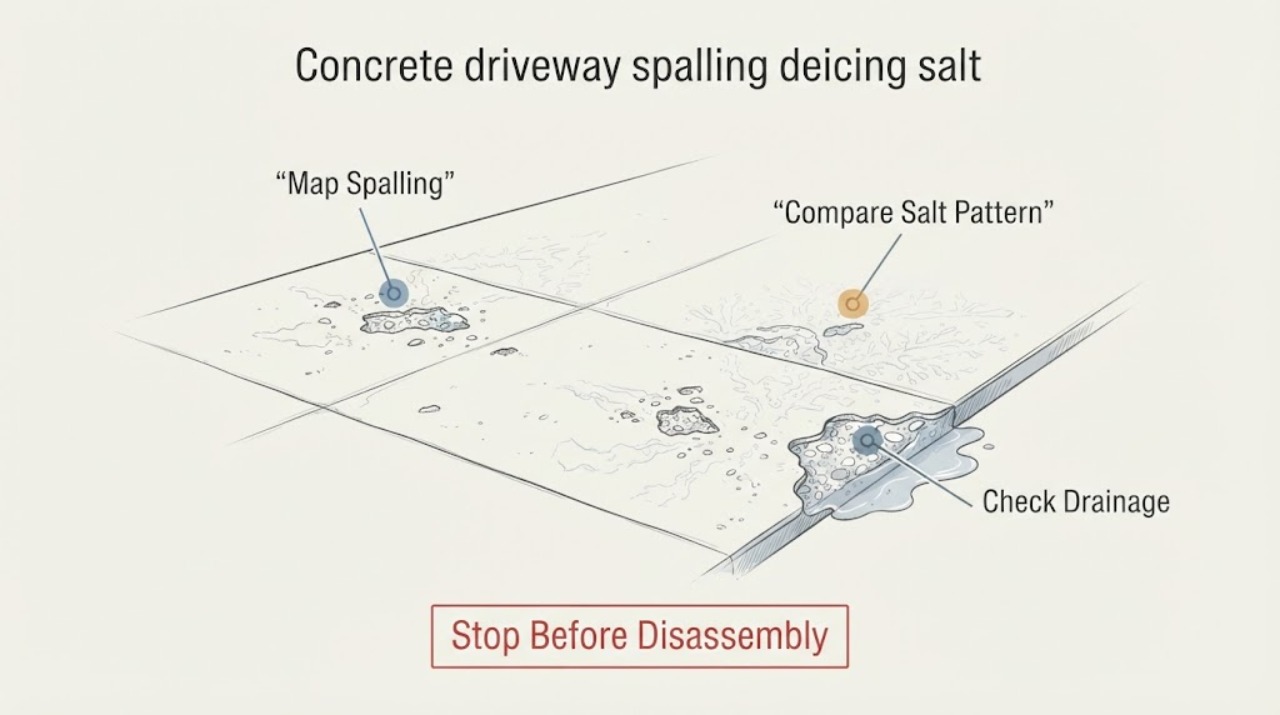
Pitted, flaking, or rough concrete after winter deicing is consistent with surface scaling or spalling, but the depth and cause must be assessed before choosing a repair. From a safe standing position, map the affected areas, compare them with untreated areas, and document drainage and salt exposure. Do not chisel, cut, grind, demolish, or mix repair chemicals; arrange concrete assessment when damage is deep, widespread, trip-forming, or still worsening.
Before you begin
Safety first
- This article is observation-only. Professionals determine depth, substrate condition, drainage interaction, repair suitability, and any required concrete work.
Work through in order
Diagnostic checks
Use only checks that match the exact appliance or system and its official guide.
-
Check 1
From a stable standing position, photograph and map each rough, pitted, flaking, or bare patch, including its location relative to joints, edges, slopes, and vehicle paths; do not chip or scrape the surface.
Expected result: Damage is isolated and shallow-looking, follows joints or edges, covers broad sections, or includes loose pieces and exposed aggregate.
Next step: Mark the locations on a simple sketch and share dated images with a concrete professional.
Stop if: Stop if the slab moves, a void is exposed, a sharp fragment or trip hazard is present, or mapping requires walking on an unsafe surface.
Why this matters
Why: A localized surface pattern may be limited scaling, while widespread loss, exposed aggregate, or loose pieces warrants assessment of depth, drainage, and freeze-thaw durability. Visual appearance cannot confirm structural soundness.
-
Check 2
Compare the affected concrete with a nearby area that receives less deicer, noting whether pitting is concentrated where salt, slush, or meltwater collects; do not apply additional chemicals to test the theory.
Expected result: Damage is strongest along a meltwater path or salt-storage area; it is similar across the driveway; or there is no clear exposure pattern.
Next step: Record the comparison and winter exposure history for the assessment rather than selecting a patch product from appearance alone.
Stop if: Do not spread test salt, use acid, or combine cleaning products.
Why this matters
Why: A concentration near repeated deicing and wetting is consistent with salt scaling, which FHWA links to deicing chemicals and moisture. A uniform or unclear pattern leaves other causes possible, including age, drainage, curing, or freeze-thaw conditions.
-
Check 3
Observe the driveway after rain or thaw from a safe edge and note ponding, slow runoff, downspout discharge, ice-melt paths, and whether water remains in the damaged zone; do not enter standing water or dig beside the slab.
Expected result: Water drains away, ponds at the damaged area, flows repeatedly across one section, or the drainage path is hidden or inaccessible.
Next step: Photograph the water path and ask for concrete and drainage review together when ponding or building runoff is involved.
Stop if: Stop for flooding, unstable soil, exposed utilities, or water near electrical equipment.
Why this matters
Why: Repeated wetting or ponding can intensify freeze-thaw exposure and helps explain why damage is localized, but a drainage observation does not establish the concrete's internal condition.
-
Check 4
From the edge of the driveway, note whether the surface is stable for walking, whether spalling is expanding after each freeze-thaw cycle, and whether cracks, lifted edges, or a height change are visible; do not test strength by striking it.
Expected result: The area is stable and unchanged; loose fragments or a trip edge are present; cracks or lifted sections are growing; or the progression is unknown.
Next step: Keep vehicles and pedestrians clear of hazards and provide the progression history to the concrete professional.
Stop if: Stop walking the area if it is slippery, unstable, or has loose material.
Why this matters
Why: A trip edge, moving slab, growing crack, or unknown progression increases the need for professional review and temporary avoidance. A stable appearance does not prove that a repair coating or patch will bond.
Use your observations
Decision map
Find the observation that best matches what you see, then follow the next safe action.
-
PATH 01Safety boundary
What you see
Is there a trip edge, lifted section, moving slab, or exposed void?
Do this next
Keep people and vehicles away and arrange concrete assessment promptly.
Why this path and its safety boundary
Safety stop: Do not strike, pry, cut, or demolish the slab.
-
PATH 02Safety boundary
What you see
Is scaling widespread or concentrated where deicer and meltwater repeatedly collect?
Do this next
Provide the mapped pattern and winter exposure history for a repair and durability assessment.
Why this path and its safety boundary
Safety stop: Do not choose a treatment solely from color or texture.
-
PATH 03Safety boundary
What you see
Does water pond or repeatedly cross the damaged area?
Do this next
Request concrete and drainage review; keep runoff and walking hazards documented.
Why this path and its safety boundary
Safety stop: Do not dig, redirect buried drainage, or work in standing water.
-
PATH 04Safety boundary
What you see
Can the depth and stability be determined without touching or disturbing the concrete?
Do this next
Share the visual finding and let the professional confirm the repair scope.
Why this path and its safety boundary
Safety stop: No manual concrete cutting, grinding, demolition, or chemical mixing is included.
Helpful context
Understand the symptom
Salt-related scaling is a surface durability clue
FHWA describes scaling from repeated deicing-salt application as a roughened, pitted surface in which small pieces of mortar flake away. Freeze-thaw exposure, moisture, the concrete surface condition, and construction history can also affect the pattern, so a photograph alone cannot determine the correct repair.
Document before disturbing the slab
Use stable footing and ordinary visual observation. Record where the damage is concentrated, whether edges are lifting, and whether water or salt accumulates there. Avoid aggressive cleaning or patching while the cause and depth are unknown; a concrete professional can distinguish a cosmetic surface repair from a broader slab or drainage issue.
Only after diagnosis
Potential parts
- concrete patch
Consider this only after a concrete professional confirms that the damage is suitable for a compatible surface repair; spalling depth, moisture, and freeze-thaw exposure can make a patch unsuitable.
Follow the product label and confirm substrate condition, weather limits, and intended traffic; this article does not direct mixing or application. - concrete sealer
Consider this only after the slab is assessed and the source of persistent wetting or salt exposure is addressed; a sealer cannot restore lost concrete or stabilize movement.
Verify compatibility with the existing finish, traffic, weather, and repair system using the manufacturer's instructions. - concrete cleaner
Consider this only for a confirmed, compatible cleaning need after loose material and drainage hazards are assessed; cleaning cannot diagnose or repair spalling.
Use only as labeled, never combine cleaners, and keep runoff away from drains, soil, and the building.
When checks do not resolve it
Need a professional?
Arrange concrete assessment for widespread or deep-looking spalling, a trip hazard, exposed aggregate or voids, moving or lifted sections, recurring ponding, or damage that continues after winter. Include the salt and freeze-thaw history even if the surface currently looks dry.
Safety scope: This article is observation-only. Professionals determine depth, substrate condition, drainage interaction, repair suitability, and any required concrete work.
Have this ready
- Dated photos and a map of each affected area
- Whether deicer, slush, or meltwater concentrates in the pattern
- Ponding, downspout runoff, slope, and drainage observations
- Trip edges, loose pieces, cracks, movement, and progression after thaw cycles
- Any prior sealer, patch, or surface treatment information
Common questions
FAQ
Does deicing salt cause concrete driveway spalling?
Repeated deicing exposure can contribute to surface scaling, especially with moisture and freeze-thaw conditions. FHWA describes rough, pitted flaking near the surface, but other causes can look similar and depth needs assessment.
Should I scrape or chip the loose concrete?
Do not disturb it as a diagnostic step. Photograph and map the area, avoid hazards, and have a concrete professional determine whether the distress is surface-limited or deeper.
What drainage details matter?
Record ponding, meltwater paths, downspout discharge, slope, and whether salt collects in one zone. Repeated wetting can change the repair decision and should be assessed with the concrete.
When is spalling more than a cosmetic issue?
A trip edge, moving or lifted slab, exposed void or aggregate, widespread loss, or continuing progression calls for professional assessment and temporary avoidance of the area.
Read the exact guide
Official sources
- Concrete Pavement RepairFederal Highway Administration · Supports documenting surface distress and obtaining a repair assessment rather than assuming a treatment from appearance.
- Chapter 4 - High-Performance Concretes, 1989-1994Federal Highway Administration · Supports the explanation that repeated deicing chemicals can produce roughened, pitted scaling and that moisture and concrete history affect performance.
Community feedback
Share a repair observation
Share a plain-text repair observation. Accepted observations are published automatically; this page may take a moment to update.