
On this page
Start here
Quick answer
A circuit breaker or panel area that feels hot is a high-risk electrical warning, not a normal DIY adjustment. Do not touch the breaker, remove the panel cover, tighten anything, reset the breaker repeatedly, or continue using heavy loads on the affected circuit. From outside the panel area, observe only for smoke, arcing, sizzling, discoloration, burning odor, repeated trips, or loss of power. Keep clear and arrange a qualified electrician promptly; leave the area and use emergency response for smoke, flame, or an escalating burning smell.
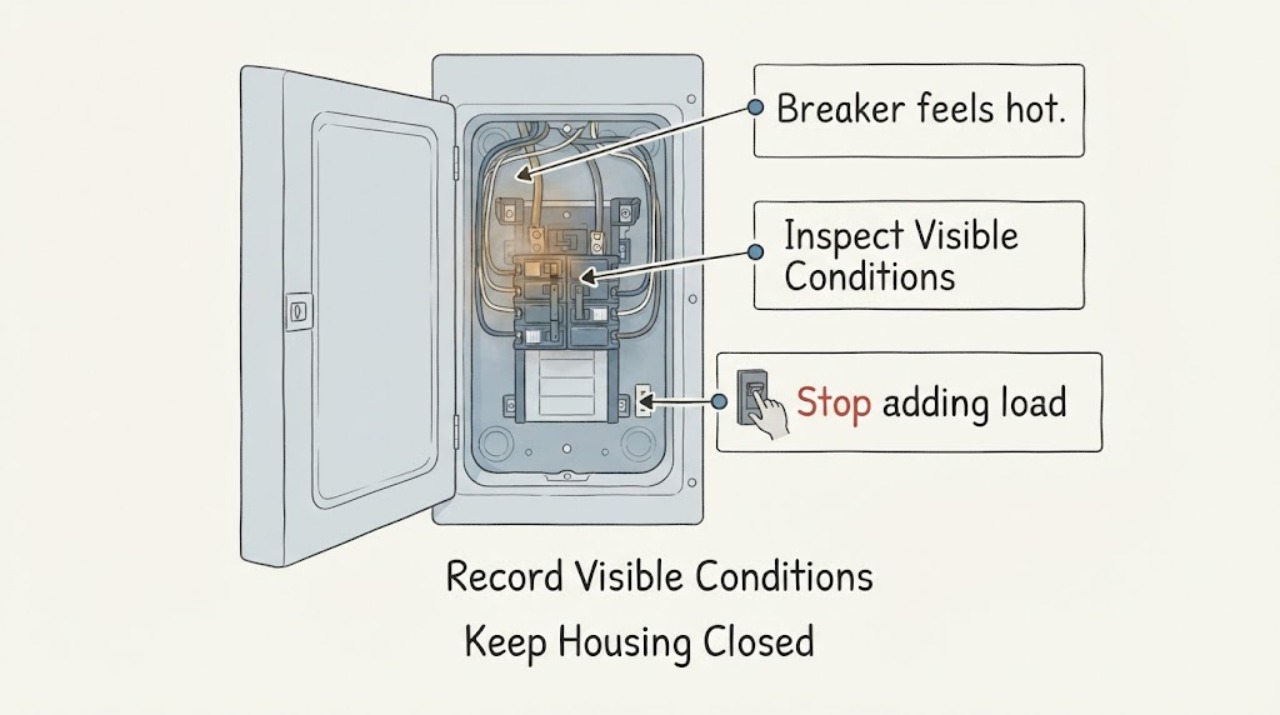
Work through in order
Diagnostic checks
Use only checks that match the exact appliance or system and its official guide.
-
Look for external emergency warning signs
From outside the panel enclosure and without touching it, look and listen for smoke, flame, visible arcing, sizzling or buzzing, a burning or hot-insulation odor, or discoloration around the door or surrounding wall.
Expected result: Smoke, flame, visible arcing, an escalating burning smell, or loud sizzling is present; or no emergency sign is visible from the safe position.
Next step: For smoke, flame, arcing, or an escalating odor, leave the area, keep others out, and contact emergency services from a safe location. If no emergency sign is visible, keep clear and arrange urgent qualified electrical service.
Stop if: Stop observing immediately if smoke, flame, arcing, worsening odor, popping, or heat spread appears.
Why this matters
Why: These signs can indicate an active electrical or fire hazard. No visible sign does not make a hot breaker safe; heat can be inside the enclosure or at a connection that cannot be assessed safely from outside.
-
Stop adding load to the affected circuit
From a safe location, identify only what was already running by its normal switch or display. Do not approach the panel to turn anything off, and do not plug in another appliance or move loads between circuits.
Expected result: A known load is still operating; the load is unknown; or no load is operating.
Next step: If the load can be stopped safely at its normal control without approaching the panel or a hot appliance, leave it off. Otherwise do not touch it; keep the area clear and tell the electrician what was running or that it is unknown.
Stop if: Stop if stopping the load would require opening the panel, touching a hot cord or device, or working near smoke, water, or arcing.
Why this matters
Why: A continuing load may worsen an overload or a fault, but the cause cannot be diagnosed by experimenting with appliances. An unknown load or no load still leaves the hot-breaker condition unresolved.
-
Record the circuit history without resetting anything
Ask occupants whether the breaker has tripped, power has flickered, lights have dimmed, or the same appliance has caused an outage. Use only memory or existing notes; do not reset the breaker to reproduce the event.
Expected result: Repeated trips, flickering or dimming, a recent outage, a single appliance associated with the event, or no known history is reported.
Next step: Give the timeline and affected appliances to the electrician. Leave the breaker in its current state and do not reset it repeatedly or substitute a higher-rated device.
Stop if: Stop if anyone suggests opening the panel, resetting the breaker as a test, or replacing a fuse or breaker without professional diagnosis.
Why this matters
Why: Repeated trips or a consistent appliance association can point the electrician toward overload, a faulty appliance, or a wiring fault, but they do not identify which part is safe to replace. No history does not rule out a loose or failing connection.
-
Capture only safe identification details
From outside the enclosure, note the panel brand or label and the affected breaker position only if the information is already visible without opening or touching the panel. Photograph the closed door from a safe distance if useful.
Expected result: The label and circuit description are readable; only partial information is visible; or identifying details would require opening the panel.
Next step: Share only the safe information and the photos with the electrician. Let the professional identify the breaker, wiring, and panel condition during a controlled assessment.
Stop if: Stop if identification would require removing a cover, touching the breaker, using a probe, or standing where smoke or heat is worsening.
Why this matters
Why: A readable label may help the electrician plan the visit, but labels can be incomplete or wrong. Missing information is safer than approaching energized components.
Use your observations
Decision map
Find the observation that best matches what you see, then follow the next safe action.
-
PATH 01Next step
What you see
Smoke, flame, visible arcing, popping, or an escalating burning odor is present.
Do this next
Leave the area, keep others away, and contact emergency services from a safe location; do not touch the panel or attempt to extinguish an energized electrical fire with water.
-
PATH 02Next step
What you see
A known appliance is still operating and can be stopped at its normal control without approaching the panel or a hot device.
Do this next
Leave that appliance off and do not add, move, or test loads while waiting for the electrician.
-
PATH 03Next step
What you see
The breaker has tripped repeatedly, lights flicker, or one appliance consistently precedes the event.
Do this next
Give the timeline to the electrician and do not reset the breaker as a test.
-
PATH 04Next step
What you see
The panel label or breaker identity is not readable without opening or touching the enclosure.
Do this next
Do not open the panel; let the electrician identify and isolate the circuit safely.
Helpful context
Understand the symptom
Stay outside the panel
Do not open the panel door or cover, remove the breaker, or put a hand near a hot component. Electrical parts can remain energized even when a breaker or main switch appears off. Do not try to tighten a terminal, replace the breaker, test voltage, or make the panel safe yourself. If you can identify the affected appliance without approaching the panel, stop using it from its normal control and keep people away; do not keep adding or moving loads to see whether the heat changes.
What to tell the electrician
Record which breaker or panel area seems involved only from a safe position, what was running at the time, when the heat was noticed, whether the breaker has tripped, and any smell, sound, smoke, discoloration, or flickering. If the panel label is already readable without opening anything, share the label wording; do not remove a cover to identify a circuit.
Only after diagnosis
Potential parts
- circuit breaker replacement
Only consider this category if a qualified electrician diagnoses the breaker as failed and confirms the correct replacement for the panel.
Breaker fit, rating, and panel listing must be confirmed by the electrician; heat alone does not identify a replacement. - electrical panel label
Only consider this after the electrical hazard is corrected and the electrician determines that circuit identification needs updating.
A label can document circuits but cannot repair overheating or substitute for a panel inspection.
When checks do not resolve it
Need a professional?
Request urgent electrician service for any breaker or panel area that feels hot, especially with a burning odor, discoloration, buzzing, repeated trips, flickering, smoke, or an appliance-related pattern.
Common questions
FAQ
Is it normal for a circuit breaker to feel hot?
A breaker or panel area that feels hot should be treated as a warning, especially with odor, buzzing, discoloration, repeated trips, or flickering. Do not touch it to compare temperatures; arrange qualified electrical service.
Should I reset a hot breaker?
No. Do not reset it repeatedly or use a reset as a test. Keep clear, stop using known loads only from their normal controls if safe, and tell the electrician what happened.
Can I tighten the breaker connection myself?
No. Opening a panel or tightening a terminal can expose energized parts and create shock or fire risk. Panel inspection and repairs belong to a qualified electrician.
When is a hot breaker an emergency?
Leave the area and contact emergency services from a safe location if there is smoke, flame, visible arcing, popping, or an escalating burning odor. Otherwise request urgent electrician service and keep the panel area clear.
Read the exact guide
Official sources
- CPSC Guide to Home Wiring HazardsU.S. Consumer Product Safety Commission · Overheating, odors, unusual sounds, arcing, panel access, and breaker warning observations
- Commission Closes Investigation Of FPE Circuit Breakers And Provides Safety Information For ConsumersU.S. Consumer Product Safety Commission · Repeated breaker trips or suspected overload associated with a hot breaker
Community feedback
Share a repair observation
Share a plain-text repair observation. Accepted observations are published automatically; this page may take a moment to update.