
On this page
Start here
Quick answer
A breaker wire termination that feels hot is an electrical warning, not a reason to tighten the screw or keep testing the circuit. A loose or incorrectly sized conductor, a poor termination, overload, damaged breaker, or bus connection can create heat, discoloration, arcing, and fire risk, while a breaker handle or nearby enclosure may feel warm for different reasons. Do not touch the termination again, remove the panel cover, probe it, or re-energize it to compare temperatures. From outside the panel, note smoke, burning odor, crackling, discoloration, melting, trips, flickering, and what load was running. Stop using the affected circuit if it can be done without approaching a hazard, keep clear of the panel, and have a licensed electrician isolate and inspect the equipment.
Before you begin
Safety first
- Owner checks are limited to staying clear, external observation, reading safely visible labels, normal load history, and documentation. A licensed electrician must handle panel access, electrical isolation and verification, torque, conductor preparation, circuit measurements, breaker or bus inspection, protective-device testing, component replacement, and code decisions.
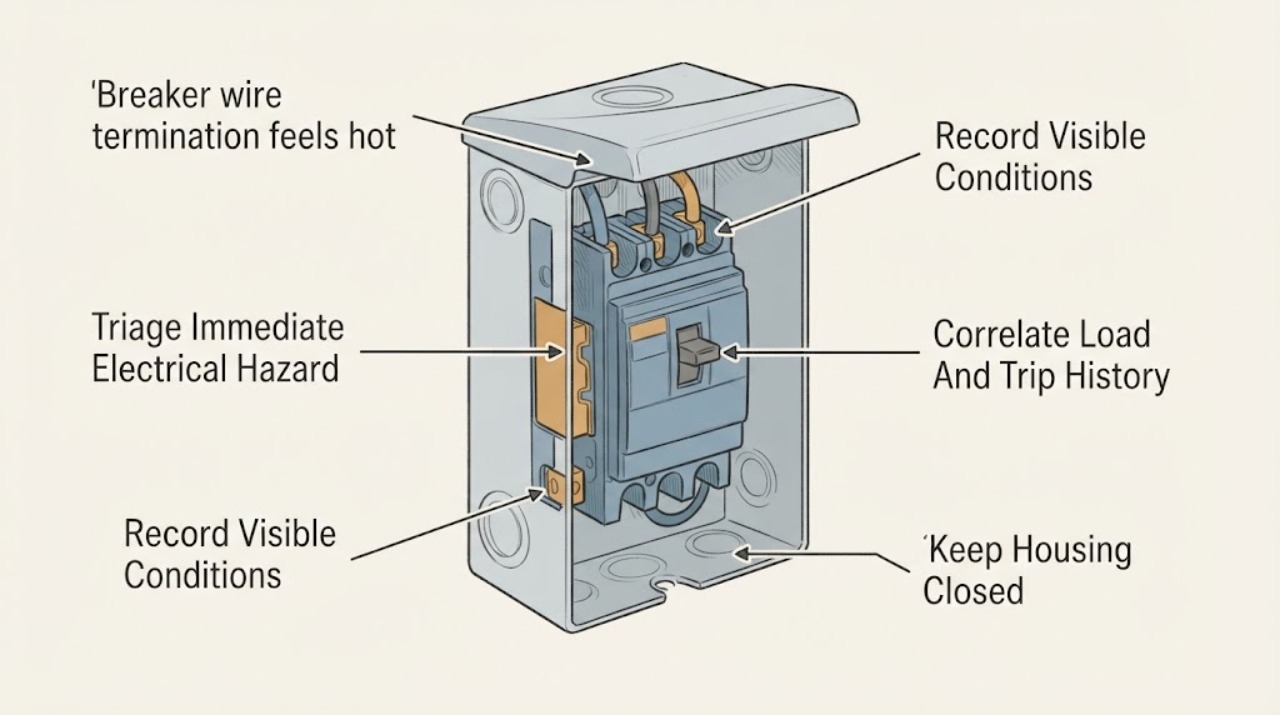
Work through in order
Diagnostic checks
Use only checks that match the exact appliance or system and its official guide.
-
Check 1
Stop touching the breaker, termination, and panel. From a safe position, check only for smoke, flame, sparks, electrical burning odor, crackling, rapidly worsening heat, or a panel that is wet or physically damaged. Keep people away and do not open the panel.
Expected result: There is smoke, flame, sparking, strong burning odor, loud crackling, rapidly worsening heat, water at the panel, exposed damage, or none of these signs.
Next step: For fire or active sparking, leave and contact emergency services from a safe location. For smoke, odor, water, or severe heat, keep clear and obtain urgent qualified electrical help. Do not touch a wet panel or attempt a local reset.
Stop if: Stop immediately for smoke, flame, sparks, arc flash, strong burning odor, loud crackling, water near the panel, exposed conductors, or any impulse to open the cover or touch the hot area.
Why this matters
Why: Smoke, flame, arcing sounds, strong odor, water, or rapidly worsening heat indicates an immediate fire or shock hazard. No visible emergency sign does not make a hot termination safe; it only allows a cautious external handoff rather than emergency evacuation.
-
Check 2
Without removing the panel cover, record which breaker position and label are associated with the symptom and photograph only visible exterior signs from a safe distance. Note discoloration, a distorted enclosure, a trip position, flickering lights, or an odor; do not use an infrared camera, thermometer, probe, or hand comparison unless a qualified professional directs it in a safe setup.
Expected result: The exterior is discolored or melted; the breaker has tripped; the panel or handle is visibly damaged; the symptom is odor or sound only; or no visible sign remains.
Next step: Keep the record for the electrician and leave the affected circuit unused when that can be done through normal controls without approaching danger. Do not remove adjacent breakers or disturb the panel to improve the photo.
Stop if: Stop if a photo requires opening the panel, moving a breaker handle near damage, touching the enclosure, or standing in water or in front of an active arc hazard.
Why this matters
Why: Discoloration, melting, damaged insulation, odor, unusual sound, or a trip supports an active electrical fault even if the area later cools. A lack of visible evidence cannot rule out heat at the termination because the connection is behind the cover.
-
Check 3
From normal use outside the panel, note what equipment was operating when the termination felt hot, whether the symptom follows a high-demand load, and whether the breaker has tripped, buzzed, or required resets. Do not turn loads on and off repeatedly to recreate the heat.
Expected result: The symptom follows a large or continuous load; lights dim or flicker; the breaker trips repeatedly; the circuit has recently gained equipment; or the heat appears with little or no load.
Next step: Leave the circuit out of service if practical and tell the electrician the load sequence and history. Do not substitute a larger breaker, use an extension cord to move a fixed load, or reset repeatedly.
Stop if: Stop if the load is a heater, motor, EV charger, water heater, range, or other high-demand equipment and the panel shows heat, odor, sound, or damage; obtain professional inspection before further use.
Why this matters
Why: Load-related symptoms can involve circuit demand, conductor sizing, termination quality, or a failing breaker. Repeated trips, flicker, or heat with little load raise concern for a connection, breaker, bus, or wiring fault rather than a normal operating temperature.
-
Check 4
Read the Eaton breaker and load-center labels only from the outside, if they are safely visible. Record the breaker family, pole count, circuit label, installation date if known, and any AFCI or GFCI test or fault indication. Do not infer compatibility from the Eaton name alone and do not remove or swap a breaker.
Expected result: The breaker or panel label is missing; the breaker appears mismatched or damaged; an AFCI/GFCI indicator or trip history is present; the panel has had recent work; or the equipment identity is clear.
Next step: Give the labels and photos to the electrician and keep the circuit isolated as appropriate. If the identity is unclear, treat that uncertainty as a reason not to order a breaker or termination part.
Stop if: Stop if identifying the equipment requires opening the panel, reading a label near energized parts, removing trim, or handling a breaker or conductor.
Why this matters
Why: Eaton breaker families, panel compatibility, conductor terminals, and protective functions vary. Recent work, a mismatch, or a fault indication increases the need for an electrician to verify the installation rather than simply retighten a wire.
-
Check 5
Do not retorque, cut, strip, crimp, move, or reinsert the wire at the hot termination. Do not apply contact cleaner, thermal paste, tape, or a replacement breaker, and do not rely on turning off only that branch handle as proof the termination is de-energized.
Expected result: The connection seems loose from outside; the breaker handle is off; the circuit is dead at an outlet; or no safe isolation has been confirmed.
Next step: Leave the panel closed and arrange a licensed electrician to de-energize, inspect, torque, test, and repair the circuit according to the exact Eaton and panel instructions and applicable code.
Stop if: Stop all owner work at the panel. Any step involving the cover, live or potentially live conductors, torque, conductor preparation, breaker removal, bus inspection, or electrical testing belongs to a qualified electrician.
Why this matters
Why: A breaker handle or downstream dead outlet does not prove the termination is safe to touch, and a loose-looking termination may have heat damage that requires replacement of more than one component. Eaton's maintenance guidance reserves terminal inspection and corrective work for equipment made safe and properly qualified personnel.
-
Check 6
Prepare a service record with the Eaton breaker and panel identity, circuit load, first time the termination felt hot, duration, trips, flicker, sound, odor, visible damage, recent installation or remodeling, and photos taken without opening the panel. Keep the circuit unused until the electrician advises otherwise.
Expected result: The symptom is one-time and no longer visible; it recurs under load; protective devices trip; heat damage is visible; or the cause remains uncertain.
Next step: Request a licensed electrician to make the panel safe and inspect the conductor, terminal, breaker, bus, circuit loading, and upstream/downstream connections. Treat smoke, arcing, strong odor, water, or severe damage as urgent.
Stop if: End owner troubleshooting once the source is not obvious from outside the panel or any electrical isolation, measurement, retermination, component replacement, or code decision is needed.
Why this matters
Why: A cooled connection can still have damaged insulation, terminal plating, bus contact, or breaker material. Recurrence under load or any protective-device activity makes a fault more likely; uncertainty cannot be resolved by more homeowner testing.
Use your observations
Decision map
Find the observation that best matches what you see, then follow the next safe action.
-
PATH 01Next step
What you see
Smoke, flame, sparks, strong electrical odor, crackling, water at the panel, or rapidly worsening heat is present.
Do this next
Leave the area and contact emergency services for fire or active arcing; otherwise obtain urgent qualified electrical help from a safe location. Keep everyone away from the panel.
Why this path and its safety boundary
Why it matters: This is an immediate fire or shock hazard, not a diagnostic opportunity. A branch handle or remote control is not a safe substitute for qualified isolation.
-
PATH 02Next step
What you see
The exterior or visible edge shows discoloration, melted material, blistered insulation, a distorted breaker, or a damaged panel.
Do this next
Keep the panel closed and the affected circuit out of service when safe, then arrange a licensed electrician for de-energized inspection and repair.
Why this path and its safety boundary
Why it matters: The termination, breaker, conductor, bus, or enclosure may have sustained heat or arcing damage. Cooling after a trip does not restore material integrity.
-
PATH 03Next step
What you see
Heat, trips, flicker, or odor returns when a high-demand or continuous load runs, while there is no immediate smoke or active arc.
Do this next
Stop using the affected load and have an electrician verify the complete circuit and termination under safe test conditions. Do not install a larger breaker or reset repeatedly.
Why this path and its safety boundary
Why it matters: Circuit demand, conductor sizing, termination quality, breaker condition, or a connection upstream or downstream becomes more likely than a harmless warm handle.
-
PATH 04Next step
What you see
The termination feels hot with little load, the symptom is one-time, or no visible damage, trip, odor, or sound can be established from outside the panel.
Do this next
Do not recreate the symptom. Document the event and ask a licensed electrician to inspect before relying on the circuit for important or high-demand equipment.
Why this path and its safety boundary
Why it matters: The observation is insufficient to call the condition normal. A termination fault can cool before inspection, and apparent handle warmth may not identify the actual heat source.
-
PATH 05Next step
What you see
The Eaton breaker or panel identity is unclear, the breaker appears mismatched, or recent remodeling, rewiring, or a new load preceded the heat.
Do this next
Keep the panel closed, do not order a replacement by appearance, and provide all labels and work history to a licensed electrician for model- and code-specific evaluation.
Why this path and its safety boundary
Why it matters: Compatibility, conductor termination, circuit capacity, or installation workmanship needs verification. The Eaton brand alone does not establish that a breaker fits a particular panel or conductor.
Helpful context
Understand the symptom
Treat heat at a termination as a possible fault
The metal and insulation around a conductor termination can overheat when the connection, conductor, load, or breaker is not appropriate for the installation. Eaton notes that elevated temperatures are often traceable to terminal connection issues, and that overheating can damage insulation or the breaker. A handle that is merely warm is not the same observation as a terminal that is hot, but the distinction cannot be made safely by touching the panel again.
Use only outside-the-panel observations
From a safe position, look for smoke, an electrical burning odor, crackling, buzzing, discoloration, melted plastic, blistered insulation, a tripped breaker, flickering lights, or a circuit that loses power under load. Do not remove the dead-front or cover: parts inside can remain energized even when a branch breaker is off. A qualified electrician must make the equipment safe before checking torque, conductor size and material, bus contact, breaker condition, or load current.
Do not infer a fix from a single symptom
Heat at one termination can result from a loose or incorrectly prepared conductor, an incompatible conductor or terminal, excessive load, a damaged breaker or bus interface, or an installation defect. Repeatedly resetting a tripped breaker, moving the conductor, or swapping a breaker without identifying the cause can make the fault worse. The useful next decision is whether the circuit can remain safely out of service until an electrician inspects it, not which part to order by appearance.
Safety boundary
Stop conditions
- Stop and leave the area for fire, active sparking, arc flash, smoke, strong electrical burning odor, loud crackling, rapidly worsening heat, or water at the panel; contact emergency help from a safe location.
- Do not remove the panel cover or dead-front, touch the termination, probe voltage, use a thermometer or infrared camera near energized equipment, or assume an off branch handle makes the termination safe.
- Do not retorque, cut, strip, crimp, move, or reinsert conductors; do not swap breakers, install a larger rating, bypass AFCI/GFCI protection, or apply cleaner, tape, or other improvised repair.
- Do not keep resetting or cycling a breaker to reproduce heat, trips, odor, flicker, buzzing, or a high-load symptom. Leave the circuit unused when it can be done through normal controls without approaching danger.
- Call a licensed electrician for any suspected hot termination, visible heat damage, unknown breaker or panel identity, recent electrical work, repeated trip, or need for isolation, measurement, retermination, breaker replacement, bus inspection, or code evaluation.
Only after diagnosis
Potential parts
- Eaton circuit breaker
Consider this only after a licensed electrician confirms that the breaker is heat-damaged or otherwise failed and that the conductor, terminal, bus, circuit loading, and panel are suitable.
Verify the exact Eaton load-center family, breaker type, pole count, rating, interrupting capability, protective function, and local requirements; never substitute by appearance or install a larger rating. - Eaton breaker terminal or conductor connection hardware
Consider this only when an electrician identifies damaged or incorrect termination hardware and confirms that the breaker is serviceable and the conductor is acceptable.
Confirm the exact breaker and panel documentation, conductor material and size, terminal listing, torque method, and code requirements; termination work is not a homeowner repair. - Eaton load-center bus or breaker mounting component
Consider this only after de-energized inspection shows heat or arcing damage at the bus or mounting interface and the electrician determines that the panel can be repaired.
Bus and mounting components are panel-specific and may require replacing the load center; verify exact documentation and code compliance before any part decision.
When checks do not resolve it
Need a professional?
Call a licensed electrician for every suspected hot wire termination, even if it cools before help arrives. Request urgent help for discoloration, melted or blistered insulation, burning odor, crackling, flickering, repeated trips, high-demand loads, water, or a damaged panel. Leave immediately and contact emergency services for fire or active arcing. Only a qualified electrician can de-energize and verify the panel, inspect conductor size and material, check termination torque, assess breaker and bus damage, measure load, and select a code-compliant repair.
Safety scope: Owner checks are limited to staying clear, external observation, reading safely visible labels, normal load history, and documentation. A licensed electrician must handle panel access, electrical isolation and verification, torque, conductor preparation, circuit measurements, breaker or bus inspection, protective-device testing, component replacement, and code decisions.
Common questions
FAQ
Why does my Eaton breaker wire termination feel hot?
Possible causes include a loose or unsuitable termination, conductor or terminal mismatch, circuit demand, a damaged breaker or bus connection, or another wiring fault. Do not touch or open the panel; have a licensed electrician inspect it.
Is it normal for an Eaton breaker to feel warm?
A warm handle does not identify the temperature at the hidden wire termination. Because the reported symptom is heat at a termination, treat it as a warning and obtain professional inspection rather than comparing it by hand with other breakers.
Can I tighten the hot wire on the breaker?
No. Do not remove the cover or retorque a conductor. The terminal may remain energized, and heat may have damaged the wire, breaker, bus, or insulation; a licensed electrician must isolate and verify the equipment first.
Does turning the Eaton breaker off make the wire termination safe?
Not necessarily. A branch handle being off does not prove every part of a panel is de-energized or verified safe. Keep the panel closed and let a qualified electrician perform isolation and testing.
What if the breaker has discoloration or melted plastic?
Discoloration, melting, or blistered insulation indicates possible overheating or arcing damage. Do not reset or touch it; keep clear and request urgent electrical service, with emergency help for smoke or active sparking.
Can an overloaded circuit make a breaker termination hot?
Load demand can contribute to heating, but a hot termination can also come from connection, conductor, breaker, bus, or installation problems. Do not install a larger breaker; have the complete circuit evaluated.
Should I keep resetting the breaker to see if it gets hot again?
No. Repeated resets or load tests can worsen a fault and increase fire risk. Record what was running and leave the circuit unused when safe until a licensed electrician inspects it.
Can I replace the Eaton breaker myself?
Do not replace it as a trial. Eaton breaker families and load centers have specific compatibility, conductor, protective-function, and rating requirements, and panel work requires qualified isolation and code-compliant installation.
What information should I give the electrician?
Provide the Eaton breaker and panel labels, circuit and load, when the heat was noticed, trips, flicker, odor or sound, visible damage, recent work, and safe exterior photos. Do not open the panel to collect more information.
When is a hot breaker termination an emergency?
Leave and contact emergency services for fire or active arcing. Treat smoke, strong burning odor, crackling, rapidly worsening heat, water at the panel, exposed conductors, or melted material as urgent hazards and keep clear.
Read the exact guide
Official sources
- Proper application and maintenance of molded case breakersEaton · Eaton official technical paper used to support the relationship between elevated temperature and terminal connection issues and the need to inspect damage; it is not a homeowner panel-repair procedure.
- Home Wiring Safety TipsElectrical Safety Foundation International · ESFI electrical-safety guidance used for recognizing overheating, odors, discoloration, arcing, unusual sounds, trips, and damaged insulation; it supports safety escalation rather than equipment-specific repair instructions.
- Residential Circuit Breakers | CH Circuit BreakersEaton · Eaton official product page used only to reinforce that breaker families and load-center features are product-specific; it does not establish fitment for an unspecified breaker or panel.
- Non-automatic Transfer Switch, Molded Case Type, Open Transition, 30-1000A Operation and Maintenance ManualEaton · Eaton official maintenance manual for molded-case switching equipment used for the inspection and safety boundary; transfer-switch equipment differs from residential panels, so its instructions are not generalized as homeowner repair steps.
- AbleEdge Smart Breaker FAQEaton · Eaton official FAQ used only to establish that Eaton residential breaker installation and wiring behavior is product-specific; the AbleEdge product is not assumed to be the user's breaker.
Community feedback
Share a repair observation
Share a plain-text repair observation. Accepted observations are published automatically; this page may take a moment to update.