
On this page
Start here
Quick answer
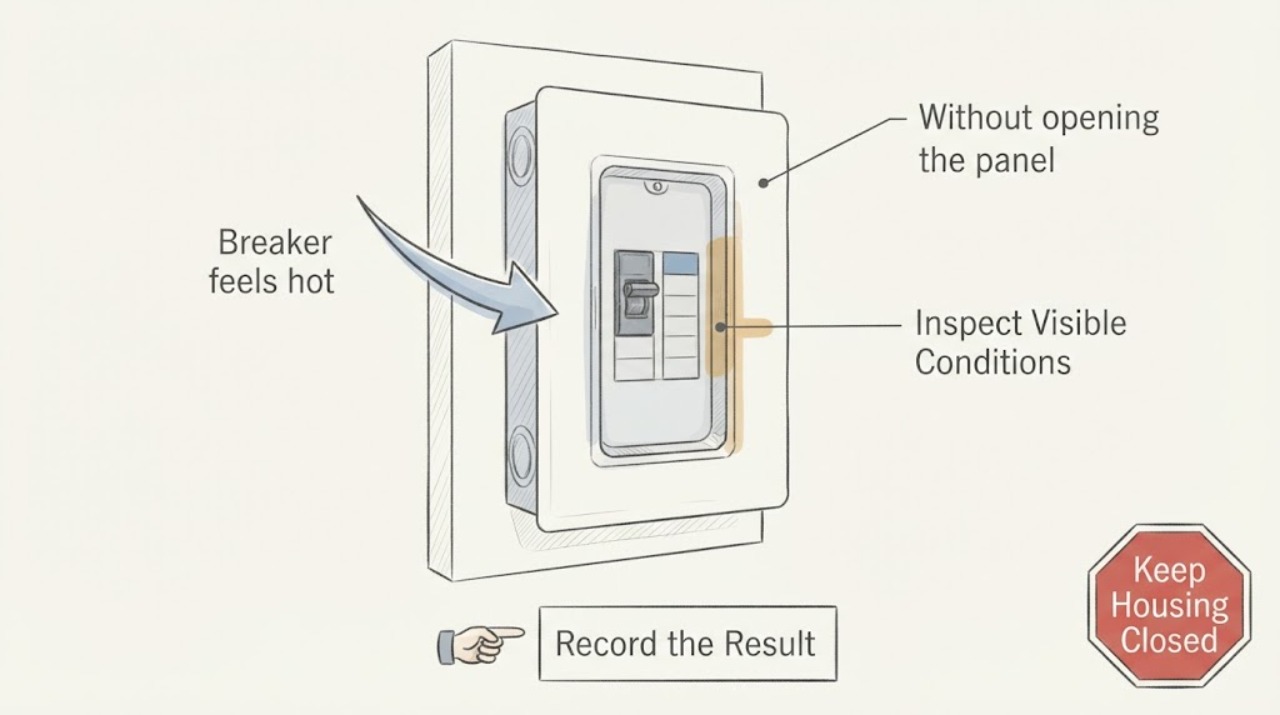
A Square D breaker that feels warm is not automatically failing, and touch alone cannot establish a safe operating temperature. Do not remove the panel cover, touch terminals, tighten connections, or repeatedly reset the breaker. From outside the closed panel, note whether the heat is unusual compared with nearby breakers and whether there is discoloration, melted plastic, an odor, buzzing, nuisance tripping, smoke, or a load-related pattern. A breaker that is much hotter than comparable breakers, shows damage, trips, or heats with a normal load needs a qualified electrician; smoke, arcing, fire, or a burning odor requires leaving the area and calling emergency services. If replacement is eventually needed, the exact Square D panel and breaker family must be matched—QO and Homeline breakers are not interchangeable.
Before you begin
Safety first
- The homeowner should not open the panel, touch terminals, tighten connections, change breaker ratings, repeatedly reset a hot breaker, or install a replacement. Diagnosis and any de-energizing, testing, or replacement belong to qualified electrical personnel.
Work through in order
Diagnostic checks
Use only checks that match the exact appliance or system and its official guide.
-
Check 1
Without opening the panel or touching the breaker, compare its visible face and surrounding closed-panel area with nearby breakers that carry similar everyday loads; use the existing observation of warmth rather than deliberately touching it again.
Expected result: The breaker feels or appears similar to neighboring breakers, is distinctly hotter than comparable breakers, or the comparison is not possible because the panel is inaccessible or the load is unknown.
Next step: Record the breaker position and circuit label. Arrange an electrical inspection for a distinct difference or uncertain condition; do not open the cover to investigate.
Why this matters
Why: A similar reading without other warning signs is less specific than a large temperature difference. A breaker that is distinctly hotter, or cannot be compared safely, needs an electrician's assessment rather than a touch-based conclusion.
-
Check 2
From outside the closed panel, look for browning, darkening, melted or deformed plastic, a cracked breaker case, scorch marks, or an odor of overheated insulation; do not remove the dead front or reach through openings.
Expected result: The case and panel look clean and dry, or there is discoloration, melting, cracking, scorching, or a burning odor.
Next step: For any damage or burning odor, stop using the affected circuit if that can be done through normal user controls without touching the hot equipment, keep clear, and call an electrician. If there is smoke or fire, leave and call emergency services.
Why this matters
Why: Visible damage or odor indicates possible overheating at the breaker, bus, conductor, or connection and is more serious than warmth alone. A clean exterior does not prove that internal connections are sound.
-
Check 3
Observe the circuit over normal use and note whether the heat or any nuisance trip appears when one known appliance or group of loads is operating; do not add loads, run appliances unattended, or repeatedly reset the breaker to test it.
Expected result: The breaker warms or trips only with a heavy or particular load, remains hot at light use, or has no clear load relationship.
Next step: Stop using the suspect appliance or reduce the load if this can be done normally and safely, then give the pattern to a qualified electrician. Do not change the breaker rating or keep resetting it.
Why this matters
Why: A load-related pattern makes sustained overcurrent, an appliance fault, or an incorrectly sized circuit more likely. Heat at light use or without a clear pattern makes a high-resistance connection or breaker fault more concerning.
-
Check 4
Record the breaker handle position, any trip indicator, repeated trips, buzzing or crackling, flickering on the circuit, and whether the panel is in unusual heat or direct sun; do not move the handle back and forth as a diagnostic test.
Expected result: The breaker is on with no trip history, is tripping or sitting in an intermediate position, or there is buzzing, flicker, or another abnormal electrical symptom.
Next step: Leave the breaker alone and arrange prompt electrical service. If there is smoke, arcing, a strong burning odor, or rapid heating, leave the area and call emergency services.
Why this matters
Why: Repeated trips or an intermediate position can reflect overload, short or ground fault, equipment trouble, or a breaker issue. Noise or flicker alongside heat increases the urgency and should not be treated as normal operation.
-
Check 5
Read the panel directory and the breaker face marking from outside the closed panel, recording the Square D family or catalog marking, pole count, circuit label, and any visible Visi-Trip or electronic indicator; do not remove the breaker or cover to find a number.
Expected result: The panel and breaker markings are legible, the panel appears to be QO or Homeline, or the markings are missing or unclear.
Next step: Give the markings and a clear exterior photo to the electrician. If identification is unclear, do not order a replacement by appearance or rating alone.
Why this matters
Why: Exact family and panel identification is needed for a safe compatibility decision. QO and Homeline breakers are different families and cannot be substituted merely because both carry the Square D name.
-
Check 6
Check from a safe position whether the heat is limited to one breaker or extends to the panel enclosure, main disconnect area, multiple breakers, or nearby wall; do not open the enclosure or touch adjacent hardware to compare temperatures.
Expected result: Only one branch breaker appears affected, several breakers or the enclosure are warm, or the main/service area appears involved.
Next step: Arrange prompt electrician service for any unusual spread of heat, and use emergency services for smoke, arcing, or fire. Do not attempt to remove the panel cover or shut off an unfamiliar service disconnect as a test.
Why this matters
Why: A single hot breaker may be local to its load, connection, or breaker. Heat across several devices or near the main/service area can indicate a broader loading, ambient, or service problem and raises the urgency.
Use your observations
Decision map
Find the observation that best matches what you see, then follow the next safe action.
-
PATH 01Next step
What you see
The breaker is only mildly warm, is similar to nearby breakers under comparable use, and there is no discoloration, odor, noise, nuisance tripping, or flicker.
Do this next
Do not open the panel or keep testing by touch. Record the circuit and ask an electrician to verify it during normal load if the heat persists or changes.
Why this path and its safety boundary
Why it matters: Normal operating heat is possible, and touch alone does not establish a defect, but the condition is not confirmed safe without qualified inspection if concern remains.
-
PATH 02Next step
What you see
One Square D breaker is distinctly hotter than comparable breakers, especially at light load, or heat is accompanied by discoloration, melted plastic, odor, buzzing, or a cracked case.
Do this next
Stop using the affected circuit when it can be done through normal controls without touching the panel, keep clear, and call an electrician promptly. Do not tighten, pull, replace, or open anything yourself.
Why this path and its safety boundary
Why it matters: A high-resistance connection, damaged bus or conductor, internal breaker problem, or other overheating fault is more likely than normal load heat.
-
PATH 03Next step
What you see
The breaker heats or trips when a particular appliance or combination of loads runs, then cools when that load is absent, without visible panel damage.
Do this next
Stop using the suspect appliance or reduce the load safely and have an electrician check the circuit and equipment. Never install a larger breaker to stop trips.
Why this path and its safety boundary
Why it matters: Sustained overcurrent, an appliance fault, or circuit sizing/load interaction is more likely than an isolated cosmetic issue.
-
PATH 04Next step
What you see
The breaker remains hot at light or no apparent load, several breakers or the enclosure are affected, or the main/service area appears warmer.
Do this next
Arrange prompt electrical service and do not open the panel. Escalate to emergency services for smoke, arcing, fire, or a strong burning odor.
Why this path and its safety boundary
Why it matters: A connection, panel, ambient, or service-level issue becomes more concerning and cannot be localized by homeowner observation.
-
PATH 05Next step
What you see
A replacement is suggested, but the panel label, Square D family, breaker markings, or rating are unclear.
Do this next
Have a qualified electrician identify the load center and breaker and verify the cause of heating before selecting or installing any replacement.
Why this path and its safety boundary
Why it matters: Compatibility is unverified. Square D QO, Homeline, QOB, and other families are not interchangeable by appearance alone.
Helpful context
Understand the symptom
Warm is not the same as dangerously overheated
Breaker heat depends on load, ambient temperature, breaker design, and position in the panel. Schneider Electric notes that a breaker may be within its operating range even when it feels warm, and that touch is not a reliable temperature measurement. The useful homeowner comparison is whether this breaker is noticeably different from similar nearby breakers under similar use, or whether heat comes with visible damage, odor, noise, or repeated trips.
The likely causes are load, connection, or the breaker itself
A hot Square D breaker can be associated with sustained overcurrent, a load or appliance problem, a high-resistance connection, oxidation or looseness at a line or load connection, or an internal breaker fault. Those causes cannot be safely distinguished by opening a residential panel as a homeowner. Look from outside for symptoms and give the electrician the circuit label, appliance pattern, trip history, and any visible change.
Square D family identification matters if a breaker is needed
Square D is a brand with multiple breaker and load-center families. Schneider's product guidance distinguishes QO and Homeline and says they fit different load centers; a similar-looking breaker is not proof of compatibility. If an electrician determines that the breaker or its connection is damaged, provide the panel label and breaker markings rather than buying a visually similar replacement.
Safety boundary
Stop conditions
- Do not remove the panel cover, dead front, breaker, conductor, or terminal, and do not touch exposed electrical parts.
- Do not tighten connections, change the breaker rating, substitute a visually similar Square D family, or repeatedly reset a hot or tripping breaker.
- Stop and leave the area for smoke, arcing, fire, a strong burning odor, rapidly increasing heat, or a cracked or melting enclosure; call emergency services from a safe location.
- Do not use touch, an improvised thermometer, or a consumer infrared reading as permission to continue using a visibly damaged or unusually hot circuit.
Only after diagnosis
Potential parts
- circuit breaker replacement
Consider this only after a qualified electrician confirms that the breaker itself is damaged or failed and has ruled out overload, equipment trouble, and overheated connections.
Match the exact load-center family, catalog marking, pole configuration, rating, interrupting capability, and required protection; Square D QO and Homeline breakers are not interchangeable.
When checks do not resolve it
Need a professional?
Request electrical service for any unusual or persistent heat, visible damage, load-related heating or tripping, suspected loose or high-resistance connection, uncertain breaker compatibility, or heat involving multiple breakers or the main area.
Safety scope: The homeowner should not open the panel, touch terminals, tighten connections, change breaker ratings, repeatedly reset a hot breaker, or install a replacement. Diagnosis and any de-energizing, testing, or replacement belong to qualified electrical personnel.
Have this ready
- Provide the Square D panel and breaker markings visible from outside, circuit label, pole count if legible, whether QO or Homeline appears on the label, appliances on the circuit, load-related timing, trip history, comparison with nearby breakers, and photos of any visible discoloration or damage without opening the panel.
Common questions
FAQ
Is it normal for a Square D breaker to feel warm?
Warmth can occur during normal operation, and Schneider says touch alone is not a reliable temperature measurement. A breaker that is much hotter than comparable breakers or has odor, discoloration, noise, or repeated trips needs qualified inspection.
What should I do if a Square D breaker is too hot to touch?
Do not touch it again or open the panel. Stop using the affected circuit through normal controls only if you can do so without approaching the hot equipment, keep clear, and call an electrician. Leave and call emergency services for smoke, arcing, fire, or a strong burning odor.
Can an overloaded appliance make a breaker hot?
Yes. A sustained overcurrent or an appliance fault can create a load-related heating pattern, while a connection or breaker fault can heat without an obvious heavy load. Do not increase the breaker rating; have the circuit and appliance checked.
Can I replace a hot Square D breaker with another Square D breaker?
Not by brand name or appearance alone. Schneider says QO and Homeline breakers fit different load centers. A qualified electrician should identify the panel family, exact breaker, rating, and cause of the heat before replacement.
Should I open the panel to check for a loose wire?
No. Opening the panel or touching terminals exposes you to shock and arc-flash hazards. Record exterior symptoms and have a qualified electrician perform any de-energizing, inspection, testing, or connection repair.
Read the exact guide
Official sources
- Square D™ QO™ and QOB Miniature Circuit BreakersSchneider Electric USA · Manufacturer product guidance used to identify QO panel labels and establish that QO and Homeline families fit different load centers.
- What breakers does a QO Load Center take?Schneider Electric USA · Manufacturer FAQ used to reinforce that replacement selection must follow the exact load-center family and approved breaker types, not visual similarity.
- How do you determine why a thermal-magnetic breaker nuisance trips?Schneider Electric USA · Manufacturer guidance used for load-related heating, high-resistance or oxidized connections, visible overheating signs, and the boundary for qualified diagnosis.
- How hot can circuit breakers get? What is the temperature of a molded case breaker?Schneider Electric USA · Manufacturer guidance used to explain why warmth by touch is not conclusive and why breaker family, loading, and heat path affect surface temperature.
- Field Testing and Maintenance GuideSquare D by Schneider Electric · Manufacturer guide used for not opening the molded case, qualified-personnel warnings, comparison of breaker surface temperatures, and investigation of discoloration or cracked cases.
Community feedback
Share a repair observation
Share a plain-text repair observation. Accepted observations are published automatically; this page may take a moment to update.