
On this page
Start here
Quick answer
A soft, steady hum from a Square D breaker can be normal for some QO or Homeline arc-fault breakers, but a new, louder, intermittent, crackling, or sizzling sound should be treated as a possible electrical fault until it is checked. Keep the panel closed and first note which breaker is noisy, whether the sound changes with a known load, whether the breaker trips, and whether there is heat, discoloration, odor, flickering, or smoke. Schneider Electric says excessive noise can involve loose hardware, wiring, current transformers, or internal breaker movement; CPSC lists buzzing or sizzling as an electrical-system warning sign. Do not remove the dead front, tighten terminals, swap breakers, or repeatedly reset the circuit. Have a licensed electrician inspect the panel, breaker, circuit load, and connections, urgently if any warning sign accompanies the noise.
Before you begin
Safety first
- This article supports listening from a safe position, reading closed-panel markings, documenting the load and warning signs, and stopping use of a suspect plug-in appliance. It does not authorize panel opening, breaker removal or replacement, terminal tightening, voltage or load testing, fixed-wiring work, safety bypasses, or energized inspection.
Work through in order
Diagnostic checks
Use only checks that match the exact appliance or system and its official guide.
-
Check 1
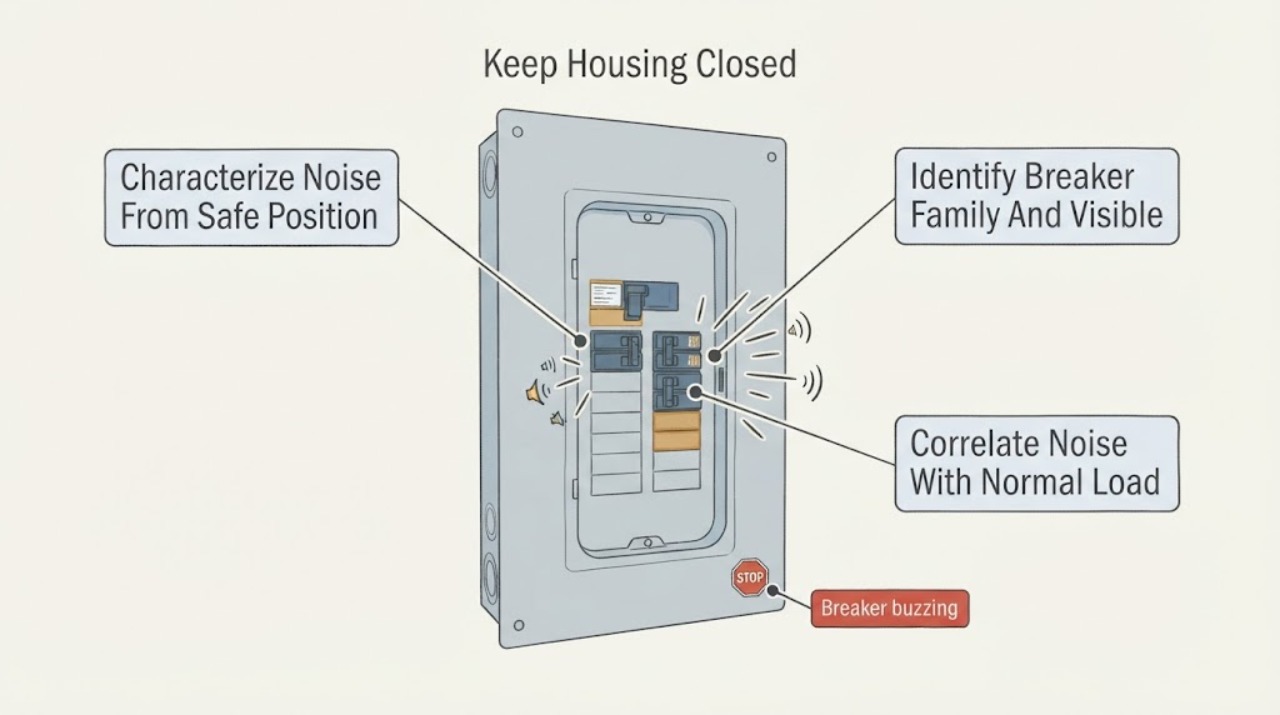
From a dry, stable position with the panel door and dead front closed, identify the general location of the sound and describe it as a steady hum, louder buzz, pulsing/chattering, crackling, sizzling, or popping. Note whether it is new or increasing and whether the breaker handle appears tripped, without touching the panel interior.
Expected result: Record which labeled breaker or panel area seems loudest, whether the sound occurs continuously or only when a known appliance is operating, and whether there is any visible smoke, spark, heat, discoloration, odor, flicker, or repeated trip.
Next step: Keep the panel closed and use the matching symptom branch. If any hazard sign is present, stop normal troubleshooting and arrange urgent electrical help; if there is smoke or fire, leave and call emergency services.
Stop if: Do not open the panel, touch the breaker face to test temperature, insert a probe, or continue approaching the equipment if there is smoke, arcing, a burning smell, or an unsafe environment.
Why this matters
Why: A low steady hum from a known QO or Homeline arc-fault breaker with no other warning sign can be an operating characteristic, but a new, excessive, intermittent, sizzling, or load-dependent noise needs inspection. Heat, odor, smoke, sparks, flicker, or tripping changes the situation from sound identification to an electrical hazard response.
-
Check 2
Read only the markings visible on the closed panel door and breaker face, such as Square D, QO, Homeline, AFCI, GFCI, or a test button, and photograph the label without removing anything. Note whether the breaker is on, tripped, or will not stay on, but do not cycle it repeatedly.
Expected result: Record the breaker family marking, circuit label, any visible trip indicator or test button, and whether the sound is associated with an arc-fault or ground-fault device, a standard breaker, or an uncertain device.
Next step: Give the exact visible markings and a photo to a licensed electrician or compare only with the installed product documentation; do not order or substitute a breaker based on a similar-looking face.
Stop if: Do not remove the dead front, pull the breaker, loosen a retaining screw, defeat an AFCI/GFCI test or trip function, or handle exposed wiring.
Why this matters
Why: Schneider Electric specifically says a low hum can come from the electronics in QO or Homeline arc-fault breakers, so that model-family detail changes how a quiet steady hum is interpreted. It does not clear a breaker that is hot, damaged, repeatedly tripping, or making a new excessive noise, and a family marking alone does not prove compatibility or condition.
-
Check 3
If there is no heat, odor, smoke, spark, flicker, or repeated trip and you already know which ordinary plug-in appliance is on the circuit, switch that appliance off at its normal control or unplug it without approaching the panel. Do not disconnect fixed wiring or deliberately add a load.
Expected result: Note whether the sound stops, becomes quieter, stays the same, or returns when the same known appliance is used again. Record the appliance and other loads that were operating at the time.
Next step: Leave the suspect load off if the buzzing returns or if any other warning sign appears, and provide the load correlation to a licensed electrician. Do not keep cycling an appliance to reproduce the noise.
Stop if: Do not use an appliance that causes buzzing, stop-and-start noise, odor, heat, flicker, or a trip, and do not test by operating high-power loads or opening a receptacle or junction box.
Why this matters
Why: A sound that changes with a particular load can be related to normal current-related vibration, a load or power-electronics interaction, a connection, or an overloaded or damaged circuit; the observation cannot distinguish those causes. A sound that persists with the known load off makes the breaker, enclosure, another connected load, or the location identification more important to inspect.
-
Check 4
Without opening the panel or touching the breaker, look from a safe distance for smoke, a flash, melted or discolored plastic, a hot or warped door or cover, water entry, burning-plastic odor, dimming or flickering lights, repeated trips, or a breaker that will not remain set.
Expected result: Classify the result as no visible warning sign, a suspected heat/odor/condition change, or active smoke, sparks, arcing, fire, or a strong burning smell.
Next step: For a suspected heat, odor, damage, flicker, or repeated-trip condition, stop using the affected circuit and contact a licensed electrician urgently without opening the panel. For smoke, arcing, or fire, leave the building and call emergency services; follow utility or fire-department instructions before re-entry.
Stop if: Do not touch a hot or damaged enclosure, throw a breaker repeatedly, spray water, remove the cover, or attempt to extinguish an energized electrical fire with water.
Why this matters
Why: No visible sign does not rule out a loose connection or internal defect, but active heat, odor, damage, flicker, or nuisance tripping raises the likelihood of an electrical fault. Smoke, sparks, arcing, or fire is an immediate life-safety event rather than a repair diagnosis.
-
Check 5
Arrange a licensed electrician inspection when the buzzing is new, excessive, persistent, load-dependent, associated with a trip, or not clearly explained by the exact Square D breaker documentation. Provide the breaker marking, circuit label, noise recording, load correlation, and all safety observations.
Expected result: The electrician should determine whether the source is enclosure hardware, wiring or termination, current-transformer installation where applicable, breaker internals, overheating, an incompatible or damaged device, or the connected circuit/load.
Next step: Use the electrician's measured findings to choose a connection, enclosure, circuit, or confirmed breaker repair and verify operation afterward. Ask the electrician to confirm the replacement family and rating against the panel and circuit, rather than matching appearance alone.
Stop if: Do not tighten terminals, remove or install a breaker, open the molded case, perform energized tests, alter overcurrent settings, or bypass AFCI/GFCI protection.
Why this matters
Why: Schneider's guidance says excessive noise has often involved loose hardware, wiring, or current transformers, while internal breaker components can also affect noise. A visual absence of damage is not enough to authorize a homeowner repair or prove that the breaker is safe under load.
Use your observations
Decision map
Find the observation that best matches what you see, then follow the next safe action.
-
PATH 01Safety boundary
What you see
The device is visibly identified as a Square D QO or Homeline arc-fault breaker, the sound is a low steady hum, and there is no heat, odor, flicker, damage, repeated trip, or other warning sign.
Do this next
Record the model-family marking and monitor for change; ask a licensed electrician to include it in the next inspection, or arrange a check sooner if the sound becomes louder, intermittent, or accompanied by a warning sign.
Why this path and its safety boundary
Why it matters: Schneider Electric says the electronics in these arc-fault breakers can produce a low hum and that this can be normal. The conclusion applies to that described condition, not to every Square D breaker or every buzzing sound.
Safety stop: Do not open the panel, replace the device by appearance, or dismiss a new heat, odor, trip, flicker, or crackling sound as normal hum.
-
PATH 02Safety boundary
What you see
The buzzing changes or stops when a known ordinary plug-in appliance is switched off, but there is no smoke, heat, burning odor, spark, flicker, or repeated trip.
Do this next
Leave the appliance off if the sound returns and arrange a licensed electrician to inspect the breaker, circuit, load, and connections; provide the exact appliance and the timing of the sound.
Why this path and its safety boundary
Why it matters: The load is relevant, but the observation cannot tell whether the cause is normal current-related vibration, power-electronics interaction, a loose connection, an overloaded circuit, or a damaged device.
Safety stop: Do not keep operating the appliance to reproduce the noise, add other loads, open a receptacle, or adjust the breaker.
-
PATH 03Safety boundary
What you see
The buzz persists with the known load off, is louder or intermittent, comes from a standard breaker or uncertain location, or cannot be matched to the exact Square D documentation.
Do this next
Keep the panel closed, avoid the suspected circuit when practical, and arrange a licensed electrician inspection with the sound recording and visible markings.
Why this path and its safety boundary
Why it matters: A loose enclosure part, wiring or termination issue, current-transformer installation where applicable, internal breaker movement, another connected load, or an incorrectly identified source needs professional inspection.
Safety stop: Do not remove the panel cover or dead front, tighten hardware, probe for voltage, replace the breaker, or treat silence after a reset as proof of repair.
-
PATH 04Safety boundary
What you see
Buzzing is accompanied by heat, melted or discolored plastic, burning odor, dimming or flickering, a breaker that trips or will not stay set, or a hot or warped panel cover.
Do this next
Stop using the affected circuit and contact a licensed electrician urgently without opening the panel. If smoke, sparks, arcing, or fire is present, leave immediately and call emergency services.
Why this path and its safety boundary
Why it matters: These combined observations are consistent with an electrical-system hazard, and the absence of visible damage cannot be safely assumed if the noise is new or worsening.
Safety stop: Do not touch the enclosure, repeatedly reset the breaker, use water, or continue operating the suspect appliance or circuit.
-
PATH 05Safety boundary
What you see
There is active smoke, sparking, visible arcing, fire, a strong burning-plastic smell, or an unsafe condition around the electrical panel.
Do this next
Leave the building and call the local emergency number or fire service from a safe location. Do not re-enter or restore power until emergency responders and a qualified electrician say it is safe.
Why this path and its safety boundary
Why it matters: This is an emergency, not a homeowner troubleshooting branch. Energized electrical equipment can cause shock, arc flash, fire, or toxic smoke.
Safety stop: Do not open the panel, throw switches while standing near smoke or arcing, spray water, or attempt a DIY repair.
Helpful context
Understand the symptom
Normal hum and dangerous noise are not the same observation
Schneider Electric describes a low hum from QO or Homeline arc-fault breaker electronics as normal, and says operational noise can also result from vibration of parts carrying alternating current. That does not make every buzzing panel safe. A sound that is new, getting louder, pulsing, crackling, or accompanied by heat, smell, discoloration, flicker, tripping, or sparks needs an electrical safety response. The breaker family, load, installation, and sound pattern all matter.
Stay on the safe side of a closed panel
A homeowner can listen from a safe position, read the label on the closed panel door, note the breaker handle position, and stop using an ordinary plug-in load if its identity is already clear. Do not remove the cover or dead front, probe the breaker, tighten a terminal, or assume that switching off the main disconnect makes every internal part safe. Schneider's field guide reserves work near energized components for qualified electrical personnel and says the molded case of a Square D molded-case breaker should not be opened.
Give the electrician a useful symptom record
Record the breaker label and visible family marking, the circuit or appliance that was operating, whether the sound stops when that normal load is switched off, and any trip, heat, odor, discoloration, flicker, or moisture. An electrician can then inspect accessible enclosure hardware, wiring, breaker condition, overheating, and the circuit's load and connections. The correct repair may be a connection or enclosure correction, a confirmed breaker replacement, or a broader circuit investigation; a guessed replacement is not a diagnosis.
Safety boundary
Stop conditions
- Do not remove the panel cover or dead front, open the molded breaker case, touch exposed wiring, tighten terminals, probe live parts, or perform energized testing.
- Do not replace a Square D breaker by appearance, substitute QO and Homeline devices, alter overcurrent settings, or bypass AFCI/GFCI protection without qualified electrical assessment and the correct panel documentation.
- Do not keep operating a circuit or appliance when buzzing is accompanied by heat, odor, discoloration, flicker, repeated tripping, water, smoke, sparks, or arcing.
- Do not repeatedly reset the breaker or reproduce the noise by adding loads; a temporary quiet period is not proof that a connection or breaker is safe.
- Arrange licensed electrical service for a new, excessive, persistent, load-dependent, or unexplained buzz. Treat smoke, sparks, visible arcing, fire, or strong burning odor as an emergency and leave the area.
Only after diagnosis
Potential parts
- Square D circuit breaker
Consider this category only if a licensed electrician confirms the breaker itself is defective or damaged and verifies the exact Square D panel family, pole arrangement, protection type, and circuit rating.
QO and Homeline breakers are different product families; confirm the panel label, electrical rating, protection function, and local requirements before ordering or installing. - load-center enclosure hardware
Consider enclosure hardware only if an electrician identifies a loose, damaged, or resonant door, cover, mounting, or other enclosure component as the source of excessive noise.
The exact load-center model and enclosure assembly must be confirmed; a homeowner should not remove covers or tighten energized panel hardware.
When checks do not resolve it
Need a professional?
Arrange a licensed electrician urgently when a Square D breaker buzzes loudly, intermittently, under a particular load, after a change, or with heat, discoloration, odor, flickering, repeated trips, or a breaker that will not stay set. For smoke, sparks, visible arcing, fire, or a strong burning odor, leave the area and call emergency services; do not approach or open the panel.
Safety scope: This article supports listening from a safe position, reading closed-panel markings, documenting the load and warning signs, and stopping use of a suspect plug-in appliance. It does not authorize panel opening, breaker removal or replacement, terminal tightening, voltage or load testing, fixed-wiring work, safety bypasses, or energized inspection.
Common questions
FAQ
Is a Square D breaker buzzing always dangerous?
No, but it should be classified by sound and accompanying signs. Schneider says a low hum can be normal in QO or Homeline arc-fault breakers, while excessive or changing noise can involve hardware, wiring, current transformers, or internal breaker movement. Heat, odor, flicker, discoloration, repeated tripping, sparks, or smoke requires urgent action.
Why does the breaker buzz only when an appliance runs?
A load can change the current-related vibration or expose an interaction, loose connection, circuit-loading issue, or appliance fault. Turning off a known plug-in appliance can be a useful observation only when there are no warning signs; it does not identify the cause. Leave the load off and arrange an electrician if the sound returns.
Can I tighten the buzzing breaker or replace it myself?
Do not open the panel, tighten terminals, pull the breaker, or open its molded case. Schneider's field guide reserves work near energized components for qualified electrical personnel and says the molded case should not be opened. A licensed electrician must confirm the panel family, breaker function, rating, and actual failed component.
What should I do if the buzzing breaker is hot or smells burnt?
Stop using the affected circuit and contact a licensed electrician urgently without opening the panel. If there is smoke, sparking, visible arcing, fire, or a strong burning-plastic smell, leave the area and call emergency services from a safe location. Do not repeatedly reset the breaker or use water.
Do QO and Homeline breakers use the same replacement?
Do not assume they are interchangeable. Record the exact family marking and have a licensed electrician verify the panel, pole arrangement, protection type, circuit rating, and manufacturer documentation before any replacement is selected.
Read the exact guide
Official sources
- Electrical Safety Month PosterU.S. Consumer Product Safety Commission · CPSC public electrical-safety warning-sign poster for household electrical systems; emergency response and local electrical requirements depend on the user's location.
- A circuit breaker, panel, or switchboard is making a buzzing or humming noiseSchneider Electric USA · Schneider Electric FAQ addressing circuit-breaker and electrical-equipment noise; the described examples do not establish that every Square D breaker or installation is safe.
- What would cause a QO or HOM arc fault breaker to hum?Schneider Electric USA · Schneider FAQ for QO and Homeline arc-fault circuit breakers; it applies to the identified product families and does not clear noise accompanied by other hazard signs.
- Field Testing and Maintenance Guide 0600IB1201Schneider Electric · Schneider Electric field guide for molded-case circuit breakers; procedures involving energized equipment are for qualified electrical personnel and may not match a residential panel's exact device.
Community feedback
Share a repair observation
Share a plain-text repair observation. Accepted observations are published automatically; this page may take a moment to update.