
On this page
Start here
Quick answer
A faint, steady hum can occur in a loaded electrical panel, but a new, loud, raspy, crackling, or sizzling buzz is not a symptom to diagnose by touching the panel. Treat heat, burning odor, smoke, discoloration, flickering, or repeated tripping as an electrical safety warning. From a safe position, identify whether the sound comes from the Siemens breaker, panel cover, an outlet, or an appliance; stop using the affected load, avoid opening the panel or tightening terminals, and arrange qualified electrical service. Do not keep resetting a breaker that trips.
Before you begin
Safety first
- The homeowner scope is limited to listening and looking from a safe position, turning off or unplugging an ordinary accessible load only when there is no hazard, and recording the symptom. Do not touch a hot or damaged device, remove the panel dead front or cover, tighten terminals, probe voltage, swap or up-rate breakers, bypass protection, or re-energize a smoking, arcing, wet, or overheating circuit.
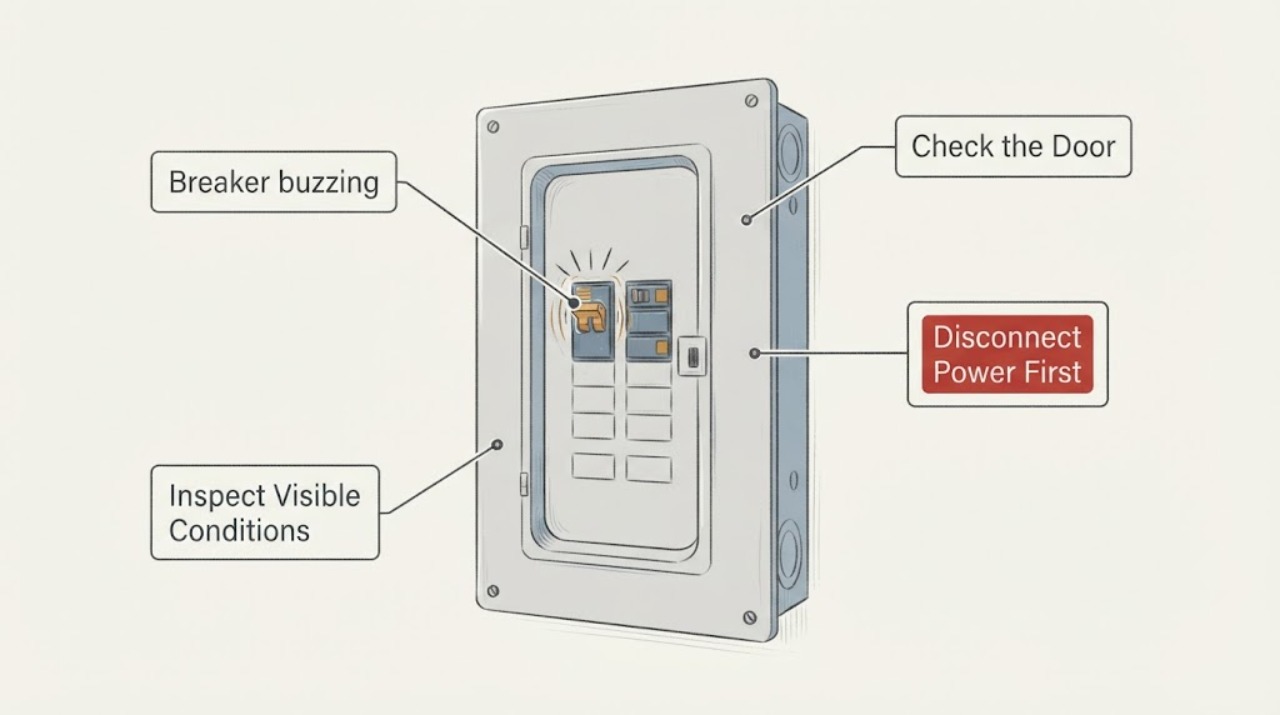
Work through in order
Diagnostic checks
Use only checks that match the exact appliance or system and its official guide.
-
Check 1
From a dry, stable position without touching the panel, listen briefly and identify whether the sound is centered at the Siemens breaker, the panel cover or door, a nearby receptacle, or a connected appliance. Note whether it is steady, intermittent, load-dependent, or accompanied by a trip.
Expected result: The sound clearly follows an appliance or outlet; it is strongest at the breaker or panel; or the source cannot be separated safely.
Next step: Continue only with the safe, external checks below. If the sound is at an outlet or appliance, stop using that load; if it is at the panel or cannot be located, arrange qualified electrical inspection.
Stop if: Stop immediately for crackling, visible arcing, smoke, burning odor, heat, or any need to touch, remove, or probe the panel.
Why this matters
Why: A downstream appliance or receptacle needs a different diagnosis from panel hardware, breaker, or branch-circuit wiring. An uncertain source is itself a reason not to open the panel.
-
Check 2
Without removing the dead front or any cover, look at the outside of the panel and accessible receptacles for discoloration, melted plastic, soot, moisture, a gap, or a cover that is visibly loose. Check from a distance for flickering lights or a light that dims when the sound changes.
Expected result: There is heat, discoloration, melted material, soot, moisture, smoke, flicker, or another visible abnormality; or the exterior looks normal.
Next step: For any warning sign, stop using the affected circuit and arrange urgent qualified electrical help; if there is smoke or active fire, leave and contact emergency services. If the exterior is normal, correlate the noise with loads without opening the panel.
Stop if: Do not touch a hot panel, wipe moisture, remove a cover, insert a tool, or continue if smoke, sparks, or an expanding burning odor is present.
Why this matters
Why: Visible or sensory damage raises the possibility of overheating, arcing, a bad connection, or a failing device and cannot be cleared by tightening a screw. A normal exterior does not prove that internal connections are safe.
-
Check 3
If there are no warning signs and the suspected load is accessible, switch off or unplug ordinary user appliances on that circuit one at a time, without moving a plug that is hot, damaged, wet, or discolored. Listen from a safe position and record which load changes the sound.
Expected result: The buzz stops or changes when one appliance is removed; it changes only with a group of high-demand loads; or it remains with ordinary loads off.
Next step: Leave the appliance that triggers the sound disconnected and have the appliance or circuit inspected. If the sound persists with loads off, leave the affected circuit off when practical and arrange an electrician rather than adding or swapping breakers.
Stop if: Do not unplug anything that is hot, sparking, wet, melted, or smoking, and do not continue load testing if the sound becomes louder or changes to crackling or sizzling.
Why this matters
Why: A sound tied to one appliance points first to that appliance, cord, or receptacle. A group-dependent sound may reflect load or connection conditions. Persistence with loads off makes the breaker, panel, or branch wiring more concerning.
-
Check 4
Check the breaker handle position and any visible trip indication once, without removing the panel cover. If it is tripped and there are no warning signs, turn off or unplug accessible loads first and follow the panel's user instructions for a single reset; do not force the handle.
Expected result: The breaker is tripped, will not reset, trips again, or stays on while the buzz continues; or it remains on with no trip history.
Next step: If it trips again or will not reset, leave it off and arrange qualified electrical diagnosis. If it stays on but the buzz remains, use the source and warning-sign results to decide whether the circuit should be taken out of use pending inspection.
Stop if: Do not repeatedly reset, hold the handle on, install a larger breaker, bypass protection, or open the panel to test voltage.
Why this matters
Why: A trip or refusal to reset indicates an unresolved overload or fault, and a repeat trip is not evidence that the breaker should be replaced by guesswork. A breaker that stays on can still have a noisy connection or load problem.
-
Check 5
Record when the buzzing occurs, which appliances were operating, whether lights flickered, whether the sound changes with load, and whether the panel or receptacle felt warm only if warmth was noticed without touching it. Photograph only visible exterior labels or damage from a safe position.
Expected result: The pattern is repeatable with one load, occurs randomly, follows a recent installation or new appliance, or is paired with a trip or warning sign.
Next step: Keep the affected load off when it triggers the sound or any warning sign, and provide the pattern, panel label, breaker rating as printed, and exact model information to the electrician. Do not conduct invasive tests yourself.
Stop if: Stop observing if the sound escalates, an odor or smoke appears, a device heats, or the circuit trips.
Why this matters
Why: A concise symptom history helps an electrician distinguish a load-related noise from panel or branch-circuit behavior, but it does not establish that a particular Siemens breaker or replacement part is defective.
Use your observations
Decision map
Find the observation that best matches what you see, then follow the next safe action.
-
PATH 01Safety boundary
What you see
The hum is faint and steady, occurs only under a known load, and there is no heat, odor, flicker, discoloration, smoke, or tripping.
Do this next
Reduce unnecessary load and monitor for a change in loudness or character; have the panel inspected if the hum is new, becomes excessive, or concerns you.
Why this path and its safety boundary
Safety stop: Stop using the affected circuit and escalate if any warning sign appears or the sound becomes raspy, crackling, sizzling, or intermittent.
-
PATH 02Safety boundary
What you see
The buzzing starts or becomes louder with one appliance, and that appliance, cord, or receptacle shows no visible damage.
Do this next
Leave the appliance disconnected and arrange appliance or electrical diagnosis; do not keep cycling it to reproduce the sound.
Why this path and its safety boundary
Safety stop: Do not use the appliance if its plug or receptacle is hot, loose, discolored, wet, melted, sparking, or smells burnt.
-
PATH 03Safety boundary
What you see
The noise remains with ordinary loads off, is strongest at the breaker or panel, or follows a recent electrical installation.
Do this next
Leave the affected circuit off when practical and arrange a qualified electrician to inspect the breaker, connections, panel hardware, and branch wiring.
Why this path and its safety boundary
Safety stop: Do not remove the dead front, tighten terminals, swap breakers, or rely on a breaker replacement without model- and panel-specific diagnosis.
-
PATH 04Safety boundary
What you see
The breaker has tripped repeatedly, will not reset, or trips again after one safe reset with accessible loads disconnected.
Do this next
Leave it off and arrange qualified electrical diagnosis for the load, circuit, breaker, and wiring; explain what was operating when it tripped.
Why this path and its safety boundary
Safety stop: Do not repeatedly reset, force the handle, install a higher-rated breaker, or bypass the protective device.
-
PATH 05Safety boundary
What you see
There is burning odor, smoke, visible arcing, melted plastic, discoloration, heat, moisture at electrical equipment, or flickering with the buzz.
Do this next
Move people away, stop using the circuit, and obtain urgent professional help; if there is active smoke or fire, leave and contact emergency services. Only operate a main disconnect if it is clearly accessible and safe to do so without approaching the hazard.
Why this path and its safety boundary
Safety stop: Do not touch the panel or device, spray water, remove covers, or re-energize the circuit to test it.
-
PATH 06Safety boundary
What you see
The apparent sound comes from a loose-looking exterior cover or door rather than the breaker, with no heat, odor, damage, or tripping.
Do this next
Do not remove or tighten internal hardware; note the location and ask an electrician to check the cover, hardware, breaker, and connections as a combined issue.
Why this path and its safety boundary
Safety stop: Escalate immediately if the cover is hot, damaged, wet, open, or the sound changes to crackling or sizzling.
Helpful context
Understand the symptom
First separate a mild hum from a warning sound
A panel can transmit a low, steady hum when a breaker is carrying load, and sound may also be amplified by a cover or other hardware. The decision changes when the sound is new, grows louder, becomes raspy or crackling, or is accompanied by heat, odor, discoloration, flicker, smoke, or a trip. Do not put a hand on the breaker or remove the panel cover to investigate; observe from a safe position and arrange an electrician when the symptom is abnormal.
The sound source matters more than the brand name
A noise that follows one appliance or receptacle is a different starting point from a buzz that remains at the breaker with loads off. A loose cover or hardware can resonate, while an internal breaker, connection, branch-circuit wiring, or overloaded load needs qualified inspection. Keep the Siemens model and panel label available, but do not infer a failed part or compatibility from the word buzzing alone.
Repeated trips are a stop signal, not a reset routine
A breaker trip is a protective event. Unplug or switch off accessible loads only when there is no heat, smoke, arcing, or other immediate hazard, and do not repeatedly reset the handle to restore power. If the breaker trips again, will not reset, or the cause is not clear, leave the circuit off and have a qualified electrician diagnose the overload, fault, breaker, and wiring.
Only after diagnosis
Potential parts
- Siemens-compatible circuit breaker
Consider this category only after a qualified electrician confirms that the breaker itself is defective and identifies the exact Siemens panel, breaker family, rating, poles, and protective function.
A breaker that fits physically may not be approved for the panel or circuit. Match the exact panel labeling and electrical specifications; do not substitute a higher rating or a different protective function. - panel cover or enclosure hardware
Consider this category only if an electrician confirms that a damaged or missing external cover or enclosure part is resonating or cannot maintain the required enclosure condition.
Match the exact enclosure and cover design. Cover hardware is not a substitute for correcting a loose connection, overheating, damaged breaker, or wiring fault. - branch-circuit receptacle or wiring device
Consider this category only when testing by a qualified electrician identifies a downstream receptacle or wiring device as the source of the noise or damage.
Selection depends on circuit rating, protective-device requirements, box and conductor condition, location, and applicable electrical rules; do not infer a replacement from buzzing alone.
When checks do not resolve it
Need a professional?
Escalate for a panel-side or persistent buzz, repeated or failed reset, a load-related buzz that implicates an appliance or receptacle, any heat, odor, flicker, discoloration, moisture, smoke, or arcing, or any need to inspect energized or internal wiring.
Safety scope: The homeowner scope is limited to listening and looking from a safe position, turning off or unplugging an ordinary accessible load only when there is no hazard, and recording the symptom. Do not touch a hot or damaged device, remove the panel dead front or cover, tighten terminals, probe voltage, swap or up-rate breakers, bypass protection, or re-energize a smoking, arcing, wet, or overheating circuit.
Have this ready
- Provide the Siemens breaker and panel labels or model information if safely visible, the exact sound location, whether it changes with a named appliance or load, trip history, visible warning signs, recent installation or appliance changes, and whether the circuit was left off.
Common questions
FAQ
Is a buzzing Siemens breaker always dangerous?
No sound alone cannot identify the fault. A faint steady hum can occur under load, but a new, loud, raspy, crackling, or sizzling sound, or any heat, odor, flicker, discoloration, smoke, or tripping, requires the affected circuit to be taken out of use and professionally assessed.
Can I tighten the breaker terminal or panel screws?
No. Do not remove the panel dead front or tighten internal terminals yourself. Loose hardware or wiring can be a cause of excessive noise, but inspection and torque work inside the panel require qualified electrical service.
What should I do if the buzzing stops when one appliance is unplugged?
Leave that appliance disconnected and do not keep cycling it to reproduce the sound. Have the appliance, cord, receptacle, and circuit assessed, especially if any plug or outlet is hot, loose, discolored, wet, melted, sparking, or smells burnt.
Should I reset a breaker that is buzzing or has tripped?
Do not repeatedly reset it. If there are no warning signs, accessible loads can be turned off and the panel's user instructions may allow one careful reset; if it trips again, will not reset, or the buzz persists, leave it off and arrange qualified diagnosis.
When is a buzzing breaker an emergency?
Treat smoke, active sparks or arcing, a burning odor, a hot or melting panel or receptacle, visible charring, or rapidly worsening noise as urgent. Move away, stop using the circuit, and if there is active smoke or fire leave and contact emergency services; do not touch or re-energize the equipment.
Read the exact guide
Official sources
- Commission Closes Investigation Of FPE Circuit Breakers And Provides Safety Information For ConsumersU.S. Consumer Product Safety Commission · CPSC consumer safety information includes general precautions applicable to electrical breakers; the historical product investigation is not evidence that a Siemens breaker has the same defect.
- A circuit breaker, panel, or switchboard is making a buzzing or humming noiseSchneider Electric USA · Schneider Electric technical FAQ describing general breaker and panel noise; the exact Siemens panel and breaker construction must be verified by its own documentation and a qualified electrician.
Community feedback
Share a repair observation
Share a plain-text repair observation. Accepted observations are published automatically; this page may take a moment to update.