
On this page
Start here
Quick answer
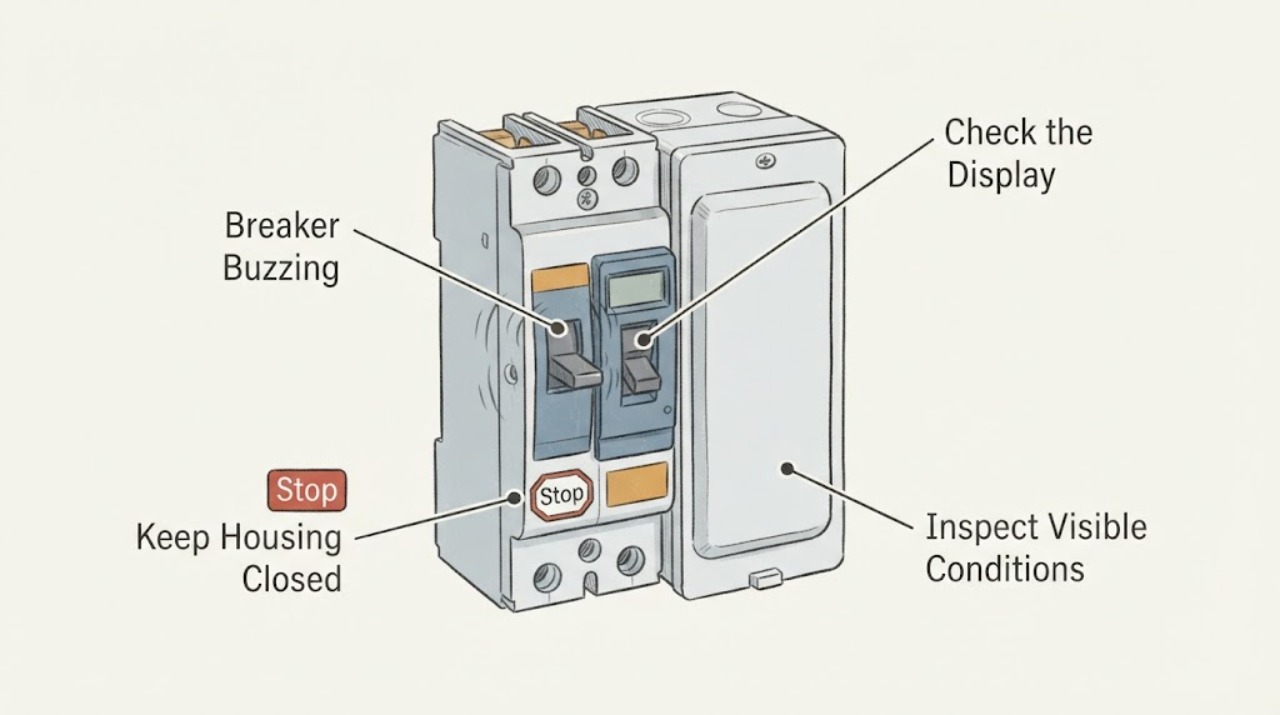
A new or clearly audible buzz from a GE circuit breaker should be treated as a warning until a qualified electrician identifies its cause. The sound may change with an overloaded or faulty appliance, but it can also come from a loose or damaged connection, breaker mechanism or arcing condition. From a dry, safe position with the panel closed, identify the affected breaker, note load timing and look for heat, burning odor, discoloration, flicker, sparks or repeated trips. If an obvious appliance load can be turned off using its normal control, leave it off; do not remove the panel cover, touch the breaker, tighten terminals, replace the breaker based on appearance, install a higher rating or repeatedly reset a trip. Stop using the affected circuit and arrange qualified electrical service immediately for heat, odor, smoke, arcing, visible damage or a breaker that trips again.
Work through in order
Diagnostic checks
Use only checks that match the exact appliance or system and its official guide.
-
Check 1
From a dry, stable position in front of the closed panel, listen without touching the enclosure or putting your face close to it. Record whether the sound comes from one GE breaker, the general panel area, a nearby appliance or another device, and whether it is a steady hum, vibration, crackle, click or intermittent buzz.
Expected result: The sound is localized to one breaker, changes when a nearby appliance starts, comes from the panel generally, or cannot be localized safely.
Next step: Record the breaker label and sound pattern and keep the panel closed. If the source is the panel or remains uncertain, arrange qualified electrical inspection rather than opening the enclosure.
Stop if: Stop immediately for crackling, snapping, sparks, smoke, burning odor, heat, visible arcing or a panel that is wet or damaged.
Why this matters
Why: Localization helps an electrician choose the circuit and equipment to inspect, but listening cannot distinguish an overload from a loose connection, breaker mechanism or arcing fault. Crackling or intermittent noise is more concerning than a quiet stable sound.
-
Check 2
Note whether the buzz begins when a particular high-demand appliance or motor starts, whether lights dim or flicker, and whether the GE breaker is visibly on, tripped or repeatedly returning to a trip state. If safe and practical, turn off or unplug the suspected appliance using its ordinary control, not the breaker wiring.
Expected result: The sound decreases when one appliance is off, continues with ordinary loads, coincides with dimming or flicker, or the breaker trips again.
Next step: Leave a suspected appliance disconnected and arrange electrician or appliance evaluation. Do not hold the breaker on, repeatedly reset it or move the load to another circuit as a workaround.
Stop if: Stop for a hot cord or receptacle, repeated trips, smoke, odor, sparks, visible damage or any need to touch the breaker or panel interior.
Why this matters
Why: A load-related change makes an appliance fault, overload or starting current more likely. Noise independent of the load, flicker and repeated trips keep the breaker, branch wiring and connections in consideration.
-
Check 3
Use a flashlight from outside the closed panel to look for a warm or discolored breaker handle, melted or warped plastic, soot, corrosion, moisture, a loose cover or an odor of overheated insulation. Do not touch the breaker or use the panel cover as a test surface for temperature.
Expected result: The exterior appears cool and intact, or there is heat, discoloration, melting, soot, corrosion, moisture or a burning odor around the breaker or enclosure.
Next step: For any warning sign, keep people away and arrange urgent qualified electrical assessment. If smoke or active arcing is present, leave the area and use local emergency guidance; do not operate or open the damaged panel.
Stop if: Stop at once for smoke, sparks, arcing, a rapidly hot panel, burning odor, exposed metal or water near the panel.
Why this matters
Why: A cool, intact exterior does not prove the connection is sound. Heat, discoloration, melting, soot, moisture or odor raises concern for overheating or arcing and makes continued operation unsafe.
-
Check 4
Read only the outside panel and breaker labels and record the GE marking, panel or load-center information, circuit label, recent electrical work, newly added load, storm or outage, trip history and any flickering on other circuits. Do not remove the dead-front or cover to find a part number.
Expected result: The panel and GE breaker identity are clear, or the label is missing, the equipment appears mixed or altered, or the identity cannot be confirmed without opening the enclosure.
Next step: Photograph the closed-panel labels and use the GE support manual lookup only to find model documentation; give the information to a qualified electrician. Do not order or swap a breaker based solely on brand, color, handle shape or amperage marking.
Stop if: Stop if labels require opening the panel, the enclosure is unsealed or damaged, or prior work left exposed conductors, unsupported wiring or overheating signs.
Why this matters
Why: Accurate identity lets an electrician check the correct listing and circuit design. Unclear or altered equipment increases the chance of an incompatible replacement or an installation defect that cannot be judged by appearance.
-
Check 5
Prepare an electrician handoff with a safe-distance sound recording if available, the affected GE breaker label, load timing, trip history, flicker, temperature or odor observations, visible markings and closed-panel photographs. Keep the affected circuit unloaded when the buzz persists or a warning sign is present.
Expected result: The buzz is brief and tied to one load, persists at ordinary load, accompanies trips or flicker, or accompanies heat, odor, arcing or damage.
Next step: Arrange qualified electrical service and provide the record. If a connected appliance is implicated, have it assessed before reconnecting; if the breaker is defective, use the exact listed replacement and installation procedure.
Stop if: Stop all homeowner checks if the panel is hot, smoking, arcing, wet, damaged, repeatedly tripping or would need to be opened for diagnosis.
Why this matters
Why: The pattern helps separate a connected-appliance issue from a breaker or wiring issue, but it does not certify the breaker as safe. Persistent or hazardous patterns warrant inspection of the device, bus connection, conductors and loads.
Use your observations
Decision map
Find the observation that best matches what you see, then follow the next safe action.
-
PATH 01Next step
What you see
The buzz changes with one obvious appliance load and stops when that appliance is switched off, with no heat, odor, flicker, visible damage or breaker trip.
Do this next
Leave the suspected appliance off and arrange qualified evaluation of the appliance and circuit if the sound returns. Do not use a temporary quiet period to clear the panel.
-
PATH 02Next step
What you see
The GE breaker buzzes with ordinary loads, the sound is new or worsening, or flicker and repeated trips occur.
Do this next
Stop using the affected circuit as far as safely possible and arrange a qualified electrician to assess the breaker, wiring, connections and connected loads. Do not repeatedly reset it or install a larger breaker.
-
PATH 03Next step
What you see
The breaker or panel is hot, discolored, melted, wet, smoky, sparking, arcing or smells of burning insulation.
Do this next
Clear the area and seek urgent electrical or emergency help. Do not touch, open or operate the damaged panel, and do not resume service because the noise stops.
-
PATH 04Next step
What you see
The GE breaker or panel identity is unclear, equipment appears mixed or altered, or localization requires opening the enclosure.
Do this next
Stop at the closed-panel boundary and have a qualified electrician identify the listed equipment and inspect the installation. Brand appearance and physical fit are not proof of compatibility.
Helpful context
Understand the symptom
A breaker buzz is not diagnosed by brand alone. GE has legacy breaker documentation now cataloged through ABB's publication library, while residential panels vary by series and installation. The useful first question is whether the sound tracks a particular load, a breaker trip or a visible safety sign—not whether the handle looks like it is still on.
Circuit breakers protect branch wiring against current that exceeds the safe level. CPSC lists unusual sizzling or buzzing, arcs or sparks, overheating, odors, flickering and frequent trips as warning signs and directs qualified help for defects. Keep the dead-front and cover in place; the outside label and breaker position are the limit of a homeowner inspection.
A tripped breaker is a symptom, not an invitation to substitute a larger device. The correct GE breaker depends on the exact load center, circuit design and listing. Use the model and panel information to help a qualified electrician, and do not rely on a matching handle, color or online photograph to establish compatibility.
Safety boundary
Stop conditions
- Stop immediately for smoke, sparks, arcing, burning odor, a hot or discolored breaker, melting, water near the panel, exposed conductors or repeated tripping.
- Do not open the panel, touch the breaker or bus, tighten a terminal, hold a breaker on, bypass protection, change its rating or use live test equipment.
- Stop repeated reset attempts when the sound or trip returns; a temporary quiet period does not prove the overload, fault or connection problem is repaired.
Only after diagnosis
Potential parts
- GE listed replacement circuit breaker
Only consider this category after a qualified electrician confirms the breaker is defective and identifies the exact listed replacement for the panel and circuit.
Confirm the load-center series, breaker type, pole arrangement, rating, interrupting capability, approvals and installation instructions; physical fit or the GE name alone does not establish compatibility.
When checks do not resolve it
Need a professional?
Arrange qualified electrical service for a GE breaker that buzzes persistently, buzzes with ordinary loads, causes flicker, trips, or cannot be localized safely., Stop using the affected circuit and seek urgent help for heat, burning odor, discoloration, melting, smoke, sparks, arcing, moisture, exposed conductors or repeated trips., Do not remove the panel dead-front, pull or reseat a breaker, tighten terminals, move conductors, perform live measurements, bypass protection or install a higher-rated device as a test., Give the electrician the panel and breaker markings, circuit label, connected loads, sound timing, trip history, recent work and closed-panel photographs; do not choose a replacement from brand or appearance alone.
Common questions
FAQ
Is a faint buzz from a GE breaker normal?
Do not assume it is normal. An unusual electrical buzz is a warning sign, and a residential breaker should be inspected if the sound is new, persistent, load-independent or accompanied by heat, odor, flicker or tripping. Keep the panel closed while arranging qualified help.
Can an overloaded circuit make a GE breaker buzz?
An overload can produce unusual breaker behavior and should be corrected without defeating the protection. Turn off an obvious appliance using its normal control, leave the affected circuit unloaded and arrange qualified service if the buzz persists; do not increase the breaker rating.
Should I tighten the terminals on a buzzing GE breaker?
No. The panel contains hazardous energized parts, and terminal work requires the correct de-energizing, verification and torque procedure. Keep the cover closed and have a qualified electrician inspect the connection and equipment.
Can I replace a buzzing GE breaker with a higher-amp breaker?
Never use a higher rating as a workaround. The device must match the circuit and listed load center; an overrated protective device can let wiring overheat. Have a qualified electrician identify the cause and exact replacement, if one is needed.
What if the GE breaker is hot or smells burnt?
Stop using the affected circuit, keep people away and seek urgent qualified electrical help. Do not touch or open the panel, repeatedly reset the breaker or resume use because the sound temporarily stops. Smoke, sparks or arcing require emergency action.
Read the exact guide
Official sources
- Publication LibraryABB Electrification U.S. · ABB-hosted publication index for legacy GE Industrial Solutions breaker and load-center documentation, including GEH circuit-breaker instructions and installation materials
- Owner's Manual & Installation InstructionsGE Appliances · GE official model-manual lookup and installation-document source for identifying exact product documentation before service
- CPSC Guide to Home Wiring HazardsU.S. Consumer Product Safety Commission · CPSC home-wiring guidance on unusual electrical buzzing, overheating, odors, arcs, circuit-breaker protection, repeated trips, qualified repair and correct ratings
Community feedback
Share a repair observation
Share a plain-text repair observation. Accepted observations are published automatically; this page may take a moment to update.