
On this page
Start here
Quick answer
A sustained buzz, hum, crackle, or sizzle from a circuit breaker or electrical panel is a warning sign, not a noise to mask or troubleshoot by opening the panel. Stop using the loads on that circuit, keep the panel cover closed, and arrange a qualified electrician to inspect it. If you notice heat, a burning smell, discoloration, smoke, sparks, or repeated tripping, leave the area and call for urgent electrical help; call emergency services if there is smoke or fire.
Before you begin
Safety first
- Keep the panel closed, do not reset repeatedly, and do not touch or disconnect wiring. Leave and call emergency services for smoke or fire.
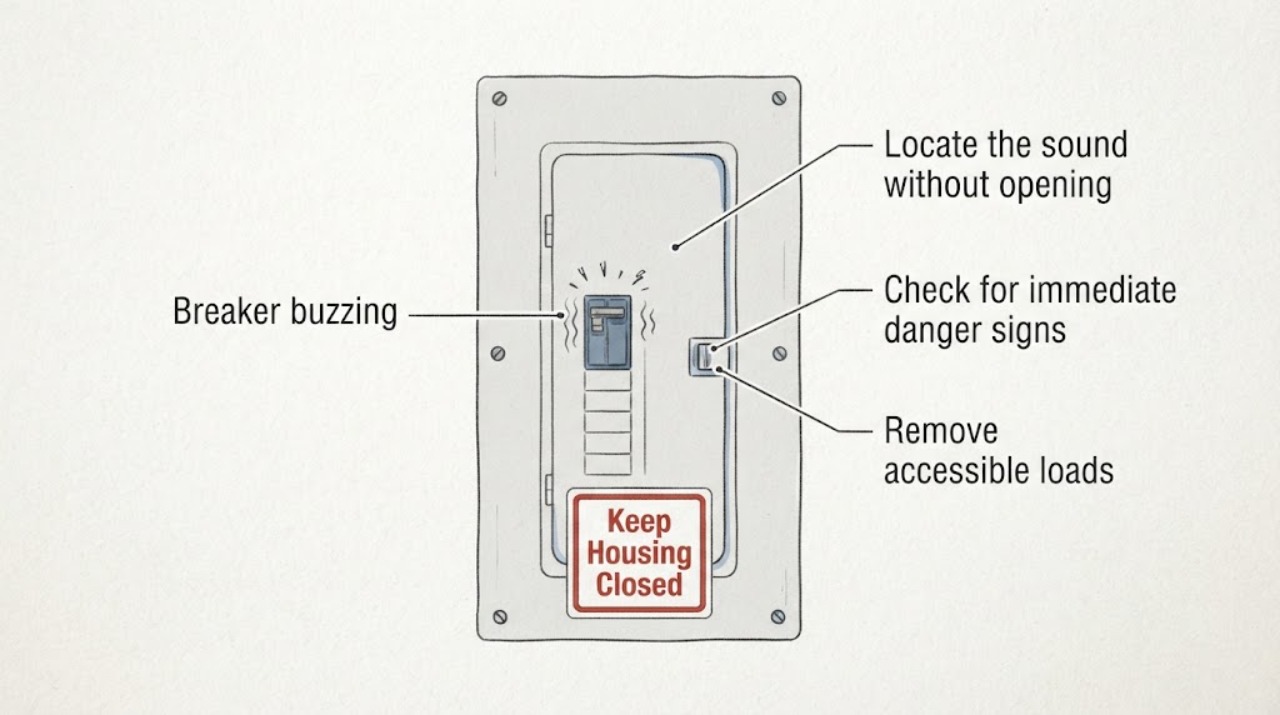
Work through in order
Diagnostic checks
Use only checks that match the exact appliance or system and its official guide.
-
1. Locate the sound without opening the panel
Stand clear of the panel and listen only from a safe position. Note whether the sound is from the panel, a receptacle or switch, or an appliance, and whether it is steady, intermittent, or load-triggered.
Expected result: Panel or breaker noise, especially with crackling, flickering, or a trip, is urgent; noise that follows one appliance still needs the appliance and circuit checked.
Stop if: Move away for any spark, smoke, hot-insulation smell, or heat from the panel.
Why this matters
Why: Keep the panel closed, record the room, appliance, visible breaker label, and timing, and give those details to the electrician.
-
2. Check for immediate danger signs
Look and smell only from a safe distance without touching the panel, removing its cover, or repeatedly resetting the breaker.
Expected result: Yes may indicate overheating, arcing, damaged insulation, or a fault not being safely cleared; no does not prove the breaker is safe.
Stop if: Any smoke, flame, active sparking, or rapidly worsening noise requires leaving the area.
Why this matters
Why: For yes, stop using the circuit and call a qualified electrician urgently; for smoke or fire, leave and call emergency services. For no, keep the panel closed and continue only with the external load check.
-
3. Remove accessible loads from the affected circuit
If there are no immediate danger signs, turn off and unplug portable appliances using normal controls and plugs; do not unplug a hot, wet, damaged, or sparking item, disconnect fixed wiring, or open an outlet.
Expected result: If the buzz stops with a particular appliance or group off, record the load and leave it disconnected; if it continues, the breaker, panel connection, fixed wiring, or another connected load remains suspect.
Stop if: Stop if the noise worsens, the circuit trips, an appliance is hot or damaged, or odor, smoke, spark, or tingling appears.
Why this matters
Why: Either result calls for an electrician and tells them whether to start with the load/appliance or the panel and circuit wiring.
-
4. Check the breaker handle position from outside
Read the handle position only; do not remove the deadfront, force the handle, or repeatedly reset it. Leave it off if it is tripped.
Expected result: A tripped or unstable handle may reflect an overload, fault, or defective protective device; an on-looking handle does not clear buzzing.
Stop if: Do not touch the handle if the panel is hot, wet, damaged, smoking, or sparking.
Why this matters
Why: Tell the electrician the handle position and any power loss. Do not install a higher-rated or substitute breaker; keep loads off and arrange inspection.
Helpful context
Understand the symptom
Why a breaker can buzz
The sound can accompany an overloaded circuit, a poor or loose connection, damaged wiring, a failing breaker, or arcing. The sound alone cannot identify which part is at fault, and the panel may contain live parts even when one branch breaker is off. Treat a new or persistent noise as a fault to be inspected rather than as a breaker that needs repeated resetting.
What not to do
Do not remove the panel cover, tighten a terminal, replace the breaker, increase its amp rating, bridge a fuse, or test energized parts. Those tasks can expose you to live conductors and arc-flash energy, and a replacement is not safe unless its type and rating match the panel, circuit, and applicable installation requirements. Do not keep using the circuit just because the noise is intermittent or disappears temporarily.
When to call a professional
Call a qualified electrician for any new, persistent, or recurring breaker/panel buzz. Treat heat, burning odor, discoloration, crackling, sparks, smoke, tingling, or repeated trips as urgent. Give the electrician the exact location of the sound, the time and load that trigger it, the breaker handle position, any flickering or outages, and every warning sign you observed. If there is smoke or fire, leave the building and call emergency services.
Only after diagnosis
Potential parts
- circuit breaker replacementDo not choose by appearance or amp number alone; compatibility and installation depend on the panel and circuit wiring. This is not a DIY replacement recommendation.
- surge protectorUse only a device suitable for the intended receptacle or electrical system, with installation reviewed by a qualified professional where hardwiring is involved.
When checks do not resolve it
Need a professional?
For any persistent or recurring buzzing from a breaker or panel; call urgently for heat, odor, discoloration, crackling, sparks, smoke, tingling, or repeated trips.
Safety scope: Keep the panel closed, do not reset repeatedly, and do not touch or disconnect wiring. Leave and call emergency services for smoke or fire.
Have this ready
- Report the sound location, steady or load-triggered timing, affected room and appliances, breaker handle position, loss of power, flickering, odor, heat, discoloration, sparks, or trips.
Common questions
FAQ
Can I keep using a breaker that only buzzes sometimes?
No. An intermittent buzz can still indicate a load, connection, wiring, or breaker problem. Turn off accessible loads safely, keep the panel closed, and arrange an electrician inspection rather than waiting for the sound to become constant.
Should I reset a buzzing breaker?
Do not repeatedly reset it. If it is tripped, leave it off and tell the electrician. A reset is not a diagnosis and can re-energize a fault.
Does replacing the breaker always fix the buzzing?
No. The cause may be an overloaded circuit, a loose or damaged connection, fixed wiring, or a connected appliance. A professional should identify the cause and confirm any replacement is compatible before installing it.
Is a quiet hum from an electrical panel normal?
You cannot determine safety from volume alone. A new, persistent, changing, or load-related hum or buzz deserves inspection, especially if it is accompanied by flicker, heat, odor, discoloration, crackling, or trips.
Read the exact guide
Official sources
- Guide to Home Wiring HazardsU.S. Consumer Product Safety Commission · Supports breaker/panel protective function, overload and tripping behavior, leaving defects for qualified professionals, and not using higher-rated protection.
- Fundamentals of arc flash mitigationEaton · Supports keeping untrained readers away from energized panel work and recognizing damaged insulation, loose/incorrect wiring, and faulty connections as hazards.
- Don’t Overload Your HomeElectrical Safety Foundation International · Supports treating buzzing, flickering, warm/discolored surfaces, odor, and repeated trips as warning signs and calling a qualified electrician.
Community feedback
Share a repair observation
Share a plain-text repair observation. Accepted observations are published automatically; this page may take a moment to update.