
On this page
Start here
Quick answer
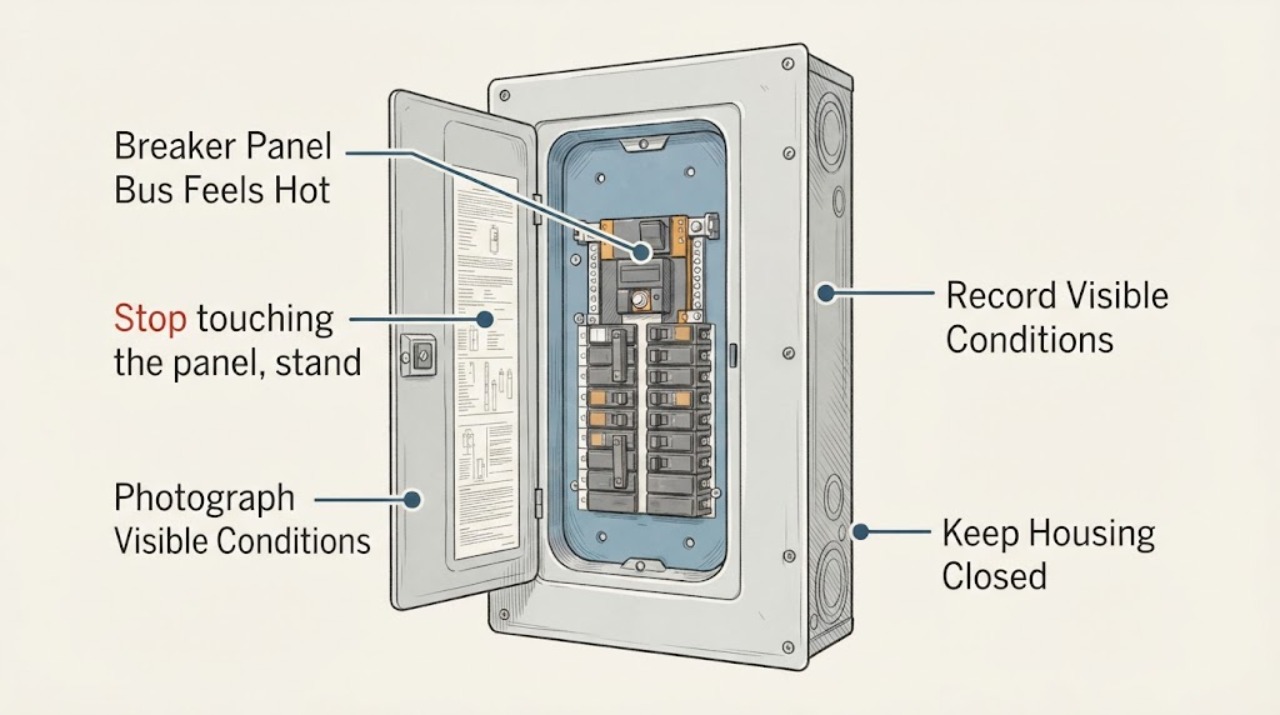
Stop touching the panel and do not remove its cover. A bus is an energized internal conductor, and warmth felt at the enclosure does not identify whether the heat comes from the bus, a breaker connection, a lug, an overload, a high ambient condition, or a damaged joint. From a dry, stable position, look only for smoke, burning odor, crackling, arcing, melted or discolored trim, a breaker that is tripping, or rapidly increasing heat. For any of those signs, keep clear and obtain emergency electrical help. If there is no immediate danger, record which area feels warm from the outside, which loads were running, recent work or added equipment, and the exact panel and breaker labels. Have a qualified electrician inspect the energized-equipment risk, loading, terminations, and bus connections; do not use an infrared probe, remove the deadfront, tighten a lug, cycle a breaker repeatedly, or assume a breaker is safe because it has not tripped.
Before you begin
Safety first
- Keep the panel closed and avoid contact until qualified personnel establish safe isolation and testing. Do not operate switches near water or smoke, open the deadfront, take energized readings, tighten connections, replace a breaker, or reset a tripping circuit as a homeowner.
Work through in order
Diagnostic checks
Use only checks that match the exact appliance or system and its official guide.
-
Check 1
Stop touching the panel, stand on a dry stable surface, and look from outside the enclosure for smoke, flames, crackling, arcing, burning odor, melted or discolored trim, visible moisture, or a breaker repeatedly tripping. Do not open the cover or place a hand, probe, or tool inside.
Expected result: Smoke, flame, arcing, crackling, burning odor, melting, rapidly worsening heat, visible moisture, or repeated tripping is present.
Next step: Keep clear and obtain emergency electrical help; call emergency services for smoke or fire. Do not operate switches in the affected area, cycle breakers, or re-enter to take a closer look.
Why this matters
Why: The panel may have an active electrical fault, overheating connection, insulation failure, or fire risk. This is not a safe touch or reset diagnosis.
-
Check 2
Without touching the enclosure again, identify the outside area that is warmest: beside one branch breaker, around the main disconnect, near the top or bottom of the panel, across the whole cover, or at an adjacent conduit or wall. Photograph the closed panel and its labels from a safe position.
Expected result: Warmth is concentrated beside one breaker or connection area, concentrated near the main, spread across the panel, or actually comes from an adjacent cable, conduit, wall, or another enclosure.
Next step: Do not remove the deadfront to follow the heat. Give the electrician the photo, exact location, panel model, and whether the heat is changing or spreading.
Why this matters
Why: A concentrated pattern makes a local breaker, termination, bus interface, or main connection more important to inspect; broad warmth can also involve cumulative loading or ambient conditions, while an adjacent source may not be the bus.
-
Check 3
Record which normal loads were running when the warmth appeared, such as heating, cooking, charging, pumping, or motor equipment, and whether the warmth decreases after those loads naturally stop. Do not turn equipment on deliberately to reproduce the heat and do not add load to test it.
Expected result: The panel warms broadly during several simultaneous loads, one load consistently precedes the warmth, or the warmth remains or increases after the loads stop.
Next step: Reduce use of nonessential high-load equipment without approaching the panel and arrange electrical inspection. Stop all use and seek urgent help for odor, noise, visible damage, or rapid temperature change.
Why this matters
Why: Load-related timing can help an electrician evaluate cumulative heating, continuous duty, circuit loading, or a local high-resistance connection. Persistent heat after loads stop is more concerning for stored heat, a fault, or a connection problem.
-
Check 4
From outside the closed panel, note each affected breaker handle position, any recent trips, flickering or voltage-related equipment behavior, and whether the panel has recently received a new circuit, charger, solar equipment, generator, or other modification. Do not repeatedly reset a tripped breaker or change a breaker size.
Expected result: A breaker is tripped or will not remain on, lights or equipment flicker, the warmth began after added equipment or rewiring, or no breaker event or recent change is known.
Next step: Leave a tripped or unstable circuit off and call a qualified electrician. Provide the panel and breaker labels and the date and scope of recent work; never upsize a breaker or bypass protection to stop tripping.
Why this matters
Why: Trips or unstable operation can accompany overload, short, arc or ground fault, while a recent modification can change loading, heat dissipation, or the panel assembly. No trip does not rule out a hot termination or bus interface.
-
Check 5
Observe the panel's environment without opening it: dampness, water entry, condensation, dust, blocked ventilation, unusual room heat, vibration, corrosion, or combustible material near the enclosure. Keep water and stored material away without reaching behind or around energized equipment.
Expected result: Moisture, corrosion, heavy contamination, blocked airflow, unusual ambient heat, vibration, or a combustible item is present, or the environment appears dry and ordinary.
Next step: Do not clean, spray, open, or move the panel. Keep people clear, address only an obvious combustible obstruction from a safe position, and arrange a qualified inspection, especially for moisture or corrosion.
Why this matters
Why: Moisture, contamination, vibration, and ambient conditions can degrade connections or increase heat, while a normal environment shifts attention toward loading, terminations, breaker fit, or the bus itself.
-
Check 6
Prepare a service record with the Eaton panel nameplate and breaker labels photographed from outside, the warm location, load timing, breaker status, recent work, environmental observations, and any odor, sound, discoloration, or trip evidence. Do not take an energized temperature reading or remove a cover for the record.
Expected result: The electrician has a repeatable warm location and timing, or the report remains only that the panel felt hot once with no visible pattern.
Next step: Arrange a qualified electrical inspection in either case. Ask for review of the bus and breaker interfaces, terminations, conductor sizing, loading, enclosure condition, and any recent modification rather than requesting a blind breaker replacement.
Why this matters
Why: Repeatable location and timing help a professional select a safe inspection path; an isolated sensation still cannot be cleared by appearance because internal bus and connection conditions are hidden.
Use your observations
Decision map
Find the observation that best matches what you see, then follow the next safe action.
-
PATH 01Next step
What you see
A single breaker area or main area is warmer than the rest and there is discoloration, odor, crackling, a trip, flicker, or heat that persists after the load stops.
Do this next
Stop using the affected circuit if it can be left off without approaching the hazard, keep the panel closed, and obtain prompt qualified electrical inspection. Do not tighten, replace, or reseat the breaker yourself.
Why this path and its safety boundary
Why it matters: A localized breaker termination, bus interface, lug, or damaged conductor is more likely than uniform ambient warming, and continued operation can worsen damage.
-
PATH 02Next step
What you see
The whole closed panel warms during simultaneous high-demand use, then returns toward ambient without odor, noise, visible damage, or breaker trips.
Do this next
Avoid deliberately reproducing the condition, reduce nonessential simultaneous high loads, and schedule an electrician to review loading, conductor and device sizing, ventilation, and panel configuration.
Why this path and its safety boundary
Why it matters: Cumulative panel heating, load pattern, ambient conditions, or equipment sizing deserves review; the pattern does not prove that the bus is safe.
-
PATH 03Next step
What you see
The enclosure feels warm but the reported bus location cannot be seen or safely localized from outside, and there are no visible symptoms.
Do this next
Do not open the panel or use a probe as a homeowner test. Record timing and outside location and arrange a qualified inspection with the panel closed until the electrician establishes a safe isolation and test plan.
Why this path and its safety boundary
Why it matters: The heat source remains unconfirmed; an exterior surface cannot distinguish a bus, connection, breaker, conduit, wall, or ambient source.
-
PATH 04Next step
What you see
The warmth began after new circuits, solar or generator equipment, an electric vehicle charger, rewiring, or a change in the room environment.
Do this next
Keep the panel closed and provide the electrician the modification date, equipment, permits or documentation if available, and the affected circuit labels. Do not alter breaker ratings or disconnect wiring.
Why this path and its safety boundary
Why it matters: A changed load, assembly, ambient condition, conductor termination, or installation detail may have altered heat distribution or protective coordination.
-
PATH 05Next step
What you see
Smoke, flame, arcing, burning odor, melted or blistered insulation, water intrusion, rapid worsening, or repeated breaker trips occurs.
Do this next
Keep everyone away and obtain emergency electrical help; call emergency services for smoke or fire. Do not touch the panel, operate switches in the affected area, reset breakers, or remove the cover.
Why this path and its safety boundary
Why it matters: An active fault, fire, shock, arc-flash, or insulation-damage hazard may be present.
Helpful context
Understand the symptom
The outside of the panel cannot prove which internal part is hot
In a residential panel, the bus and its connections are behind the cover and may remain energized even when an individual branch breaker is off. Heat conducted to the trim can come from a breaker termination, a main connection, a bus joint, a heavily loaded circuit, the surrounding room, or damaged insulation. Do not open the panel to confirm the source. A qualified electrician can choose the appropriate isolation, instruments, and protective equipment for the equipment and installation.
A warm panel and a dangerous hot spot are different decisions
Eaton describes heat in electrical equipment as a function of current and resistance and notes that a compromised joint can be much hotter than the surrounding equipment. A general increase while several large loads run can point toward loading or ambient conditions, while one concentrated area, discoloration, odor, crackling, or repeated trips raises concern for a connection, breaker, bus interface, insulation, or fault. Absolute surface temperature alone is not a safe homeowner pass-or-fail test.
Why a breaker that has not tripped does not clear the panel
A breaker is designed to interrupt certain overcurrent conditions, but a high-resistance connection or damaged interface may create localized heating without producing the same pattern as a conventional overload or short circuit. Eaton's maintenance material treats overheating, discoloration, melting, blistering, and arcing damage as inspection findings. Leave diagnosis and repairs to a qualified electrician and preserve the evidence by not repeatedly cycling or disturbing the equipment.
Safety boundary
Stop conditions
- Stop immediately for smoke, flame, arcing, crackling, burning odor, melted or blistered insulation, rapidly worsening heat, water intrusion, or repeated breaker trips. Keep clear and obtain emergency electrical help; call emergency services for smoke or fire.
- Do not remove the panel cover or deadfront, touch the bus, insert a probe, measure energized voltage or current, tighten lugs, reseat a breaker, change breaker size, or bypass protective devices.
- Do not repeatedly reset a tripped breaker or turn high-load equipment on to reproduce the warmth. Leave an unstable or tripping circuit off when that can be done without approaching the hazard, and call a qualified electrician.
- Treat a bus or main-connection concern as professional electrical work even when the panel has no odor or visible damage. A closed-panel sensation is not proof of a safe internal temperature or connection.
Only after diagnosis
Potential parts
- Eaton circuit breaker
Consider this only after qualified diagnosis confirms the breaker itself is damaged or unsuitable and does not confuse a bus, termination, overload, or conductor problem with a breaker failure.
Breaker type, interrupting rating, mounting, panel listing, and circuit requirements must be confirmed for the exact panel and installation. Do not select by appearance or ampere label alone. - panel bus or bus connection assembly
Consider this only when qualified inspection identifies heat damage, pitting, loss of contact, or another confirmed fault in the bus or its breaker interface.
Bus assemblies and interfaces are specific to the panel design and may require panel replacement or manufacturer-approved service. Confirm the exact panel documentation and fault assessment first. - conductor termination or lug component
Consider this only when an electrician confirms a damaged, loose, overheated, or incorrectly specified termination is the source of the localized heat.
Lug, conductor, torque, material, and enclosure requirements depend on the exact panel and wiring. This is not a homeowner tightening or substitution task.
When checks do not resolve it
Need a professional?
Request electrical inspection for any suspected hot bus, breaker, main connection, or panel enclosure. Request urgent help for localized persistent heat, a tripping or unstable circuit, visible damage, moisture, odor, crackling, or a recent modification followed by heat.
Safety scope: Keep the panel closed and avoid contact until qualified personnel establish safe isolation and testing. Do not operate switches near water or smoke, open the deadfront, take energized readings, tighten connections, replace a breaker, or reset a tripping circuit as a homeowner.
Common questions
FAQ
Is it normal for an Eaton breaker panel bus to feel warm?
You cannot clear an internal bus by touch. The bus is behind the panel cover, and warmth at the enclosure may come from a breaker connection, main connection, load pattern, ambient condition, or another source. Stop touching it, look only for visible danger signs, and arrange a qualified electrical inspection.
Why can a panel connection get hot without the breaker tripping?
A breaker responds to the protective conditions it is designed to detect. A localized high-resistance connection or damaged interface can produce heat without behaving like a conventional overload or short circuit. Do not use the absence of a trip as a safety test; have the bus, breaker interface, and terminations inspected.
Can I remove the Eaton panel cover to see whether the bus is hot?
No. Do not remove the cover or deadfront, touch the bus, insert a probe, or take energized readings as a homeowner. Eaton describes panelboards as containing energized parts and identifies arc and incident-energy risks. Keep the panel closed until qualified personnel establish safe isolation and testing.
What if the panel only gets warm when several large loads run?
Record which loads were already operating and whether the warmth remains after they naturally stop, but do not deliberately reproduce it. Eaton notes that ambient conditions, loading, duty pattern, sizing, and cumulative panelboard heating can affect temperature. An electrician should review the load and installation rather than changing a breaker size.
When is a hot Eaton panel an emergency?
Treat smoke, flame, arcing, crackling, burning odor, melted or blistered insulation, rapidly worsening heat, water intrusion, or repeated trips as urgent. Keep clear and obtain emergency electrical help; call emergency services for smoke or fire. Do not reset breakers or operate switches in the affected area.
Read the exact guide
Official sources
- Fundamentals of electrical safety in low-voltage installations: Protecting people, property, equipment and dataEaton · Eaton low-voltage electrical-safety guide; local codes, equipment ratings, and qualified-personnel procedures govern a specific installation.
- BarriersEaton · Eaton NEC explanatory page; equipment-specific boundaries and safe work practices still apply.
- Circuit breaker fundamentalsEaton · Eaton educational page; actual breaker behavior and ratings depend on the model and installation.
- PRL4X PB panelboard design guideEaton · Eaton Pow-R-Line 4X panelboard design guide; its design details must not be generalized to another panel family.
- Delta T: the intelligent way to detect electrical faultsEaton · Eaton technical article for electrical switchgear maintenance; thermal diagnosis requires suitable equipment and qualified personnel.
Community feedback
Share a repair observation
Share a plain-text repair observation. Accepted observations are published automatically; this page may take a moment to update.