
On this page
Start here
Quick answer
If the lamp socket on a Casablanca ceiling fan does not work, first turn the light control off and let the bulb and shade cool. From the floor, note whether the fan motor still runs, whether every light on the fixture is out, and whether the light responds to the wall control, pull chain, or remote. With power off and the fixture cool, confirm that a known-good bulb is the correct base, dimming type, and wattage for the socket; do not exceed the socket label. If the bulb is good but the socket is dark, loose, corroded, heat-marked, or has a bent contact, stop using that light and arrange qualified electrical or appliance-fan service. Do not reach above a ladder, touch socket contacts, open the canopy or switch housing, or fit a generic light kit without the exact Casablanca model and wiring instructions.
Before you begin
Safety first
- This article supports floor-level observation, model identification, and a cool-bulb check only. Do not work overhead, open the canopy or switch housing, probe wiring, modify a light kit, bypass a receiver, or operate a damaged or intermittently flickering light.
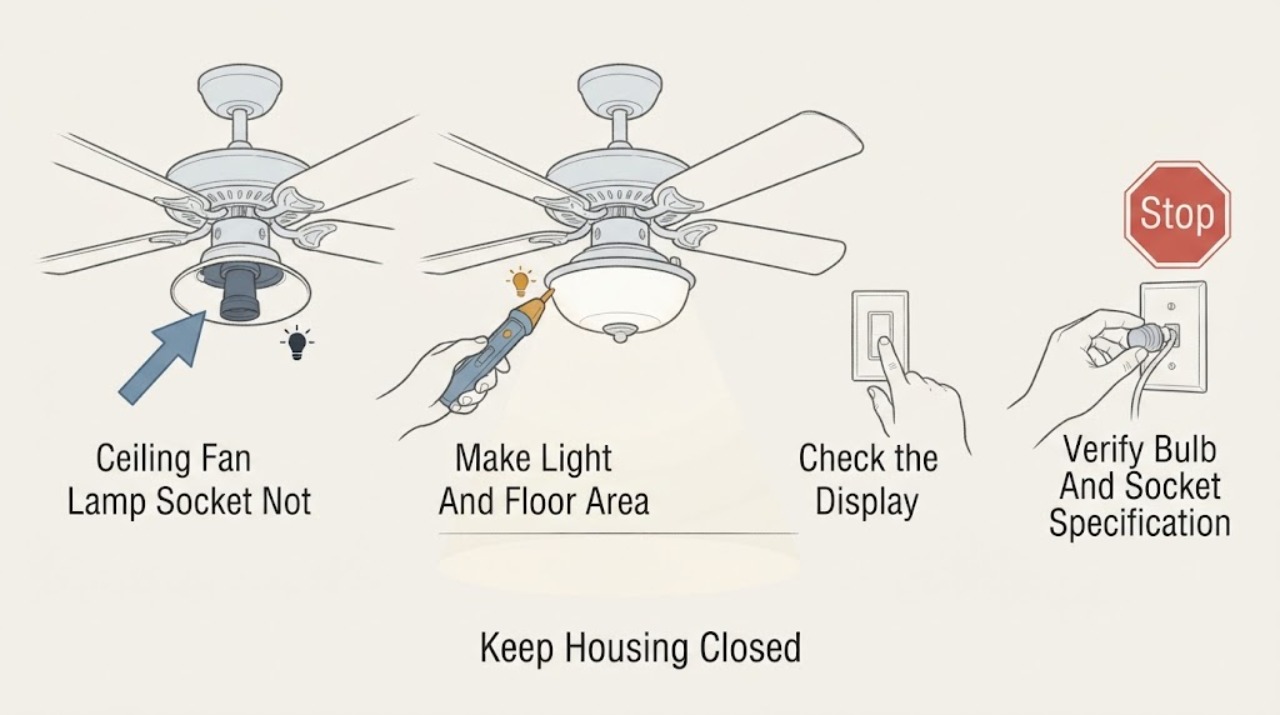
Work through in order
Diagnostic checks
Use only checks that match the exact appliance or system and its official guide.
-
Check 1
From a dry floor position, turn the light control off and look for smoke, flicker, arcing, crackling, burning odor, melted plastic, a hot shade, or a loose or broken bulb; do not touch the fixture or climb to inspect it.
Expected result: Record whether there is an urgent symptom, only an unlit lamp, a broken bulb or shade, or no safe way to tell because the fixture is high, hot, wet, or unstable.
Next step: For smoke, arcing, odor, melting, or heat damage, keep people away and have a qualified electrician or fan technician isolate and inspect it. Otherwise leave the light off until the fixture is cool before continuing.
Stop if: Do not touch the shade, bulb, socket, or wall controls with wet hands, use a ladder on an unstable surface, or keep resetting a breaker that trips.
Why this matters
Why: Odor, arcing, heat damage, crackling, or melting can indicate an energized socket or wiring fault and is not a bulb-replacement situation. A quiet unlit lamp supports a low-risk bulb and control check only when the fixture is cool and safely reachable.
-
Check 2
With the fixture viewed from the floor, operate only the installed wall switch, pull chain, or Casablanca remote controls as normally intended; compare the fan motor, any other lamp, and the affected lamp without removing covers or changing wiring.
Expected result: Record whether the fan runs while the light is out, all lights are out, the light flickers or responds intermittently, the light works from one control but not another, the remote display or battery appears inactive, or both fan and light are dead.
Next step: Record the response and stop operating the light if it flickers, smells hot, or trips protection. Check only the model's normal battery or pairing instructions when applicable; request service for persistent or unsafe behavior.
Stop if: Do not bypass a wall control, open a receiver, pair an unknown control by trial, or operate the fan while a loose shade, bulb, or light kit is hanging.
Why this matters
Why: Fan-on/light-off points toward the bulb, socket, light-kit connector, light output, or light-control path. Intermittent response points toward a control, receiver, loose connection, or failing socket. Both functions dead broadens the check to supply, wall control, receiver, or breaker; controls that work from only one interface may indicate a control-path issue.
-
Check 3
After the light has cooled and the exact manual or socket label is available, switch off power to the light at the normal control and replace the bulb only if it can be reached securely without touching energized contacts; use a known-good bulb with the same base, approved type, dimming capability, and no greater wattage than the socket label.
Expected result: Record whether the correct bulb illuminates steadily, remains dark, flickers, trips protection, or does not fit without force; note whether another socket works with the same approved bulb.
Next step: Leave the light off and request service when the correct bulb does not work, the socket is damaged, or the light behaves abnormally. Keep the bulb packaging or specifications with the model information.
Stop if: Do not exceed the socket label, force a bulb, use a bulb with a different base, remove a socket contact, use a non-dimmable bulb with a dimming setup when the manual prohibits it, or test with exposed metal parts.
Why this matters
Why: A correct bulb that works in the socket supports a failed or incompatible original bulb. A correct bulb that remains dark shifts attention to the socket contact, light-kit wiring, receiver, control, or LED module. Flicker, heat, odor, or a trip indicates a fault rather than permission to try higher-wattage or different bulb types.
-
Check 4
With power isolated by the exact model instructions and the bulb removed only from a cool, stable, safely reachable fixture, look into the socket from outside for burn marks, discoloration, corrosion, cracked insulation, a loose socket body, or a contact that is visibly out of position; do not touch or bend the contact.
Expected result: Classify the socket as clean and intact, contaminated but dry, heat-marked or melted, corroded or loose, visibly cracked, or impossible to assess without removing the shade, light kit, or housing.
Next step: Do not use a damaged or uncertain socket. Photograph the condition from a safe position and request qualified service for the socket, light kit, wiring, receiver, or control diagnosis.
Stop if: Do not scrape, bend, tighten, spray cleaner into, probe, or remove the socket, and do not open the canopy or switch housing as an ordinary-user check.
Why this matters
Why: Hunter identifies burn marks in a socket as a possible wiring problem. Corrosion, looseness, melting, a displaced contact, or cracked insulation can make a bulb replacement unsafe and can recur even with a new bulb; a clean socket with a correct bulb that remains dark points to the electrical path beyond the socket.
-
Check 5
Read the Casablanca model and date information from an ordinary-access label or the original paperwork, without moving the fan, removing the canopy, or taking down the shade or light kit; identify whether the light uses replaceable bulbs or an integrated LED module.
Expected result: Record the exact model if visible, light-kit or shade style, number of lamps, bulb base and rating from the socket label, presence of a remote or wall control, and whether the fan has an integrated light.
Next step: Give the model, photos, bulb specification, control type, and symptom pattern to the manufacturer or qualified technician; do not buy a generic socket or light kit based on appearance.
Stop if: Stop if locating the label requires a ladder, moving the fan, removing a cover, handling glass, or touching wiring or a hanging light assembly.
Why this matters
Why: Casablanca models can use different controls, sockets, light kits, and integrated modules. The model determines whether a socket is separately serviceable, whether a light kit can be changed, and which wiring diagram and parts are appropriate.
-
Check 6
If the approved bulb and visible socket checks do not restore a steady light, leave the light off and document whether the fan still runs, which control was used, and whether the problem began after a bulb, light-kit, remote, or electrical change.
Expected result: Record a stable fan with dark light, intermittent light, both fan and light dead, breaker or protection trips, visible socket damage, or an integrated LED module that does not illuminate.
Next step: Arrange qualified electrical or Casablanca fan service and provide the model and evidence record. Ask the technician to isolate power, inspect the light-control path, and confirm compatible replacement parts before repair.
Stop if: Do not remove the canopy, open the switch housing, test live voltage, splice wires, bypass the receiver, or support a fan or light kit while working overhead.
Why this matters
Why: These results can involve the socket, light-kit plug, receiver output, wall control, branch wiring, LED driver or module, or supply. They cannot be distinguished safely by opening a canopy or probing live wiring from a ladder.
Use your observations
Decision map
Find the observation that best matches what you see, then follow the next safe action.
-
PATH 01Safety boundary
What you see
The Casablanca fan runs normally, the control responds, the socket label is known, and a correct known-good bulb remains dark in the affected socket.
Do this next
Leave the light off and arrange model-specific service for socket and light-path diagnosis; do not open the canopy or bypass a control.
Why this path and its safety boundary
Why it matters: A socket contact, light-kit connection, receiver light output, or integrated module is more likely than the original bulb; a dark bulb does not show which component failed.
Safety stop: Do not bend the socket contact, install a higher-wattage bulb, or test exposed contacts.
-
PATH 02Safety boundary
What you see
The lamp works after installing a bulb with the exact socket base, approved type, dimming capability, and wattage, while the original bulb was dark or incompatible.
Do this next
Keep the approved bulb and record its specification for future replacement; monitor for flicker, heat, odor, or a repeated failure and request service if any appears.
Why this path and its safety boundary
Why it matters: The original bulb or its compatibility was the likely cause; a physically fitting bulb is not automatically electrically or control-compatible.
Safety stop: Do not exceed the socket label, force a different base, or assume a non-dimmable bulb is suitable for every Casablanca control mode.
-
PATH 03Safety boundary
What you see
The socket has burn marks, discoloration, melting, corrosion, looseness, a crack, a displaced contact, flicker, odor, or repeated bulb failure.
Do this next
Stop using that lamp, keep the light control off, and request qualified electrical or fan service to inspect the socket, light kit, and wiring.
Why this path and its safety boundary
Why it matters: The socket or connected wiring may be heat-damaged or electrically unreliable; another bulb can hide rather than correct the fault.
Safety stop: Do not scrape or bend contacts, spray cleaner, tighten live parts, or continue operating the light after a protection trip or heat symptom.
-
PATH 04Safety boundary
What you see
Neither the fan nor its light responds, or the breaker or other protection trips when the fan-light is operated.
Do this next
Stop resetting protection and arrange qualified electrical or fan service. Provide the control type, model, timing, and any odor, heat, or noise observed from the floor.
Why this path and its safety boundary
Why it matters: The issue may be at the supply, wall control, remote or receiver, switch housing, or shared wiring rather than only the lamp socket; a tripping protection device raises the safety priority.
Safety stop: Do not replace a breaker with a larger one, open the canopy, bypass the receiver, or keep cycling power to force operation.
-
PATH 05Safety boundary
What you see
The fan has an integrated LED module or the light assembly cannot be identified as a replaceable bulb-and-socket design from the model information.
Do this next
Keep the light off, identify the exact model without disassembly, and request compatible Casablanca service or parts guidance.
Why this path and its safety boundary
Why it matters: A standard bulb swap may not apply; the driver, LED module, control, or proprietary light assembly may require model-specific service.
Safety stop: Do not pry open an LED module, substitute a bulb socket, modify the light kit, or install a generic assembly.
Helpful context
Understand the symptom
A working fan motor narrows the light fault, but does not prove the socket is safe
If the blades run while the lamp stays off, the motor's power path is not the same as the light's final path. The bulb, socket contact, light-kit connector, receiver output, control, switch housing, or branch wiring can still be involved. If the fan and light both stopped, start with the wall switch, remote battery or pairing state, and breaker only from a dry floor position; do not assume the socket itself failed. A socket with burn marks, melting, crackling, odor, or heat needs electrical service rather than another bulb.
Bulb compatibility is part of the diagnosis
Casablanca fan light kits can use different bulb bases, wattage limits, and control behavior. Hunter's bulb guidance says the replacement must fit the same socket, and a bulb intended to dim must be paired with a control that supports dimming. A bulb that fits physically may still be wrong for the socket or control. Read the socket label and exact manual; never exceed its marking or force a bulb into place.
Integrated lights and accessory light kits have different service paths
Some Casablanca fans use a replaceable bulb and socket, while others use an integrated LED module or a model-specific accessory light kit. The exterior shade does not identify the internal assembly. Casablanca support directs owners to have the model number ready, and Hunter's parts guidance warns that generic parts can affect performance and warranty coverage. Record the model without removing the canopy, shade, or light kit, then let the exact manual or a qualified technician determine the repair part.
Safety boundary
Stop conditions
- Stop using the light for smoke, arcing, crackling, burning odor, melting, unusual heat, visible socket damage, or a breaker or protection device that trips.
- Do not touch or probe socket contacts, live wiring, the canopy, receiver, switch housing, or light-kit connectors; electrical isolation and overhead wiring work belong to qualified service.
- Do not exceed the socket label's wattage, force a bulb, use a different socket base, or pair an incompatible dimming and bulb setup.
- Do not remove or modify an integrated LED module or light kit, use a generic replacement based on appearance, or support a hanging assembly from an unsafe ladder.
- Do not keep resetting a tripped breaker or cycling the control to make a damaged or intermittently flickering light operate.
Only after diagnosis
Potential parts
- approved replacement light bulb
Consider only when the original bulb is failed or incompatible and the socket label and exact manual identify the same base, approved type, dimming capability, and wattage limit.
Confirm the exact socket and control requirements; do not exceed the socket label or assume a physically fitting bulb is compatible. - Casablanca lamp socket or light-kit assembly
Consider only when a correct bulb remains dark or inspection finds socket damage and qualified diagnosis confirms a replaceable socket or light-kit assembly.
Match the exact Casablanca model and light architecture; do not substitute a generic socket or kit based on appearance. - integrated LED module, driver, receiver, or light-control component
Consider only after model-specific diagnosis identifies an integrated-light, receiver, control, or driver fault beyond the bulb and visible socket.
Qualified service must confirm the exact model, wiring, control system, and manufacturer-approved replacement before ordering or opening the assembly.
When checks do not resolve it
Need a professional?
Arrange qualified electrical or Casablanca fan service when a correct bulb does not illuminate, the socket is burned, corroded, loose, melted, cracked, or intermittent, the light and fan both fail, a breaker trips, an integrated LED module is dark, or any repair would require opening the canopy, switch housing, receiver, or wiring. Provide the exact model and date information if safely visible, light-kit type, socket label, bulb specification, control type, fan-versus-light response, photos, and any odor, heat, flicker, or protection trip. Keep the affected light off until the path is inspected.
Safety scope: This article supports floor-level observation, model identification, and a cool-bulb check only. Do not work overhead, open the canopy or switch housing, probe wiring, modify a light kit, bypass a receiver, or operate a damaged or intermittently flickering light.
Common questions
FAQ
Why does my Casablanca fan work but the light socket does not?
The motor and light use separate portions of the control and wiring path. A failed or incompatible bulb is possible, but the socket contact, light-kit connector, receiver output, wall control, or integrated LED module can also be involved. Check only the correct bulb and visible socket condition, then request service if the light remains dark.
Can I use any bulb that fits a Casablanca fan socket?
No. Use the same socket base and an approved bulb type, dimming capability, and wattage that does not exceed the socket label and exact manual. Physical fit alone does not establish control compatibility.
What does a burn mark inside the fan light socket mean?
It can indicate a socket or wiring problem. Turn the light off, do not scrape or bend the contact, and arrange qualified electrical or fan service. A new bulb does not make a heat-damaged socket safe.
Can I replace the Casablanca fan lamp socket myself?
Do not open the canopy, switch housing, or light kit as an ordinary-user repair. Socket and overhead wiring work require power isolation, model-specific parts, and safe support of the assembly; have a qualified technician diagnose and replace it.
What if my Casablanca fan has an integrated LED light?
A standard bulb replacement may not apply. Identify the exact model without removing the assembly and request model-specific service for the LED module, driver, receiver, or control. Do not substitute a generic socket or modify an integrated light kit.
Read the exact guide
Official sources
- Hunter & Casablanca Fan Replacement PartsHunter Fan Company · Hunter and Casablanca parts guidance; exact model and manual determine whether a light kit or integrated light can be changed.
- My fan stopped working. What do I do?Hunter Fan Company · Hunter support guidance for ceiling-fan light troubleshooting; the exact Casablanca model manual controls model-specific bulb and service steps.
- Replacing Your Ceiling Fan Light BulbsHunter Fan Company · Hunter support guidance for fan light bulbs; use the exact Casablanca socket label and model manual for a particular fan.
- Casablanca Fans Consumer SupportHunter Fan Company · Casablanca consumer-support page maintained by Hunter; it routes owners to model-specific manuals and troubleshooting.
- How to toggle the dimming feature for my Casablanca fan?Hunter Fan Company · Casablanca support guidance for models using a compatible remote or wall control; exact model instructions and bulb requirements control.
Community feedback
Share a repair observation
Share a plain-text repair observation. Accepted observations are published automatically; this page may take a moment to update.