
On this page
Start here
Quick answer
First determine whether the fan still runs and whether the failed light uses a replaceable bulb or an integrated LED module. Use the light control by itself, then—only if the bulb is safely reachable—turn off power, let it cool, and try the correct known-good bulb. Look for darkening, melting, a loose socket, a burned smell, or a light-kit plug that is visibly separated, but do not touch socket contacts, open the canopy, or access wiring while energized. A working fan with one dead lamp points toward the bulb, socket, light kit, or its connection; a dead fan and light or a breaker that trips points toward the supply, control, or wiring. Stop using the light for arcing, heat, smoke, damaged insulation, or a loose fixture and call an electrician.
Before you begin
Safety first
- Turn off the circuit breaker before accessing a bulb socket, light kit, or wiring, and do not rely on the wall switch alone. Do not touch socket contacts, open the canopy or receiver, rewire, bypass a control, reset a tripping breaker repeatedly, use a ladder or improvised support, or work on a loose overhead fixture. Keep people clear and have electrical and fixture-support work handled by a qualified electrician.
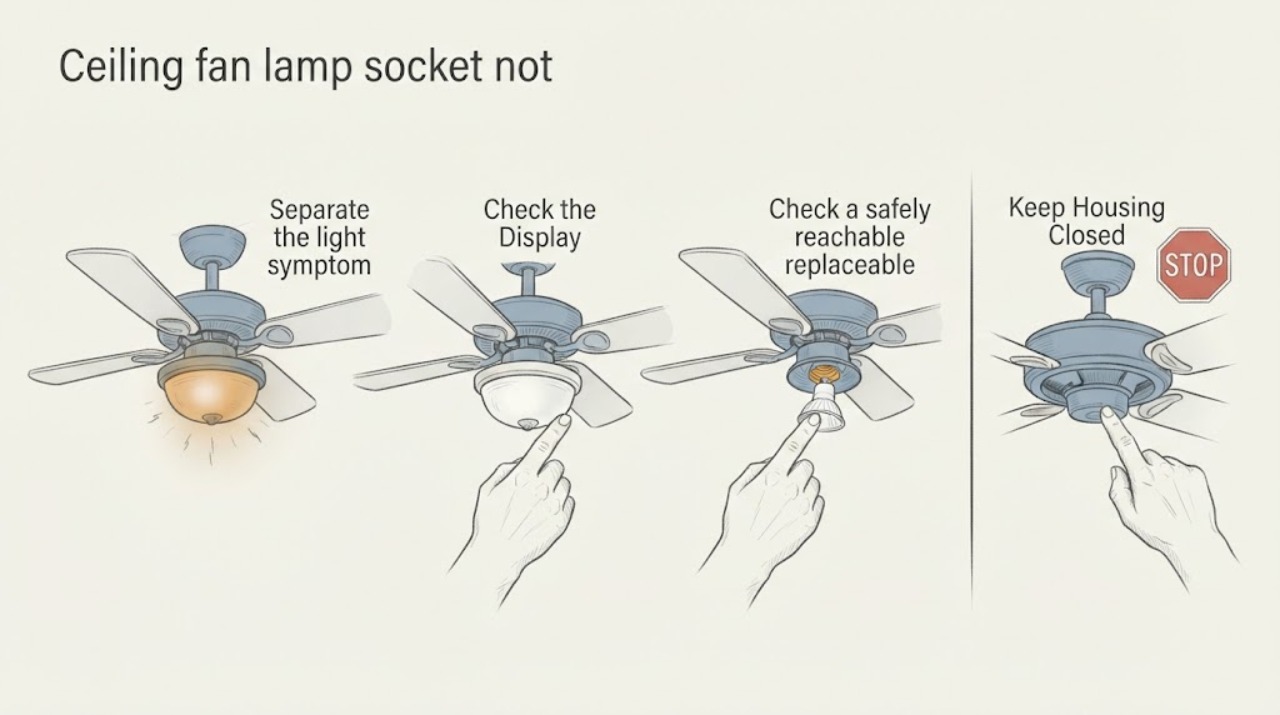
Work through in order
Diagnostic checks
Use only checks that match the exact appliance or system and its official guide.
-
Separate the light symptom from the fan symptom
From a stable standing position, use the normal wall control, remote, or pull control to observe the fan and light separately. Do not reach over furniture, climb an improvised surface, or operate a loose or wobbling fixture.
Expected result: Record a fan that runs while the light stays dark, a light that works while the fan does not, both functions failing, intermittent operation, or a control that does not respond.
Next step: Keep the symptom description and continue only with safe visual checks. If the fixture wobbles, sparks, smells burned, or the breaker trips, turn off power and arrange electrical service.
Stop if: Stop for smoke, arcing, buzzing with heat, a loose canopy, a falling light kit, a wobbling fan, or any need to use a ladder or reach energized parts.
Why this matters
Why: Fan-only operation makes the lamp, socket, light-kit connection, or light-control channel more likely; failure of both functions shifts attention to the supply, wall control, receiver, or wiring. Intermittent operation can indicate a loose connection or heat-related fault.
-
Identify the light type and control path
Visually identify a replaceable bulb and socket, an enclosed light kit, or an integrated LED panel, and note whether the light is controlled by a separate wall switch, remote button, or pull control. Do not remove a shade, bulb, receiver, or light kit until power is off and the part can be safely supported.
Expected result: Record the lamp type, number of lamps, visible socket style, light-kit label, control arrangement, and whether any part is loose, cracked, discolored, or missing.
Next step: Use the identified light type and any model marking to locate the correct manual or prepare a service handoff. Keep the light off if the socket or housing is damaged.
Stop if: Stop for cracked glass, exposed conductors, a loose light kit, a burnt housing, unreadable wiring, or any need to remove overhead hardware without a safe support and de-energized circuit.
Why this matters
Why: A replaceable-bulb socket follows a different diagnostic path from an integrated LED module or receiver-controlled light. Light kits and controls may be brand- or model-specific, so appearance alone does not establish compatibility.
-
Check a safely reachable replaceable bulb
If the bulb is reachable without a ladder, turn off the circuit breaker for the fan/light, verify the light is off by its normal control, allow the bulb to cool, and inspect or replace it with a known-good lamp of the same specified type and wattage. Do not touch the socket center contact or continue if the bulb is stuck.
Expected result: Record a failed bulb, a known-good bulb that remains dark, a bulb that flickers, a socket that is loose or darkened, or no replaceable bulb because the unit uses an LED module.
Next step: Restore power only for a normal brief check when the socket and housing are intact. Leave power off and call an electrician for socket damage, heat, flicker, arcing, or a light that remains dead after a correct bulb.
Stop if: Stop for a tripped breaker, scorch marks, melted plastic, a cracked bulb, a stuck bulb, exposed metal, a hot socket, or any need to climb or force the lamp.
Why this matters
Why: A known-good correct lamp that works points to the original bulb; a known-good lamp that remains dark shifts attention to the socket, light kit, control, or wiring. Darkening, melting, looseness, or flicker is not a normal bulb-only result.
-
Inspect the socket and light housing with power off
With the circuit breaker off and the bulb removed only if safely reachable, use a flashlight to look at the socket, lamp base, shade, and light-kit housing without inserting tools or touching contacts. Do not open the canopy, loosen wiring, bend a socket contact, or probe for voltage.
Expected result: Record a clean intact socket, a darkened or pitted contact, melted insulation, corrosion, a loose socket in its housing, water or insect residue, a cracked shade, or a separated light-kit connector visible without disassembly.
Next step: Leave the breaker off for any heat, burn, moisture, loose connector, or damaged insulation and provide photos to an electrician. Do not apply cleaner, tape, or sealant inside the socket.
Stop if: Stop for any energized indication, burn or melting, wetness, loose wire, damaged insulation, or any need to remove the light kit or canopy.
Why this matters
Why: A damaged socket, heat mark, loose housing, or connector issue can create shock or fire risk and requires electrical diagnosis. A clean socket with a dead correct bulb points toward the light kit, receiver/control path, or wiring rather than a cosmetic lamp problem.
-
Check the supply and control clues without opening wiring
From normal standing positions, note whether the wall switch or remote controls the fan, whether the light responds separately, whether the breaker is visibly tripped, and whether another fixture on the same control is also out. Do not reset a breaker repeatedly, remove a switch plate, open a receiver, or test live wires.
Expected result: Record a light-only control failure, both fan and light out, a breaker that trips again, a remote or wall control with no light response, or only one lamp/socket dark.
Next step: Keep the circuit off for repeated trips, heat, or electrical odor and call an electrician. Supply and control diagnosis should use the exact fan wiring diagram and appropriate test equipment.
Stop if: Stop for a breaker that trips again, burning odor, buzzing, hot controls, exposed wiring, a wet fixture, or any need to remove covers or measure energized conductors.
Why this matters
Why: A repeated trip or both functions failing suggests a supply, control, receiver, or wiring fault. A light-only control failure can implicate the receiver or switch channel, while one dead socket points more locally to the lamp or light kit.
-
Prepare a model-specific repair handoff
Collect the fan and light-kit brand/model if visible, lamp or LED type, control type, fan-versus-light behavior, bulb result, socket and housing photos, breaker behavior, and any recent installation or bulb change. Do not order a module, light kit, or receiver from appearance alone.
Expected result: Record whether the likely path is bulb/socket, LED module, light kit, receiver or control, supply/wiring, or unresolved without electrical testing.
Next step: Keep power off when the fault involves heat, arcing, wiring, a repeated trip, or a loose fixture, and request an electrician. Provide the observations before any light-kit access.
Stop if: Stop gathering information when it requires a ladder, overhead support, canopy or receiver access, live testing, rewiring, or removal of the light kit.
Why this matters
Why: Ceiling-fan light kits and controls can be model- or brand-specific, and a socket symptom may be caused by the upstream control or wiring. A precise identity prevents an incompatible part from being installed into an energized or unsupported fixture.
Use your observations
Decision map
Find the observation that best matches what you see, then follow the next safe action.
-
PATH 01Next step
What you see
The fan runs, a correct known-good replaceable bulb does not, and the socket is damaged, darkened, loose, hot, or flickering.
Do this next
Turn off the circuit breaker and call an electrician for socket or light-kit diagnosis. Do not bend contacts, tape the socket, or continue operating the light.
-
PATH 02Next step
What you see
The bulb is failed and the socket and housing are intact after the circuit is safely de-energized.
Do this next
Replace only with the specified lamp type and wattage, then perform one normal brief check. If it fails again, stop and request electrical service rather than trying higher-wattage lamps.
-
PATH 03Next step
What you see
The light uses an integrated LED module or the light kit is not identifiable.
Do this next
Do not open or rewire the light kit. Record the model and request manufacturer or electrician guidance for a compatible module or assembly.
-
PATH 04Next step
What you see
Both fan and light fail, the light control is unresponsive, or the breaker trips again.
Do this next
Leave power off and call an electrician to assess the supply, wall control, receiver, and wiring. Do not reset repeatedly or bypass a control or breaker.
-
PATH 05Next step
What you see
A loose fixture, exposed conductor, burn mark, melting, water, buzzing, smoke, or electrical odor is present.
Do this next
Turn off the circuit if it can be done safely, keep people clear, and request urgent electrical service. Do not touch the fixture or use the fan/light.
-
PATH 06Next step
What you see
The correct lamp works, the socket and housing are intact, and the fixture operates normally after a single safe check.
Do this next
Keep the model and lamp information for future maintenance. If the light goes dark, flickers, overheats, or trips the breaker again, turn off power and reopen the electrical service request.
Helpful context
Understand the symptom
The fan and light can fail on different paths
A ceiling-fan light may be a replaceable lamp in a socket, a dedicated light kit, or an integrated LED assembly. The fan motor can still operate when the light's bulb, socket, control channel, plug, module, or wiring has failed. Conversely, a dark light together with a nonworking fan or a tripped breaker suggests a supply or control problem rather than a socket alone. Identify the symptom before ordering a light part.
Use the power-off boundary
A socket and light-kit wiring can remain energized even when the light is switched off, depending on the fan's wiring and controls. Turn off the relevant circuit before opening any light cover or accessing a socket, and do not rely on a wall switch alone. Ceiling fans are overhead fixtures that may be heavy or poorly supported; canopy, light-kit, and electrical-box work belongs to a qualified professional when the manufacturer's instructions or your ability are uncertain.
Only after diagnosis
Potential parts
- ceiling fan LED module
Consider only when the fan uses an integrated LED light and the model documentation or electrician confirms that the module, not the control or supply, has failed.
Match the fan model, module connector, mounting pattern, voltage, light-control method, and listed installation instructions; do not substitute a visually similar energized module. - ceiling fan light kit
Consider only when a compatible light-kit assembly is confirmed as the failed component after bulb, socket, control, and supply clues are assessed.
Verify the fan's light-kit adaptability, mounting, wiring connector, control compatibility, and support requirements; many kits are limited to particular brands or models. - fan remote receiver
Consider only when the fan and light respond differently through a receiver-controlled system and the model-specific diagnosis identifies the light channel or receiver as failed.
Match receiver, remote, frequency/control protocol, wiring connector, fan model, and electrical ratings; do not install a receiver while the circuit is energized or assume universal compatibility.
When checks do not resolve it
Need a professional?
Call an electrician for a dead light after a correct bulb, damaged or loose socket, integrated LED failure, separated light-kit wiring, unresponsive light control, repeated breaker trips, flicker, heat, arcing, buzzing, smoke, water, exposed conductors, a loose or wobbling fan, or any work requiring canopy, receiver, light-kit, electrical-box, or live-circuit access.
Safety scope: Turn off the circuit breaker before accessing a bulb socket, light kit, or wiring, and do not rely on the wall switch alone. Do not touch socket contacts, open the canopy or receiver, rewire, bypass a control, reset a tripping breaker repeatedly, use a ladder or improvised support, or work on a loose overhead fixture. Keep people clear and have electrical and fixture-support work handled by a qualified electrician.
Have this ready
- Provide the fan/light brand and model if visible, replaceable-bulb or integrated-LED type, control arrangement, whether the fan still runs, bulb result, socket and housing photos with power off, breaker behavior, recent bulb or installation history, and any heat, odor, flicker, or noise.
Common questions
FAQ
Why does my ceiling fan work but the light does not?
The fan motor and light can use separate control channels and connections. A failed bulb, socket, LED module, light kit, receiver channel, or wiring connection can leave the fan running. Start with the control and bulb type, then use the breaker-off boundary before socket access.
Can I test a ceiling fan lamp socket while the switch is off?
Do not touch contacts or wiring based only on a wall-switch position. Turn off the circuit breaker before accessing the socket or light kit. If there is heat, arcing, a burn mark, exposed conductor, or uncertainty, leave power off and call an electrician.
What if a new bulb does not fix the ceiling fan light?
A correct known-good bulb that remains dark shifts attention to the socket, light kit, LED module, receiver/control, or supply. Inspect only for visible damage with power off; do not bend socket contacts, open the canopy, or install a replacement part without model confirmation.
How do I know whether I need an LED module or a light kit?
An integrated LED panel generally has no replaceable bulb, while an attachable kit may have a socket, shade, or separate connector. Record the fan model and visible light assembly, then follow the exact manufacturer documentation or ask an electrician; similar-looking modules are not proof of compatibility.
When is a dead ceiling fan light an electrical emergency?
Treat smoke, arcing, burning odor, heat, melted parts, water, exposed conductors, repeated breaker trips, a loose overhead fixture, or a wobbling fan as urgent. Turn off power if safe, keep clear, and call an electrician rather than continuing tests.
Read the exact guide
Official sources
- Ceiling Fan Installation and Usage TipsENERGY STAR · ENERGY STAR guidance supports the article's caution that ceiling fans require an appropriate fan-rated electrical box, secure mounting, and manufacturer instructions; it is not a live-circuit troubleshooting procedure.
- Ceiling Fan Accessories and Purchasing ChoicesENERGY STAR · ENERGY STAR's accessory guidance supports conditional part selection by explaining that light kits may be integrated, included, or sold separately and that control compatibility can be brand- and model-dependent.
- My fan stopped working. What do I do?Hunter Fan Company · Hunter's support article is used for the general distinction between bulb and socket clues and for the boundary that power must be off before accessing fan connections; exact light-kit and wiring procedures are model-specific.
Community feedback
Share a repair observation
Share a plain-text repair observation. Accepted observations are published automatically; this page may take a moment to update.