
On this page
Start here
Quick answer
If a Casablanca ceiling-fan LED module is dark, first determine whether the fan still runs and whether the light control produces any response. Confirm the wall switch or breaker is on, press the light control once, and follow the exact Casablanca manual for that model's light-control or pairing behavior. An integrated LED module has no ordinary screw-in bulb to replace, so a dark light can be caused by a control setting, wall switch, receiver, disconnected light plug, damaged wiring, or the module itself. With the breaker off, a qualified person may visually check the model-specific light connector and visible damage; do not probe live wiring, bypass the module, or open the motor housing. Stop using the fan and obtain qualified electrical or ceiling-fan service for heat, smoke, sparking, a burning odor, exposed conductors, a loose light assembly, repeated breaker trips, or any inability to isolate power safely.
Before you begin
Safety first
- This article supports external control checks, one safe breaker observation, model-specific control steps, and a power-off visual check only. Qualified service handles live testing, canopy or switch-housing wiring, receiver and harness diagnosis, LED-module replacement, overhead mounting, and any uncertain electrical work.
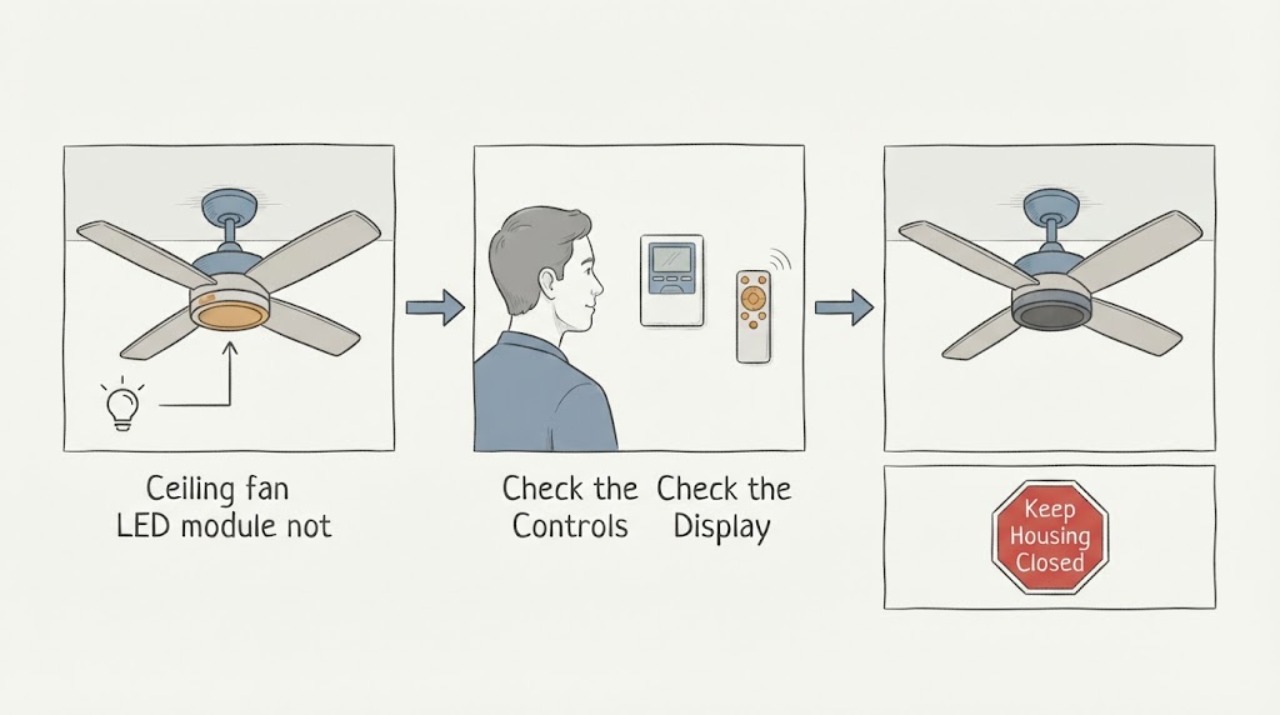
Work through in order
Diagnostic checks
Use only checks that match the exact appliance or system and its official guide.
-
Check 1
From the floor and without reaching toward the fixture, turn the known Casablanca wall switch on and press the approved light control once; observe the fan and LED module together.
Expected result: Record whether the fan runs, whether the LED module is fully dark, faint, flickering, delayed, or responsive only after repeated commands, and whether the light and fan respond differently.
Next step: Use the response pattern to choose the control/power branch or the LED-assembly branch; stop testing if the fan starts unexpectedly or the fixture shows heat, smoke, sparking, or movement.
Stop if: Stop immediately for a burning odor, smoke, sparks, hot housing, exposed wire, loose light assembly, repeated breaker trip, or an unstable fan.
Why this matters
Why: A running fan with a dark LED module narrows the problem to the light command, receiver/light output, connector or wiring, or LED assembly. A dead fan and dead light keep supply, wall switch, control, receiver, or wiring ahead of the module. Flicker, delay, or a response that changes when the fixture moves is not a normal bulb failure and raises a connection or physical-damage concern.
-
Check 2
Check that the wall switch supplying the fan is on and inspect the known fan breaker from a dry, safe position; then use the exact manual's light button or wall-control command once.
Expected result: Record a switch or breaker that was off, a light command that produces a normal response, no light response with a running fan, an unexpected dim/low state, or a breaker that trips again.
Next step: If the manual-approved light command restores the light, monitor it and document the model/control settings. If the breaker trips, the switch is hot or loose, or there is no supply, leave it off and arrange qualified electrical service; otherwise continue to the model-specific control check.
Stop if: Do not reset a breaker repeatedly, remove a wall plate, test live terminals, or touch a wet, damaged, hot, or sparking switch.
Why this matters
Why: An off switch or disabled light command can make a good LED module appear failed. A normal fan response with no light response shifts attention to the light-control output, connector, wiring, or module. A repeated trip, hot switch, or loss of supply points to an electrical fault rather than a light-module replacement.
-
Check 3
Identify the fan model and its control type, replace a remote or wall-control battery only with the type specified by that manual, and follow the model-specific light-control, dimming, or pairing procedure exactly once.
Expected result: Record a confirmed light response, a light that responds only at close range or after pairing, no response with a good battery, a dimming mode that was selected incorrectly, or a procedure that does not match the fan's manual.
Next step: Keep the confirmed model and control information with the fan. If one manual-approved attempt does not restore the light, stop changing settings and arrange model-specific diagnosis rather than altering dip switches or buying a generic module.
Stop if: Do not apply another model's pairing sequence, alter receiver coding by guesswork, short control contacts, or continue if the fan behaves unpredictably.
Why this matters
Why: A restored response supports a battery, control-mode, or lost-pairing issue rather than a failed LED module. A light that remains dark while the fan responds normally keeps receiver light output, light wiring, and the module in contention. A mismatched procedure or unknown control system is not evidence that the LED assembly has failed.
-
Check 4
With the fan stopped and the breaker locked or otherwise secured off, inspect the LED lens and light-kit assembly from a stable, safe position without opening the motor housing or removing the fixture unless the exact manual permits it.
Expected result: Record a secure lens and fixture with no marks, a cracked lens, loose or missing light-kit screw, visible scorch mark, moisture, cracked LED board, pinched lead, or light assembly that shifts when it should be rigid.
Next step: Leave power off and arrange qualified ceiling-fan service for damage, looseness, moisture, or any sign of overheating. Do not remove a lens or support an overhead assembly from an unstable ladder just to identify the module.
Stop if: Do not operate a fixture with a cracked lens, loose housing, exposed board, missing fastener, water entry, scorch mark, or a light assembly that can move.
Why this matters
Why: A secure, undamaged assembly does not rule out an electrical module fault but makes physical damage less likely. Cracks, scorch marks, moisture, pinched leads, or loose hardware can cause a dark or intermittent light and create falling-object or shock risk; a replacement module alone may not correct them.
-
Check 5
Only if qualified to perform electrical work and the breaker is off and verified dead, compare the visible LED/light connector and wire routing with the exact Casablanca manual; otherwise leave the housing closed for a professional.
Expected result: Record a fully seated, undamaged connector and unpinched wires, a plug that is separated or not latched, a burned/corroded connector, an unknown added part, or wiring that cannot be positively identified.
Next step: If the model manual clearly identifies a connector that is visibly disconnected and the person performing the work is qualified, restore only the manual-specified connection with power isolated. For any damage, uncertainty, or persistent darkness, keep power off and provide the model and photos to qualified service.
Stop if: Do not work live, pull on wires, bypass a connector, bridge the LED module, restore power with the housing open, or touch a capacitor or other internal component.
Why this matters
Why: A separated or unlatched light plug can interrupt an otherwise good LED module. Burned, corroded, pinched, incorrectly routed, or unidentified wiring indicates a fault that can recur or create a fire/shock hazard; it is not a reason to bypass the connector or connect colors by guesswork.
-
Check 6
Give the technician the fan model, control type, response pattern, one safe breaker check, and any power-off connector or damage observation; do not order an LED module until the diagnostic path identifies the module or its approved light kit as the failed part.
Expected result: Record whether qualified testing finds a valid light-control output and intact light wiring with a dark module, or instead finds no control output, a failed receiver/harness, supply fault, or physical light-kit damage.
Next step: Use the exact model's parts list and manufacturer support to identify a compatible replacement only after diagnosis. Have the repair or any overhead electrical access completed by qualified service when it involves live testing, internal electronics, mounting, or uncertain wiring.
Stop if: Do not substitute a generic LED board, defeat thermal or current protection, bypass a receiver, or keep operating a fan with a suspected electrical or mounting defect.
Why this matters
Why: A confirmed control signal and intact, model-correct connections make the LED module or complete light kit more plausible. No valid output, a failed receiver, damaged harness, or unsafe mount points elsewhere; replacing the module first could leave the real fault energized or unresolved.
Use your observations
Decision map
Find the observation that best matches what you see, then follow the next safe action.
-
PATH 01Safety boundary
What you see
The fan runs normally, the breaker and wall switch are on, the exact light command or pairing procedure produces no light response, and there is no visible damage.
Do this next
Keep the fan off if further access is needed and have qualified service diagnose the receiver/light output, connector, wiring, and model-matched LED module in that order.
Why this path and its safety boundary
Why it matters: Power reaches at least part of the fan, while the light-control output, light connector, wiring, or LED module remains unresolved. A remote battery or dimming-mode problem is less likely after a model-correct check.
Safety stop: Do not repeatedly cycle power, bypass the receiver, or open the motor housing to force the light on.
-
PATH 02Safety boundary
What you see
Neither the fan nor LED module responds, or the breaker or wall switch is off, has no power, feels hot, or trips again.
Do this next
Leave the circuit off for a repeated trip, heat, damage, or absent power and arrange licensed electrical diagnosis; provide the exact Casablanca model and control type.
Why this path and its safety boundary
Why it matters: The supply, wall switch, control, receiver, or wiring path is more likely than an isolated LED-module failure. A new module cannot restore a missing fan supply.
Safety stop: Do not reset a tripping breaker repeatedly, test energized terminals, or remove the wall switch or canopy as an ordinary user check.
-
PATH 03Safety boundary
What you see
The LED module turns on after a correct light command, battery replacement, dimming-mode correction, or model-specific pairing step, with no heat, damage, or abnormal behavior.
Do this next
Document the model and control setting, observe a normal on/off cycle, and arrange service if the control loses the light again or the module flickers.
Why this path and its safety boundary
Why it matters: The control path was more likely than a failed LED module. The symptom should not be used to justify replacing the light assembly.
Safety stop: Stop using the light for heat, buzzing with visible damage, smoke, sparking, or a response that changes when the fixture is touched.
-
PATH 04Safety boundary
What you see
With power isolated by a qualified person, the model manual identifies a light connector that is visibly separated or unlatched, while the LED assembly, leads, and housing show no damage.
Do this next
Restore only the exact manual-specified connection with power isolated and the assembly securely supported; then have the work checked if the light remains dark or the plug will not latch.
Why this path and its safety boundary
Why it matters: An interrupted light connection can explain a dark module without proving that the module itself failed. Reconnecting the wrong plug or pinching the lead can create a new fault.
Safety stop: Do not connect by wire color alone, force a mismatched plug, leave wires outside the housing, or restore power with the assembly unsecured.
-
PATH 05Safety boundary
What you see
The LED board or light kit has a scorch mark, cracked board or lens, moisture, pinched lead, missing screw, looseness, or intermittent behavior tied to fixture movement.
Do this next
Keep the breaker off and obtain qualified ceiling-fan/electrical service to identify the model-matched light kit, wiring repair, mounting repair, or replacement path.
Why this path and its safety boundary
Why it matters: Physical or thermal damage makes continued operation unsafe and means a module-only replacement may be incomplete. The light assembly can also become a falling-object hazard.
Safety stop: Do not operate, tape over, straighten, or bypass damaged LED or wiring parts, and do not work from an unstable ladder.
-
PATH 06Safety boundary
What you see
Qualified diagnosis confirms the fan has the correct supply and light-control output, the model-correct connector and harness are intact, and the LED module remains dark without physical damage.
Do this next
Use the Casablanca model number and parts documentation to identify the approved module or light kit, and have overhead replacement performed by qualified service if access or wiring is involved.
Why this path and its safety boundary
Why it matters: The LED module or complete light-kit assembly is now a leading suspect, but fitment, connector version, and the manufacturer's parts list still matter.
Safety stop: Do not buy a generic LED board, infer compatibility from appearance, or discard the failed part before model and warranty information are recorded.
Helpful context
Understand the symptom
Separate the LED module from its control path
A Casablanca fan whose blades run while the LED module stays dark has power to at least part of the fan, but that does not prove the module is defective. The light command may be disabled, dimmed to an unusable level, unpaired, or interrupted by a wall switch, receiver, or light lead. If both fan and light are dead, start with the supply and control path instead of condemning the LED assembly. If the light flashes, works intermittently, or changes when the canopy or light housing moves, stop operating it and treat that as a connector, wiring, or mounting concern.
Use the exact Casablanca control and manual
Casablanca control systems differ by model and age. Some manuals use a light button, a wall control, a remote, or a model-specific pairing or dimming mode. Use the model number from the fan label and the manual supplied for that fan before repeating a power cycle or changing a control setting. Do not apply a pairing sequence or dimming switch position from another Casablanca series simply because the remote looks similar.
The LED assembly is an overhead electrical and falling-object boundary
An integrated LED module is normally part of a light-kit assembly, not a universal bulb socket. Accessing its plug or screws means working beneath an overhead fixture and may expose line-voltage conductors. Turn off the breaker before any housing access, verify that the fan cannot start, and have a qualified person do the inspection if the model instructions, support position, or wiring are unclear. Never leave the fixture partly supported, restore power with a cover open, or substitute a module without confirming model fitment.
Safety boundary
Stop conditions
- Turn the fan off and disconnect power at the circuit breaker before any canopy, switch-housing, LED-module, connector, or wiring access; a wall switch alone is not sufficient for electrical work.
- Do not test live terminals, bridge the LED module, bypass a receiver, defeat a limiter or protection device, or substitute wiring by color or appearance.
- Do not operate the fan or light with smoke, sparking, a burning odor, hot housing, exposed conductors, moisture, a cracked lens or board, a loose fixture, or a repeated breaker trip.
- Do not climb onto an unstable ladder, support an overhead assembly by its wires, leave the light housing partly attached, or restore power with covers open.
- If power cannot be isolated, the model/control system is unknown, or the connector and module cannot be positively identified, stop and arrange licensed electrical or qualified ceiling-fan service.
Only after diagnosis
Potential parts
- Casablanca LED light-kit module
Consider this category only after qualified diagnosis confirms the correct light-control output and model-matched connector/harness are intact while the LED module remains dark.
Use the exact Casablanca model and parts documentation; an LED board or module that looks similar may have different connectors, ratings, mounting, or control requirements. - Casablanca light-kit connector or wiring harness
Consider this category only when power-off inspection or qualified testing identifies a loose, damaged, corroded, pinched, or failed light connector or harness rather than a failed LED module.
Match the exact model, connector arrangement, and wiring diagram; electrical isolation and overhead access are required. - Casablanca receiver or light-control component
Consider this category only when the fan and LED response pattern and qualified testing show that the light-control output or receiver is not sending the required signal while the LED assembly is intact.
Confirm the exact Casablanca control system and model; do not substitute a receiver or wall control by appearance or brand name alone.
When checks do not resolve it
Need a professional?
Arrange qualified electrical or ceiling-fan service when the correct switch, breaker, light command, battery, and model-specific control checks do not restore the Casablanca LED module, when the fan and light respond differently, or when the connector, receiver, harness, module, or light-kit mounting is suspected. Seek urgent service for smoke, sparking, burning odor, heat, exposed wiring, moisture, a loose or falling light assembly, repeated breaker trips, or any inability to isolate power safely.
Safety scope: This article supports external control checks, one safe breaker observation, model-specific control steps, and a power-off visual check only. Qualified service handles live testing, canopy or switch-housing wiring, receiver and harness diagnosis, LED-module replacement, overhead mounting, and any uncertain electrical work.
Common questions
FAQ
Why is my Casablanca ceiling fan LED module not working while the fan still runs?
The light command, control mode or pairing, receiver light output, connector, wiring harness, or LED module may be at fault. Start with the wall switch and exact light command, then use the model-specific manual. A running fan does not prove that the LED module has the correct light power.
Does a Casablanca integrated LED module have a bulb I can replace?
Many Casablanca fans use an integrated LED assembly rather than a standard screw-in bulb. Confirm the installed model and its manual before buying a part; do not fit a generic LED board by appearance.
What should I check before replacing a Casablanca LED module?
Determine whether the fan responds, verify the wall switch and breaker, try the exact model's light control or pairing procedure, and have a qualified person inspect the power-off light connector and visible damage. A disconnected plug or failed receiver can mimic a failed module.
Can a Casablanca remote or dimming setting make the LED light appear dead?
Yes. Depending on the model, the light may be controlled by a wall control, remote, pairing state, or dimming mode. Use only the procedure for the exact fan; do not copy a sequence or setting from another Casablanca series.
Can I unplug and reconnect the Casablanca LED module myself?
Treat that as overhead electrical work. Power must be disconnected at the breaker, the fixture must be supported, and the connector must be identified from the exact manual. If you are not qualified or cannot verify the circuit is dead, leave the housing closed and call qualified service.
When should I call an electrician for a Casablanca LED module problem?
Call when the light remains dark after the safe control and breaker checks, when the connector, receiver, wiring, or module is suspected, or when the light flickers or responds to fixture movement. Seek urgent service for smoke, sparking, heat, burning odor, exposed wires, moisture, a loose light assembly, repeated breaker trips, or power that cannot be isolated safely.
Read the exact guide
Official sources
- How to Fix a Ceiling Fan That Won't Turn On, Wobbles, or Makes NoiseHunter Fan Company · Official Hunter guidance used for general ceiling-fan light and safety distinctions; Casablanca owners must confirm actions against their exact Casablanca manual.
- What is covered under my Casablanca fan warranty?Hunter Fan Support Site and Help Center · Official Casablanca warranty guidance; eligibility depends on the product, purchaser, proof of purchase, defect determination, and the current warranty terms.
- Hunter & Casablanca Fan Replacement PartsHunter Fan Support Site and Help Center · Official Hunter/Casablanca parts guidance; exact model and manufacturer fitment information are required before ordering.
- M8535-01 Casablanca Ceiling Fan Installation and Operation ManualCasablanca Fan Company · Official Casablanca Fan Company manual hosted in the Hunter asset system; the exact manual for the installed Casablanca model takes precedence.
- My fan stopped working. What do I do?Hunter Fan Support Site and Help Center · Official Hunter guidance used for general fan control and safety distinctions; Casablanca model instructions take precedence.
Community feedback
Share a repair observation
Share a plain-text repair observation. Accepted observations are published automatically; this page may take a moment to update.