
On this page
Start here
Quick answer
First determine whether the ceiling fan still runs and whether the light fails from every normal control. A light-only failure can involve the control path, receiver, connector, LED driver, or LED module, and the exact design varies by fan. From floor level, check the wall switch, remote battery and light button, breaker status, and visible damage. Do not remove the light kit or touch wiring until power is off at the wall control and circuit breaker and the absence of voltage has been verified by a qualified person using the model instructions. If the breaker trips, there is burning, heat, a crack, exposed wiring, or an unstable fixture, stop and call an electrician. Match a replacement by exact fan model and manufacturer documentation, not appearance alone.
Before you begin
Safety first
- Do not perform live electrical testing, open the light kit or canopy without verified power isolation, bypass a receiver, reconnect wires by color alone, climb unsafely, or repeatedly reset a tripping breaker.
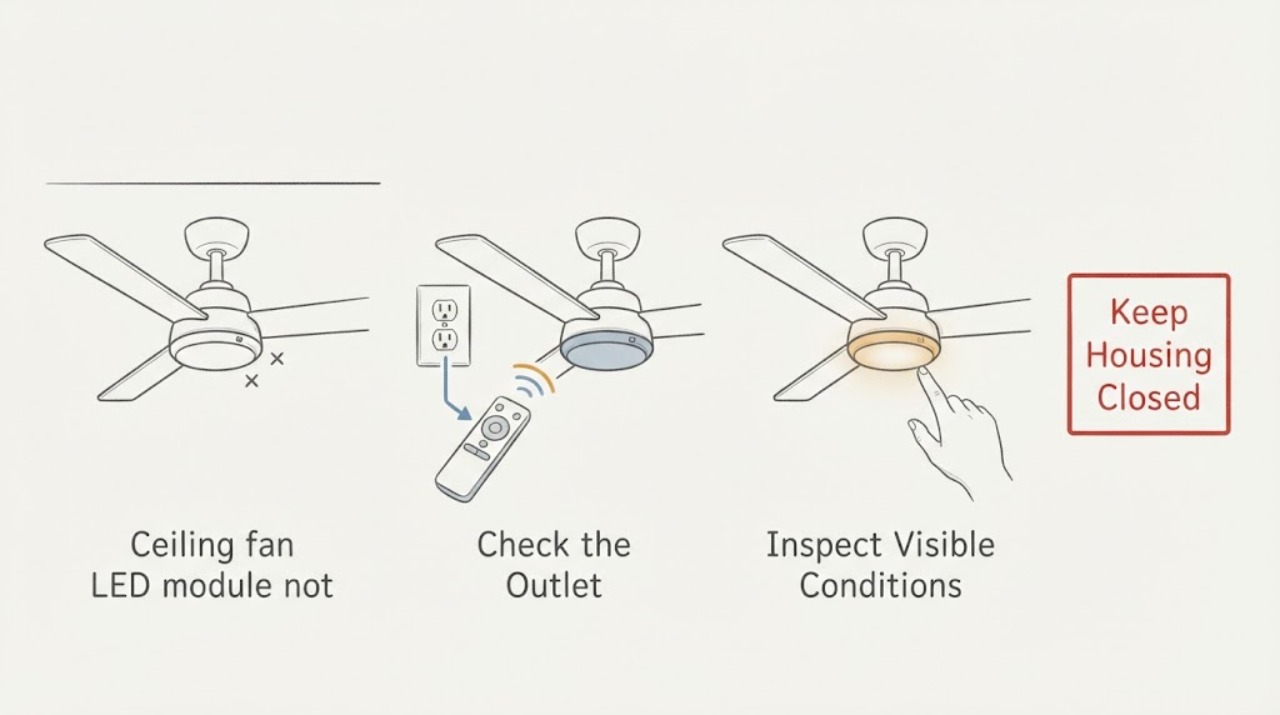
Work through in order
Diagnostic checks
Use only checks that match the exact appliance or system and its official guide.
-
Check 1
From the floor, operate the light control once using the wall switch, remote light button, or pull control that came with the fan; do not remove a cover or climb to reach the fan.
Expected result: Record whether the fan motor runs, whether the light is dark, flickers, starts late, or responds only to one control. Note whether the remote indicator responds and whether the light was previously dimmed.
Next step: Repeat the observation with only the normal controls specified for the fan and photograph the remote or wall-control model markings from a safe position. Continue to the breaker and identification checks without disassembling anything.
Stop if: Stop if the fan shakes, the light housing moves, there is smoke, burning odor, buzzing, sparking, or any sign that operating the control is unsafe.
Why this matters
Why: A running fan with a light-only failure points toward the light-control path, receiver output, driver, connector, or LED module. If both functions are dead, a breaker, wall control, receiver, or supply issue remains possible; do not assume the LED module is bad.
-
Check 2
Look at the electrical panel and wall control from a safe standing position to see whether the fan circuit breaker is visibly tripped or the switch is damaged; do not open the panel or touch conductors.
Expected result: Classify the breaker as apparently on, tripped, or unknown, and the wall control as normal, loose, cracked, warm, buzzing, or discolored. If the breaker trips again after a single normal reset, record that result instead of resetting repeatedly.
Next step: If the breaker is tripped and the panel and area are dry and undamaged, follow the home's normal breaker-reset procedure once only if you are comfortable; if it trips again or anything looks abnormal, leave it off and call an electrician. Otherwise continue with control and fan identification.
Stop if: Stop before touching the panel if it is wet, hot, damaged, smoking, or unfamiliar, or if the breaker trips again.
Why this matters
Why: A tripped or repeatedly tripping breaker is a circuit-safety signal, not proof of a failed LED module. Heat, discoloration, noise, or a loose control requires electrical assessment before further testing.
-
Check 3
Check the remote battery compartment and the fan's visible model label, manual, or registration information without opening the fan housing; use a stable floor-level view rather than reaching from a chair or ladder.
Expected result: Record the exact fan model if readable, whether the remote battery is present and not visibly leaking, whether the manual describes an integrated LED or separate light kit, and whether the light is controlled by a receiver, wall control, or pull chain.
Next step: Use the model-specific manual and manufacturer parts information to identify the light assembly and approved replacement path. If the model cannot be identified, give the technician photographs of the fan, label, controls, and light assembly rather than guessing.
Stop if: Stop if model identification requires removing the canopy, switch housing, diffuser, or any other part, or if access requires an unsafe ladder position.
Why this matters
Why: The architecture determines whether a module, complete light kit, receiver, or control is a candidate. Compatibility can be limited by brand, model, wiring, lamp rating, or dimming requirements, so generic visual matching is unreliable.
-
Check 4
Inspect the visible diffuser, light trim, and underside of the fan from the floor without touching the LED surface or removing the glass or trim.
Expected result: Look for a darkened or cracked diffuser, scorch or discoloration, moisture, a loose-looking trim ring, a missing fastener, or a completely normal exterior. Note whether the failure began after a power event, cleaning, impact, or water exposure.
Next step: Keep the light off if it is hot, wet, damaged, or loose, and arrange professional inspection. If the exterior is normal, use the model information to decide whether a qualified person should inspect the de-energized light-kit connector or driver.
Stop if: Stop if any part is hot, wet, cracked, scorched, loose enough to fall, or reachable only by climbing or supporting the fan.
Why this matters
Why: Heat, moisture, impact, or a loose light assembly can make continued operation unsafe and can damage more than the LED module. A normal exterior cannot rule out an internal driver, receiver, connector, or module failure.
-
Check 5
Before any light-kit, diffuser, connector, or wiring access, turn the fan's wall control off and switch off the correct circuit breaker; have a qualified person verify the circuit is de-energized before contact with wiring.
Expected result: The safe outcome is a documented, verified de-energized circuit and a model-specific manual that permits the intended access. If the correct breaker cannot be identified or voltage remains, the access check is not complete.
Next step: If you are not trained and equipped to verify de-energization and follow the manual, stop here and call an electrician or qualified fan technician. If a professional opens the assembly, ask them to identify the failed stage and confirm compatibility before ordering a part.
Stop if: Stop if the breaker is unknown, the circuit cannot be verified dead, wiring is damaged, the manual is missing, or access requires unsafe height or support.
Why this matters
Why: The light kit can expose line-voltage wiring even when the wall switch is off. A failed LED module does not justify live probing, improvised bypasses, or wire reconnection by guesswork.
-
Check 6
Make a concise failure timeline for the technician: last known good operation, control used, fan-motor status, dimming behavior, power events, and any earlier light-kit work.
Expected result: Record whether the light failed suddenly or gradually, whether it fails at every brightness setting, whether the motor and remote remain reliable, and whether the problem returns after a breaker reset or control re-pairing performed according to the manual.
Next step: Provide the timeline, exact model, photos, control type, and breaker behavior to the service provider. Request a written recommendation identifying whether the repair is a module, driver, receiver, complete light kit, control, or wiring issue and why.
Stop if: Stop and escalate if the timeline includes repeated breaker trips, burning, smoke, water, a falling fixture, exposed wiring, or any need for live testing.
Why this matters
Why: A sudden light-only failure may fit a control, receiver, driver, connection, or module fault, while a failure after water, heat, impact, or wiring work raises a broader safety concern. The pattern narrows professional testing but does not prove a part.
Use your observations
Decision map
Find the observation that best matches what you see, then follow the next safe action.
-
PATH 01Next step
What you see
The fan runs normally, but the LED light is dark or unresponsive from every normal control.
Do this next
Treat the issue as a light-path fault and use the model manual to determine whether the unit has an integrated LED, separate module, driver, or receiver. Arrange professional de-energized inspection before selecting a part.
-
PATH 02Next step
What you see
The fan and light are both dead, or the remote and wall control do not respond.
Do this next
Check only the visible switch and breaker status. If the breaker is normal, the receiver, supply, or control path may be involved; do not order an LED module until the electrical path is assessed.
-
PATH 03Next step
What you see
The light flickers, starts late, works only at some dimming levels, or changes when the fan control is used.
Do this next
Stop repeated cycling and record the control and brightness pattern. Ask a technician to assess dimmer or control compatibility, receiver output, driver, connections, and the LED module as a system.
-
PATH 04Next step
What you see
The diffuser or light assembly is hot, scorched, cracked, wet, loose, or smells burnt.
Do this next
Stop using the light, avoid contact, and call an electrician or qualified fan technician. Do not reset a tripping breaker or replace the module before the cause and fixture security are checked.
-
PATH 05Next step
What you see
The exact model and light-kit architecture are known and the exterior shows no hazard.
Do this next
Use the model-specific manual and manufacturer fit information to identify an approved module or light kit. Compatibility must be confirmed before purchase; a generic-looking module is not enough.
-
PATH 06Next step
What you see
The model is unknown, the breaker cannot be verified, wiring is exposed, or access requires unsafe height.
Do this next
Stop user troubleshooting and provide safe photos and the failure timeline to a professional. Do not remove the canopy, light kit, receiver, or wiring to discover the model.
Helpful context
Understand the symptom
What a dead LED module does and does not tell you
A ceiling-fan light may be an integrated LED engine, a replaceable light kit, or a module controlled through a receiver and remote. If the fan motor works while the light is dark, the incoming supply is not automatically cleared, but the fault is more likely to be in the light-control path than in the motor. If both fan and light are dead, start with the wall switch, breaker, receiver, or supply instead of ordering an LED module. Flicker, delayed start, or dim light can involve the control, connection, driver, heat, or module; it does not identify one part by itself.
Stay below the electrical boundary
The checks below are visible and low-risk. Read the fan's model-specific manual before any light-kit access. Manufacturer guidance calls for turning off both the wall switch and circuit breaker before installation work, then verifying that power is off before contacting wiring. A wall switch alone is not a sufficient guarantee. Never use a live-wire test, bypass a receiver, or reach above a ladder while diagnosing a failed light.
Stop and call an electrician
Stop if the breaker trips again, the light housing is hot, scorched, cracked, wet, loose, or hanging, there is a burning smell, buzzing or arcing, exposed conductors, a damaged ceiling box, or any uncertainty about identifying the circuit. Do not repeatedly reset a tripping breaker or open the switch housing to guess at a connector. An electrician or qualified fan technician can isolate the circuit, inspect the receiver and driver, and determine whether a module or complete light kit is compatible.
Only after diagnosis
Potential parts
- Ceiling fan LED module
Consider only after a qualified inspection confirms the module itself is the failed stage and the fan uses a replaceable module rather than an integrated assembly or separate driver.
Confirm the exact fan model, module dimensions, connector, electrical ratings, dimming behavior, and manufacturer fit information before ordering. - Ceiling fan light kit
Consider only when the original light assembly is damaged or the manufacturer specifies complete light-kit replacement instead of a module-level repair.
Verify the exact fan model, mounting interface, wiring connector, control system, and brand-specific compatibility requirements in the manual. - Fan remote receiver
Consider only when the fan and light control path has been professionally assessed and the receiver is identified as the failed stage; a dead LED module can have unrelated causes.
Match the receiver to the exact fan and remote system, control functions, wiring arrangement, and manufacturer instructions; do not bypass or substitute it by wire color alone.
When checks do not resolve it
Need a professional?
Call an electrician or qualified ceiling-fan technician when the light remains dead after normal control checks, the breaker trips, both fan and light are dead, the light flickers or overheats, the assembly is damaged or loose, or model-specific access and testing are required.
Safety scope: Do not perform live electrical testing, open the light kit or canopy without verified power isolation, bypass a receiver, reconnect wires by color alone, climb unsafely, or repeatedly reset a tripping breaker.
Have this ready
- Provide the exact fan model if safely visible, photos from the floor, whether the motor works, remote or wall-control behavior, dimming pattern, breaker status, failure timeline, and any heat, odor, moisture, impact, or prior wiring work.
Common questions
FAQ
If the fan still spins, is the LED module definitely bad?
No. The light control, receiver, connector, driver, or module can each be involved, and the architecture varies by model. Confirm the fan model and have the de-energized light path assessed before ordering a module.
Can I remove the diffuser to inspect the LED board?
Only a qualified person should access the light kit after the correct breaker is off and the circuit is verified de-energized. Do not remove it from a ladder, touch wiring, or inspect live equipment just because the light is already dark.
Why does the LED light flicker instead of staying off?
Flicker can involve the control or dimmer, receiver, driver, connection, heat, or LED module. Record when it flickers and at which control or brightness setting, then request system-level inspection rather than assuming a module replacement.
Can I use a universal ceiling-fan light kit or LED module?
Do not assume universal fit. Light kits and controls can be brand- or model-specific and must match the mounting, connector, control, electrical, and dimming requirements in the fan documentation.
What should I do if the breaker trips when the light is used?
Stop using the light and do not repeatedly reset the breaker. Keep the circuit off if it trips again or there is heat, odor, moisture, or visible damage, and call an electrician to identify the fault before any part is replaced.
Read the exact guide
Official sources
- How do I install my fan without the light kit?Hunter Fan Support · Hunter fan light-kit examples; use only as general safety context and follow the exact fan manual.
- How to Install a Ceiling Fan: Step-by-Step DIY GuideHunter Fan · General Hunter installation guidance; the model-specific manual controls the exact light-kit procedure.
- Ceiling Fan Accessories and Purchasing ChoicesENERGY STAR · General ceiling-fan accessory selection; exact fit and ratings must be confirmed from the fan documentation.
Community feedback
Share a repair observation
Share a plain-text repair observation. Accepted observations are published automatically; this page may take a moment to update.