
On this page
Start here
Quick answer
Flickering after switching breakers on and off should not be investigated by continuing to move the handles. First separate a flickering light or whole-home symptom from a breaker indicator or a visible arc, using only a safe-distance observation of what already happened. Flickering with buzzing, heat, discoloration, burning odor, smoke, sparks, shock, moisture, or another trip is an electrical hazard: stop using the affected circuit and do not reset it, open the panel, touch wiring, or reproduce the event. Contact a qualified electrician; contact the utility or emergency services when service equipment, smoke, or fire may be involved.
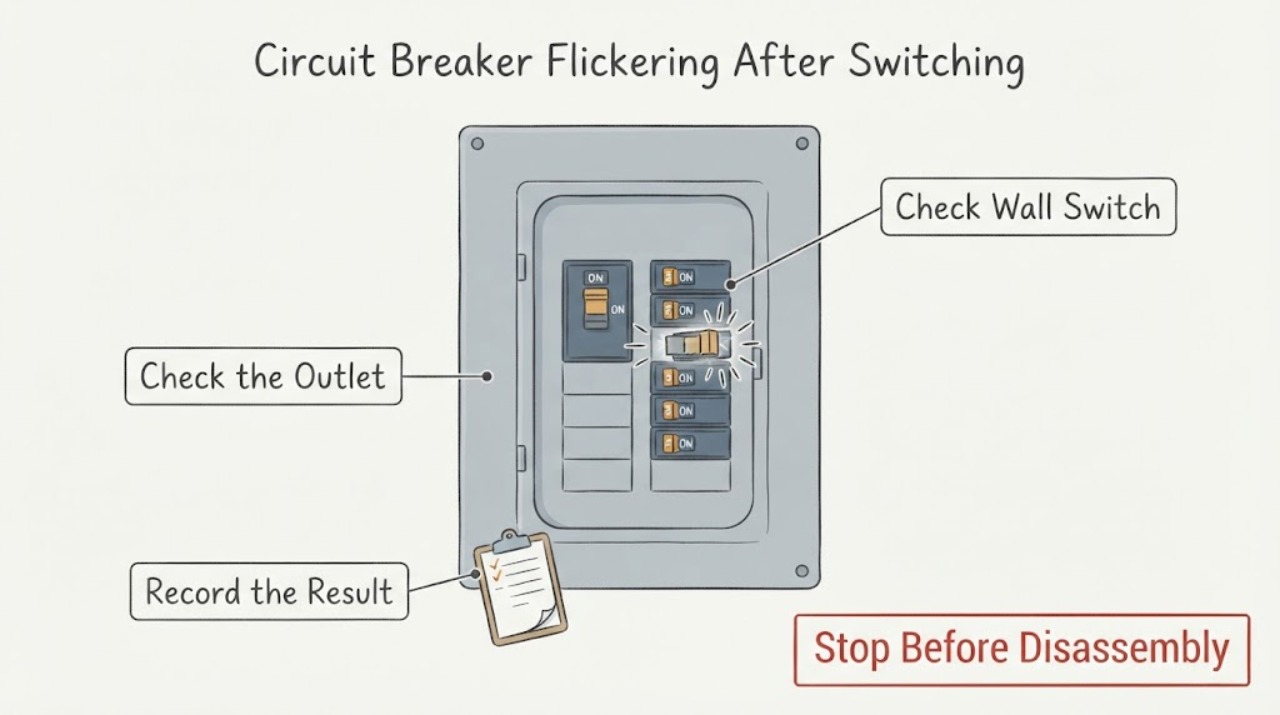
Work through in order
Diagnostic checks
Use only checks that match the exact appliance or system and its official guide.
-
Check 1
Stop switching breakers and look from a dry, stable position at what flickered during or after the already-completed on-and-off operations: a light, a breaker indicator, or a visible flash at the panel, switch, receptacle, cord, or appliance.
Expected result: A visible arc or spark, smoke, flame, strong burning odor, or buzzing occurred; or only a lamp or indicator changed without those signs.
Next step: For an arc, smoke, flame, strong odor, or abnormal heat, leave the area and contact emergency services or the utility from a safe location; do not touch or reset anything. Otherwise keep the affected circuit unused and make no further breaker changes.
Why this matters
Why: A visible arc, smoke, heat, or abnormal sound can indicate an energized fault and fire risk. A lamp or indicator symptom without those signs still needs diagnosis but does not identify the breaker as the cause.
-
Check 2
Without operating a breaker, map the scope from normal room access: note which light, outlet, appliance, or room is affected and whether unrelated rooms or the whole home changed together.
Expected result: Only one fixture or branch appears affected, or multiple rooms and unrelated loads flicker together.
Next step: Record locations and time without deliberately switching loads. Request an electrician for a local pattern; contact the utility promptly if the symptom is broad, weather-linked, or appears at service equipment.
Why this matters
Why: A single branch pattern points toward a local fixture, connected device, or branch-circuit issue. A broad pattern can involve a shared connection, service equipment, or a utility-side disturbance.
-
Check 3
From outside the electrical equipment, look only for visible discoloration, melted plastic, moisture, a damaged cord, or a switch or outlet that already appears hot; do not touch a suspect surface or remove a cover.
Expected result: A cover or plug is hot or discolored, moisture is present, a cord is damaged, or no external damage is visible.
Next step: Stop using the affected outlet, switch, cord, or circuit and arrange qualified electrical inspection. Keep water away and do not handle wet equipment; use emergency help for smoke, flame, or active arcing.
Why this matters
Why: Heat, discoloration, moisture, or damaged insulation can accompany a poor connection, overload, fault, or shock hazard. A normal appearance cannot rule out hidden wiring damage.
-
Check 4
Write down the sequence without trying it again: which breakers were moved, their observed handle positions afterward, when the flicker began, what lost power, any appliance association, weather, and whether a breaker opened again without another deliberate operation.
Expected result: The flicker follows one device or branch, follows a particular switch or outlet, repeats without another reset, or occurs throughout the home.
Next step: Give the timeline to the electrician or utility and leave the suspected circuit or device unused. Do not unplug a hot, damaged, wet, or arcing device and do not reproduce the flicker.
Why this matters
Why: A device or branch association suggests a local appliance or wiring inspection. A switch or outlet association suggests local device or connection work. A broad or unprompted recurrence needs utility or electrician triage.
-
Check 5
If a protective device has a test button or indicator, record its label and displayed state from the outside without pressing it; note the panel or breaker brand only if plainly readable without opening the panel.
Expected result: The device appears to be an AFCI or GFCI type, an ordinary breaker, or its type cannot be identified safely.
Next step: Send the label and state to the electrician rather than pressing test or reset during this incident. Do not substitute a device, change its rating, or open the panel.
Why this matters
Why: Different protective devices address different hazards, and an indicator does not identify the underlying fault. Diagnosis, replacement, and installation in a panel require qualified electrical work.
-
Check 6
Prepare a service handoff with the exact condition that flickering appeared after switching breakers on and off, the affected locations, whether an indicator or visible arc was involved, odor, sound, heat, moisture, smoke, trip history, appliance association, and any utility or weather pattern.
Expected result: The record supports a local fixture or circuit concern, a broad service or utility concern, or an immediate fire or shock hazard.
Next step: Request a qualified electrician for circuit and protective-device diagnosis. Use the utility for a suspected service-side problem and emergency services for smoke, flame, or active arcing; keep the affected equipment out of use until cleared.
Why this matters
Why: A precise sequence helps the professional choose between electrician, utility, and emergency response without a risky reset or test.
Use your observations
Decision map
Find the observation that best matches what you see, then follow the next safe action.
-
PATH 01Next step
What you see
A flash, spark, smoke, flame, strong burning odor, or sizzling or buzzing was seen or heard.
Do this next
Do not touch or reset the equipment. Leave the area and contact emergency services; contact the utility from a safe location when service equipment may be involved.
Why this path and its safety boundary
Why it matters: This is not a normal breaker indication and can represent an energized electrical fire hazard.
-
PATH 02Next step
What you see
The flicker is confined to one fixture or branch and there is no smoke, heat, odor, arc, moisture, or shock.
Do this next
Keep the affected device or circuit unused and arrange qualified electrician inspection without opening the panel or reproducing the flicker.
Why this path and its safety boundary
Why it matters: A local device, connection, overload, or branch wiring issue is more plausible, but a safe appearance does not prove the circuit is sound.
-
PATH 03Next step
What you see
Unrelated lights or rooms flicker together, or the symptom follows weather or changes at service equipment.
Do this next
Avoid the panel and service equipment and contact the utility and a qualified electrician from a safe location.
Why this path and its safety boundary
Why it matters: A shared service connection or utility-side problem is possible and is outside ordinary user troubleshooting.
-
PATH 04Next step
What you see
Water or dampness is present, a faceplate or plug is hot or discolored, or cord insulation is damaged.
Do this next
Keep clear, stop using the affected equipment, and arrange electrician inspection. Do not touch wet equipment or attempt a reset; use emergency response for smoke or fire.
Why this path and its safety boundary
Why it matters: Moisture and overheating increase shock and fire risk even if the breaker remains on.
Helpful context
Understand the symptom
Do not keep switching breakers
The phrase circuit breaker flickering can refer to a lamp or group of lights, a status indicator, or a visible flash at the panel or another device. After multiple on-and-off operations, the safe next step is to stop operating the handles and record what was already observed. A light-only symptom, a breaker indicator, and an electrical arc have different risk levels, and none can be diagnosed safely by making the event happen again.
Treat warning signs as a stop signal
Flicker together with a hot or discolored cover, a burning smell, sizzling or buzzing, smoke, sparks, a shock, damaged insulation, moisture, or another trip can signal an overload, poor connection, damaged device, or arcing fault. Keep people away from the affected equipment. Do not open the panel, touch a conductor, probe for live power, tighten a connection, or substitute a protective-device rating.
Use the pattern to choose the professional
One room or one appliance suggests a local circuit or device investigation. Several rooms, whole-home flicker, or a symptom that changes with weather may involve a shared service connection or the utility. This pattern is useful for an electrician or utility crew, but it is not permission to approach service equipment or perform a reset test.
Safety boundary
Stop conditions
- Stop immediately for visible arcing or sparks, smoke, flame, a strong burning odor, sizzling or buzzing, a hot or discolored panel, switch, outlet, plug, or cord, a shock or tingle, moisture, or another breaker trip.
- Do not switch or reset breakers again to reproduce the flicker, open a panel or receptacle, touch wiring, tighten connections, probe live power, change a protective-device rating, bypass protection, or use wet equipment.
- If water is present near electrical equipment, or if smoke or fire is present, keep clear and use emergency services or a qualified electrician or utility from a safe location.
When checks do not resolve it
Need a professional?
Call a qualified electrician for any unexplained flicker after breakers have been switched on and off, especially when one branch, light, switch, outlet, or appliance is involved. Contact the utility for a broad or service-side pattern. Use emergency services for smoke, flame, active arcing, or immediate danger; do not resume use until the responsible professional clears it.
Common questions
FAQ
Why do lights flicker after I switch breakers on and off?
The timing may reflect a local load, fixture, branch connection, protective-device response, or a broader service issue, but it does not prove the breaker is defective. Map the affected area without moving the handles again and have a qualified professional diagnose it.
Should I switch the breakers again to see if the flicker returns?
No. Repeated switching can re-energize a fault and does not identify its cause. Keep the affected circuit unused and seek qualified electrical help, using emergency response for smoke, flame, or visible arcing.
What if several rooms flicker together?
A broad pattern can involve service equipment or a utility-side connection rather than one room. Do not touch the panel or service equipment; contact the utility and a qualified electrician from a safe location.
Read the exact guide
Official sources
- Electrical Safety DosElectrical Safety Foundation International · General home electrical safety education; equipment-specific instructions and local code may add requirements.
- Preventing Home Fires: Arc Fault Circuit Interrupters (AFCIs)U.S. Consumer Product Safety Commission · General residential arc-fault protection information; it does not identify the fault in a particular panel or authorize user panel work.
- CPSC Guide to Home Wiring HazardsU.S. Consumer Product Safety Commission · General household electrical safety guidance; the actual installation and local requirements determine professional repair.
Community feedback
Share a repair observation
Share a plain-text repair observation. Accepted observations are published automatically; this page may take a moment to update.