
On this page
Start here
Quick answer
A report that a circuit breaker is flickering may actually describe a breaker indicator, a nearby light or switch, whole-room or whole-home lights, or a visible electrical flash. First identify which item is flickering and whether the change affects one light, one circuit, several circuits, or the whole service. Do not actively reproduce the symptom, open the panel, touch wiring, test voltage, bypass protection, or repeatedly reset a breaker. Flickering or dimming combined with buzzing, crackling, a burning smell, a warm or discolored panel or switch, a shock, a breaker trip, or any arc is an electrical stop condition. From a safe distance, record the affected area, timing, whether it coincided with an appliance already in use, and any smoke or heat. If smoke, flame, active arcing, or rapidly worsening heat is present, leave and call emergency services; otherwise keep the affected circuit or equipment out of use and arrange a licensed electrician or utility assessment.
Before you begin
Safety first
- The reader-level scope is stopping use and making distance-based observations. A licensed electrician or utility must isolate, test, open, repair, or replace breakers, switches, transformers, service equipment, outlets, wiring, and connections.
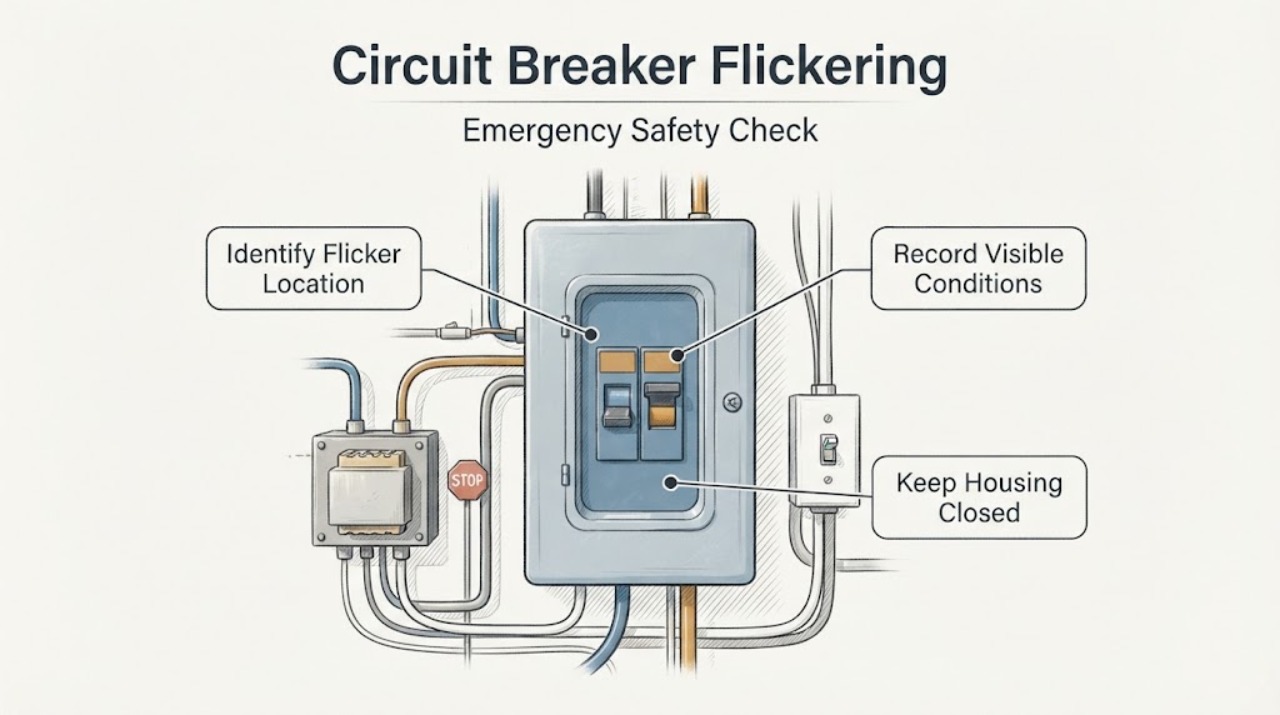
Work through in order
Diagnostic checks
Use only checks that match the exact appliance or system and its official guide.
-
Check 1
Stop using the affected circuit or equipment and observe only from a safe, dry position for smoke, flame, visible arc or flash, rapidly increasing heat, burning odor, a hot panel or switch, or a shock; if any is present, leave and call emergency services from outside or another safe location.
Expected result: No emergency sign is present and the flicker is stable, or smoke, flame, arcing, heat, odor, or shock is present.
Next step: For no emergency sign, keep the suspected circuit and equipment out of use and continue with distance-based classification. For an emergency sign, keep people away and do not approach the panel, wiring, or equipment.
Stop if: Do not touch a hot panel or switch, operate a control near smoke or arcing, throw water on electrical equipment, or remain in the area to locate the fault.
Why this matters
Why: An active fire or arc is an emergency, not a diagnostic test. A stable flicker without visible damage is still an electrical warning that requires a controlled handoff rather than active reproduction.
-
Check 2
From a safe distance, identify whether the flicker is a breaker indicator, a single lamp or fixture, one room or circuit, several rooms, the whole home, a switch or transformer-fed control, or a visible electrical flash; do not open or touch the affected device.
Expected result: Only one light or control changes, a group on one circuit changes, multiple circuits change together, the breaker itself appears to flicker, or a flash or arc is visible.
Next step: Record the locations and safe photos or video without activating the symptom. Ask a licensed electrician to assess local wiring and contact the utility when the change affects multiple circuits or the whole service.
Stop if: Do not remove a lamp, switch plate, breaker cover, transformer, or fixture, and do not use a test instrument or a tool to locate the flash.
Why this matters
Why: The scope changes the service path: one fixture may need fixture or branch inspection, one circuit suggests local wiring or load assessment, several circuits or the whole home can involve service or utility supply, and an arc is an urgent stop condition.
-
Check 3
Without switching anything on or off to reproduce the symptom, record when the flicker occurs, whether it began after an existing appliance or heating load was already running, whether it changes with wind or weather, and whether a breaker has tripped before.
Expected result: The flicker is random, follows an existing load, occurs when a particular room or circuit is used, changes across several rooms, or is associated with a prior trip, buzzing, heat, or odor.
Next step: Stop using the related load and give the timeline to the electrician or utility. Do not cycle loads, reset the breaker, or create a comparison test.
Stop if: Do not deliberately switch appliances, lights, or breakers to chase the flicker, and do not use an extension cord or alternate circuit as a workaround.
Why this matters
Why: Timing can help separate a fixture issue, branch-circuit load or connection, service equipment, or utility-supply concern, but it does not prove the cause. A load-linked flicker with heat, noise, smell, or repeated trips increases urgency.
-
Check 4
From a safe distance and only without touching, note warm or discolored wall plates, a loose-looking switch, buzzing or sizzling, burning smell, scorch marks, damaged cord insulation, a breaker that feels or looks abnormal, or a flickering indicator on a control or transformer.
Expected result: No external warning sign is visible, or heat, discoloration, noise, smell, damage, shock, or arc is present.
Next step: Document the sign from a distance and leave the circuit or equipment out of use. If smoke, flame, active arcing, or rapidly increasing heat appears, return to the emergency branch.
Stop if: Do not touch the plate, switch, outlet, breaker, transformer, cord, or wiring; do not remove covers or perform live electrical testing.
Why this matters
Why: A normal-looking exterior does not clear hidden wiring, but any heat, smell, sound, shock, discoloration, or arc makes the circuit unsafe for continued use and raises the need for prompt electrical inspection.
-
Check 5
Prepare a handoff record with exactly what flickers, affected rooms and circuits, timing, existing loads, breaker trip history, weather or utility events, heat, sound, smell, smoke, arc, shock, and safe photos; leave the suspected equipment out of use.
Expected result: The issue is isolated to one fixture or circuit, affects multiple circuits or the whole home, appears at the panel or transformer, or remains uncertain.
Next step: Give the record to a licensed electrician; contact the utility when multiple circuits or the whole service are affected. Restore use only after the responsible professional confirms the system is safe.
Stop if: Do not reset repeatedly, open a panel or switch, touch wiring, bypass a protective device, replace a transformer or breaker, or restore power for a test.
Why this matters
Why: A structured record helps a licensed electrician or utility choose between fixture, branch wiring, service equipment, transformer, or supply assessment. Uncertainty is a reason to preserve the stop-use boundary, not to open equipment.
Use your observations
Decision map
Find the observation that best matches what you see, then follow the next safe action.
-
PATH 01Next step
What you see
Smoke, flame, visible arc or flash, rapidly increasing heat, a strong burning smell, or a shock is present.
Do this next
Leave immediately, warn others, call emergency services from a safe location, and do not approach or use water on energized electrical equipment.
-
PATH 02Next step
What you see
Only one lamp, fixture, switch, breaker indicator, or transformer-fed control flickers and no heat, smell, buzz, arc, or smoke is present.
Do this next
Stop using the affected device and arrange licensed electrician inspection. Do not remove the fixture, switch, transformer, or breaker to identify the cause.
-
PATH 03Next step
What you see
One room or circuit flickers, particularly when an existing appliance or load is operating, or the breaker has tripped before.
Do this next
Stop using the related load, do not cycle it or reset the breaker, and ask a licensed electrician to inspect the branch circuit, connections, protective device, and equipment.
-
PATH 04Next step
What you see
Several rooms, circuits, or the whole home flicker or dim together, or the change follows a service or weather event.
Do this next
Avoid active testing and contact the utility or a licensed electrician for service-supply assessment. Use emergency help for smoke, flame, arcing, or rapidly worsening heat.
-
PATH 05Next step
What you see
The flicker cannot be localized safely, the panel or transformer is involved, or inspection would require touching wiring or opening equipment.
Do this next
Keep the suspected system out of use, document only from a safe distance, and have a licensed electrician identify the fault.
Helpful context
Understand the symptom
Clarify what is flickering before choosing a response
A flickering light, a breaker indicator, a transformer-fed control, and a visible flash are not the same symptom. A single lamp may have a lamp or fixture issue, while multiple lights changing together can involve a shared circuit, service connection, or utility supply. A visible arc, smoke, burning odor, heat, or buzzing overrides this classification and requires immediate stop-use action.
Flicker that follows an existing load is still not a permission to test
Note whether the flicker was already present, began when an appliance or heating load was operating, or affected several rooms at once. Do not switch loads on and off to make the flicker happen. The timing helps an electrician or utility determine whether to inspect an appliance, branch circuit, service equipment, or supply connection.
Heat, sound, smell, and arcing raise urgency
ESFI lists flickering or dimming lights alongside warm or discolored switches and outlets, buzzing or sizzling, burning odor, and frequent trips as electrical warning signs. CPSC also treats hot faceplates, flickering lights, burning plastic smell, arcing, and damaged wiring as hazards that should not be investigated by the occupant.
The breaker and wiring are professional service boundaries
A breaker can open a circuit when current exceeds a safe level, but a flicker can occur without a visible trip. A switch, transformer, branch connection, service entrance, or utility supply may be involved. Do not remove the panel cover, loosen a terminal, touch wiring, measure live voltage, or substitute a breaker. A licensed electrician or utility should isolate and diagnose the system.
Safety boundary
Stop conditions
- Stop and leave for smoke, flame, visible arcing, rapidly increasing heat, a strong burning smell, or an electrical fire; call emergency services from a safe location and never use water on energized equipment.
- Do not touch a hot or discolored panel, switch, outlet, breaker, transformer, cord, or wiring, and do not operate equipment from a wet or unsafe position.
- Do not repeatedly reset or cycle breakers, loads, switches, or appliances to reproduce the flicker; do not open panels or devices, measure live voltage, touch wiring, or bypass protection.
- Do not replace a breaker or transformer, use an extension-cord workaround, or restore power until a licensed electrician or utility has assessed the affected system.
Only after diagnosis
Potential parts
- circuit breaker or protective device
Consider only if professional inspection confirms the protective device is damaged or incompatible; flicker alone does not identify it as the cause.
Breaker type, rating, panel listing, and installation must be verified by a licensed electrician; never substitute a higher rating. - switch or transformer component
Consider only when a licensed electrician traces the flicker to the switch, transformer, or related wiring rather than the branch or utility supply.
The correct device depends on the system, load, enclosure, local requirements, and professional diagnosis.
When checks do not resolve it
Need a professional?
Call emergency services immediately for smoke, flame, visible arcing, rapidly increasing heat, or an electrical fire. Request prompt licensed electrician inspection for persistent flickering or dimming, a warm or discolored panel or switch, buzzing, burning odor, shock, repeated breaker trips, or a flicker tied to one circuit. Contact the utility or electrician when multiple circuits or the whole home are affected.
Safety scope: The reader-level scope is stopping use and making distance-based observations. A licensed electrician or utility must isolate, test, open, repair, or replace breakers, switches, transformers, service equipment, outlets, wiring, and connections.
Have this ready
- Provide the exact flickering item, affected rooms and circuits, timing, existing load context without reproducing it, breaker trip history, weather or service events, heat, odor, sound, smoke, arc, shock, and safe photos or video.
Common questions
FAQ
What does it mean if my circuit breaker or lights flicker?
First clarify whether the breaker indicator, one fixture, one circuit, or several rooms are flickering. Flickering or dimming can be an electrical warning, especially with heat, discoloration, buzzing, burning odor, shocks, arcs, or repeated trips. Stop use and arrange qualified inspection rather than trying to reproduce it.
Should I reset the breaker to see whether the flicker stops?
No. Do not repeatedly reset or cycle a breaker or appliance. Record its position and the affected rooms from a safe distance, keep the circuit out of use, and have a licensed electrician diagnose the cause.
Can I open the panel or switch to look for a loose wire?
No. Do not open a panel or switch, touch wiring, remove a transformer, or perform live testing. Heat, arcing, and hidden connections can cause shock or fire; these checks belong to a licensed electrician or utility.
When should I call the utility instead of an electrician?
Contact the utility or ask an electrician about utility assessment when several circuits or the whole home flicker or dim together, particularly after a service or weather event. Use emergency services for smoke, flame, active arcing, or rapidly worsening heat.
Read the exact guide
Official sources
- Home Wiring Safety TipsElectrical Safety Foundation International · ESFI identifies flickering lights, arcs and sparks, unusual sounds, hot or discolored plates, and damaged insulation as wiring warning signs and directs homeowners to a licensed electrician.
- Don’t Overload Your HomeElectrical Safety Foundation International · ESFI lists flickering or dimming lights, warm or discolored plates, cracking or buzzing receptacles, burning odor, and frequent breaker trips as warning signs that warrant qualified inspection.
- REPAIRING ALUMINUM WIRINGU.S. Consumer Product Safety Commission · CPSC identifies hot faceplates, flickering lights, nonworking circuits, and burning plastic odor as electrical-system warning signs and says a qualified electrician should determine the cause.
- CPSC Guide to Home Wiring HazardsU.S. Consumer Product Safety Commission · CPSC explains that flickering can involve service connections and warns consumers not to attempt correction or touch equipment in that situation; it also directs qualified electricians for breaker, hot outlet, and arcing problems.
Community feedback
Share a repair observation
Share a plain-text repair observation. Accepted observations are published automatically; this page may take a moment to update.