
On this page
Start here
Quick answer
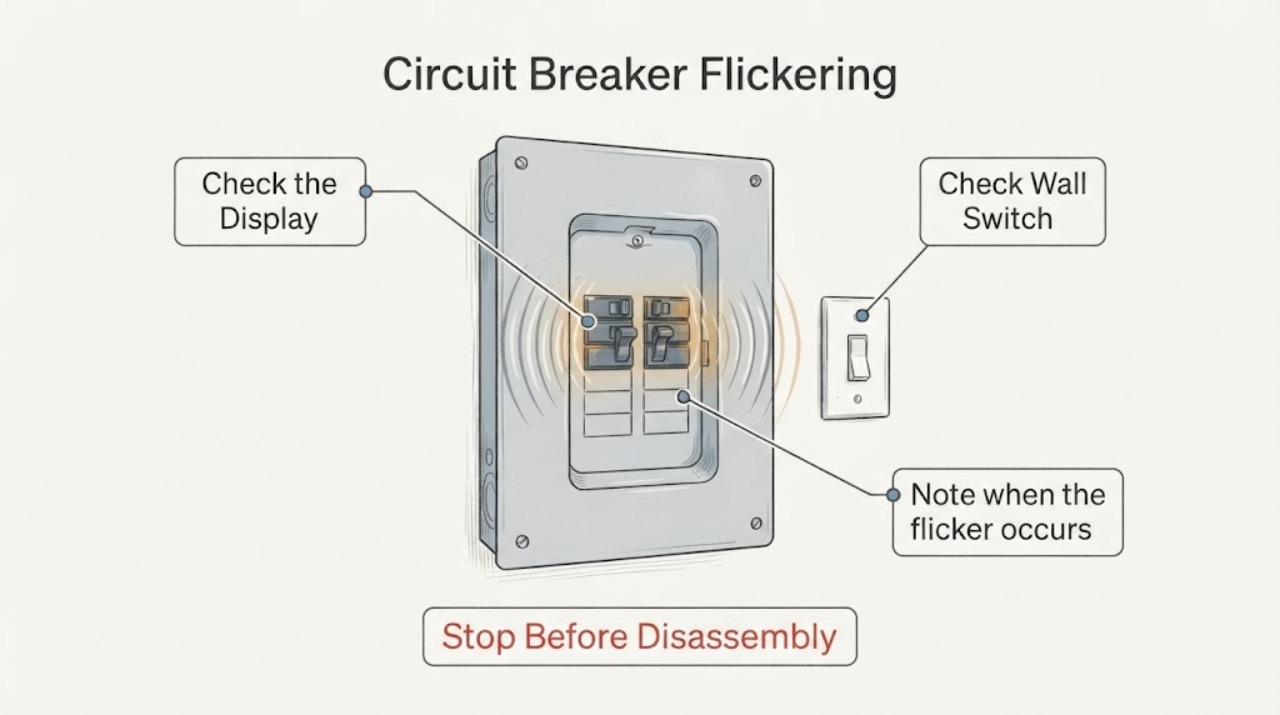
Treat a flickering breaker indicator, nearby lights, or circuit as an electrical warning until you know exactly what is flickering. From a safe distance, note whether the change is only the breaker's indicator, one light, one circuit, the whole home, or an outside utility supply. Do not open the panel, touch wiring, measure voltage, repeatedly reset the breaker, or bypass protection. Smoke, a bright arc, crackling or buzzing, burning odor, a hot or discolored panel, tingling, water, or a breaker that will not remain set means stop using the affected equipment, keep clear, and get an electrician; flickering that changes with wind or appears across the home may require the electric utility as well.
Work through in order
Diagnostic checks
Use only checks that match the exact appliance or system and its official guide.
-
Check 1
From a safe position, identify the exact thing that flickers: the breaker's indicator, a single lamp, several lights on one circuit, a receptacle-fed device, or lights throughout the property. Do not remove the panel cover or move close to inspect a live breaker.
Expected result: The flicker may be confined to one fixture or branch, follow one appliance, affect several rooms, or appear in the breaker indicator without a visible lighting change.
Next step: Record the scope and continue only with safe-distance observations. If there is a bright flash, smoke, heat, buzzing, odor, or shock, stop and use electrician or emergency assistance as appropriate.
Why this matters
Why: A localized pattern gives an electrician a circuit or equipment lead, while a broad pattern can involve the main supply or utility side. A breaker indicator alone is not enough to identify an arc or overload.
-
Check 2
Without touching the panel, switch, receptacle, cord, or appliance, look and listen from a safe distance for a bright flash, crackling, sizzling, buzzing, smoke, burning odor, discoloration, heat radiating from a surface, or a tingling report.
Expected result: There may be no companion sign, or one or more warning signs may appear near a fixture, outlet, cord, appliance, panel, or service equipment.
Next step: For any warning sign, stop using the affected area or equipment if it can be done without approaching danger, keep people away, and call a qualified electrician. For active smoke or fire, leave and contact emergency services.
Why this matters
Why: CPSC and electrical-safety guidance treat arcs, unusual sounds, overheating, odors, shocks, and flickering or dimming as warning signs. These observations do not justify opening equipment to find the cause.
-
Check 3
Note when the flicker occurs and what was already running: a high-load appliance, lighting change, motor start, storm, wind, or no identifiable event. Do not add a load, reproduce the flicker, run an appliance as a test, or repeatedly reset the breaker.
Expected result: The flicker may follow one appliance or load, occur randomly on one branch, affect the home during wind, or coincide with a storm or utility disturbance.
Next step: Keep the suspected load out of use and give the timeline to an electrician. If wind or the service area appears involved, contact the electric utility from a safe location; do not approach outdoor service equipment.
Why this matters
Why: A repeatable load relationship helps an electrician assess overload or equipment faults. A wind-related or whole-home pattern can indicate service-entry or utility equipment, which a resident must not touch.
-
Check 4
If the affected circuit is clearly identified and there is no smoke, arc, heat, water, or other immediate danger, record the breaker's handle position and indicator pattern from the front only. Do not open the panel, remove a dead-front cover, touch terminals, perform electrical measurements, or force the handle.
Expected result: The handle may be on, off, or in a middle/tripped position; an electronic breaker may show a manufacturer-specific fault indication, or there may be no indicator.
Next step: Do not reset when a warning sign is present or the reason is unclear. Give the handle and indicator observation to an electrician; follow only the breaker's own safe instructions if a qualified professional directs a single reset.
Why this matters
Why: A trip means a protective device detected a condition, but an indicator pattern is meaningful only for that exact breaker model. Resetting without addressing the cause can conceal a dangerous fault.
-
Check 5
Check the pattern from a safe, dry location after weather or a power event without touching wet equipment, cords, service hardware, or exposed metal. Note whether a neighbor or other room has the same flicker and whether outdoor lines or service equipment are visibly damaged from a distance.
Expected result: The issue may be isolated indoors, shared across the home or neighboring properties, or associated with visible damage or movement near the utility service.
Next step: Report a likely utility-side problem to the electric utility; report indoor localized symptoms to an electrician. If conductors are down, sparking, or smoking, stay away and use emergency assistance.
Why this matters
Why: A shared or wind-dependent flicker can be upstream of the branch circuit. CPSC specifically warns not to correct or touch service equipment when arcing or wind-related flicker is present.
-
Check 6
Prepare a concise handoff record: locations, timing, weather, loads in use, breaker handle or indicator state, odors or sounds, warmth or discoloration, water exposure, and any prior trip. Photograph only from a safe distance; do not remove covers to obtain a better view.
Expected result: The record may show a single fixture, an appliance-linked event, a branch-circuit pattern, a whole-home event, or an unresolved intermittent fault.
Next step: Keep the affected equipment unused until the responsible qualified professional confirms it is safe. If the issue recurs, update the record rather than performing more tests.
Why this matters
Why: A clear timeline lets the electrician or utility choose the correct isolation and inspection path without asking the occupant to chase wiring or recreate an arc.
Use your observations
Decision map
Find the observation that best matches what you see, then follow the next safe action.
-
PATH 01Next step
What you see
There is smoke, a visible arc or spark, a burning odor, crackling, a hot or discolored panel, a shock, or water near electrical equipment.
Do this next
Stop immediately, keep people away, avoid touching or operating the equipment, and use emergency assistance for fire or active smoke; otherwise arrange an electrician from a safe location.
-
PATH 02Next step
What you see
The flicker is localized to one fixture, appliance, outlet, or branch and there is no immediate emergency sign.
Do this next
Keep the suspect equipment out of use and give the exact location and load timeline to a qualified electrician; do not open or test it.
-
PATH 03Next step
What you see
The flicker affects multiple rooms, the whole property, or changes with wind, and service equipment may be involved.
Do this next
Stay away from service hardware and contact the electric utility; use an electrician for the indoor installation after immediate utility hazards are excluded.
-
PATH 04Next step
What you see
The breaker is tripped or its indicator shows a fault, but the cause is not known.
Do this next
Do not repeatedly reset it or interpret a light pattern across brands; arrange qualified electrical diagnosis.
-
PATH 05Next step
What you see
The flicker followed moisture, flooding, a damaged cord, or work on the wiring.
Do this next
Keep clear and de-energize only by a safe, accessible control if this can be done without approaching the hazard; have a qualified electrician inspect before reuse.
-
PATH 06Next step
What you see
The flicker was brief and no warning sign is present, but it returns or its scope is uncertain.
Do this next
Do not reproduce it. Record the time and conditions and arrange an electrician because intermittent faults can remain hidden.
Helpful context
Understand the symptom
A breaker can have a status light that flashes by design, while flickering lights or a changing panel indicator can also signal a loose connection, overload, arc fault, damaged equipment, or an upstream supply problem. The first useful fact is where the flicker occurs and what else changes at the same time. Do not infer a diagnosis from the light pattern alone.
Only make observations that do not require opening an enclosure or approaching energized parts. An electrician can isolate the circuit, verify it is de-energized, and inspect wiring with the required training and equipment. If the pattern is at service equipment or changes with wind, the utility may own the hazardous section.
A single brief blink during a normal load change is different from repeated flicker, dimming, buzzing, heat, odor, or a visible flash. Any companion warning sign moves the decision from observation to immediate isolation and professional help.
Safety boundary
Stop conditions
- Stop and keep clear for smoke, fire, a bright arc, sparks, crackling, burning odor, a hot or discolored panel, a tingling shock, or visibly damaged electrical equipment.
- Do not open the breaker panel, remove covers, touch wiring or service equipment, measure voltage, trace conductors, or attempt a repair while energized.
- Do not repeatedly reset a breaker, bypass protection, replace a fuse with an incorrect device, or add a load to reproduce the flicker.
- Treat water, dampness, flooding, or a wet cord or panel as an electrical hazard; do not touch the equipment or use water on an electrical fire.
- Use a qualified electrician for indoor wiring and the electric utility for suspected service-side or wind-related flicker; keep the affected circuit or equipment out of use until cleared.
When checks do not resolve it
Need a professional?
Call a qualified electrician for any recurring or unexplained breaker flicker, localized light or outlet flicker, repeated trip, warm or discolored equipment, buzzing, odor, damaged cord, or moisture exposure. Contact the electric utility when the flicker affects the whole property, nearby properties, or service equipment, especially during wind. Use emergency assistance for active smoke, fire, exposed sparking conductors, or immediate shock danger.
Have this ready
- Provide the locations, exact timing, weather, loads in use, breaker handle and indicator behavior, scope across rooms or properties, odors, sounds, heat, discoloration, moisture, prior trips, and any visible damage observed from a safe distance.
Common questions
FAQ
Does a flickering breaker light always mean an arc?
No. A breaker indicator can have device-specific meanings, and a flickering light may be a local fixture or supply issue. Treat the pattern as a warning, do not open the panel, and have a qualified electrician interpret the exact breaker and circuit.
Can I reset a breaker that is flickering?
Do not repeatedly reset it or reset it when there is smoke, odor, heat, arcing, water, damage, or an unknown cause. Record its visible handle or indicator state and arrange qualified electrical diagnosis.
What if lights flicker throughout the home?
Note whether nearby properties or outdoor service equipment show the same change and whether wind is involved, but keep away from service hardware. Contact the electric utility for a likely upstream issue and an electrician for the indoor installation.
What if flickering happens after water exposure?
Treat wet panels, cords, outlets, and equipment as energized hazards. Do not touch or test them; keep clear and have a qualified electrician make the installation safe before reuse.
What information should I give the electrician?
Give the locations, timing, weather, loads in use, breaker handle and indicator behavior, scope across rooms, sounds, odors, warmth, discoloration, moisture, prior trips, and visible damage observed without opening anything.
Read the exact guide
Official sources
- CPSC Guide to Home Wiring HazardsU.S. Consumer Product Safety Commission · Home wiring warning signs, flickering lights, arcing, overheating, odors, shocks, breaker hazards, and utility-side service equipment
- Introduction to electrical safetyHealth and Safety Executive · Electrical shock, arcing, faulty equipment, wet surroundings, de-energization, and competent-person repair guidance
- Electrical Safety in the WorkplaceNational Institute for Occupational Safety and Health · Electrical arcing, energized parts, qualified-person work, de-energization, and electrical injury prevention
- Electronic Circuit Breaker Trip TroubleshootingABB Electrification U.S. · Manufacturer example of electronic breaker trip indications, arc and overload categories, visible warning checks, and licensed-electrician boundaries
- Don't Overload Your HomeElectrical Safety Foundation International · Residential overload warning signs including flickering, frequent trips, warm or discolored plates, buzzing, burning odors, and shocks
Community feedback
Share a repair observation
Share a plain-text repair observation. Accepted observations are published automatically; this page may take a moment to update.