
On this page
Start here
Quick answer
First clarify what is flickering: a breaker or indicator handle, lights on the circuit, or an actual flash at the panel or switch. Flickering lights can be an electrical warning, especially with buzzing, sizzling, heat, discoloration, burning odor, shocks, or repeated trips. From a safe, dry position record the affected circuit and load, leave a suspect breaker or switch alone, and arrange a licensed electrician or utility assessment. Do not open the panel, touch wiring, measure live voltage, repeatedly reclose a breaker, or bypass protection. If there is smoke, fire, arcing, a hot panel, or an active shock hazard, leave the area and contact emergency help.
Before you begin
Safety first
- Do not open the panel, remove a deadfront or breaker, touch wiring, make live measurements, tighten terminals, repeatedly reclose protection, substitute a higher rating, bypass an interlock, or work in wet/damaged electrical areas.
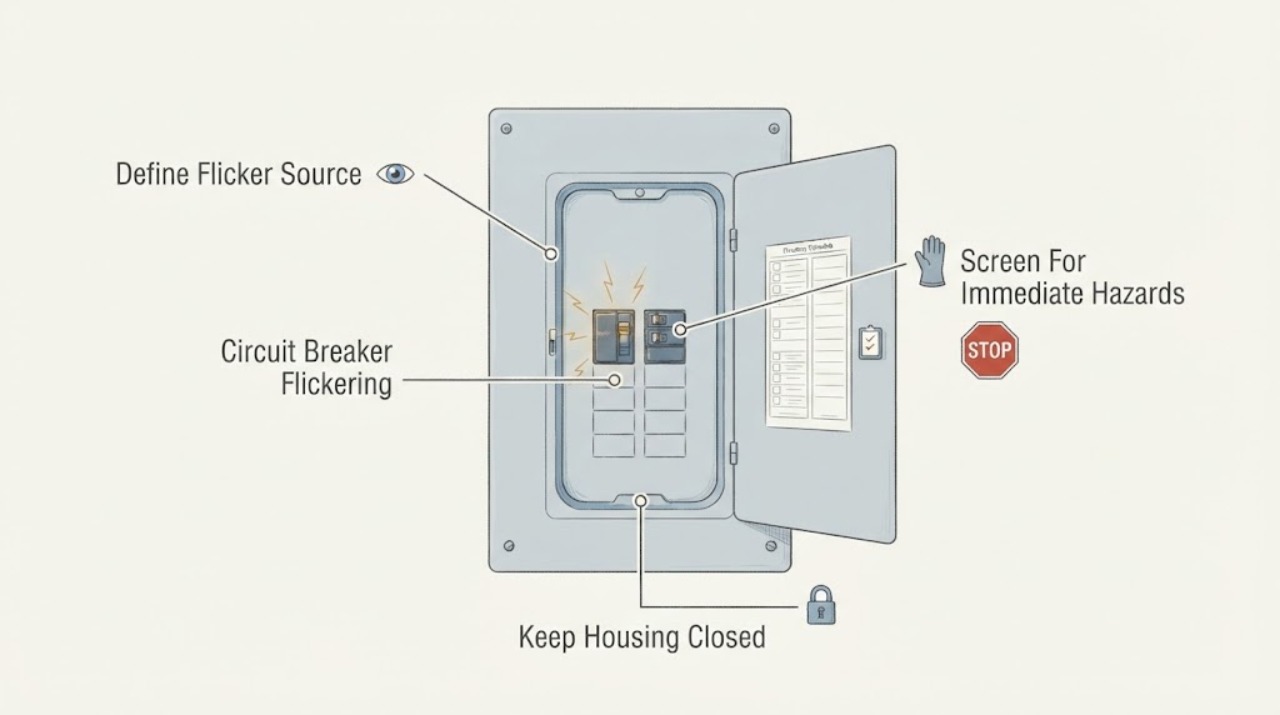
Work through in order
Diagnostic checks
Use only checks that match the exact appliance or system and its official guide.
-
Check 1
From a safe, dry position, observe whether the flicker is the breaker handle/indicator itself, lights or devices on its circuit, or a visible flash at the panel, switch, or receptacle; do not touch the panel or switch.
Expected result: Record the exact location, whether one or many circuits are affected, whether lights dim or brighten, and whether the breaker handle is firmly ON, visibly intermediate, or physically moving.
Next step: Leave the affected circuit and suspect switch alone, record a photo from a safe distance if possible, and arrange licensed electrician or utility assessment based on the scope.
Stop if: Do not open the panel, remove the deadfront, touch a breaker, switch, receptacle, or exposed conductor, or approach a flash or arc.
Why this matters
Why: A branch-light symptom can indicate a circuit or device issue; a handle or indicator symptom needs an electrician to identify the breaker type; a flash or arc is an immediate hazard. Whole-home changes can involve service or utility equipment rather than one switch.
-
Check 2
From outside the electrical area, listen and look for buzzing, sizzling, crackling, smoke, a burning odor, discoloration, heat radiating from a plate or panel, sparks, or a shock/tingle history; do not touch to check temperature.
Expected result: Classify the condition as flicker only, flicker with sound, flicker with odor/heat/discoloration, visible arcing/smoke, or shock/tingle.
Next step: For any active hazard keep away, leave the area if necessary, and contact emergency help or a licensed electrician from a safe location; do not reclose the breaker.
Stop if: Do not touch a hot or wet panel, smell closely, spray water, use an extinguisher on energized equipment, or continue investigating an arc or smoke.
Why this matters
Why: Sound, heat, odor, discoloration, arcs, sparks, and shocks are electrical warning signs rather than a normal breaker indication. A flicker with no other sign still warrants inspection if it recurs, but active signs raise urgency.
-
Check 3
Without operating the suspect switch or breaker, list the rooms, lights, receptacles, and appliances that flicker and note whether the symptom appears when a known large load starts or stops.
Expected result: Record one fixture, one room/branch, several circuits, or the whole home; note whether the flicker is tied to a specific appliance, weather event, outage, or time pattern.
Next step: Stop using a load that coincides with heat, odor, sound, or flicker and give the circuit map to the electrician; contact the utility for a neighborhood or service-side pattern.
Stop if: Do not move high-load appliances to extension cords, overload another circuit, or use a switch repeatedly to compare the result.
Why this matters
Why: A single fixture can have a local lamp, fitting, or connection issue; a branch-wide pattern points toward the circuit; several circuits or whole-home brightening/dimming can indicate a service, neutral, overload, or utility-side concern.
-
Check 4
From the outside of the closed panel, note the suspect breaker label and whether the handle is fully ON, fully OFF, or in an intermediate/tripped position; do not force it or remove the panel cover.
Expected result: Record the label, position, any adjacent breaker change, repeated trip history, and whether the flicker continues without touching the handle.
Next step: Leave the breaker as found and arrange licensed electrical service, especially for repeated trips, a loose-feeling handle, heat, odor, or any uncertain circuit label.
Stop if: Do not repeatedly reclose the breaker, hold it ON, substitute a higher rating, open the panel, or bypass an interlock or protective device.
Why this matters
Why: An intermediate or tripped position indicates protection operated and needs the cause assessed before restoration. A handle that appears to flicker while lights flicker is not a safe invitation to reseat or replace the breaker; the mechanism and wiring require professional inspection.
-
Check 5
From a dry, safe position, inspect only the visible face of affected switches, outlets, plugs, and light fixtures for looseness, damage, discoloration, or moisture; do not remove a plate or handle a cord.
Expected result: Record a normal-looking face, loose or tilted switch, warm/discolored plate reported without touching, damaged cord/plug, moisture, or a visible gap/exposed part.
Next step: Stop using the affected point and arrange electrician inspection for any damage, moisture, heat, odor, sound, or persistent flicker; keep the circuit unused where practical.
Stop if: Do not tighten terminals, remove plates, insert tools, operate wet equipment, or handle a damaged cord or outlet.
Why this matters
Why: A loose, discolored, wet, damaged, or warm control point can indicate a wiring or device hazard. A normal face does not rule out an internal connection or service problem when flicker persists.
-
Check 6
From inside the property and away from service equipment, compare the flicker with the weather, a neighborhood outage, and changes in other homes or shared building areas; do not approach the meter, service drop, or a downed line.
Expected result: Record a whole-home symptom, one-unit/shared-building symptom, neighborhood outage, wind-related change, or a symptom limited to one branch.
Next step: Contact the utility for a suspected supply outage or service-side issue and a licensed electrician for the building installation; provide the timing and scope to both when uncertain.
Stop if: Do not touch outdoor electrical equipment, downed lines, wet service areas, or attempt to coordinate a test by switching loads.
Why this matters
Why: Whole-home, wind-related, or neighborhood patterns can involve utility service or a building main; one-branch patterns are more localized. The observation cannot safely distinguish a loose neutral or service defect.
-
Check 7
Prepare a service record with the breaker label, exact flicker source, affected loads, timing, handle position, weather/outage context, and every sound, odor, heat, discoloration, spark, or shock observation.
Expected result: Include photos only from safe distance and state whether the panel, switch, receptacle, or service equipment was wet, damaged, or inaccessible.
Next step: Give the record to a licensed electrician and the utility when the pattern is whole-home or service-side; keep the suspect circuit out of use until they advise otherwise.
Stop if: Do not perform live measurements, open the panel, remove a breaker, replace a switch, or restore protection repeatedly to collect more data.
Why this matters
Why: Scope and timing help the electrician or utility separate a fixture, branch circuit, breaker/switch mechanism, building service, or utility supply concern without unsafe homeowner measurements.
Use your observations
Decision map
Find the observation that best matches what you see, then follow the next safe action.
-
PATH 01Safety boundary
What you see
A visible flash, arc, spark shower, smoke, flame, burning odor, hot panel, or shock occurs.
Do this next
Leave the area, keep people away, and contact emergency help or the utility/electrician from a safe location; do not touch or reclose the equipment.
Why this path and its safety boundary
Why it matters: This is an active electrical hazard, not a breaker-position or lamp troubleshooting issue.
Safety stop: Do not open the panel, use water, reset protection, or approach the source.
-
PATH 02Safety boundary
What you see
Lights across the home or building flicker, brightness changes with weather or large loads, or neighbors report the same issue.
Do this next
Contact the utility and a licensed electrician, provide the timing and scope, and avoid high-load use until the condition is assessed.
Why this path and its safety boundary
Why it matters: A service, neutral, overload, building-main, or utility-side condition is possible and cannot be safely localized from a breaker handle.
Safety stop: Do not touch service equipment, downed lines, or wet electrical areas, and do not coordinate load switching as a test.
-
PATH 03Safety boundary
What you see
Flicker is confined to one fixture, switch, receptacle, room, or branch while the rest of the home is stable.
Do this next
Stop using the affected point if flicker persists or any warning sign appears and arrange electrician inspection; record the circuit and load map.
Why this path and its safety boundary
Why it matters: A local lamp, fixture, device, connection, switch, or branch-circuit issue is more likely, but a visible face cannot rule out wiring faults.
Safety stop: Do not remove plates, tighten terminals, replace a switch, or use a higher-rated breaker.
-
PATH 04Safety boundary
What you see
The breaker handle is intermediate/tripped, flicker occurs when the circuit is loaded, or the breaker trips repeatedly.
Do this next
Leave it as found and arrange licensed electrical diagnosis with the affected loads and trip timing; do not keep testing by reclosing it.
Why this path and its safety boundary
Why it matters: Protection may be responding to an overload, fault, appliance, connection, or breaker problem; repeated restoration can increase risk.
Safety stop: Do not hold the handle on, substitute a larger breaker, bypass protection, or open the panel.
-
PATH 05Safety boundary
What you see
The flicker has no visible arc, smoke, heat, odor, buzz, or trip but recurs or is unexplained.
Do this next
Avoid unnecessary use of the affected circuit and schedule a qualified electrician with the observation record rather than attempting internal checks.
Why this path and its safety boundary
Why it matters: The absence of a visible hazard does not prove the circuit is safe; an intermittent connection, device, load, or service issue remains possible.
Safety stop: Escalate immediately if sound, odor, heat, discoloration, sparks, or shocks appear.
Helpful context
Understand the symptom
The word flickering can describe three different faults
A breaker handle or accessory indicator may appear to move, blink, or show an intermediate position; the lights or equipment on its circuit may be flickering; or a person may have seen a flash, spark, or arc at the panel, switch, or receptacle. These paths are not interchangeable. The switch component in this topic is kept as an observation point, not a permission to remove the deadfront or replace a breaker. Record the exact visible behavior from a safe distance and let a licensed electrician identify the electrical cause.
Flicker without a visible arc still deserves attention
CPSC lists dim or flickering lights, unusual sizzles or buzzes, overheating, odors, arcs or sparks, and frequent breaker operation as potential electrical hazards. ESFI likewise recommends a qualified electrician when lights flicker or dim, switches are warm, buzzing is present, or burning is noticed. A circuit can have a loose connection, overload, failing device, or service-side problem without showing a visible spark, so do not wait for an arc to begin treating the condition seriously.
Rain, outages, and utility-side symptoms need a different call
If flicker affects the whole home, changes when large equipment starts, or appears with a service drop, meter, or neighborhood outage, the utility may need to assess the supply while an electrician checks the building installation. If the symptom is confined to one light, outlet, switch, or branch, the electrician can start at that circuit. Do not approach outdoor service equipment, flooded areas, or damaged lines, and do not restore a tripped breaker simply to collect another symptom.
Only after diagnosis
Potential parts
- circuit breaker
Consider only after a licensed electrician confirms the breaker mechanism is defective and rules out an overload, wiring, load, service, or utility cause.
Panel listing, breaker type, rating, interrupting capacity, and local approval are exact-installation requirements; never substitute a higher rating. - wall switch or dimmer
Consider only when an electrician identifies the switch or dimmer as the source and confirms the connected load and wiring arrangement.
Load type, rating, box wiring, grounding, neutral requirements, and local code must be confirmed by the electrician. - receptacle or lighting connection
Consider only after professional diagnosis identifies a damaged or loose device/connection rather than a service or branch fault.
Device rating, protection, wiring method, box, grounding, and installation requirements are site-specific.
When checks do not resolve it
Need a professional?
Arrange a licensed electrician for recurring or unexplained flicker, a breaker or switch that appears unstable, any branch-wide symptom, repeated trips, buzzing, heat, discoloration, odor, or a load-related pattern. Contact the utility for whole-home, neighborhood, wind-related, meter/service, or downed-line symptoms. Treat smoke, fire, arcing, shocks, wet equipment, or a hot panel as an immediate safety stop.
Safety scope: Do not open the panel, remove a deadfront or breaker, touch wiring, make live measurements, tighten terminals, repeatedly reclose protection, substitute a higher rating, bypass an interlock, or work in wet/damaged electrical areas.
Have this ready
- Provide the exact entity and component context (circuit breaker; switch), breaker label and position, affected rooms and loads, flicker timing, weather/outage context, recent appliance or electrical work, safe-distance photos, and every sound, odor, heat, discoloration, spark, trip, or shock observation.
Common questions
FAQ
Is a flickering circuit breaker dangerous?
It depends on what is flickering, but a breaker or indicator that appears unstable should not be touched. Flickering lights, buzzing, heat, discoloration, odors, sparks, shocks, or repeated trips are electrical warning signs; leave the circuit alone and arrange qualified inspection.
What if only the lights on one circuit flicker?
A local fixture, switch, device, branch connection, or load is possible. Record the affected rooms and timing without opening anything, stop using the point if warnings appear, and have a licensed electrician inspect it.
Should I reset a flickering breaker?
Do not repeatedly reclose or hold a suspect breaker on. If it has tripped, is intermediate, or the flicker returns after a normal event, leave it as found and arrange electrician diagnosis; repeated operation can conceal the fault or increase risk.
When should I call the utility instead of an electrician?
Contact the utility for whole-home or neighborhood flicker, wind-related service symptoms, a suspected meter/service issue, or a downed line; contact an electrician for a single branch, switch, receptacle, breaker, or building wiring symptom. Use both when the boundary is unclear.
Can I open the electrical panel to see why the breaker flickers?
No. Do not remove the panel cover, touch wiring, make live measurements, or replace the breaker yourself. Record the label and visible handle position from outside and arrange licensed electrical service.
Read the exact guide
Official sources
- Switch to SafetyElectrical Safety Foundation International · General residential electrical safety education.
- Home Electrical SafetyElectrical Safety Foundation International · General residential electrical safety education.
- CPSC Guide to Home Wiring HazardsU.S. Consumer Product Safety Commission · General U.S. residential electrical safety guidance; local code and qualified electrician instructions govern.
- May Is National Electrical Safety Month: Good News for Homeowners - Aluminum Wiring Fix Still AvailableU.S. Consumer Product Safety Commission · CPSC warning-sign guidance; no aluminum-wiring conclusion is made for this topic.
- Electrical Safety DosElectrical Safety Foundation International · General residential electrical safety guidance.
Community feedback
Share a repair observation
Share a plain-text repair observation. Accepted observations are published automatically; this page may take a moment to update.