
On this page
Start here
Quick answer
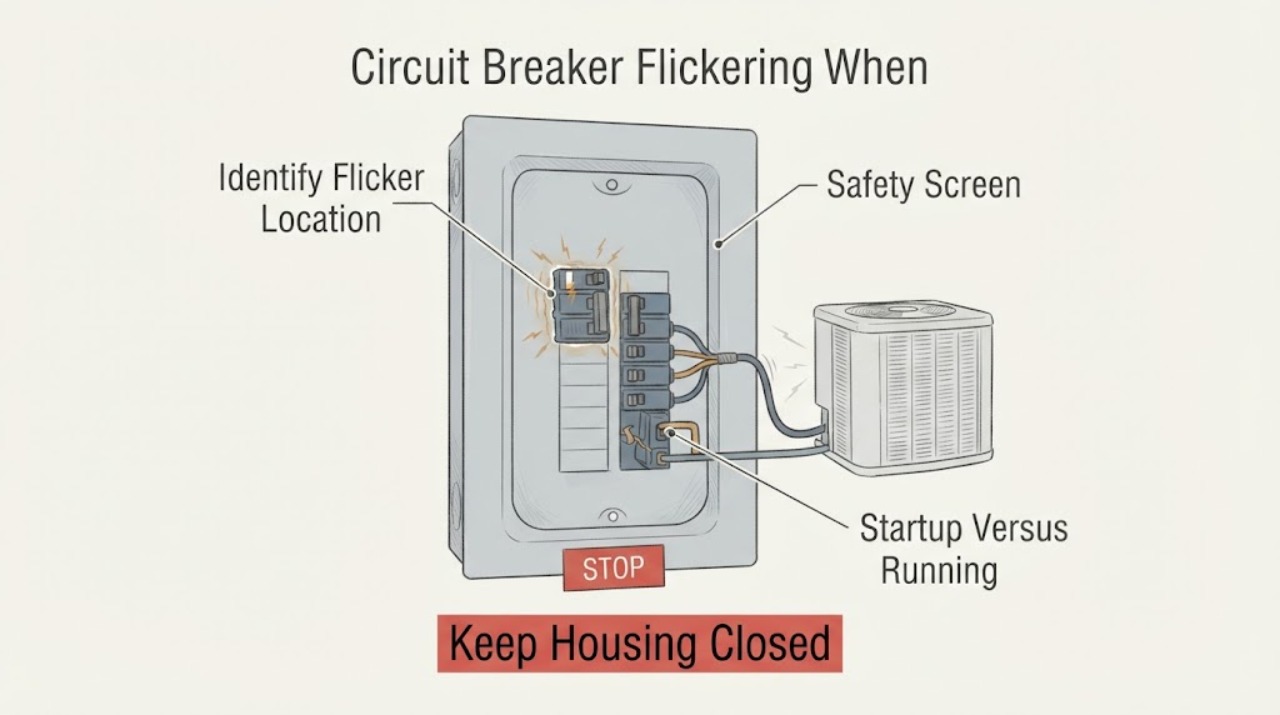
If lights or a breaker indicator flicker exactly when an air conditioner starts, a brief startup load can cause a small momentary voltage change, but visible or repeated flicker is not something to diagnose by opening the panel. First identify whether the flicker is a light, the breaker handle or indicator, or power to the whole home. Note whether it lasts only at startup, continues while the AC runs, affects one circuit or many, and whether the breaker trips. Stop the AC and keep away from the panel for buzzing, sizzling, burning odor, a hot or discolored panel or switch, sparks, smoke, damaged wiring, repeated trips, or persistent flicker. An electrician should assess the branch circuit, connections, breaker, and HVAC equipment; a utility may be needed when multiple homes or all circuits are affected. Do not touch terminals, HVAC capacitors or contactors, measure live voltage, change breaker size, or repeatedly start the AC to reproduce the symptom.
Work through in order
Diagnostic checks
Use only checks that match the exact appliance or system and its official guide.
-
Check 1
Stop the AC and observe from a safe position without touching the panel, breaker, disconnect, thermostat wiring, or HVAC cabinet.
Expected result: Record smoke, sparks, arcing, sizzling or buzzing, a burning or rubbery odor, a hot or discolored panel or switch, damaged insulation, a repeated breaker trip, or a breaker that chatters or will not stay set.
Next step: Keep the AC off, move away from the hazard, and arrange qualified electrician service; use emergency assistance if there is smoke, fire, or an immediate danger.
Stop if: Do not reset repeatedly, touch the panel or HVAC parts, use water on an electrical fire, or restart the AC after a safety symptom.
Why this matters
Why: These are warning signs of an electrical or equipment hazard, not a harmless startup fluctuation.
-
Check 2
From a safe distance, identify whether the flicker is a lamp, multiple lights, a breaker handle or indicator, the thermostat/display, or power throughout the home.
Expected result: One lamp or room points toward a local circuit or fixture; a visible breaker movement or panel symptom points to electrical service; many rooms or the whole home points toward a main-service or utility path.
Next step: Record the affected locations and keep the AC off if the panel or breaker itself moves, buzzes, heats, or trips.
Stop if: Do not open the panel, remove a cover, or approach service conductors to confirm the source.
Why this matters
Why: The phrase circuit-breaker flickering does not by itself identify the component that is changing state.
-
Check 3
Record whether the symptom occurs once at the moment the AC starts, repeats while the compressor runs, appears when the AC cycles off, or continues after the AC is stopped; do not deliberately cycle the unit.
Expected result: A single brief start event is different from repeated pulses, persistent dimming, a breaker that chatters, or flicker with the AC off; the latter patterns require a professional electrical assessment.
Next step: Leave the AC off and provide the exact timing and duration to the electrician or HVAC professional.
Stop if: Do not repeatedly turn the thermostat on and off, bypass a control, or run the AC while the symptom is worsening.
Why this matters
Why: Air-conditioner compressors require high startup current, but timing alone cannot prove the circuit is safe.
-
Check 4
Without touching the panel, note which lights, outlets, appliances, or rooms change and whether the effect is limited to one circuit or appears across multiple circuits.
Expected result: A localized effect supports an appliance branch, connection, or local circuit path; several unrelated circuits or whole-home dimming raises a service-entrance or utility concern.
Next step: Keep the AC off for persistent or widespread flicker and share the circuit map and timing with the electrician or utility.
Stop if: Do not move loads between circuits, unplug equipment from a hot outlet, or attempt panel work to isolate the effect.
Why this matters
Why: The spread of the symptom determines whether an electrician should start at the branch circuit or investigate the incoming supply.
-
Check 5
From outside the panel, note whether the breaker remains firmly on, moves or chatters, trips to an intermediate or off position, or shows heat or discoloration; do not touch it.
Expected result: A trip or unstable handle indicates protective operation or a possible breaker, circuit, or equipment fault; a firm handle with light flicker leaves wiring, connections, HVAC startup, or utility causes possible.
Next step: Do not reclose a tripping or chattering breaker; arrange electrician and HVAC assessment with the breaker position recorded.
Stop if: Do not hold the breaker on, repeatedly reset it, install a larger breaker, or remove the dead front.
Why this matters
Why: A breaker is a safety device and its movement is not a user-adjustable indication to override.
-
Check 6
From a safe distance, note the AC type and any external sound, odor, visible damage, blocked outdoor unit, or disconnect/power-cord damage without opening the equipment.
Expected result: A hard-start sound, repeated clicking, burning odor, damaged disconnect, or equipment that stops and restarts abnormally gives the HVAC professional a useful lead; a normal sound does not clear the electrical circuit.
Next step: Leave the AC off and arrange HVAC service together with an electrician when startup load or equipment damage is suspected.
Stop if: Do not remove the disconnect, touch capacitors or contactors, open the outdoor unit, or measure live voltage.
Why this matters
Why: The AC can be the load causing the symptom, while its compressor, capacitor, contactor, disconnect, or wiring remains a professional-only path.
-
Check 7
Record whether high-demand loads such as heaters, pumps, dryers, or cooking equipment were running when the AC started, without turning equipment on to reproduce the flicker.
Expected result: A symptom that appears only when several loads overlap suggests a load or supply-capacity assessment; a symptom with the AC alone keeps an AC branch or service fault possible.
Next step: Leave nonessential high-demand equipment off and give the load timing to the electrician; do not redistribute wiring or install an extension cord.
Stop if: Do not add a higher-rated breaker, defeat protection, or operate multiple large loads while flicker continues.
Why this matters
Why: Electrical demand changes when loads start, but a homeowner cannot determine safe circuit capacity from flicker alone.
-
Check 8
If safe, note whether neighbors or other units experience the same flicker and whether unrelated circuits dim when the AC starts; do not inspect the meter or service entrance.
Expected result: A building-wide or neighborhood-wide effect supports a utility or shared-service investigation; a symptom limited to the home or one branch supports electrician and HVAC diagnosis.
Next step: Report widespread flicker to the utility or building manager and keep the AC off until the responsible professional advises otherwise.
Stop if: Do not touch the meter, service drop, overhead conductors, or utility equipment.
Why this matters
Why: The fault may be upstream of the home's panel, where only the utility or qualified service personnel can work.
-
Check 9
Do not perform a live-voltage test or open the panel; instead, preserve the exact visual and timing record and check only whether the AC remains switched off.
Expected result: A complete record without internal probing is sufficient for a qualified electrician to decide whether to inspect the branch circuit, breaker, service connections, or utility side.
Next step: Arrange service and provide photos only when taken from a safe distance, with model information and the symptom sequence.
Stop if: Do not remove covers, probe terminals, touch HVAC capacitors, or use a meter unless you are a qualified professional following applicable procedures.
Why this matters
Why: The missing measurement is a reason for professional diagnosis, not permission to improvise one.
-
Check 10
Prepare a service record with the AC type and model, thermostat event, exact start timing, duration, affected lights or circuits, breaker position, other loads, sounds, odors, heat, trips, and whether neighbors were affected.
Expected result: The sequence separates a brief startup event from persistent voltage variation, a tripping branch, a failing HVAC component, a service connection, or a utility disturbance.
Next step: Keep the AC off until the responsible professional confirms the system is safe, especially when flicker repeats or the breaker moves.
Stop if: Do not order a breaker, capacitor, contactor, wiring, or other component from flicker alone.
Why this matters
Why: Electrician and HVAC professionals can coordinate without unsafe repeat testing or panel access by the homeowner.
Use your observations
Decision map
Find the observation that best matches what you see, then follow the next safe action.
-
PATH 01Safety boundary
What you see
There is smoke, fire, arcing, sparks, sizzling or buzzing, burning odor, a hot or discolored panel or switch, damaged wiring, repeated trips, or a breaker that chatters or will not stay set.
Do this next
Keep the AC off, move away from the hazard, and obtain qualified electrician service; use emergency help for smoke, fire, or immediate danger.
Why this path and its safety boundary
Why it matters: The electrical system or AC may present shock, fire, or equipment hazards.
Safety stop: Do not touch the panel or HVAC internals, reset repeatedly, or restart the AC.
-
PATH 02Safety boundary
What you see
A minor change occurs only once when the AC starts, with no breaker movement, trip, odor, heat, noise, or ongoing flicker.
Do this next
Record the event, avoid deliberate repeat tests, and ask an electrician to assess it if it returns, becomes more visible, or affects more circuits.
Why this path and its safety boundary
Why it matters: The compressor's startup current may be causing a brief voltage disturbance, but that observation does not certify the installation.
Safety stop: Stop using the AC if the brief event becomes repeated, sustained, or associated with any warning sign.
-
PATH 03Safety boundary
What you see
The flicker continues during the AC run or is limited to one room, branch, or nearby light.
Do this next
Keep the AC off and arrange electrician service, with HVAC service when the equipment's startup or operation is abnormal.
Why this path and its safety boundary
Why it matters: A local branch circuit, connection, breaker, or AC electrical component needs assessment.
Safety stop: Do not move circuits, open the panel, or repeatedly run the AC.
-
PATH 04Safety boundary
What you see
Several unrelated rooms or circuits dim, or the whole home flickers when the AC starts.
Do this next
Keep the AC off, report widespread symptoms to the utility or building manager, and arrange electrician assessment of the home service.
Why this path and its safety boundary
Why it matters: A main-service, shared-building, or utility-side voltage problem is possible in addition to an AC load issue.
Safety stop: Do not inspect the meter, service conductors, or overhead equipment.
-
PATH 05Safety boundary
What you see
The breaker trips, chatters, vibrates visibly, or will not remain set when the AC starts.
Do this next
Leave the breaker and AC off and arrange qualified electrician and HVAC diagnosis.
Why this path and its safety boundary
Why it matters: Protection may be responding to overload, short circuit, equipment fault, or a breaker or connection problem.
Safety stop: Do not hold the breaker on, reset repeatedly, or install a larger-rated breaker.
-
PATH 06Safety boundary
What you see
The flicker coincides with hard starting, repeated clicking, unusual HVAC noise, a damaged disconnect or cord, or an equipment odor.
Do this next
Keep the equipment off and arrange HVAC service coordinated with an electrician.
Why this path and its safety boundary
Why it matters: The AC's compressor, capacitor, contactor, disconnect, wiring, or controls may be affecting startup load.
Safety stop: Do not open the unit, touch capacitors or contactors, or perform live measurements.
-
PATH 07Safety boundary
What you see
Flicker occurs when the AC starts while other high-demand loads are already running.
Do this next
Leave nonessential high-demand loads off and have an electrician assess the circuit and service; do not reconfigure wiring.
Why this path and its safety boundary
Why it matters: Overlapping demand or a supply-capacity issue may be contributing, but safe capacity cannot be inferred from the symptom.
Safety stop: Do not add loads, use extension cords for large equipment, or change overcurrent protection.
-
PATH 08Safety boundary
What you see
Neighbors, other units, or the building also report flicker, or the disturbance affects the home independent of one branch.
Do this next
Report it to the utility or building manager and keep the AC off until the supply is assessed.
Why this path and its safety boundary
Why it matters: The disturbance may be upstream of the individual panel.
Safety stop: Do not access the meter, service entrance, or utility equipment.
-
PATH 09Safety boundary
What you see
The symptom cannot be localized without opening a panel, measuring live voltage, or accessing HVAC internals.
Do this next
Preserve the observation record and arrange qualified electrician or HVAC service.
Why this path and its safety boundary
Why it matters: The next diagnostic step is hazardous and outside ordinary homeowner checks.
Safety stop: Do not probe terminals, remove covers, touch stored-energy components, or bypass protection.
Helpful context
Understand the symptom
Clarify what is actually flickering
People use “circuit breaker flickering” to describe several different observations: room lights dimming, a breaker handle visibly vibrating, a panel indicator changing state, or the whole home briefly losing power. These are not interchangeable. Observe only from a safe distance and write down the exact light, circuit, panel location, AC type, and whether the change is a single brief event or repeats throughout the cooling cycle. A breaker that trips or will not stay set is a protective response, not a setting to defeat.
Startup current explains a brief event, not a blanket pass
Large motor loads such as air conditioners draw a strong inrush current when starting. A very brief, minor change can therefore be different from lights that pulse repeatedly, a breaker that chatters, or voltage that sags while the compressor runs. The duration and spread of the symptom matter: one nearby light at startup points to a different inspection path from multiple circuits or every light in the home. Do not repeatedly start the AC as a test.
Keep panel and HVAC internals out of homeowner checks
A safe external observation can identify a hot or discolored cover, a smell, a sound, a tripping breaker, or a damaged visible cord. It cannot establish whether a breaker, lug, neutral, service connection, compressor, capacitor, contactor, disconnect, or wiring is defective. Panel covers expose energized parts, and HVAC equipment can retain dangerous electrical energy after it stops. An electrician and, when appropriate, an HVAC professional should coordinate the diagnosis.
Separate home wiring from utility supply
If the flicker is limited to one circuit or room when this AC starts, the branch circuit, breaker, connections, or equipment deserves attention. If many circuits flicker, the main service or utility supply may be involved. Ask neighbors or building management only from a safe, ordinary conversation; do not inspect service conductors or the meter. A utility or qualified electrician can determine which side of the service boundary is responsible.
Safety boundary
Stop conditions
- Stop immediately for smoke, fire, sparks, arcing, sizzling or buzzing, burning odor, a hot or discolored panel or switch, damaged wiring, repeated trips, or a chattering breaker.
- Do not open the electrical panel, remove a dead front, touch terminals, inspect service conductors, or measure live voltage.
- Do not touch HVAC capacitors, contactors, disconnects, compressor wiring, or other internal equipment; do not repeatedly start the AC to reproduce flicker.
- Do not hold a breaker on, repeatedly reset it, change its rating, bypass protection, redistribute wiring, or use an extension cord for the AC.
- Keep the AC off and arrange electrician, HVAC, utility, or building service when flicker is persistent, widespread, associated with a trip, or not safely explained by a single brief startup event.
Only after diagnosis
Potential parts
- circuit breaker or connection hardware
Only relevant after an electrician confirms a breaker, termination, or connection fault; flicker alone does not identify a replacement part.
Rating, panel family, conductor, installation method, and local requirements must be confirmed by a qualified electrician. Never install a larger breaker to stop trips. - air-conditioner start or control component
Only relevant when HVAC diagnosis links hard starting or abnormal startup current to an equipment component.
The exact AC model, electrical specifications, and safety procedures must be confirmed by a qualified HVAC professional; do not select capacitors or contactors from the symptom alone.
When checks do not resolve it
Need a professional?
Arrange a qualified electrician when lights flicker repeatedly, a breaker or panel changes state, the effect affects multiple circuits, the AC starts hard, or the symptom continues with the AC off. Add an HVAC professional for compressor, capacitor, contactor, disconnect, or equipment symptoms, and contact the utility or building manager when multiple homes or the service supply are affected. Any smoke, sparks, arcing, burning odor, hot or discolored equipment, or repeated trip is an immediate stop condition.
Common questions
FAQ
Is a brief light flicker when the AC starts always dangerous?
Not necessarily. An air-conditioner compressor needs strong startup current, so a brief minor change can differ from repeated or sustained flicker. It is not safe to dismiss the symptom if a breaker moves or trips, the panel is hot, there is buzzing, odor, smoke, arcing, or the flicker affects many circuits.
Why does the breaker seem to flicker when the AC turns on?
The observation may actually be a light dimming, a breaker handle moving, a panel indicator changing, or a brief whole-home voltage change. Record exactly what moves and when. A breaker that chatters, trips, or will not stay set needs the AC left off and qualified electrician service.
Can I test the AC by turning it on and off several times?
No. Repeated starts can add stress and do not safely identify a breaker, connection, compressor, capacitor, or utility problem. Preserve the first safe observation and have an electrician or HVAC professional diagnose it.
Should I replace the circuit breaker with a larger one?
Never choose a larger breaker to stop flicker or trips. Breakers protect the wiring, and the correct rating depends on the circuit design and equipment. A qualified electrician must identify and correct the cause.
When should the utility be involved?
If multiple rooms, circuits, units, or nearby homes flicker, or the disturbance continues independently of one branch, an upstream or shared-service issue is possible. Keep the AC off, do not inspect the meter or service conductors, and report the pattern to the utility or building manager while arranging electrician assessment.
Read the exact guide
Official sources
- Electrical Safety: ChecklistNational Fire Protection Association · Home electrical warning signs and qualified-electrician escalation
- CPSC Guide to Home Wiring HazardsU.S. Consumer Product Safety Commission · Home wiring hazard signs, circuit breakers, flicker, arcing, buzzing, and safe escalation
- The Integrated Grid: Realizing the Full Value of Central and Distributed Energy ResourcesU.S. Department of Energy / Electric Power Research Institute · Air-conditioner compressor startup current and grid voltage support context
- Air Conditioner and Fan SafetyElectrical Safety Foundation International · Air-conditioner electrical servicing and homeowner safety
- Keeping the Lights On: Essential Reliability ServicesU.S. Department of Energy · Electric-grid voltage control and load-change context
Community feedback
Share a repair observation
Share a plain-text repair observation. Accepted observations are published automatically; this page may take a moment to update.