
On this page
Start here
Quick answer
A circuit breaker that keeps tripping is opening to interrupt a condition it considers unsafe; it is not a reset-and-ignore symptom. From a safe position, record which breaker opens, which rooms and devices lose power, whether it trips immediately or only when a particular load starts, and whether there is heat, discoloration, buzzing, burning odor, water, smoke, or a shock. Stop using the suspected device or circuit if that can be done safely, and call a qualified electrician rather than repeatedly resetting the breaker. Do not open the panel, replace the breaker with a larger one, bypass protection, or keep testing a circuit that trips again. Use emergency services for smoke, flames, active arcing, or immediate fire danger.
Before you begin
Safety first
- User work is limited to safe observation, documenting affected loads, and stopping or disconnecting an accessible suspect device only when there is no hazard. Do not repeatedly reset, open the panel, touch internal wiring, replace protection, perform live tests, or recreate the trip.
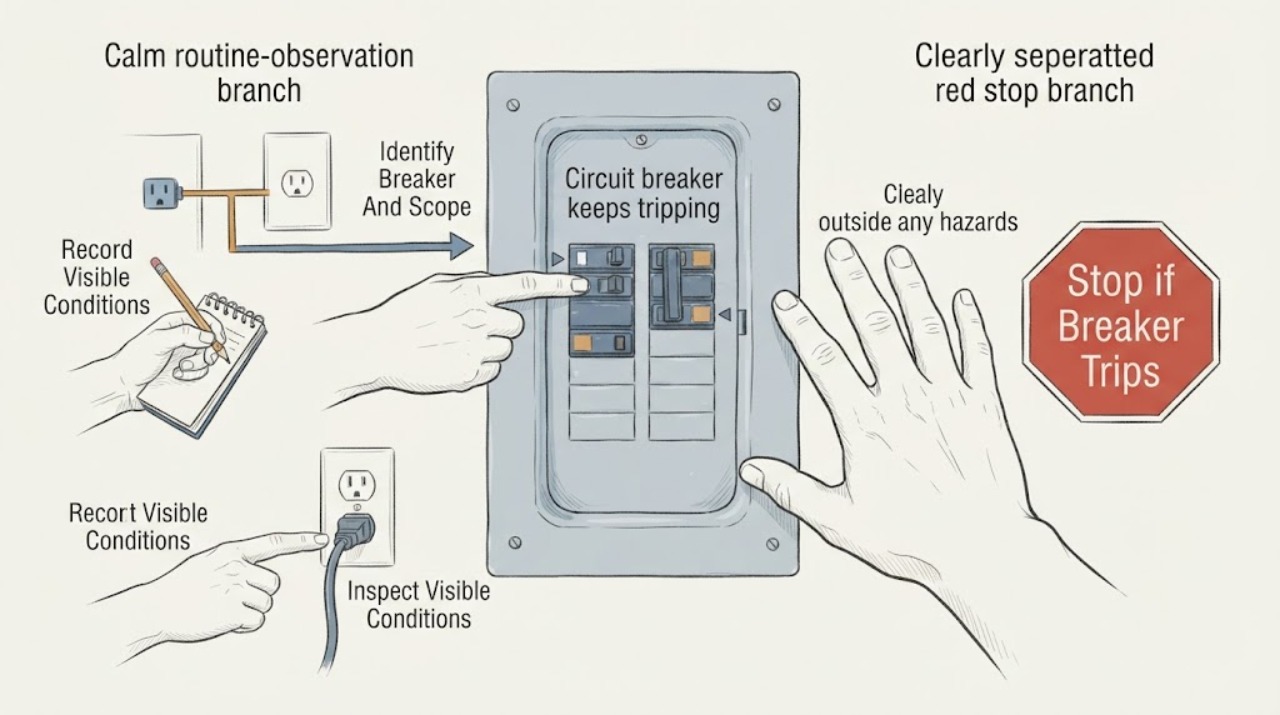
Work through in order
Diagnostic checks
Use only checks that match the exact appliance or system and its official guide.
-
Check 1
From a safe position, identify the breaker that opens and record the rooms, outlets, lights, appliances, and other equipment that lose power; do not remove the panel cover or touch the breaker repeatedly.
Expected result: Only one room or branch is affected, several areas are affected, an essential circuit is affected, or the breaker identity is unclear.
Next step: Keep people away from any suspect equipment, record the panel label and affected areas, and arrange qualified electrical assessment.
Stop if: Stop for smoke, flames, sparks, heat, burning odor, water, exposed wiring, shock or tingle, a hot panel, or any need to open the panel.
Why this matters
Why: A single branch can route the inspection toward its loads and wiring, while multiple-area or unclear behavior can involve shared, panel, or service conditions. Scope alone does not identify a safe repair.
-
Check 2
Without intentionally recreating the fault, record whether the trip happened at reset, when one named device or switch was used, after several loads ran, during weather or water exposure, or with no clear trigger.
Expected result: The trip is immediate, tied to one device or switch, follows combined normal use, follows water or weather, or has no repeatable pattern.
Next step: Stop using the suspected device or switch if safe, do not test it again, and give the timing and recent history to the electrician.
Stop if: Do not keep resetting or switching the suspected load, use a higher-rated protective device, or continue if there is heat, odor, noise, arcing, or water.
Why this matters
Why: Immediate or device-linked trips can focus the electrician on that equipment or branch; a load pattern suggests a possible load or circuit issue; water or unexplained trips require a broader safety assessment.
-
Check 3
From outside the panel and from ordinary user access, look and listen for discoloration, melting, heat, buzzing, sizzling, smoke, burning odor, visible arcing, hot switch or receptacle plates, damaged cords, or water near the electrical system.
Expected result: No external warning sign is visible, or one or more signs are present.
Next step: For any warning sign, stop using the affected circuit and arrange urgent qualified electrical help; use emergency services for smoke, flames, active arcing, or immediate fire danger.
Stop if: Do not touch a hot, wet, smoking, sparking, melted, or discolored panel, switch, receptacle, cord, or appliance; do not remove the panel cover.
Why this matters
Why: A quiet, cool exterior does not clear the circuit. Heat, discoloration, unusual sound, odor, arc, smoke, water, or shock is evidence of a higher-risk fault and not a DIY troubleshooting branch.
-
Check 4
If there are no warning signs and the affected devices can be turned off or unplugged from a dry, ordinary-access location without reaching into a hazard, note which loads were already connected; do not add, move, or repeatedly switch loads to test the circuit.
Expected result: The trip stops only when one device is disconnected, the circuit still trips with ordinary loads off, or the load history cannot be separated safely.
Next step: Leave the suspect device disconnected, keep the breaker in its safe state, and request electrician diagnosis; do not substitute another appliance or use an extension cord.
Stop if: Do not unplug hot, wet, sparking, damaged, or hard-to-reach equipment, and do not enter a wet area or open a device to inspect it.
Why this matters
Why: A device-linked result gives the electrician a useful lead but does not prove the device or receptacle is safe. A continued trip with loads off raises concern for wiring, breaker, panel, or concealed equipment.
-
Check 5
Record the breaker label, approximate trip count, date and time, recent appliance or lighting changes, renovation, storm, water event, electrical work, and whether flickering or other symptoms occurred before the trips.
Expected result: The trips began after a change, follow a recurring device or weather pattern, or have no known trigger.
Next step: Send the timeline and safe photos of labels or exterior conditions to the electrician and stop user diagnosis at that point.
Stop if: Do not remove labels, open the panel, loosen connections, change breaker ratings, or take measurements on exposed conductors.
Why this matters
Why: A documented timeline helps distinguish a load, equipment, environmental, branch, or service investigation, but it cannot establish breaker size, wiring capacity, or a replacement part.
Use your observations
Decision map
Find the observation that best matches what you see, then follow the next safe action.
-
PATH 01Next step
What you see
There is smoke, flame, active arcing, sparking, a strong burning odor, a hot or wet panel, exposed wiring, or an electric shock.
Do this next
Keep people clear, do not touch or open the panel, and use emergency services for smoke, flame, active arcing, or immediate fire danger. Arrange urgent qualified electrical response for other warning signs.
-
PATH 02Next step
What you see
The breaker trips when one particular appliance, light, switch, or receptacle is used, or the trip stops only when that device is disconnected safely.
Do this next
Stop using and do not reconnect the suspect device. Have a qualified electrician or appropriate appliance professional determine whether the device, cord, receptacle, branch circuit, or wiring is at fault.
-
PATH 03Next step
What you see
The breaker trips after several normal loads operate together, without an external heat, odor, arc, water, or shock sign.
Do this next
Leave nonessential loads off and request electrical assessment for the branch capacity, load distribution, equipment, and protection. Do not solve the problem with a larger breaker or extension-cord chain.
-
PATH 04Next step
What you see
The breaker trips immediately or continues to trip when accessible loads are off or disconnected without hazard.
Do this next
Stop resetting it and leave the circuit in a safe state. A qualified electrician must inspect the branch wiring, breaker, panel, and concealed loads before re-energization.
-
PATH 05Next step
What you see
The breaker has a recurring but unexplained trip pattern, or the affected circuit and cause cannot be identified without panel access or live testing.
Do this next
Stop user troubleshooting and arrange qualified electrical diagnosis. Provide the trip history, affected areas, recent changes, and all observed stop conditions.
Helpful context
Understand the symptom
A trip is a protective event, not a diagnosis
A breaker opens when the circuit reaches a condition that requires interruption. The cause may be too much connected load, a particular appliance or light, damaged wiring, a connection, or the breaker or panel itself. CPSC explains that breakers protect branch circuits and that repeated trips associated with a particular switch, light, or outlet should be handled by a qualified electrician. A reset can restore power temporarily, but it does not identify or correct the cause.
Use timing and scope to help the electrician
The useful user-level distinction is when the trip occurs: immediately when the breaker is reset, when one device is switched on, after several loads run, or without a clear pattern. Also note whether one room, several rooms, or an essential circuit is affected. Do not deliberately reproduce the trip, use an extension cord as a workaround, or keep a faulty appliance connected while collecting observations.
Keep the panel closed and treat warning signs seriously
CPSC describes its home-wiring guide as a way to point out problems before professional help, not an instruction manual for repairing defective electrical systems, and says not to remove the service-panel cover. ESFI lists flickering, arcs or sparks, unusual sounds, heat, odor, and shocks as wiring-hazard signs. Those signs move the situation from routine observation to urgent electrical or emergency response.
Safety boundary
Stop conditions
- Do not repeatedly reset the breaker, bypass its protection, install a higher-rated breaker, or use an extension-cord workaround.
- Do not remove the panel cover, tighten connections, replace the breaker, or perform live testing on exposed conductors.
- Stop for smoke, flames, active arcing, sparks, heat, discoloration, burning odor, buzzing or sizzling, water, exposed wiring, shock, or a hot panel.
- Do not reconnect or move a suspect appliance, light, switch, or receptacle to another circuit as a test.
When checks do not resolve it
Need a professional?
Call a qualified electrician when the breaker trips again, trips with a particular device or switch, trips with accessible loads off, or has no clear pattern. Seek urgent help for heat, discoloration, burning odor, buzzing or sizzling, water, exposed wiring, sparks, shock, or a panel that is hot or damaged; use emergency services for smoke, flames, active arcing, or immediate fire danger. Provide the breaker label, affected rooms and devices, trip timing, recent changes, weather or water history, and the point where safe observation stopped.
Safety scope: User work is limited to safe observation, documenting affected loads, and stopping or disconnecting an accessible suspect device only when there is no hazard. Do not repeatedly reset, open the panel, touch internal wiring, replace protection, perform live tests, or recreate the trip.
Common questions
FAQ
Why does my circuit breaker keep tripping?
Possible paths include too much connected load, one faulty appliance or light, damaged wiring, a connection, or the breaker or panel. The timing and affected rooms help a qualified electrician route the inspection, but repeated trips should not be diagnosed by repeated resets.
Can I keep resetting a tripped breaker?
No. Repeated resets can re-energize an unresolved overload or fault. If it trips again, stop using the suspected circuit or device if safe, leave the breaker alone, and call a qualified electrician.
Should I replace the breaker with a higher amp rating?
No. A higher-rated breaker can remove protection from wiring that was not designed for it and create a fire hazard. A qualified electrician must determine the circuit rating, wiring, breaker, and load condition.
What if the breaker trips when one appliance is turned on?
Stop using that appliance and do not reconnect it to another outlet as a test. The appliance, cord, receptacle, branch wiring, or protection may be involved; provide the timing and device information to qualified service.
When is a repeatedly tripping breaker an emergency?
Use emergency services for smoke, flame, active arcing, or immediate fire danger. Seek urgent electrical help for heat, discoloration, burning odor, buzzing or sizzling, water, exposed wiring, sparks, shock, or a trip that affects essential equipment or cannot be safely isolated.
Read the exact guide
Official sources
- CPSC Guide to Home Wiring HazardsU.S. Consumer Product Safety Commission · Government consumer-safety guide used to explain breaker trips, warning signs, and the boundary against panel or wiring repair; it does not diagnose a particular home.
- Don’t Overload Your HomeElectrical Safety Foundation International · Electrical-safety guidance used to route load-related trips; it does not establish that a particular branch or breaker is overloaded.
- Home Wiring Safety TipsElectrical Safety Foundation International · Electrical-safety organization guidance used for stop conditions and professional escalation; a licensed electrician determines the local repair scope.
Community feedback
Share a repair observation
Share a plain-text repair observation. Accepted observations are published automatically; this page may take a moment to update.